Propensity to Buy Scoring: A Practical Guide to Account Prioritization
Learn how Prospectory's current P2B score weighs five account-research factors and presents explanations with available source context for seller review.
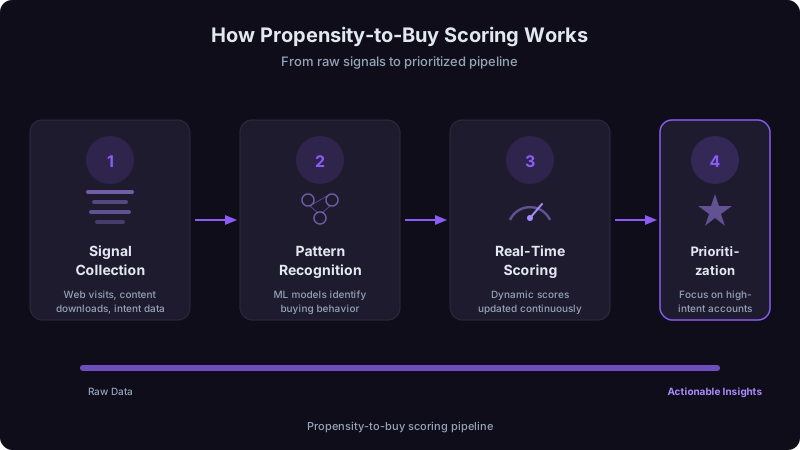
Propensity to Buy scoring helps a revenue team decide which accounts deserve review first. Prospectory's current P2B score does that by evaluating five company-level research factors, applying a defined weight to each one, and keeping a reviewable explanation and available source context with each factor.
The result is a consistent account-research summary for prioritization. Inspect the evidence, correct weak inputs, and let the account owner decide whether the account deserves action now. The current product uses defined factor weights; CRM outcomes help the team evaluate the ranking rather than train those weights.
This guide explains the current Prospectory calculation, how it differs from contact activity scores, and how to evaluate whether it helps your own sales process.
The Five Factors in Prospectory P2B
The current score combines five factors. Each factor is evaluated on a 0 to 100 scale, and the weighted values add up to the final account score. See the current P2B product method. [1]
| Factor | Weight | What the Research Reviews |
|---|---|---|
| Current solution and workflow maturity | 30% [1] | How the account handles the workflow today and whether related tools or processes are already in place |
| Business gaps | 25% [1] | Evidence of a problem the seller's company may be able to address |
| Growth indicators | 20% [1] | Dated expansion signals such as funding, hiring, product activity, or new markets |
| Competitive landscape | 15% [1] | The account's current approach and the practical room for another option |
| Market timing | 10% [1] | Available context about business priorities, budget conditions, or other timing factors |
These factors answer a company-level question: does the target account show the conditions Prospectory currently uses to assess buying potential? They do not answer whether a particular contact will reply, whether a meeting will occur, or whether a deal will close.
A high score means the weighted research factors are strong under the current method. It does not confirm a budget, an active evaluation, or a purchase decision. Open the factor explanations before choosing the next step.
How the Score Is Calculated
The calculation is a weighted sum. In compact form:
P2B =
  current solution and workflow maturity x 0.30
  + business gaps x 0.25
  + growth indicators x 0.20
  + competitive landscape x 0.15
  + market timing x 0.10
Prospectory then classifies the result as high, medium, or low. Scores of 75 and above are high, scores from 50 through 74 are medium, and scores below 50 are low.
An illustrative account could have strong workflow maturity and growth evidence but weak timing information. The final score would reflect both strengths and the missing context. A seller should not fill that gap with a favorable assumption. The next action may be further research rather than outreach.
The current weights are part of Prospectory's product method. They do not change automatically from a customer's CRM history. CRM outcomes remain useful for evaluating whether the score bands help a specific team, segment, and sales motion.
Why the Explanation Matters as Much as the Number
A score without evidence is difficult to use responsibly. Two accounts can receive the same final score for different reasons. One may have a clear business gap and strong timing but limited workflow maturity. Another may have established tooling and growth signals but no current reason to change.
Prospectory couples each factor score with an explanation and available source context. Provenance, validity, and continuing monitoring are useful checks whenever an AI-supported score informs work. [3] That gives the seller several practical questions:
- Does the source actually support the explanation?
- Is the information about the right company?
- Is the evidence current enough for this decision?
- Does the explanation distinguish a fact from an inference?
- Is an important factor missing or contradicted by the CRM record?
The seller can then decide whether to research further, keep the account on watch, prepare a relevant message, or leave the account unworked.
P2B and P2C Answer Different Questions
Prospectory calculates both scores at the company level, but they use different factors.
P2B reviews whether the target company shows the current conditions used to assess buying potential. P2C reviews whether changing from the company's current solution may be practical. P2C uses replaceable solutions, contract timing, dissatisfaction signs, implementation complexity, and strategic alignment.
| Question | P2B | P2C |
|---|---|---|
| Unit of analysis | Target company | Target company |
| Primary use | Organize buying-potential research | Organize current-solution conversion research |
| Core inputs | Workflow maturity, business gaps, growth, competitive landscape, timing | Replaceability, contract timing, dissatisfaction signs, implementation complexity, strategic alignment |
| Human decision | Whether the account deserves review or action | Whether the evidence supports a relevant change conversation |
An account may have a high P2B score and a lower P2C score. For example, it may have a clear problem and strong growth but a current solution that is difficult to change. The opposite can also occur. Keeping the questions separate prevents one score from hiding the actual research gap.
Put P2B Into a Seller Review Workflow
Use the score in a sequence that keeps account ownership with the seller.
- 1Choose the account cohort. Start with a named-account list that represents the segment and sales motion you want to evaluate.
- 2Build the Account Intelligence record. Bring selected company, solution, growth, competitive, and timing evidence into one view.
- 3Review the factor explanations. Check sources, dates, company identity, and conflicts with information already in the CRM.
- 4Choose the next action. Research further, watch the account, prepare outreach, or leave it unworked.
- 5Record the decision. Keep the selected action and any correction in the shared account history.
- 6Measure what follows. Compare later CRM outcomes by score band without assuming the score caused the result.
Avoid launching outreach from the score alone. The message still needs a real audience, a relevant offer, accurate claims, appropriate channel rules, and human review. NIST's Generative AI Profile treats source integrity and the design of human-AI roles as material parts of risk management. [4]
Evaluate P2B Against Your Own Process
Start in shadow mode. Let Prospectory score a fixed account cohort while your team continues using its current prioritization method. This creates a comparison without changing account ownership, compensation, or buyer treatment during the first review. The NIST AI Risk Management Framework playbook recommends representative data, defined benchmarks, documented measurement, and ongoing evaluation. [2]
Before the evaluation, define:
- the account sample and included segments;
- the date range for source evidence;
- what counts as a completed seller review;
- the current prioritization baseline;
- the CRM outcomes you will observe;
- the length of the measurement window; and
- who decides whether P2B becomes part of the operating process.
Then compare high, medium, and low bands with the same downstream definitions. Useful measures may include seller review time, accounts worked, positive replies, held meetings, accepted opportunities, disqualifications, and data corrections. The purpose is not to retrain the current weights. It is to learn whether the ranking adds useful separation for your team. Use an experimental design and analysis method appropriate to your sample, baseline event rate, and decision. NIST's engineering statistics handbook provides practical references for designing and interpreting those comparisons. [5]
If higher bands do not differ from the current process, inspect why. The source coverage may be weak, the account sample may not match the intended use, or the five-factor method may not carry enough useful information for that segment. A result like that is a reason to limit how the score is used, not to hide the result.
Common Misuses to Avoid
Calling P2B a forecast. The score summarizes current research factors. It does not replace the opportunity forecast or the judgment of the account team.
Treating a high band as confirmed intent. Public activity, hiring, funding, or technology context can make an account interesting without proving an active purchase process.
Scoring a contact instead of the company. Prospectory's current P2B calculation is company-level. Contact quality and buyer-role relevance still require a separate review.
Assuming the weights are customer-trained. The current model uses defined product weights. Customer CRM outcomes can evaluate the ranking, but they do not train or recalibrate those weights.
Ignoring the factor explanations. A strong score based on stale, mismatched, or weakly sourced evidence should not drive action.
Using unequal groups. Keep the account cohort and outcome definitions consistent across the score bands and the current-process baseline.
How Prospectory Supports the Review
Prospectory brings the named account, selected research, P2B factors, reviewable explanations, available source context, and workflow context into one view. Sellers can inspect why an account received its score, correct weak evidence, and choose the next step.
The product also provides P2C as a separate company-level view of potential conversion from the current solution. Keeping P2B and P2C distinct helps the team see whether it has a buying-potential question, a change-readiness question, or both.
The evaluation stays with your team. Compare score bands with later CRM outcomes, document where the ranking helped or failed, and decide how much weight it deserves in account prioritization.
Start With One Account Cohort
Choose a representative named-account sample and one sales motion. Review the five factors using the same method across every account. Record missing evidence instead of guessing. Let sellers inspect the explanations and available source context, then compare the ordered list with the process they use today.
That gives the team a concrete decision: use P2B as a review input where it adds useful separation, narrow its role where the evidence is weak, and keep the person responsible for the account in control of the action.
Prepare a named-account sample, your current prioritization rule, and the CRM outcomes you already trust. Prospectory can then show the same five-factor method across the sample and make the review concrete.
References
[1]Prospectory, Propensity to Buy product method. https://prospectory.ai/propensity-to-buy
[2]NIST AI Resource Center, AI Risk Management Framework Playbook: Measure. https://airc.nist.gov/airmf-resources/playbook/measure/
[3]NIST AI Resource Center, Trustworthy and Responsible AI Characteristics. https://airc.nist.gov/airmf-resources/airmf/3-sec-characteristics/
[4]NIST, Artificial Intelligence Risk Management Framework: Generative Artificial Intelligence Profile. https://nvlpubs.nist.gov/nistpubs/ai/NIST.AI.600-1.pdf
[5]NIST/SEMATECH, e-Handbook of Statistical Methods. https://www.nist.gov/programs-projects/nistsematech-engineering-statistics-handbook
Ready to transform your sales pipeline?
See how Prospectory's AI-powered platform can help your team research, reach, and relate to prospects at scale.
Related Articles
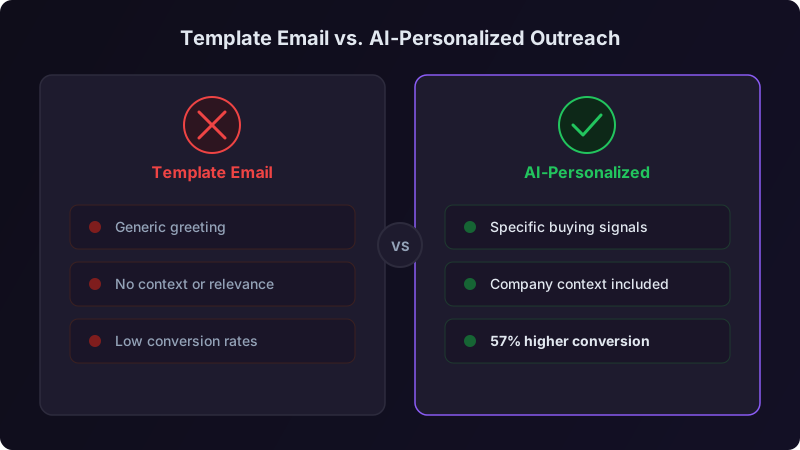
Hyper-Personalization at Scale: How to Use AI to Write Better Sales Emails
Generic templates get ignored. Learn how to use AI for research-backed personalization at scale, where people still need to review, and how to measure the result against your templates.
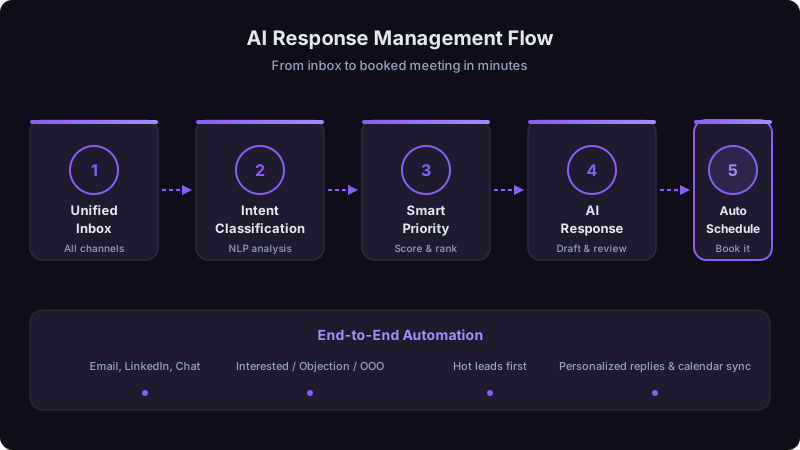
AI Response Management: How to Handle More Replies Without Hiring
Getting replies is only half the battle. Learn how AI-assisted classification, routing, and drafting turn more of the replies you already earn into meetings.
AI Sales Forecasting: Why Your Pipeline Predictions Are Wrong (And How to Fix Them)
Most sales forecasts miss because they rest on rep optimism and stale CRM data. Learn how AI forecasting uses engagement and pipeline signals, and how to commit deals on buyer evidence.