AI SDRs: A Practical Guide to Human-Guided Sales Development
Learn where AI-assisted SDR workflows fit, where human judgment matters, and how to run a controlled pilot using your own conversion, quality, and cost data.
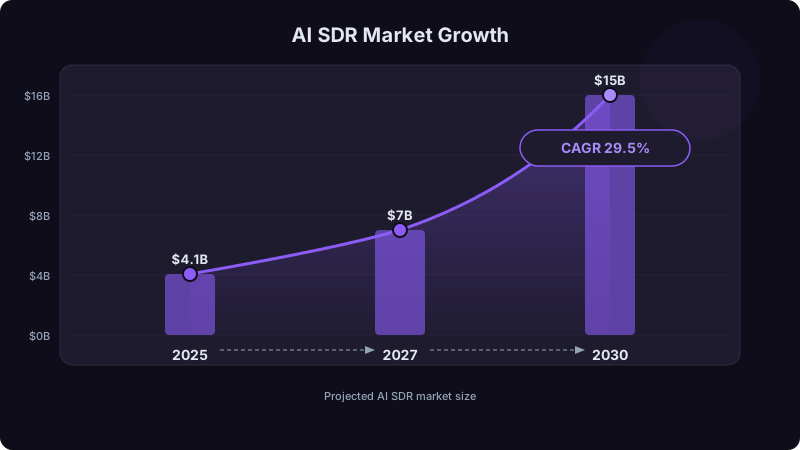
AI-assisted sales development can make research, drafting, routing, and follow-up more consistent. It can also scale weak messaging, bad data, and poor judgment across the same account list. The useful question is not whether an AI SDR can send more activity. It is whether a clearly bounded workflow can create qualified conversations without lowering buyer trust or creating more work downstream.
That makes an AI SDR an operating-model decision, not a virtual headcount purchase. Before selecting a platform, define the work it may perform, the decisions that stay with people, the evidence needed to expand it, and the conditions that should pause it. The NIST AI Risk Management Framework provides a useful foundation for assigning responsibility and evaluating AI systems throughout their lifecycle. [1]
What an AI SDR workflow actually includes
"AI SDR" is a broad market label. In practice, it can describe a collection of separate capabilities:
- selecting accounts from the team's named target list
- collecting company, buyer, and trigger context
- drafting outreach from documented positioning
- scheduling and stopping sequence steps
- classifying replies for routing
- preparing meeting context for an account executive
- recording activity and outcomes in the CRM
These capabilities do not need the same level of autonomy. A team may allow automatic CRM updates while requiring human review for every first-touch message. It may automate scheduling for inbound requests while routing objections and sensitive replies to a person. Treat each step as its own decision rather than enabling an entire workflow at once.
| Activity | Useful AI role | Human responsibility | Evidence to review |
|---|---|---|---|
| Account research | Gather documented public and licensed signals | Confirm relevance and remove weak assumptions | Source validity and research time |
| Message drafting | Draft from the value proposition and account context | Review claims, tone, and strategic angle | Edit rate and message-quality score |
| Sequence operations | Schedule reviewed steps and honor suppression rules | Set frequency, channel, and account boundaries | Delivery, opt-out, and complaint trends |
| Reply triage | Suggest intent and route straightforward responses | Handle ambiguity, objections, and sensitive topics | Correct routing and recovery rate |
| Meeting handoff | Assemble the signal, thread, and source context | Validate qualification and prepare the next conversation | Held-meeting and accepted-opportunity rates |
Where AI assistance fits best
Good pilot candidates have repeatable work, reliable data, clear messaging, and limited downside when a draft needs correction. Examples include researching a defined account list, drafting follow-ups after a known signal, routing common inbound requests, and preparing CRM-ready meeting notes.
Human ownership matters more when the account is strategically important, the message makes a material claim, the buyer raises a nuanced objection, or the context involves regulated or sensitive information. Those situations require judgment about the relationship and the business, not simply a more polished sentence.
Choose one audience, one trigger, one offer, and one success definition for the first pilot. A narrow scope makes quality problems visible and gives the team a fair way to compare the workflow with its current process.
Build an account-tier operating model
Account tiers are useful when they determine how work is handled, not merely how accounts are labeled. Define tiers using potential value, strategic importance, relationship context, buying complexity, and the cost of a poor interaction.
| Motion | Research | First touch | Follow-up | Reply handling |
|---|---|---|---|---|
| Strategic accounts | AI gathers and organizes evidence | Human writes or substantially edits | Human-led with AI support | Human-owned |
| Core accounts | AI prepares a sourced brief | AI drafts; human reviews until quality is stable | Monitored automation within set limits | Routine routing; human escalation |
| Scaled coverage | AI works from reviewed data and documented plays | Bounded automation within set limits | Bounded automation within set limits | Automatic routing with a visible exception queue |
The correct boundary depends on your buyers, sales motion, data quality, and risk tolerance. Do not copy another company's tier definitions or autonomy settings. Use your own opportunity economics and brand standards.
Treat response time as a service-level experiment
Fast response can be useful when a buyer has requested contact, but a fast irrelevant response is not a win. Establish a response-time baseline, decide which inbound actions qualify for immediate follow-up, and measure how the assisted workflow changes both latency and conversation quality.
Track median and tail response time rather than reporting only the minimum response time. Separate business-hours and after-hours activity. Review held meetings and accepted opportunities, not just calendar bookings. This shows whether prompt routing helps buyers or simply creates more low-quality activity.
If email is part of the workflow, include sender authentication, spam rates, and unsubscribe behavior in the operating scorecard. Gmail publishes current sender requirements covering authentication, wanted mail, and one-click unsubscribe for bulk senders. [4]
Design the pilot before enabling outreach
Define the pilot hypothesis
Write a testable statement tied to a specific workflow. NIST's AI RMF Playbook uses a Govern, Map, Measure, and Manage structure that can help a team connect ownership, context, evaluation, and response before launch. [2] For example:
For product-demo requests from our target segment, AI-assisted research and drafting will respond sooner than our baseline while maintaining our current qualification, buyer-feedback, and opt-out standards.
The hypothesis names the audience, intervention, intended change, and quality constraints. It is far more useful than a general goal such as "send more activity."
Capture a baseline and comparison group
Measure the existing process before changing it. Use a matched comparison group or a phased rollout when practical. Keep audience, offer, channel, territory, and time period as consistent as the business allows. Record changes to lists, messaging, and routing rules so the team can explain movement in the results.
Instrument the full funnel
Activity volume is diagnostic, not the outcome. A useful scorecard connects the first automated action to downstream quality.
| Metric | Calculation | Decision it informs |
|---|---|---|
| Response latency | Time from qualifying signal to first appropriate response | Is the workflow removing avoidable delay? |
| Draft acceptance rate | Drafts accepted without material edits divided by drafts reviewed | Is the message system ready for broader use? |
| Positive-reply rate | Relevant positive replies divided by delivered outreach | Is the audience and message resonating? |
| Correctly routed share | Correctly routed replies divided by replies reviewed | Can routine triage remain automated? |
| Held-meeting rate | Held qualified meetings divided by meetings booked | Are calendar bookings useful to sales? |
| Opportunity acceptance | Opportunities accepted by sales divided by qualified meetings | Does the workflow create pipeline-quality conversations? |
| Buyer-friction rate | Opt-outs, complaints, and negative quality feedback divided by delivered outreach | Is the motion protecting buyer trust? |
| Cost per held meeting | Total pilot cost divided by held qualified meetings | How does the total cost compare with the baseline? |
Agree on definitions before the pilot. If marketing, sales development, and sales operations count a qualified meeting differently, the test will create debate instead of evidence.
Put guardrails around data, claims, and action
An AI SDR should operate from an explicit policy that people can inspect and change. Include:
- documented account and contact sources
- suppression lists, consent rules, and opt-out handling for every active channel
- claims that may be used and the evidence behind them
- topics, competitors, and sensitive attributes that require review
- per-account and per-domain contact limits
- reply classes that require a person
- calendar and CRM permissions
- logs for source context, generated messages, edits, sends, replies, and overrides
- a named owner who can pause the workflow
The goal is not to anticipate every possible edge case. It is to create a clear default, a visible exception path, and a fast way to stop or correct the system.
For commercial email in the United States, the FTC's CAN-SPAM guidance covers accurate sender information, non-deceptive subject lines, opt-out mechanisms, and responsibility for vendors sending on a company's behalf. [3] Platform rules also matter. LinkedIn's User Agreement prohibits unauthorized bots that send messages or create engagement, so a multichannel pilot should verify its tools and permissions before launch. [5]
Review quality with a repeatable rubric
Sample output on a fixed cadence and score it against the same criteria used for human outreach:
- factual support and source traceability
- relevance to the buyer and the triggering event
- clarity of the problem and proposed next step
- consistency with documented positioning
- tone and respect for the existing relationship
- alignment with channel, consent, and suppression rules
- correct response classification and escalation
Record both the score and the edit. Edit patterns reveal where the system needs better data, instructions, examples, or permissions. Averages alone can hide severe failures, so review the weakest examples and every buyer complaint.
Calculate economics from your own inputs
An AI SDR business case should include more than a platform subscription. Count data and enrichment, model or usage charges, implementation, integration maintenance, deliverability operations, human review, management time, and exception handling.
Then compare cost at meaningful funnel stages:
- total workflow cost per held qualified meeting
- total workflow cost per accepted opportunity
- total workflow cost per closed-won customer
- pipeline created per unit of spend
- seller time returned to strategic account work
Use the same attribution window and cost categories for the current process and the pilot. A workflow that books inexpensive meetings but produces weak opportunities may cost more at the accepted-opportunity stage.
Give account executives the full conversation context
The handoff should show why the account was selected, which signal triggered outreach, which sources supported the message, what the buyer said, how the reply was classified, and what remains uncertain. Account executives should be able to correct qualification and routing decisions. Those corrections are valuable feedback for the next iteration.
Do not hide whether automation created the message or managed the thread. The sales team needs that operational context to prepare well and diagnose quality issues.
A controlled rollout plan
Select a repeatable, measurable job with a clearly defined audience and owner.
Document current latency, response quality, held meetings, opportunity acceptance, buyer friction, human effort, and total cost.
Document data sources, claims, message examples, contact limits, routing rules, and stop conditions before live activity begins.
Generate research, drafts, and reply classifications without sending. Compare output with the team's decisions and correct the largest gaps.
Use a bounded account cohort and keep a comparable baseline or holdout. Review exceptions and buyer feedback throughout the test.
Expand, revise, or stop based on held meetings, accepted opportunities, buyer friction, quality scores, and fully loaded cost, not send volume.
What changes for the SDR team
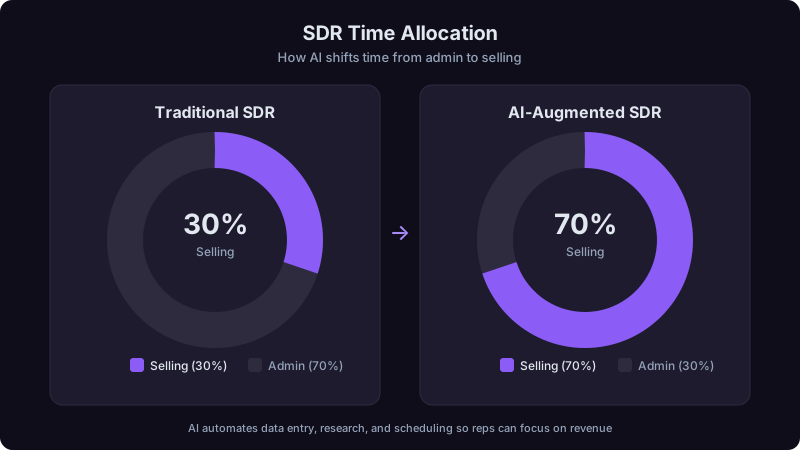
AI assistance can move time away from repetitive research and administration, but it does not remove the need for sales judgment. SDRs become responsible for account strategy, message quality, exception handling, relationship development, and system feedback. Sales operations becomes responsible for definitions, permissions, instrumentation, and auditability.
That is a more demanding operating model than turning on a sequence. It is also the path to learning how AI assistance changes your specific sales motion.
Start with the accounts, buyers, signals, and context your team already trusts. Automate a bounded workflow, keep people at the judgment points, and expand only when your own funnel data supports the decision. See how Prospectory brings account, buyer, signal, and relationship context into one workspace.
References
[1]National Institute of Standards and Technology, Artificial Intelligence Risk Management Framework (AI RMF 1.0). https://www.nist.gov/publications/artificial-intelligence-risk-management-framework-ai-rmf-10
[2]National Institute of Standards and Technology, NIST AI RMF Playbook. https://www.nist.gov/itl/ai-risk-management-framework/nist-ai-rmf-playbook
[3]Federal Trade Commission, CAN-SPAM Act: A Compliance Guide for Business. https://www.ftc.gov/business-guidance/resources/can-spam-act-compliance-guide-business
[4]Google, Email Sender Guidelines. https://support.google.com/mail/answer/81126
[5]LinkedIn, User Agreement. https://www.linkedin.com/legal/user-agreement
Ready to transform your sales pipeline?
See how Prospectory's AI-powered platform can help your team research, reach, and relate to prospects at scale.
Related Articles
The AI SDR Reality Check: What Autonomous Agents Actually Book
AI SDR agents reliably automate research, list-building, and sequencing. Here is how to design a pilot that measures held meetings, protects your sending domain, and keeps humans deciding.
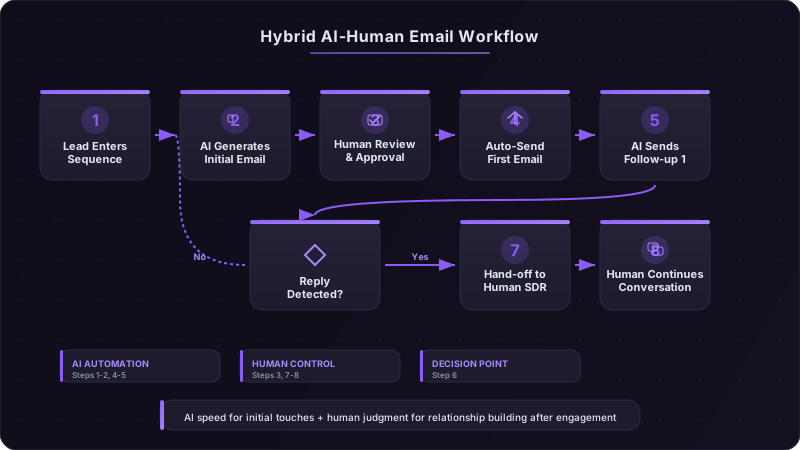
AI vs. Human Email Writing: How to Test Which Earns More Replies
How to run a fair test of AI-written against human-written cold email, what to measure beyond reply rate, and how to turn the results into a hybrid workflow.
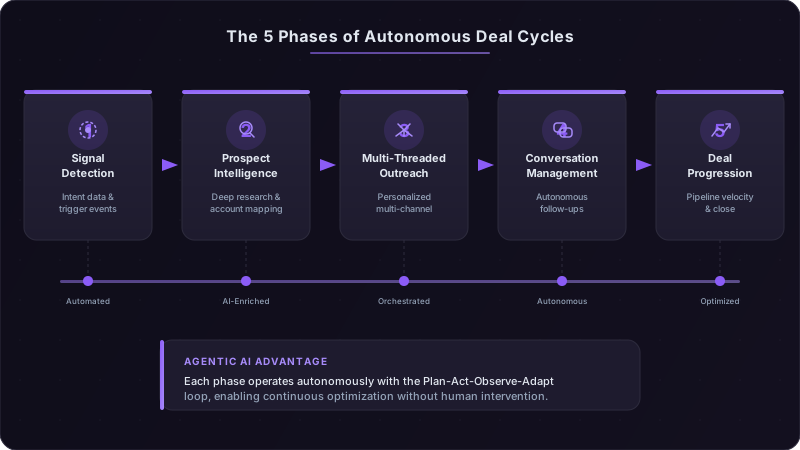
Agentic AI in Sales: How Autonomous Deal Cycles Are Replacing the Traditional Pipeline
Agentic AI is moving beyond task automation into coordinated deal workflows. Learn where AI agents can support research, outreach, and follow-up with human oversight.