LinkedIn Commenting for Social Selling: A Practical Playbook
Use thoughtful LinkedIn comments to learn from target buyers, start relevant conversations, and measure whether those conversations create qualified pipeline.
LinkedIn comments can support social selling because they let a seller join a conversation a buyer has already chosen to have. A useful comment demonstrates how the seller thinks, creates context for a later conversation, and can reveal the language buyers use for a problem. It is not a shortcut around relevance, and it should not be treated as a contest for likes or feed reach.
The goal of this playbook is simple: identify conversations that matter to your target accounts, contribute something useful, continue only when there is mutual interest, and measure whether the work creates qualified sales outcomes. LinkedIn's Professional Community Policies ask members to contribute in a constructive, authentic, relevant, and professional way. [1]
Start with accounts and people, not the feed
A productive social-selling motion begins with the same foundation as account-based marketing:
- the accounts your go-to-market team wants in pipeline
- the named buyers and influencers at those accounts
- the business signals that make a conversation relevant
- the relationship and opportunity history already in your CRM
Build a working list of buyers who discuss topics connected to the problems your team understands. Include subject-matter experts and potential champions, not only senior executives. Record the themes they write about and the colleagues who regularly join the discussion.
This keeps the activity focused. Without an account list, commenting can become a busy feed habit that produces engagement but no useful market learning or pipeline.
Decide whether a post deserves a comment
Comment when at least one of these is true:
- you can add a concrete example the audience can use
- you can clarify an important tradeoff or implementation detail
- you have a genuine question that moves the topic forward
- you can connect the post to a related issue the author has not covered
- the discussion reveals a problem your team is qualified to help solve
Skip the comment when you would only restate the post, praise the author, force a product mention, or invent an experience to sound credible. Silence is better than a generic "great insight" attached to your name.
Three useful comment patterns
Add a practical layer
Build on the author's point with a detail that makes it easier to apply.
The handoff issue is important. One step that helps is recording the trigger, the buyer's stated concern, and the unresolved question in the CRM before the meeting. Which part of the handoff breaks most often for your team?
This works because it contributes an actionable idea and invites the author to discuss their environment.
Offer a respectful counterpoint
Disagree with the idea, not the person. State the condition that changes your view.
I would use a different approach for strategic accounts with an existing relationship. In that case, a new automated sequence can erase useful context. How do you separate net-new accounts from active relationships in this process?
The comment gives the author something specific to respond to without turning the thread into a debate performance.
Ask a bridge question
Connect the post to an adjacent operating problem.
This sounds closely tied to data ownership. When marketing and sales use different account lists, who decides which version drives prioritization?
A bridge question can uncover the process behind the visible problem. It can also show whether a later conversation would be useful.
Show evidence without inventing authority
Specificity makes a comment credible, but a made-up customer story or unsupported metric does the opposite. Use evidence you can stand behind:
- a public source you can link
- a named customer result with permission and the required attribution
- a clearly labeled example or scenario
- a process observation that does not pretend to be a measured outcome
- a question that lets the buyer supply the missing context
If you cannot disclose a customer or explain how a number was calculated, do not use the result as proof. The FTC's advertising substantiation policy calls for a reasonable basis before an objective claim is published. [5] A well-framed question is more trustworthy than an impressive statistic with no source.
Continue the thread before moving channels
Treat a reply as the beginning of a conversation, not permission to pitch. Respond to what the person actually said. If the exchange becomes detailed, ask whether they would like to continue in a direct message. Move channels when sensitive details, length, or a concrete next step makes that useful.
A direct message should preserve the context of the thread:
Your point about keeping the account list consistent across sales and marketing was useful. I have a short framework for assigning ownership and recording changes. Would it be helpful if I sent it here?
That message offers a relevant next step and gives the recipient an easy choice. It does not manufacture urgency or hide a meeting request inside a compliment.
A public reply is not a hidden meeting request. Continue the topic first. Suggest a direct message only when the buyer asks for detail, requests a resource, raises a non-public issue, or agrees that another channel would be useful.
Use a signal-based cadence
A fixed waiting period is less useful than observing the conversation. Continue when the buyer asks a question, requests a resource, describes an active problem, or agrees that a deeper exchange would help. Pause when replies become brief, the topic is resolved, or the buyer does not respond.
Respect opt-outs and channel preferences. LinkedIn's User Agreement prohibits unauthorized automated methods that create comments, messages, or other engagement. [2] LinkedIn's automated-activity guidance also warns against third-party tools that scrape or automate activity on the site. [3] Tools can help a seller organize documented information, but a person should remain accountable for what is posted under their identity.
Turn public conversations into account context
Comments can add value beyond individual outreach. Capture what the discussion teaches your team:
- the buyer's language for the problem
- the initiatives and constraints they mention publicly
- other stakeholders who join the thread
- objections or tradeoffs that appear repeatedly
- resources and examples the buyer values
- a clear reason to contact the account now, if one exists
Add only relevant, appropriate context to the CRM. A useful note should help the next seller understand the business conversation without turning routine social activity into surveillance. The NIST Privacy Framework offers a practical structure for identifying and managing privacy risk when an organization processes personal information. [6]
Design a measurable social-selling pilot
Do not compare LinkedIn commenting with cold email using anecdotes from different audiences or periods. Define a pilot that your revenue team can audit. LinkedIn's own social-selling measurement guidance recommends establishing tracking early and reviewing which activities produce useful next steps. [4]
Write the hypothesis
Name the audience, activity, intended outcome, and quality constraint. For example:
For named buyers who publicly discuss our target problem, useful comments and permission-based follow-up will create qualified conversations while meeting our buyer-feedback and opportunity-quality standards.
Define an eligible cohort
Choose accounts from the shared target list. Document why each person and post qualifies. If you compare channels, keep the account tier, persona, offer, relationship stage, and measurement window as consistent as possible.
Establish the current baseline
Record the same funnel stages for the existing outbound motion. Include seller time and downstream opportunity quality. Without a baseline, more replies can look like progress even when fewer conversations reach a useful sales outcome.
Use a scorecard the revenue team can verify
| Metric | Calculation | What to inspect |
|---|---|---|
| Relevant comments | Comments that meet the documented relevance rubric | Are sellers contributing where they have useful context? |
| Comment-to-reply rate | Reply threads divided by relevant comments | Does the contribution invite a real exchange? |
| Reply-to-DM rate | Permission-based direct-message conversations divided by reply threads | Is there a natural reason to continue privately? |
| DM-to-held-meeting rate | Held qualified meetings divided by direct-message conversations | Do conversations lead to useful next steps? |
| Opportunity acceptance | Sales-accepted opportunities divided by held meetings | Is the motion reaching the right buyers at the right time? |
| Buyer-friction rate | Negative feedback, removal requests, and blocked contacts divided by active conversations | Is the approach protecting trust? |
| Seller effort | Time spent researching, commenting, following up, and recording context | Is the workflow sustainable? |
| Cost per accepted opportunity | Total pilot cost divided by accepted opportunities | How does the motion compare with other channels? |
Define each stage before the pilot begins. A reply is not automatically a qualified conversation, and a booked meeting is not automatically a held or accepted meeting.
Create an attribution trail
For every opportunity that begins in a LinkedIn discussion, record:
- the account and buyer
- the original post URL
- the seller's comment and the buyer's reply
- the date and reason the conversation moved to a direct message
- the first meeting date and whether it was held
- the opportunity source and acceptance decision
- the associated campaign or pilot cohort
Use a consistent CRM source value and keep the post URL in the activity record. This gives sales operations a traceable path from the original conversation to pipeline without relying on broad "influenced" attribution.
Review comment quality, not just volume
A manager or peer reviewer can score a sample of comments against a short rubric:
- relevant to the specific post
- factually supportable
- useful without a product pitch
- written in the seller's natural voice
- respectful of the buyer and the public setting
- contains a genuine opening for response when appropriate
Review weak examples and buyer feedback, then update coaching and examples. Do not turn the rubric into a template that makes every seller sound the same.
Avoid the automation trap
Automating research and reminders can help a seller maintain focus. Automating the actual comment can create generic, repetitive, or inaccurate public statements under that seller's identity. It can also conflict with current platform rules.
Before adopting a tool, ask:
- Does it post automatically or only recommend relevant conversations?
- Can the seller inspect the source and edit every draft?
- Does it preserve suppression and account-ownership rules?
- Can activity be exported to the CRM with a reliable source trail?
- Can a manager pause it immediately?
- Does its current use comply with LinkedIn's terms and your company policy?
The purpose of tooling is to help people find and remember valuable conversations. It should not simulate relationships at scale.
A practical weekly operating rhythm
Review new posts and active threads from named buyers at target accounts. Select only the discussions where the seller has relevant knowledge.
Use a practical layer, respectful counterpoint, or bridge question. Verify every factual claim before posting.
Respond to the buyer's point, share promised resources, and move to a direct message only when the exchange supports it.
Capture the source link, buyer language, relevant signal, next step, and relationship history in the CRM.
Compare replies, permission-based DMs, held meetings, accepted opportunities, buyer feedback, and seller effort with the pilot baseline.
What good social selling looks like
Good social selling is recognizable even before it creates an opportunity. Sellers learn directly from buyers, contribute expertise without forcing a pitch, and preserve the context of the relationship for the rest of the go-to-market team. When a buyer wants to continue, the transition feels like the next step in a useful conversation.
Start with a small set of named buyers and one clear problem area. Track the complete path from comment to opportunity, review the quality of the public contributions, and let your own pipeline evidence decide whether the motion deserves more time. See how Prospectory connects account, buyer, signal, and relationship context.
References
[1]LinkedIn, Professional Community Policies. https://www.linkedin.com/legal/professional-community-policies
[2]LinkedIn, User Agreement. https://www.linkedin.com/legal/user-agreement
[3]LinkedIn Help, Automated Activity on LinkedIn. https://www.linkedin.com/help/linkedin/answer/a1340567/automated-activity-on-linkedin
[4]LinkedIn Sales Solutions, How to Manage Social Selling Activity. https://www.linkedin.com/business/sales/blog/modern-selling/how-to-manage-social-selling-activity
[5]Federal Trade Commission, Policy Statement Regarding Advertising Substantiation. https://www.ftc.gov/legal-library/browse/ftc-policy-statement-regarding-advertising-substantiation
[6]National Institute of Standards and Technology, Privacy Framework. https://www.nist.gov/privacy-framework
Ready to transform your sales pipeline?
See how Prospectory's AI-powered platform can help your team research, reach, and relate to prospects at scale.
Related Articles
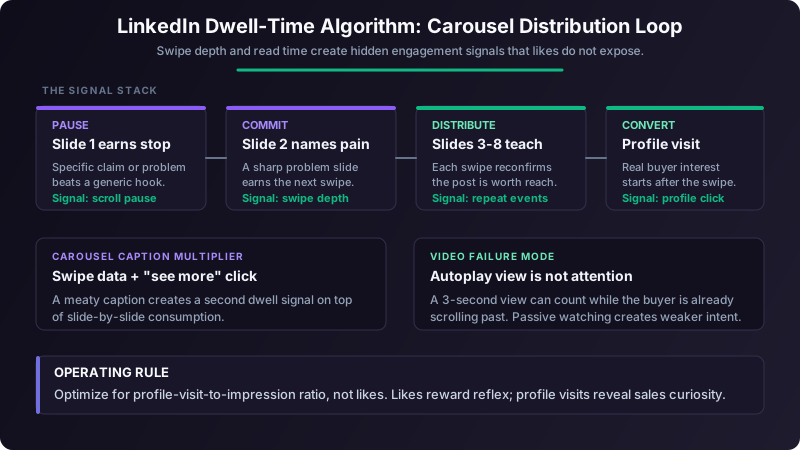
LinkedIn Carousels vs Video: Why Dwell Time Beats Vanity Metrics
Likes are a weak measure of whether a post reached the right buyers. Here is how sales teams can judge carousels and video by attention and profile visits instead.
When Product Ships Faster Than Sales Can Learn: A Research Loop for GTM
Fast feature delivery changes the sales bottleneck. Use an account research loop to find buyers, test real problems, and turn releases into qualified conversations.
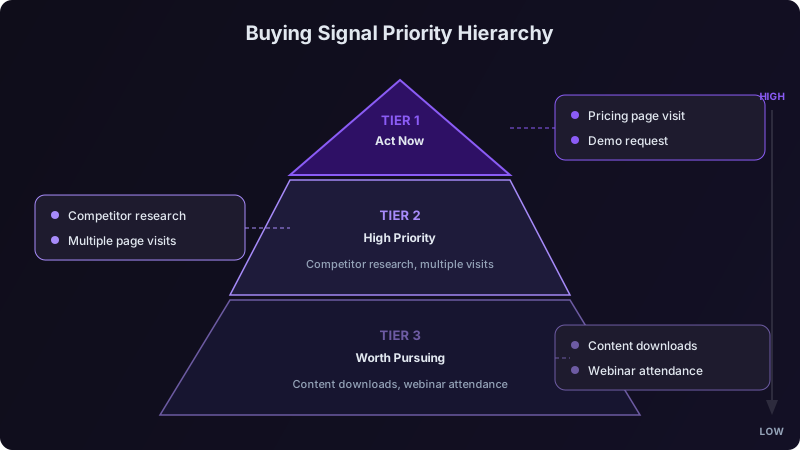
Buying Signals 101: How to Identify Prospects Who Are Ready to Buy Now
Stop guessing which accounts to pursue. Learn how to use intent data and buying signals to focus on prospects actively researching solutions like yours.