When Product Ships Faster Than Sales Can Learn: A Research Loop for GTM
Fast feature delivery changes the sales bottleneck. Use an account research loop to find buyers, test real problems, and turn releases into qualified conversations.
A sales leader asks for a product change on Tuesday. Engineering ships it before the next pipeline review. The old answer, "it is not on the roadmap," has lost much of its force. The feature request is no longer waiting in a queue. The sales team is.
That is an operating scenario, not a claim that every software team now ships at the same speed. A 2025 Microsoft Research study across three developer field experiments found more completed tasks among developers using an AI coding assistant, while also noting variation across the experiments [3]. DORA's 2025 research describes AI as an amplifier of the organizational system around it [1]. Another Microsoft Research field experiment found that AI changed tasks individuals could perform independently more readily than work requiring coordination [4]. Faster code can be real, but it does not automatically produce faster customer learning.
The practical question for sales is this: once the capability exists, which accounts have a reason to care, who owns the problem, and what evidence would make a conversation worth having? A salesperson who cannot answer those questions has a larger menu of features, not a stronger pipeline.
The Constraint Moves from Feature Requests to Customer Discovery
The traditional feature request process gave sales a way to quantify customer impact. A rep collected an account name, deal value, expected use case, and urgency. Product weighed that request against other work. When delivery took months, the roadmap decision was the visible constraint.
In a faster shipping cycle, requests are cheaper to satisfy. That can improve the customer experience. It can also hide a weak sales motion. A request from one loud prospect is still one data point. Shipping it does not show how many other accounts share the need, whether the buyer will change behavior, or whether the feature will help win and retain customers.
Salesforce's 2026 State of Sales survey reports that respondents spent 40% of an average workweek selling and 60% on other work, including prospecting and planning [2]. That survey does not prove a particular team's bottleneck. It does make a useful point: asking reps to absorb releases, research accounts, find contacts, and develop new messages takes real capacity. If the product cadence rises, the learning system has to become more deliberate.
| Previous question | Question after a fast release | Evidence to collect | Decision owner |
|---|---|---|---|
| Can product build this request? | Which buyer problem does the release address? | Customer language from calls and support tickets | Product marketing with sales |
| Is the requesting deal large enough? | How many similar accounts have the problem now? | Account list with a verified trigger and use case | Sales research or RevOps |
| Where is it on the roadmap? | Can the field explain and demonstrate it? | Demo path, proof, limits, and a discovery question | Enablement |
| When will it ship? | When will the first qualified conversation happen? | Release date, field-ready date, and call outcome | Frontline sales manager |
| Did we close the request? | Did the capability affect a buying decision? | Opportunity notes, adoption, and lost-deal reasons | Account team |
The table changes the unit of work. A shipped feature is an input. A verified customer problem and a qualified conversation are outputs.
Build a Research Packet Before You Build an Outreach Sequence
The fastest way to waste a new capability is to announce it to every account in a territory. A release is not a buying signal. It tells you what your team can do. It says nothing about a prospect's timing. HubSpot's 2025 sales survey found that 74% of surveyed sales professionals believed AI made it easier for buyers to research products independently [5]. That is a reported seller perception, not proof of how any particular buyer researches; it raises the bar for a rep to bring useful account context to the conversation.
For each release, create a one-page research packet that a rep can use in fifteen minutes. It should contain five fields:
- 1Customer job: Describe the work the buyer is trying to complete in the buyer's terms. "Reconcile account ownership after a territory change" is more useful than "use our new mapping engine."
- 2Observable change: Identify a public or first-party event that could make the job urgent. A new sales leader, a territory expansion, a hiring plan, an integration project, or a repeated support question can be a lead. Treat it as a hypothesis until a buyer confirms it.
- 3Likely owner: Map the person accountable for the outcome and the people who will influence the purchase. The owner of pipeline operations may differ from the person who signs the contract.
- 4Disqualifier: Name the circumstance in which the account should not be contacted. A team with no relevant workflow, no near-term change, or a solution already working well belongs outside this release campaign.
- 5Discovery question: Ask about the operating problem before mentioning the feature. The answer should change whether the rep pursues the account.
For example, suppose a product team ships a faster way to reconcile CRM account ownership. A weak campaign says, "We launched territory mapping; want a demo?" A useful research packet identifies companies that have just announced a sales reorganization, confirms that the likely operations owner is in place, and asks, "What happens to open opportunities when an account changes owner?" The question tests the problem. The feature enters the conversation only if the problem is real.
Require a rep to record the account event, its source, the likely owner, and the question they will test. If any field is blank, the account stays in research. This protects buyer attention and gives managers an observable quality standard.
The negative persona framework can help define exclusions. The account intelligence view shows the kind of account context a rep needs before choosing a contact. Neither replaces a conversation with the buyer.
Use Three Research Lanes, Not One Big Prospect List
A single list mixes very different jobs. Split research into three lanes and give each lane a distinct next action.
Lane 1: Existing customer expansion. Start with customers already using a related workflow. Check whether the new capability removes a known obstacle, whether the right team knows it exists, and whether usage can be observed. The next action may be a working session with the account team, not a cold campaign.
Lane 2: Active problem discovery. Find accounts with an observable change that could create the problem now. Verify the event, map the buying group, and ask a narrow question. A job posting can indicate a new initiative, but it does not establish budget or intent. The rep should record what the buyer confirms and what remains uncertain.
Lane 3: Market learning. When no reliable trigger exists, run a small interview cohort. Select accounts that fit the intended customer profile but vary by industry, team size, or process maturity. Ask how they solve the job today and what makes the current approach costly. Do not force these interviews into a demo target. The output is a clearer market hypothesis.
This separation matters because "more prospects" can mean three different things: more existing customers who can use a release, more accounts with a current problem, or more people who can teach you whether the problem is common. Counting all three as pipeline inflates confidence.
Run a Weekly Release-to-Conversation Review
A release note is too passive for a fast product team. Create a short weekly meeting with product marketing, one frontline manager, and a research or RevOps owner. The agenda should be based on decisions, not a tour of every shipped ticket.
Start with the capabilities that changed a customer's available workflow. For each one, ask: who asked for it, what job did they describe, which other accounts look similar, and what would disprove the sales hypothesis? Assign an owner to the research packet. Give the field a demo path and an honest scope statement. Then review the first conversations one week later.
Use a compact scorecard:
| Measure | Definition | What it diagnoses | Review cadence |
|---|---|---|---|
| Ship-to-field-ready time | Days from production release to approved research packet and demo | Enablement lag | Weekly |
| Verified-trigger coverage | Target accounts with a sourced event and named owner divided by target accounts researched | Research quality | Weekly |
| Qualified conversation rate | Conversations confirming the problem and a relevant owner divided by conversations held | Hypothesis quality | Weekly |
| Opportunity progression | Qualified conversations with an agreed next step / all qualified conversations in the same release cohort; report both counts | Commercial relevance | Monthly |
| Post-sale adoption | Eligible new customers with recorded use within 90 days / new customers with the capability enabled and a completed 90-day window; report both counts | Whether the promised use case was real | Quarterly |
Report the numerator and denominator beside every rate, using the same release cohort and time window for both. List accounts that have not yet completed an adoption window separately from the eligible denominator. Five qualified conversations from six calls can be promising, but it is not yet a repeatable motion. Keep a record of why accounts were excluded and why buyers said no. A rejection can reveal that the buyer is elsewhere in the organization, the problem is infrequent, or the release solves only one part of the workflow.
Avoid rewarding activity that is easy to automate. Emails sent, features mentioned, and demos booked are useful operational counts, but none proves that a customer had the problem. The learning loop needs evidence from the buyer's own words.
Let Sales Feed Product Without Returning to a Feature Queue
Faster delivery does not make product feedback irrelevant. It raises the standard for it. Instead of forwarding a feature request with a deal amount attached, send a structured observation:
- Situation: What changed at the account and when?
- Job: What outcome is the buyer trying to achieve?
- Current workaround: What do they do today, and who bears the cost?
- Evidence: Which buyer said it, in what conversation, and what source supports the account context?
- Commercial consequence: Did it block a next step, reduce the expected scope, or affect adoption?
- Alternative: Could the existing product solve the job through configuration, training, or a different process?
This is a better input to product because it separates an observed problem from a proposed solution. It is also a better input to sales because a pattern across accounts becomes a stronger account-selection rule.
The same record should flow back to enablement. If five buyers describe the problem in different words, the team may have a messaging issue. If buyers understand the problem but cannot use the feature in their environment, the team may have an integration or implementation issue. If buyers do not have the problem at all, the next campaign should stop.
Prospectory can support the research side by organizing account context, contact discovery, and signals into a working view for the seller. The rep still owns the hypothesis, the conversation, and the decision to pursue. The sales plays are most useful when they start with a real account event and end with a measurable next step.
Frequently Asked Questions
Does faster shipping mean sales should announce every feature?
No. Group releases by the customer job they change. A buyer rarely needs a ticket-by-ticket list. They need to know whether a specific workflow can now produce a better outcome and what would be required to use it.
What if we cannot find a reliable buying signal?
Use the market-learning lane. Choose a small, well-defined interview cohort and ask about the job and current workaround. Do not label a weak proxy, such as a generic funding announcement, as proof of immediate intent.
Who owns this research loop?
Product marketing owns the customer job and field explanation. RevOps or research operations owns the data definitions and account list. The frontline manager owns whether reps use the packet and record what buyers say. Product participates when observations reveal a repeated gap. One named owner should maintain the weekly scorecard.
Is a shipped feature itself proof that the market wants it?
No. It proves that the team delivered a capability. Evidence of demand comes from repeated buyer problems, qualified conversations, purchase decisions, and eventual use. Keep these measures separate.
How do we know whether the research loop is working?
Look for a shorter ship-to-field-ready interval, more accounts with verified triggers, more conversations that confirm the problem, and better progression from those conversations. Check adoption after the sale so the team does not confuse a good pitch with a useful product.
Next Step: Pick One Release and Test the Loop
Choose one recent capability with a clear customer job. Write the five-field research packet, select a small set of existing customers and new accounts, and run ten discovery conversations. Record the buyer's words and the disqualifications. At the next release review, decide whether to broaden the account set, change the message, or retire the hypothesis.
When software ships quickly, the sales advantage comes from learning which customers need it, and learning that at the same pace.
References
[1]DORA, State of AI-assisted Software Development 2025. https://dora.dev/research/2025/dora-report/
[2]Salesforce, State of Sales, Seventh Edition, 2026. https://www.salesforce.com/en/wp-content/uploads/sites/4/documents/reports/sales/salesforce-state-of-sales-report-2026.pdf
[3]Microsoft Research, The Effects of Generative AI on High-Skilled Work, 2025. https://www.microsoft.com/en-us/research/publication/the-effects-of-generative-ai-on-high-skilled-work-evidence-from-three-field-experiments-with-software-developers/
[4]Microsoft Research, Shifting Work Patterns with Generative AI, 2025. https://www.microsoft.com/en-us/research/publication/shifting-work-patterns-with-generative-ai/
[5]HubSpot, State of Sales Report, 2025. https://blog.hubspot.com/sales/hubspot-sales-strategy-report
Ready to transform your sales pipeline?
See how Prospectory's AI-powered platform can help your team research, reach, and relate to prospects at scale.
Related Articles
LinkedIn Commenting for Social Selling: A Practical Playbook
Use thoughtful LinkedIn comments to learn from target buyers, start relevant conversations, and measure whether those conversations create qualified pipeline.
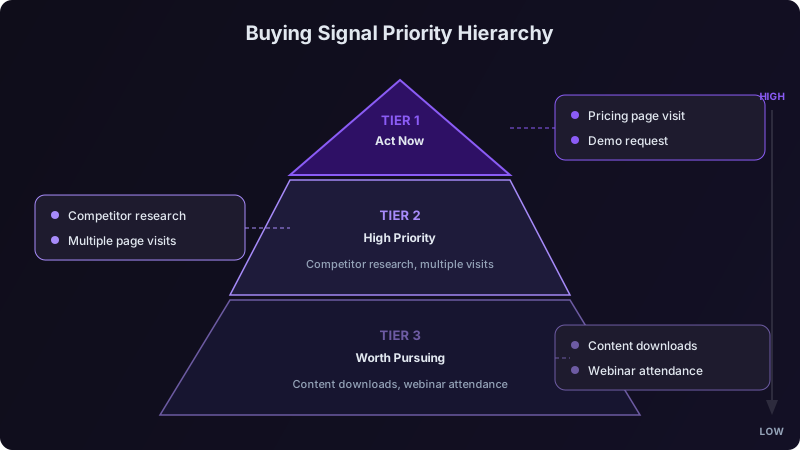
Buying Signals 101: How to Identify Prospects Who Are Ready to Buy Now
Stop guessing which accounts to pursue. Learn how to use intent data and buying signals to focus on prospects actively researching solutions like yours.
Prompt Libraries for Sales Teams: Standardizing AI Outputs Across 40+ Reps
How RevOps builds a versioned, owner-assigned prompt library with required CRM reference fields and weekly output sampling so 40+ reps produce consistent, reviewable AI outreach.