Buying Signals 101: How to Identify Prospects Who Are Ready to Buy Now
Stop guessing which accounts to pursue. Learn how to use intent data and buying signals to focus on prospects actively researching solutions like yours.
Many sales teams still run outbound the old way: build a list, blast it, hope for the best. SDRs spend their mornings cold-calling accounts with zero context.
Paying attention to buying signals changes that. The change that matters is not better reps or better copy. It is to stop guessing and start listening.
Here is a framework for building a signal monitoring system from scratch.
Quick Answer: What Buying Signals Show
Buying signals show that a prospect or account is moving from passive fit to active evaluation. The strongest signals combine a current business change, a relevant research pattern, and a reachable buyer. Recent strategic moves, such as a funding round, new revenue leader, product launch, cloud migration, partner program change, or hiring surge, often create the budget, urgency, and internal mandate behind a buying window.
For a query like "Knowledge Relay Inc buying intent signals," do not treat the company name alone as intent. Look for recent strategic moves at the prospect company, then connect those moves to observable behavior:
| Buying intent signal | What to verify | Why it matters | Sales action |
|---|---|---|---|
| New executive hire | CRO, VP Sales, RevOps, GTM, or Partnerships announcement | New leaders often reassess tools and pipeline process in their first months | Send a business-change note tied to their first-quarter priorities |
| Funding or budget event | Funding, grant, acquisition, expansion, or new strategic partner | Fresh capital creates a short planning window before budget is allocated | Prioritize the account for fast outreach and executive mapping |
| Hiring surge | Multiple SDR, AE, RevOps, partner, or demand roles | Growth hiring usually requires better prospecting, routing, and conversion systems | Share a capacity plan and the operational gaps to watch |
| Category research | Searches, review-site activity, competitor visits, or repeated resource views | The account is comparing options, not just learning the category | Use comparison, pricing, and implementation proof in the first sequence |
| Technology change | CRM, engagement, data, cloud, or marketplace stack movement | Tool changes create integration work and vendor replacement opportunities | Lead with workflow fit, migration path, and time-to-value |
The practical rule is simple: one signal earns monitoring, two aligned signals earn outreach, and three aligned signals earn same-day seller action.
What Buying Signals Actually Are (And Aren't)
A buying signal is any observable action or event that correlates with purchase readiness. That's the textbook definition. In practice, it's simpler: it's a prospect raising their hand in some way, even if they don't know they're doing it.
But here's where most teams go wrong, they treat every signal the same. A VP visiting your pricing page three times in a week is not the same as an intern downloading a whitepaper. The signal matters, but context matters more.
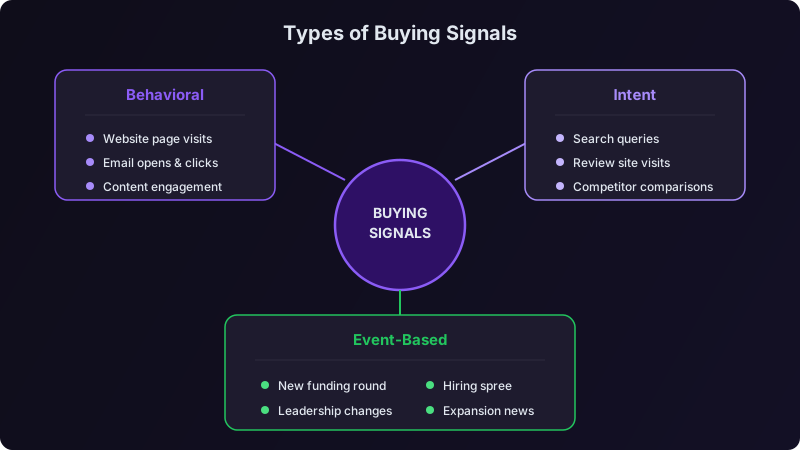
Signals break into three categories, and you need coverage across all three to build a complete picture.
Behavioral Signals (What They Do On Your Properties)
These are actions prospects take on channels you own:
- Pricing page visits: The single strongest first-party signal. If someone hits your pricing page more than once, they're comparing you to alternatives right now.
- Demo or trial requests: Obvious, but surprisingly under-routed at many companies. At some companies, demo requests sit in a shared inbox for days.
- Content downloads: Weaker on their own, but pattern matters. Three whitepapers in a week from the same account? That's a buying committee doing research.
- Email engagement clusters: One open means nothing. Five opens across three people at the same company in two days? That email got forwarded internally.
- Webinar attendance: Especially valuable when the topic maps to a specific pain point you solve.
Intent Signals (What They Do Off Your Properties)
This is where third-party intent data comes in, signals from review sites, publisher networks, and search behavior:
- G2 or Capterra category research: Someone at the account is reading reviews in your category. They're comparing options.
- Competitor website visits: Bombora, 6sense, and similar providers can surface when accounts are researching your competitors.
- Search behavior surges: An account suddenly spiking on keywords related to your solution category.
- Content consumption patterns: Reading articles about problems your product solves across B2B publisher networks.
Third-party intent data has real signal, but it's noisy. Used in isolation, it produces plenty of false positives. Intent data works best as a multiplier on top of first-party signals, not as a standalone trigger. If an account shows intent AND visits your site, that's gold. Intent alone? Worth watching, not worth a full-court press.
Event-Based Signals (What's Happening At Their Company)
These are firmographic and situational changes that create buying windows:
- Funding rounds: A Series B or C often precedes new tool purchases.
- Executive hires: A new VP of Sales or CRO almost always re-evaluates the tech stack in their first quarter.
- Expansion signals: Job postings for SDRs or AEs suggest the team is scaling, and they'll need tools to support that.
- Technology changes: If they just ripped out a competitor or adopted a complementary tool, the timing is right.
- M&A activity: Mergers and acquisitions trigger tool consolidation decisions.
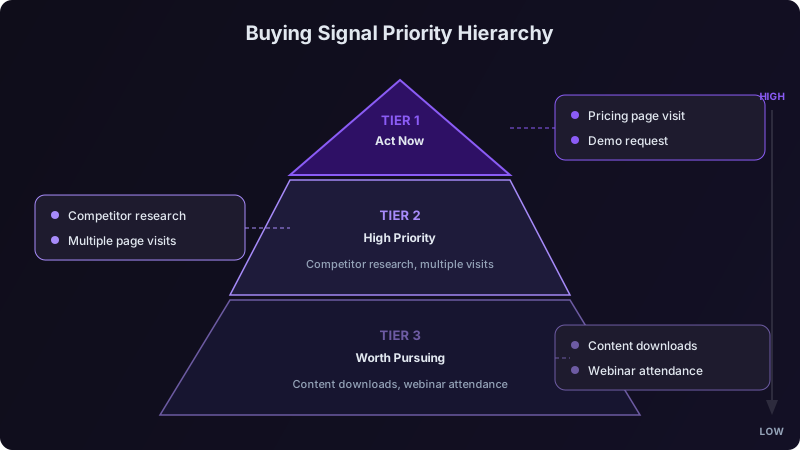
The Three-Tier Signal Hierarchy
Not all signals deserve the same response. The biggest early mistake is treating everything as urgent: reps get alert fatigue and start ignoring the dashboard entirely.
Here's a tier framework and a response playbook for each tier. The response windows are operating targets to set for your team's coverage.
| Tier | Signal Examples | Target Response Time (Your Choice) | Action |
|---|---|---|---|
| Tier 1: Act Now | Repeat pricing page visits, demo request, trial signup, inbound form fill | < 5 minutes | Phone call + personalized email within the hour |
| Tier 2: High Priority | Competitor research spike, multiple site visits in 48hrs, senior stakeholder engagement, G2 comparison views | < 2 hours | Personalized outreach sequence with signal-specific messaging |
| Tier 3: Nurture & Monitor | General category research, single content download, funding announcement, job postings | < 24 hours | Add to signal-aware nurture sequence, set monitoring alerts |
Research published in Harvard Business Review found that firms that tried to contact a lead within an hour were nearly seven times as likely to qualify it as firms that waited even an hour longer, and more than 60 times as likely as firms that waited 24 hours or more [1]. The study covers the first hour; minute-level targets like the ones in the table above are operating choices you set and test, not research findings. One setup: Slack alerts that ping the assigned rep and their manager, escalating if nobody responds within the window you choose.
Building a Signal Monitoring System: The Ops Playbook
Here's how to actually build this, step by step. I'm writing this for the sales ops person who needs to wire it together, not the SDR who just wants to know who to call.
Before you buy anything, audit what you already have. Most teams are sitting on signals they're not using:
- Website analytics (Google Analytics, HubSpot, or your MAP): You already track page visits. Are you routing high-intent pages to sales in real time?
- CRM activity data: Email opens, link clicks, meeting no-shows followed by re-engagement.
- Marketing automation: Lead scoring probably exists but is it calibrated to actual conversion data?
- Customer support tickets from prospects: Pre-sale support inquiries are strong signals.
Then identify gaps. The most common missing sources are third-party intent (Bombora, 6sense, G2 Buyer Intent) and technographic data (BuiltWith, HG Insights).
Don't overcomplicate this at the start. Teams can spend months building a 50-variable model before they've validated that any signals actually predict deals. Start simple:
Point-based scoring (an example starting model):
- Pricing page visit: 25 points
- Demo request: 100 points
- Competitor research (intent data): 15 points
- Multiple stakeholders engaging: 20 points per additional person
- Content download: 5 points
- Funding event: 10 points
- Executive hire: 10 points
Decay: Points lose half their value every 14 days. A signal from last month is worth a quarter of a signal from today.
Threshold: Any account over 50 points gets flagged for Tier 1 or Tier 2 action depending on signal composition.
Calibrate this quarterly against actual closed-won data. Expect your first model to be wrong; a common miss is overweighting content downloads and underweighting multi-stakeholder engagement. Keep tuning until it predicts.
This is where most implementations stall. You need signals to reach the right rep at the right time, automatically. Here's a simple routing logic:
1. Account ownership check: Does this account have an assigned rep? Route to them.
2. Territory fallback: No owner? Route based on territory/segment rules.
3. Round-robin overflow: Territory rep at capacity? Round-robin to available reps.
4. Escalation timer: No action within SLA window? Escalate to manager.
You can build this in Salesforce with Flow and a lightweight middleware such as Tray.io, or with Zapier, Make, or native CRM automation, depending on your stack.
Generic outreach wastes a good signal. Each tier and signal type should have a corresponding message template that references the signal without being creepy about it.
Good (Tier 1, pricing page visit):
"Hi [Name], I noticed your team has been evaluating tools in the [category] space. We work with companies like [similar customer] who were solving [specific problem]. Worth a 15-minute call to see if there's a fit?"
Bad:
"I see you visited our pricing page at 2:47 PM on Tuesday." (This happens more than you'd think. Don't be surveillance-y.)
Good (Tier 2, funding signal):
"Congrats on the Series B! When [similar company] was at the same stage, they needed to scale their outbound fast. If that's on your roadmap, happy to share what worked for them."
Track these metrics weekly:
- Signal-to-meeting rate: What percentage of Tier 1 signals convert to meetings?
- Response time by tier: Are you hitting your SLA windows?
- Signal accuracy: What percentage of flagged accounts actually had buying intent? (Check against pipeline creation within a measurement window you define, such as one quarter.)
- Rep adoption: Are reps actually acting on alerts, or ignoring them?
The Five Mistakes That Kill Signal Programs
These are the most common mistakes.
A common launch mistake is sending reps dozens of alerts per day. They end up ignoring all of them, including the Tier 1 signals that actually matter. Ruthlessly limit alerts to signals that have proven conversion correlation. Start with fewer signals and add more only when you've validated each one.
Mistake #2: Treating intent data as a silver bullet. Intent data is directional, not deterministic. An account "surging" on a topic might be a competitor doing research, an analyst writing a report, or an intern doing a school project. Layer intent with first-party signals before committing rep time.
Mistake #3: Slow response on hot signals. A Tier 1 signal with a 48-hour response time is just a Tier 3 signal with extra steps. If you can't guarantee fast response, fix your routing before you invest in more signal sources.
Mistake #4: No feedback loop. Reps need to mark signals as "accurate" or "noise" so you can tune the model. Without this, your scoring model drifts and eventually becomes useless. A simple thumbs-up/thumbs-down in Slack that feeds back to the scoring weights is enough to start.
Mistake #5: Ignoring negative signals. Someone unsubscribing, marking you as spam, or a champion leaving the company, these are signals too. Build suppression and de-prioritization rules, not just escalation rules.
What Good Looks Like: A Before-and-After
Measure your own before-and-after: Tier 1 response time, signal-to-meeting rate, and win rate on signal-sourced opportunities against last quarter's baseline.
The biggest shift is behavioral, not technological: reps stop thinking of their job as "make X calls per day" and start thinking of it as "respond to the highest-quality signals as fast as possible." That mindset, supported by the right data infrastructure, is what gives the numbers a chance to move.
Getting Started This Week
You don't need to build the whole system at once. Here's a quick-start checklist:
- 1Today: Set up real-time alerts for pricing page visits. Most MAPs can do this natively.
- 2This week: Audit your existing signal sources, you're probably sitting on data you're not routing.
- 3This month: Implement a simple point-based scoring model with 5-7 signals. Calibrate against last quarter's closed-won deals.
- 4This quarter: Add one third-party intent data source and measure lift against your baseline.
- 5Next quarter: Build the feedback loop. Get reps rating signal quality so your model improves over time.
Buying signals aren't about predicting the future. They're about paying attention to what's already happening and responding faster than your competitors. The teams that figure this out first don't just win more deals, they win them more efficiently, with less wasted effort and fewer burned leads.
The data is already out there. The question is whether your team is wired to act on it.
References
[1]Oldroyd, James B., Kristina McElheran, and David Elkington, "The Short Life of Online Sales Leads," Harvard Business Review, March 2011. https://hbr.org/2011/03/the-short-life-of-online-sales-leads
Ready to transform your sales pipeline?
See how Prospectory's AI-powered platform can help your team research, reach, and relate to prospects at scale.
Related Articles
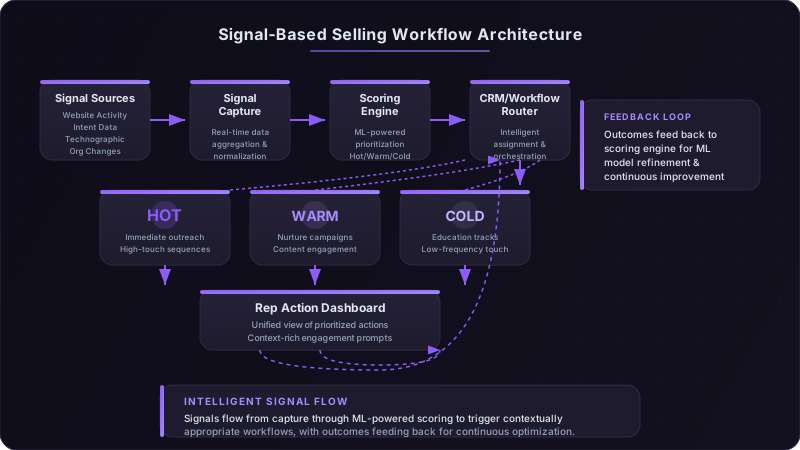
Building a Signal-Based Selling Motion from Scratch
A practical playbook for sales teams transitioning from spray-and-pray list-based outbound to a signal-driven approach that actually converts.
Signal Stacking: How to Combine Buying Indicators Instead of Chasing Single Signals
A single buying signal is easy to misread. Learn how to combine concurrent signals from different categories, weight and decay them, and test whether stacked accounts convert better in your pipeline.
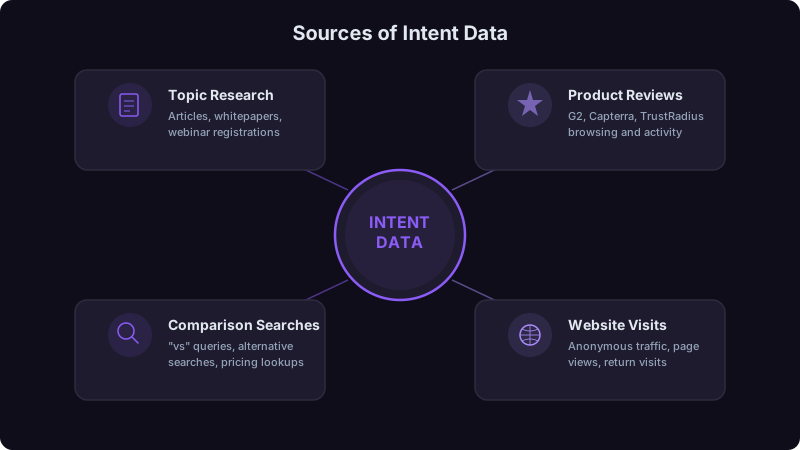
Intent Data Decoded: How to Compare and Pilot Intent Data Providers
Not all intent data is equal. Learn the main types of intent data, the questions that separate providers, how to run a controlled pilot, and how to turn signals into pipeline.