Intent Data Decoded: How to Compare and Pilot Intent Data Providers
Not all intent data is equal. Learn the main types of intent data, the questions that separate providers, how to run a controlled pilot, and how to turn signals into pipeline.
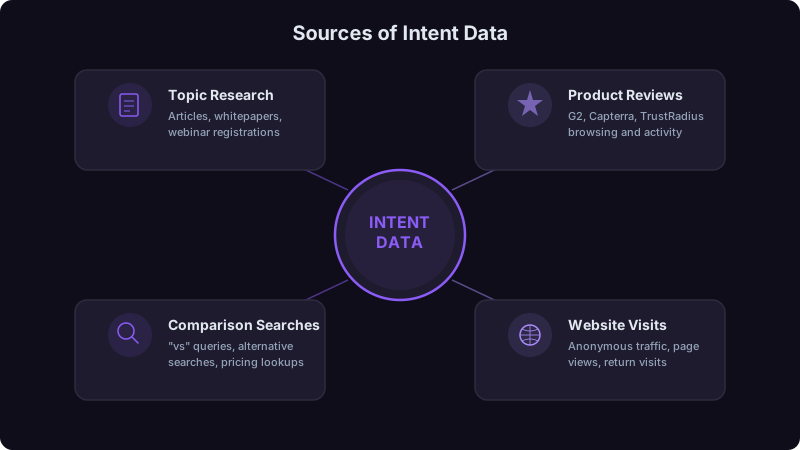
Intent data can produce real pipeline or expensive noise, and the difference often has less to do with the provider than with how the team chose and implemented it. This guide is a comparison framework: the main types of intent data, the questions that separate providers, how to run a pilot that produces a clear answer, and the implementation mistakes that waste budget.
What Intent Data Is (and Is Not)
Intent data is any signal suggesting that a company or person is researching a problem or solution category. It is not a list of accounts ready to buy. It is evidence that someone at an account is consuming content related to your space.
The signal might mean a purchase is coming. It might mean someone is writing an internal report, or clicked an ad by accident. Your ability to separate real buying activity from noise decides whether the investment pays off.
The Main Types of Intent Data
| Type | How It Works | Strengths | Weaknesses |
|---|---|---|---|
| Publisher co-op data | Aggregates research activity across a network of B2B publishers and sites | Broad coverage; catches early research | Noisier; often account-level; depends on the network's makeup |
| Review-site data | Tracks research on software review platforms | Close to active evaluation; category-specific | Limited to activity on that platform; lower volume |
| Search and content engagement | Infers research from search and content consumption | Shows topic-level interest | Identity resolution can be imperfect |
| First-party website activity | Identifies companies visiting your own site | Your own signal; strongest intent | Only covers accounts that already found you |
Two Provider Examples, From Their Own Descriptions
Provider claims change, so compare current documentation rather than relying on any article, including this one. Two examples show how different the underlying sources can be:
| Provider | Intent Type | How the Provider Describes Its Source |
|---|---|---|
| Bombora (Company Surge) | Publisher co-op | Intent data derived from a Data Co-op made up of thousands of media destinations, including publishers, B2B brands, and premium data providers [1] |
| G2 (Buyer Intent) | Review-site | Signals generated from actions on G2 such as product and category page views, competitor comparisons, pricing page engagement, and review consumption and contribution [2] |
| Your own website analytics | First-party | Visits to your pages, matched to companies by your analytics or identification tool |
These sources answer different questions. Co-op data suggests which accounts are researching a topic across the web. Review-site data suggests which accounts are comparing products in your category. First-party data tells you which accounts are already looking at you.
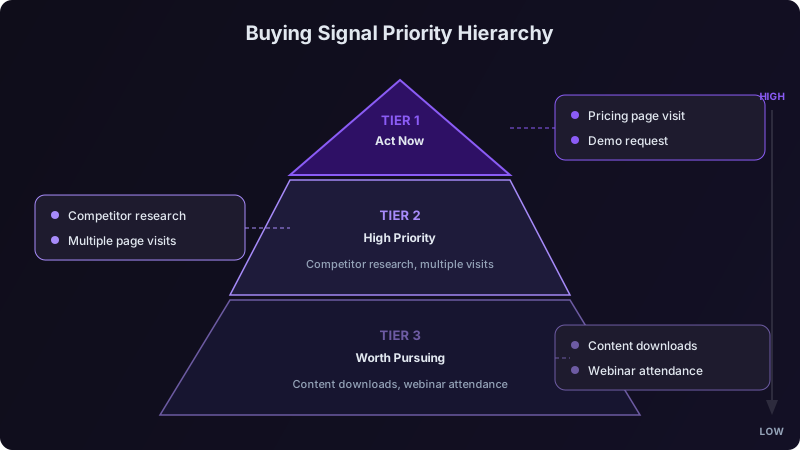
Think of intent in levels of signal strength. At the bottom, someone at the account read an article loosely related to your category. At the top, several people from the account visited your pricing page this week. First-party intent is usually stronger than third-party intent, but third-party intent can catch accounts earlier, before they find you.
How to Evaluate Intent Data Providers
Vendor demos show their best examples. These criteria cut through that.
Criterion 1: Data source transparency
Ask: "Where exactly do your signals come from?"
Good answers name the source: a defined publisher network, activity on a specific platform, or a documented panel. Weak answers are vague: "our proprietary AI analyzes signals across the internet." If a provider cannot say where signals originate, you cannot judge their quality.
Questions to ask:
- What sources contribute to your signals, and how is consent handled?
- How have privacy changes affected your data collection?
- Can you show the raw activity behind a specific account's score?
Criterion 2: Signal freshness
Intent goes stale. An account researching your category last month may already have decided.
Questions to ask:
- How long between a signal being captured and appearing in my tools?
- How often are signals updated?
- Do signals expire, and can I filter by recency?
During a pilot, take a sample of accounts the provider marks as high intent and have reps contact them. Record how many confirm they are currently evaluating solutions in your category. If few do, the signals are stale, too broad, or both.
Criterion 3: Coverage of your target market
The best intent data is useless if it does not cover the accounts you sell to.
Questions to ask:
- Upload your target account list. What share has signal coverage?
- How is coverage in your industries and regions?
- How dense are signals for smaller companies, where data often gets thin?
Criterion 4: Topic granularity
"Interest in cloud computing" is too broad. "Interest in Kubernetes container orchestration" is actionable.
Questions to ask:
- How granular is the topic taxonomy? Can I create custom topics?
- Can you distinguish researching the problem from researching solutions?
Criterion 5: Integration and actionability
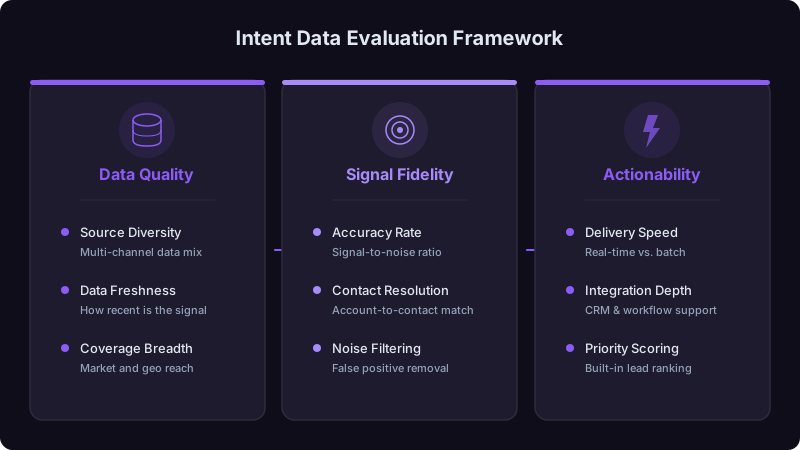
Intent data in a standalone dashboard is a report, not a workflow.
Questions to ask:
- Does it integrate with our CRM and sequencing tools?
- Can signals trigger alerts, routing, or scoring changes?
- Do signals arrive as they happen or in scheduled batches?
Running a Proper Pilot
Do not sign an annual contract based on a demo. Run a pilot.
Agree before the pilot starts on what "good" means, for example: the share of high-intent accounts that confirm active research, the meeting rate for intent-flagged accounts compared with the control group, the share of signals fresh enough to act on, and coverage of your target list. Write the thresholds down so the result is not argued after the fact.
Split target accounts into two matched groups:
- Group A (intent-informed): reps receive signals and use them to prioritize and personalize
- Group B (control): reps work accounts with your standard prioritization
Run both at the same time for a full sales-cycle window, often a few months. Compare meetings, opportunities, and pipeline.
For every high-intent account, record whether you reached someone, whether they were researching your category, whether the deal progressed, and how long it took from signal to first meeting.
Include the subscription cost, the time reps spent using it, incremental pipeline against the control group, and any change in deal speed.
What to Expect From Each Type
Publisher co-op intent
Useful for: finding accounts in early research across a large addressable market, and as one input into a multi-signal score.
Limitations: used alone, it produces false positives. Account-level signals do not tell you who to call, so they need contact data alongside them.
Review-site intent
Useful for: competitive categories where review sites are part of the buying process, and for seeing when accounts research your competitors.
Limitations: volume. In any given week, only a fraction of your target accounts will be active on a review platform.
Search and content intent
Useful for: teams combining outbound with account-based marketing, since topic signals can inform both personalization and ad targeting.
Limitations: identity resolution. Some "accounts" turn out to be universities, coworking spaces, or VPN exits. Filter carefully.
First-party website activity
Useful for: prioritizing accounts that already know you and are researching your company.
Limitations: volume is capped by your traffic, and it cannot find accounts that have never heard of you.
Implementation: Where Teams Go Wrong
Many intent data failures are implementation failures. The signals may be fine, but if reps cannot see them in their workflow, do not trust them, or do not know how to act on them, you have bought a dashboard nobody opens.
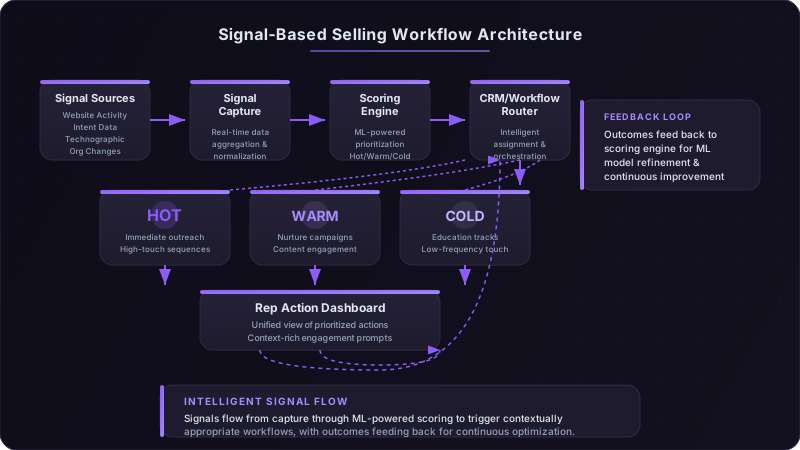
Mistake 1: Signals in a dashboard nobody checks. Push signals into the CRM, sequencing tool, and team chat. If reps have to log into another platform, they will stop.
Mistake 2: Treating all signals equally. A first topic signal is not the same as a third pricing page visit. Build tiers (researching the problem, comparing solutions, evaluating you) and give each a different response.
Mistake 3: Not training reps to use signals in conversation. "I noticed your company is showing interest in our category" is unsettling. "Teams in your industry are working through [problem]; is that on your radar?" is useful. Reference the situation, never the tracking.
Mistake 4: Buying intent before fixing fundamentals. Without clean account lists, a working outbound sequence, and reliable CRM data, intent data will not save the program. It amplifies what already works.
Mistake 5: Relying on one source. No single provider sees everything. Combining first-party activity, one third-party source, and your own engagement data gives a more reliable composite than any one feed.
The Evaluation Scorecard
Score each provider from 1 to 5 on each criterion, then multiply by a weight from 1 (minor) to 3 (critical) that reflects your priorities.
| Criterion | Suggested Weight (1 to 3) | What to Assess |
|---|---|---|
| Data source transparency | 2 | Can they show where signals come from? |
| Signal freshness | 2 | Latency from capture to delivery; expiry policy |
| Coverage of your target list | 3 | Match rate on your uploaded account list |
| Topic granularity | 1 | Broad categories vs. specific topics |
| Contact-level resolution | 2 | Account-only vs. people identified |
| Integration depth | 2 | CRM, sequencing, ads, and alerting connections |
| Pricing model fit | 1 | Per seat, per account, or per signal; how it scales |
Shift the weights to your situation. A small SDR team may care most about integration. An enterprise ABM program may care most about coverage and topic granularity.
If you are buying intent data for the first time, start with two sources: first-party website activity, and one third-party source that covers your market well. Run both through a pilot before adding more. Two sources used well teach you more than five you barely touch.
Intent data is an input, not a strategy. The teams that get the most from it integrate signals into existing workflows, train reps to act on them quickly and naturally, and keep checking signal quality against real outcomes.
References
[1]Bombora, Company Surge Intent data. https://bombora.com/intent/
[2]G2, Buyer Intent. https://sell.g2.com/buyer-intent
Ready to transform your sales pipeline?
See how Prospectory's AI-powered platform can help your team research, reach, and relate to prospects at scale.
Related Articles
Buying Signals 101: How to Identify Prospects Who Are Ready to Buy Now
Stop guessing which accounts to pursue. Learn how to use intent data and buying signals to focus on prospects actively researching solutions like yours.
Building a Signal-Based Selling Motion from Scratch
A practical playbook for sales teams transitioning from spray-and-pray list-based outbound to a signal-driven approach that actually converts.
ICP Scoring Models That Actually Predict Revenue
How to build an ICP scoring model that combines firmographics, technographics, and behavioral signals, with example weightings and decay rules you can test against your own deals.