Competitive Intelligence for Sales: How to Win When Prospects Are Evaluating Alternatives
When a deal turns into a competitive evaluation, prospects do much of the comparing on their own. Learn how to arm your team with intelligence that wins head-to-head battles.
Picture an illustrative loss: one of your best AEs loses a large deal to a competitor nobody on the team had heard of. The post-mortem is brutal. The prospect had been evaluating several vendors for weeks, and your team learned about most of them only at the final demo. The rep walked into that meeting blind.
A loss like that is the usual trigger for building a competitive intelligence program from scratch. Here is how to build that CI muscle in your org.
Why This Matters Now
When a deal turns into a competitive evaluation, prospects do much of the comparing on their own. In a Gartner survey of 632 B2B buyers, 61% said they prefer an overall rep-free buying experience [1]. They read reviews on G2, Capterra, or TrustRadius and compare vendors before they ever talk to your reps.
That puts a premium on showing up early with relevant, specific information. If your team keeps arriving second or third, CI is how you fix it.
Why Most CI Programs Fail Before They Start
Teams tend to stand up competitive intelligence in three ways, and two of them don't work.
The "marketing owns it" approach. Marketing builds beautiful competitor pages on the website. Sales never reads them because they're written for prospects, not reps. The information is too high-level to use in a live conversation.
The "everybody pitch in" approach. Leadership sends an email asking reps to share competitive intel when they encounter it. Two people contribute in week one. Nobody contributes by week three. The shared doc dies.
The structured program approach. This is the one that works. It requires a dedicated owner (even part-time), a clear process for gathering and distributing intel, and a feedback loop that keeps information fresh.
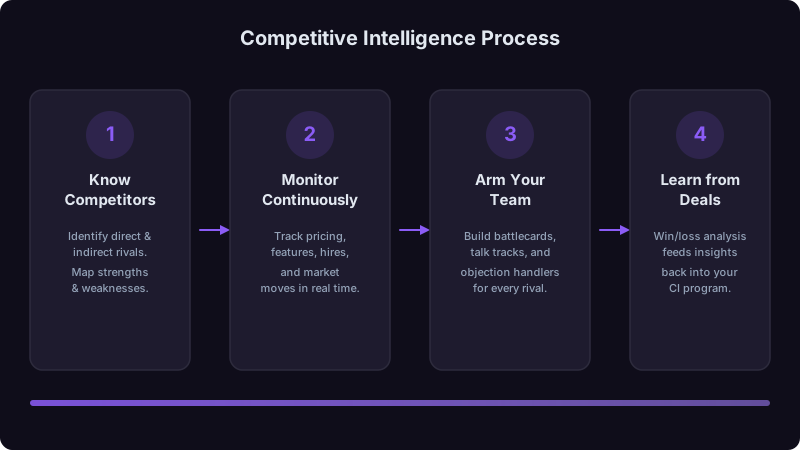
Building a CI Program That Sticks
Here is a four-phase approach. Expect the foundation to take a quarter or so, and longer to mature.
You can't track everyone. Start with the competitors you encounter most often in deals.
Pull your CRM data from the last 12 months. Look at closed-lost deals where a competitor was named. Rank them by frequency. A typical result looks like this:
- Tier 1 (the competitors you meet most often): a couple of names
- Tier 2 (competitors you meet regularly): a handful more
- Tier 3 (occasional mentions): Everyone else
Focus your initial effort on Tier 1. Build light coverage for Tier 2. Ignore Tier 3 until they show up more often.
This is where people get nervous, so let me be clear: you don't need to do anything shady. The best competitive intelligence comes from public and first-party sources.
Public sources that matter:
- Product pages and pricing pages (screenshot them regularly; they change)
- G2 and Capterra reviews (read the 2-star and 3-star reviews carefully; that's where real weaknesses surface)
- Job postings (a competitor hiring 15 data engineers tells you something about their product roadmap)
- Earnings calls and press releases for public companies
- Their customers' case studies (tells you who they sell to and what outcomes they claim)
First-party intelligence from your own deals:
- Win/loss interviews (this is gold; I'll cover this below)
- What prospects tell your reps during competitive evaluations
- What churned competitor customers tell you when they switch to you
- Demo recordings where the prospect mentions competitor capabilities
What NOT to do:
- Don't ask candidates from competitor companies to share proprietary information in interviews
- Don't create fake accounts to access their product
- Don't scrape behind login walls
- Don't misrepresent yourself to get competitor pricing
A battlecard is a one-page (two pages max) reference doc a rep can pull up in 10 seconds during a call. If it's longer than that, nobody will use it.
This is the piece most teams skip, and it's the piece that makes CI sustainable. Every competitive deal (win or loss) should feed back into the system.
Battlecard Template That Actually Gets Used
Here's a battlecard structure that works well. It uses a fictional competitor called "RivalCo" as an example.
| Section | What to Include | Example |
|---|---|---|
| Quick Overview | Who they are, target market, positioning | "RivalCo targets mid-market manufacturing. Positions as 'easiest to implement.'" |
| Their Strengths | Be honest; reps lose credibility if they dismiss competitors | "Strong mobile app. Fast implementation (avg 2 weeks). Good for simple use cases." |
| Their Weaknesses | Where you genuinely win | "No API. Limited reporting. Struggles above 500 users. No enterprise SSO." |
| Landmine Questions | Questions that expose gaps without badmouthing | "How important is integration with your ERP?" / "What does your reporting workflow look like today?" |
| Objection Handlers | When the prospect says "But RivalCo does X..." | "That's true for basic scenarios. Where customers tell us they hit limits is..." |
| Proof Points | Customers who switched from them to you | "Acme Corp switched from RivalCo after 8 months. [Result the customer approved for sharing.]" |
| Pricing Intel | What you know about their pricing model | "Per-user pricing, [published range]. No volume discounts. Implementation fee [published or confirmed range]." |
Never trash-talk the competitor on the battlecard. Write it as if the prospect might read it (because sometimes they do). Honest assessments build trust. Dismissive ones destroy it.
Win/Loss Interviews: Your Secret Weapon
If you could only do one CI activity, make it win/loss interviews. Here's a process.
Who to interview: Every meaningful closed deal where a competitor was involved. Both wins and losses. Losses are more valuable, which feels counterintuitive.
When to interview: 2-4 weeks after the deal closes. Soon enough that memory is fresh. Late enough that emotions have cooled.
Who should conduct the interview: NOT the rep who worked the deal. Use someone from product, marketing, or an external firm. Prospects are more honest with someone who wasn't trying to sell them.
The five questions that surface real intelligence:
- 1"Walk me through your evaluation process from the beginning. How did you first identify vendors to consider?"
- 2"What were your top three criteria when comparing solutions?"
- 3"Where did each vendor stand out, and where did they fall short?"
- 4"Was there a specific moment or factor that tipped the decision?"
- 5"If you could change one thing about our process, what would it be?"
The biggest insights from win/loss interviews rarely involve product features. They involve how the buying experience felt. Did the rep understand our business? Did the demo address our specific workflows? Did the vendor make the internal selling process easy?
Competitive Selling Tactics That Work in the Room
Once your reps have battlecards and intel, they need to know how to use it. Here are tactics to train on.
Set the evaluation criteria early
If you're first to the table, help the prospect build their evaluation framework. Include criteria where you're strong. By the time competitors arrive, the prospect is already judging them against your strengths.
"Based on what I'm hearing about your needs, here are the five things I'd evaluate any vendor on..." Then list criteria that favor you.
Ask landmine questions naturally
Don't rapid-fire gotcha questions. Weave them into discovery.
"I'm curious -- you mentioned you need this to work with your SAP instance. How are you thinking about the integration requirements?" (Works perfectly if the competitor has no SAP integration.)
Use the "acknowledge and redirect" pattern
When a prospect brings up a competitor's strength:
- 1Acknowledge it genuinely: "You're right, they do that well."
- 2Ask a follow-up: "How important is that compared to [area where you win]?"
- 3Share a proof point: "What we've heard from customers who evaluated both..."
Let third parties make the case
"I could tell you why we're better, but you probably trust your peers more. Here's what G2 reviewers say when comparing us..." or "Gartner ranked us ahead in these three categories. Happy to share the report."
Speed kills (in a good way)
When you learn a prospect is evaluating competitors, compress your timeline. Get the next meeting booked within 48 hours. Send the proposal within 24 hours of the final presentation. Be the vendor that's easiest to do business with.
Measuring Your CI Program
Track these metrics monthly to see if your investment is paying off.
| Metric | What It Tells You | Target |
|---|---|---|
| Competitive win rate | Is your CI making a difference? | Rising quarter over quarter |
| Battlecard usage rate | Are reps actually using the tools? | Most reps, weekly |
| Intel freshness | Is your data current? | Updated monthly for Tier 1 |
| Win/loss interview rate | Are you learning from outcomes? | Most competitive deals |
| Time to competitive response | How fast do reps act on competitive intel? | Under 24 hours |
Common Mistakes
Building battlecards without rep input. Battlecards written entirely by marketing often go unopened. Co-create them with your top AEs, and adoption follows.
Treating CI as a one-time project. Competitor products change. Pricing changes. Positioning changes. A battlecard that's six months old is worse than no battlecard because it gives reps false confidence.
Focusing on features instead of narratives. Your reps don't need a 47-row feature comparison matrix. They need a story: "Here's who they are, here's where they win, here's where we win, and here's how to steer the conversation."
Ignoring competitors you're losing to. Teams can spend months obsessing over the biggest-name competitor while a smaller one quietly wins a large share of the deals they lose. Check your data before deciding who to track.
If you're building from zero, start with three things this week: (1) Pull 12 months of competitive deal data from your CRM. (2) Schedule win/loss interviews for your last 5 competitive losses. (3) Build one battlecard for your most-encountered competitor. That's enough to start changing outcomes.
The best competitive intelligence programs don't just make reps smarter about competitors. They change how your whole team thinks about deals. When reps understand the competitive landscape, they ask better discovery questions, they position your product more precisely, and they stop being surprised in final presentations.
That's not a nice-to-have. When most of your deals are competitive, it's survival.
References
[1]Gartner, "Gartner Sales Survey Finds 61% of B2B Buyers Prefer a Rep-Free Buying Experience," press release, June 25, 2025, as republished by MarketScreener. https://uk.marketscreener.com/quote/stock/GARTNER-INC-40311131/news/Gartner-Sales-Survey-Finds-61-of-B2B-Buyers-Prefer-a-Rep-Free-Buying-Experience-50340554/
Ready to transform your sales pipeline?
See how Prospectory's AI-powered platform can help your team research, reach, and relate to prospects at scale.
Related Articles
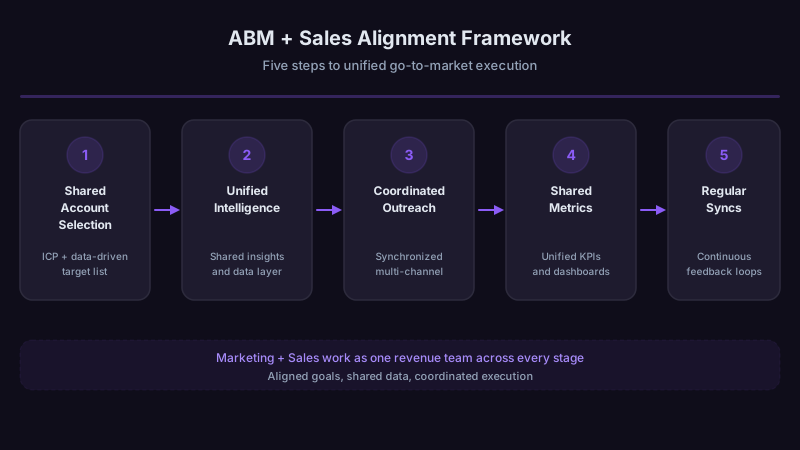
ABM + Sales: How to Align Marketing and Sales on Target Accounts
Build one target-account list, one buyer map, and one operating rhythm that marketing and sales can use together.
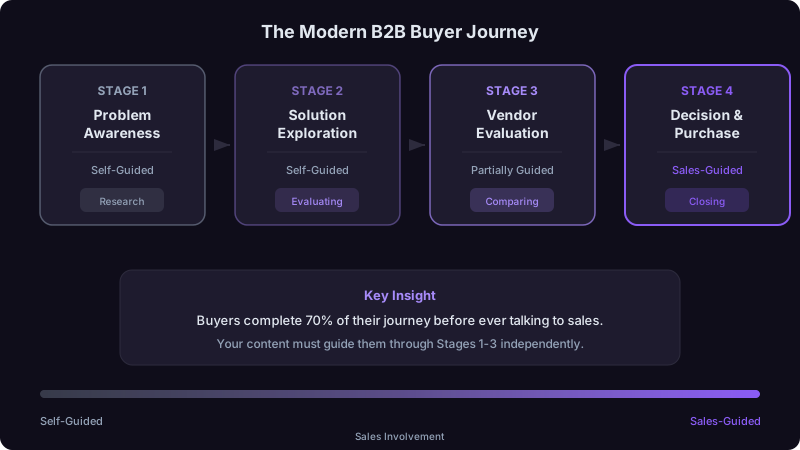
B2B Buyer Journey Mapping: Understanding How Modern Buyers Make Decisions
The B2B buyer journey has changed dramatically. Learn how to map and influence the modern buying process.
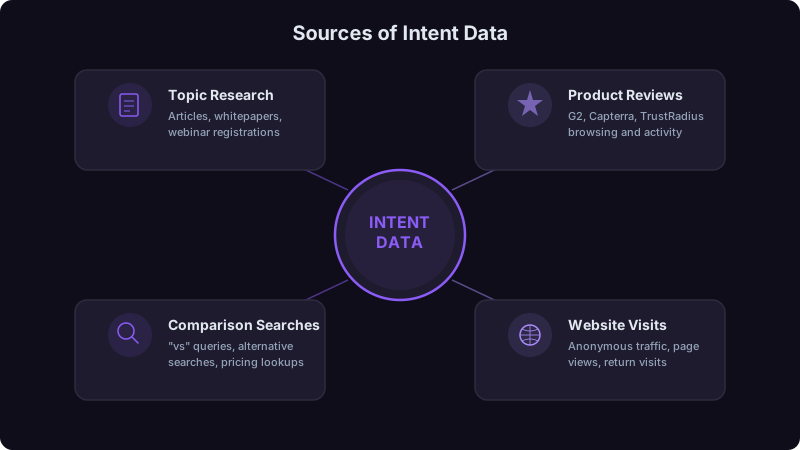
Intent Data Decoded: How to Compare and Pilot Intent Data Providers
Not all intent data is equal. Learn the main types of intent data, the questions that separate providers, how to run a controlled pilot, and how to turn signals into pipeline.