How to Use AI for Better Cold-Call Preparation
Cold calling still has a role when reps have useful account context. Learn how AI can support preparation, call guidance, and follow-up measurement.
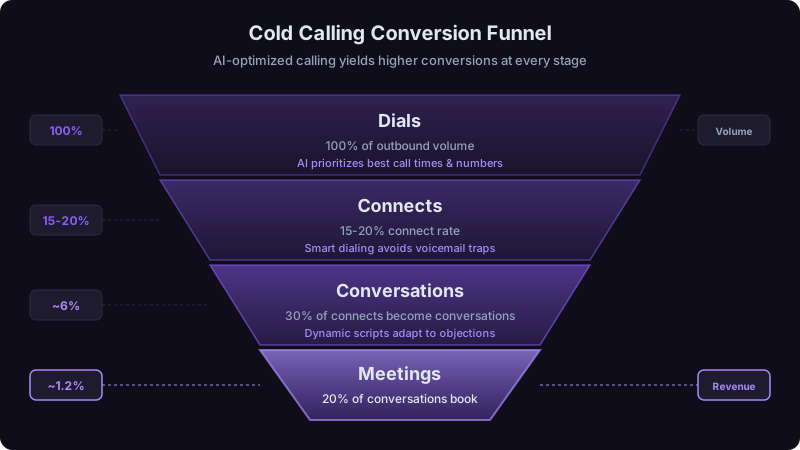
Cold calling is worth evaluating as part of a coordinated outbound motion. The right channel mix depends on your buyers, market, offer, and current conversion data. Compare phone outreach with email, LinkedIn, and other channels using the same audience and measurement window.
List-based dialing without account context gives a rep little reason to call and gives the buyer little reason to continue. AI can help assemble a concise brief, suggest relevant questions, and organize follow-up tasks. The rep still owns the judgment, conversation, and next step.
Before launch, have the team responsible for your campaign determine which federal, state, and market-specific rules apply. The FTC's Telemarketing Sales Rule explains federal scope, calling practices, and recordkeeping, while the FCC covers separate call and text requirements under the TCPA. [1] [2] For UK campaigns, the ICO provides specific guidance for live direct-marketing calls. [3]
Build a Phone Outreach Baseline
Decide whether phone belongs in your channel mix by comparing it with other channels for a similar audience, offer, and measurement window.
| Channel | Initial Engagement | Next-Step Conversion | Qualified Pipeline |
|---|---|---|---|
| Phone | Live connect and conversation rate | Held meetings from conversations | Opportunities influenced by calls |
| Reply rate and reply quality | Held meetings from replies | Opportunities influenced by email | |
| Connection and response rate | Held meetings from responses | Opportunities influenced by LinkedIn | |
| Coordinated sequence | Engagement on any channel | Held meetings per account | Opportunities from the full sequence |
Do not compare channels on activity alone. Track whether a live conversation produces a relevant next step, whether the meeting is held, and whether the account becomes a qualified opportunity. Also record the touches that came before the response so one channel does not receive all the credit for a coordinated sequence.
Test phone as part of the sequence, not only as a standalone channel. For example, compare an email-only cohort with a cohort that adds a relevant LinkedIn touch and a phone call. Keep the account criteria and message consistent, then use your results to choose the cadence.
Pre-Call Research: Where AI Actually Helps
AI can collect account context into a consistent brief before a call. The rep gets the relevant material in one place, can review available source context, and should flag unsupported details before using them.
A Compact Pre-Call Brief
Before a prioritized call, the AI-generated brief should include:
Company context: What does the company do, how big are they, any recent news (funding rounds, product launches, executive changes, earnings calls)?
Prospect context: What's their role, how long have they been in it, what did they do before, are they active on LinkedIn, have they posted about anything relevant?
Trigger events: Anything that suggests they might be open to a conversation right now. Hiring for roles that indicate growth or pain. Technology changes visible in their stack. Competitor mentions. Industry regulation changes.
Suggested opening angles: Based on all of the above, 2-3 specific conversation starters that are relevant to this specific person at this specific moment.
Use AI to prepare for the conversation, not to replace it with a word-for-word script. Review the brief, choose the relevant points, and speak in your own words.
The Call Structure Framework
Use a framework that guides the conversation while leaving room for the rep to listen and adapt. Salesforce's sales-call training likewise emphasizes active listening, clarifying objections, and responding to what the buyer actually says. [5]
Keep the opening brief. The goal is not to pitch. It is to state who you are, explain why the call may be relevant, and let the buyer decide whether to continue.
What works:
"Hey [First Name], this is [Your Name] with [Company]. I know I'm calling out of the blue, do you have 30 seconds for me to tell you why, and you can decide if it's worth continuing?"
Why test it: It is transparent about the interruption and gives the buyer control over whether to continue.
Openings to test carefully:
"Hi, how are you doing today?" (does not explain why the call is relevant)
"Is this a good time?" (asks for time before providing context)
"I'm calling from [Company], we're the leading provider of..." (starts with the seller instead of the buyer's situation)
Use the relevance statement to show why the conversation may matter to this buyer. This is where the pre-call research supports the rep.
Structure: [Observation about their situation] + [Problem you've seen in similar companies] + [Quick bridge to why you're calling]
Example: "I saw you just brought on three new SDRs this quarter, congrats on the growth. Teams at this stage often review how they prioritize accounts and support new reps. Is that something you're working on?"
Example: "I noticed [Company] just launched the enterprise product line. Teams making that shift may need to revisit personas, messaging, and channels. Is that something you're working on?"
If they're still engaged after your relevance statement, transition into discovery. Don't pitch your product yet. Ask a question that:
- Confirms you're talking to the right person
- Opens up their current situation
- Shows you understand their world
Good qualifying questions:
- "How are you handling [specific challenge] right now?"
- "What's your biggest bottleneck when it comes to [relevant area]?"
- "When you think about hitting your number this quarter, what's the thing keeping you up at night?"
If they answer your qualifying question, listen before moving into a pitch. Ask a relevant follow-up and reflect what you heard to confirm your understanding.
Rep: "What's your biggest challenge with outbound right now?"
Prospect: "Honestly, reply rates have tanked."
Rep: "When you say tanked, what does that look like? Are we talking single digits, or..."
Prospect: "Cold email is not producing enough useful conversations."
Rep: "What have you tried so far, and how are you measuring the result?"
This feels like a conversation, not a sales call. That's the point.
When you've identified a real problem and confirmed there's potential fit, ask for the meeting. Be specific and low-commitment:
"It sounds like [recap their problem] is affecting [outcome they described]. Would a focused follow-up be useful so we can compare the current workflow with another approach?"
Offer a clear next step and make scheduling easy without pressuring the buyer.
Handling Five Common Objections
Common objections can sound similar, but the buyer's reason may differ. Use a question to clarify the concern instead of assuming what it means.
| Objection | What to Clarify | How to Respond |
|---|---|---|
| "I'm not interested" | Whether the topic is irrelevant or the timing is wrong | "Understood. Can I ask one quick question to confirm whether this is relevant?" |
| "We already have a solution" | Whether there is an unmet need or no reason to change | "That makes sense. Is there anything you would want to change about the current approach?" |
| "Send me an email" | What information would be useful | "Happy to. What should I include so it is relevant to you?" |
| "We don't have budget" | Whether the issue is timing, total cost, or expected value | "Understood. Which part of the business case would need to change for this to be worth revisiting?" |
| "Call me back next quarter" | What event or decision should trigger follow-up | "I can do that. What should we revisit next quarter, and when would a follow-up be useful?" |
Treat the first objection as information, not a cue for a canned rebuttal. A short clarifying question can show whether the issue is relevance, timing, cost, authority, or something else.
The Metrics That Define Your Baseline
Track the same funnel for each rep and cohort. Establish the current range before setting coaching targets.
| Metric | What It Measures | Review Question |
|---|---|---|
| Connect rate | Dials that reach the intended person | Are data quality and call timing affecting reach? |
| Conversation rate | Connects that become relevant conversations | Does the opening establish a clear reason for the call? |
| Meeting rate | Conversations that produce a booked meeting | Are discovery and the next-step request clear? |
| Show rate | Booked meetings that take place | Is the handoff and confirmation process working? |
| Opportunity rate | Held meetings that become qualified opportunities | Are calls reaching the right accounts and buyers? |
Read the ratios together. A low connect rate can point to contact data or timing. A healthy connect rate with few relevant conversations can point to targeting or the opening. Meetings that do not become qualified opportunities can point to account selection or discovery.
AI-Powered Post-Call Follow-Up
AI can also support follow-up. A consistent post-call workflow can include:
- 1Log the call in CRM with notes
- 2Send a relevant follow-up while the conversation is still current
- 3Update the prospect's status and next steps
- 4Schedule the next touchpoint
With configured transcription and summarization workflows, AI can help the rep. Microsoft's responsible-use guidance for summarization recommends human oversight and validation before summaries inform important decisions. [4] A practical workflow can:
- Auto-generate call notes from the transcription
- Draft a follow-up email that references specific things discussed
- Suggest next steps based on the conversation content
- Auto-update CRM fields
Measure the time spent on follow-up before and during a pilot. Check generated notes against the call, and calculate any time difference from the recorded workflow data.
Building a Calling Culture (Not Just a Calling Quota)
Develop phone outreach through practice, useful feedback, and a clear purpose for each call. The following habits can support that work:
Call blocks, not only call quotas: Schedule focused blocks where reps can practice together, compare openings, and get timely help.
Call coaching: Review a consistent sample of calls for each rep and give specific feedback. For example: "Your opening was clear. Next time, pause after the relevance statement and let the buyer react."
Review conversations, not just meetings: A useful conversation can reveal whether the account, buyer, message, and channel were well chosen even when it does not produce a meeting.
Share useful call examples: Add selected recordings and transcripts to team training so reps can hear how different approaches work in context.
Use the beginning of a call block to settle into the conversation framework. Review the full block instead of judging the channel from the first few attempts.
The Weekly Calling Playbook
Here is a sample rhythm to adapt using your connect and conversation data:
Monday: Review priority accounts, prepare briefs, and run the first focused call block.
Tuesday and Wednesday: Run call blocks at the times your baseline supports, then complete follow-up and prepare the next account group.
Thursday: Test a second time window or audience segment and compare results with earlier blocks.
Friday: Review call outcomes, complete CRM updates, and use what the team learned to plan the next account list.
Phone can be a useful part of outbound when the account is relevant, the rep has a clear reason to call, and the team measures business outcomes instead of dial volume alone.
Start with a focused pilot. Use AI to prepare a reviewable brief, let reps adapt the framework in their own words, and compare connects, relevant conversations, held meetings, and qualified opportunities with your current channel mix.
References
[1]Federal Trade Commission, Complying with the Telemarketing Sales Rule. https://www.ftc.gov/business-guidance/resources/complying-telemarketing-sales-rule
[2]Federal Communications Commission, Stop Unwanted Robocalls and Texts. https://www.fcc.gov/consumers/guides/stop-unwanted-robocalls-and-texts
[3]UK Information Commissioner's Office, Direct Marketing Using Live Calls. https://ico.org.uk/for-organisations/direct-marketing-and-privacy-and-electronic-communications/guidance-on-direct-marketing-using-live-calls/
[4]Microsoft Learn, Responsible Use of Text Summarization. https://learn.microsoft.com/en-us/azure/foundry/responsible-ai/language-service/guidance-integration-responsible-use-summarization
[5]Salesforce Trailhead, Make Successful Sales Calls. https://trailhead.salesforce.com/content/learn/modules/maximize-the-impact-of-sales-calls/make-successful-sales-calls
Ready to transform your sales pipeline?
See how Prospectory's AI-powered platform can help your team research, reach, and relate to prospects at scale.
Related Articles
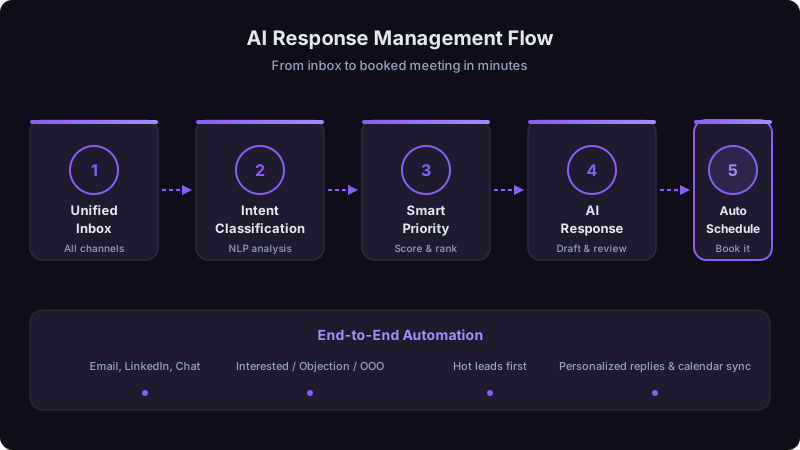
AI Response Management: How to Handle More Replies Without Hiring
Getting replies is only half the battle. Learn how AI-assisted classification, routing, and drafting turn more of the replies you already earn into meetings.
AI Sales Forecasting: Why Your Pipeline Predictions Are Wrong (And How to Fix Them)
Most sales forecasts miss because they rest on rep optimism and stale CRM data. Learn how AI forecasting uses engagement and pipeline signals, and how to commit deals on buyer evidence.
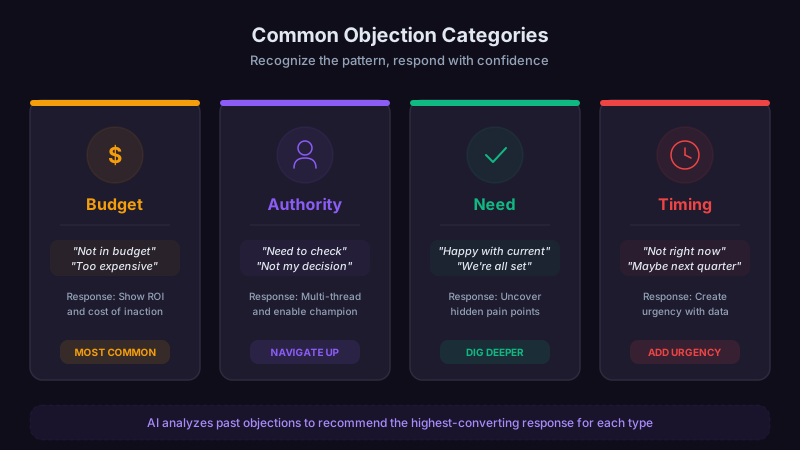
Objection Handling: How AI Can Support Better Sales Conversations
Learn how to turn real call data into objection frameworks, practice scenarios, and a measurable coaching loop.