Objection Handling: How AI Can Support Better Sales Conversations
Learn how to turn real call data into objection frameworks, practice scenarios, and a measurable coaching loop.
Consider two possible responses to "We're already using another solution and we're happy with it." One rep argues that the product is better. Another acknowledges the current approach and asks which parts of the workflow the buyer would still like to change. The second response creates room to learn what the buyer values.
Preparation makes that response easier. AI can help organize prior call notes, collect supporting proof with available sources, and prepare practice scenarios. The rep still needs to listen, verify the concern, and decide how to respond.
Why Objections Are Useful Information
An objection may reveal a concern about price, timing, relevance, authority, risk, or the current solution. It may also be a direct no. The rep's job is to clarify which situation applies and respect the answer. Salesforce's objection-handling training similarly begins with preparation, acknowledgement, discovery, and a response matched to the actual concern. [1]
Treat an objection as information. Confirm what the buyer means before offering proof, proposing a next step, or ending the conversation.
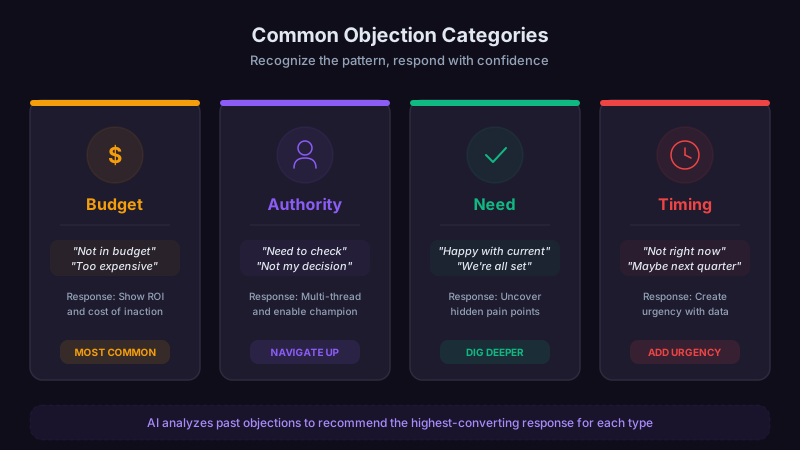
Four Common Objection Categories
These categories can help organize a playbook. Use them as prompts for clarification, not as assumptions about the buyer.
Category 1: Price and Budget
What they say: "It's too expensive." "We don't have the budget." "Can you do better on price?"
Questions to explore:
- Is the concern the total investment, payment timing, or expected value?
- What alternatives are included in the comparison?
- What evidence would the finance team need?
- Is there a defined budget window or approval process?
Do not assume a price objection is only about perceived value. Ask whether the constraint is budget, timing, scope, expected return, or another requirement. The answer determines whether there is a useful next step.
Category 2: Authority
What they say: "I need to check with my boss." "This isn't my decision." "Let me loop in our team."
Questions to explore:
- Who owns the final decision and which teams contribute?
- What questions will those stakeholders ask?
- Would a shared discussion or concise summary help?
- Is there enough interest to continue the evaluation?
Category 3: Need, Relevance, and the Current Approach
What they say: "We don't really need this." "We're happy with our current solution." "We built something internally."
Questions to explore:
- Is the problem outside the buyer's priorities?
- Has the seller connected the solution to a specific workflow?
- Does the current process already meet the requirement?
- What evidence would make further evaluation worthwhile?
Category 4: Timing
What they say: "Not right now." "Maybe next quarter." "We've got too much going on."
Questions to explore:
- Which initiative has priority today?
- Who is involved in deciding when to revisit this?
- Is there a business event that could change the timing?
- Would another implementation compete for the same people or systems?
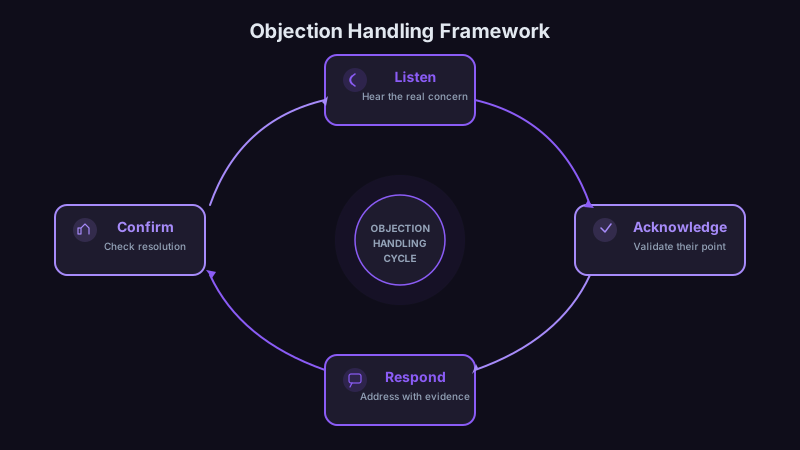
A Listen, Acknowledge, Respond, and Confirm Cycle
Use this four-part cycle as a conversation guide, then adapt it to your buyers and sales process. The useful behavior is listening and clarifying before answering. Salesforce's sales-call guidance emphasizes preparation, active listening, and documenting what follows. [2]
Listen
Let the buyer finish, then summarize the concern in plain language. Take a brief pause rather than jumping to a rehearsed answer.
Acknowledge
Validate their concern without agreeing with their conclusion. There's a critical difference between "I understand budget is tight right now" (good) and "Yeah, we are expensive" (bad).
Respond
Answer the concern with relevant evidence, or ask a neutral question when important context is still missing. Open questions and accurate summaries can surface information that a leading rebuttal misses. [3]
Confirm
Check whether the response addressed the concern and whether there is a useful next step. If the buyer has given a clear no, acknowledge it and close the conversation respectfully.
Prospect: "Honestly, this is way more than we budgeted for."
Listen: "It sounds like the proposed investment is outside the budget you planned."
Acknowledge: "Totally fair, I appreciate you being direct about that."
Respond: "Would it help to compare the current process, expected value, and implementation scope using your own assumptions?"
Confirm: "Is the main issue the total cost, or how the budget is structured this year?"
Objection-Specific Playbooks
The following response frameworks are structures, not scripts. Adapt the language to your voice, product, and evidence.
"It's too expensive"
"Just so I understand, is it the total investment, the payment structure, or that you're not seeing enough value to justify the cost?"
"Let's use your current costs, process, and target outcome to see whether the business case is worth exploring."
"We can separate the investment by team, workflow, and phase, then compare it with the value of the outcome you are targeting."
"Is this something that could fit in this quarter's budget, or would it help to look at a phased rollout that starts smaller?"
"We're happy with [Competitor]"
Avoid disparaging the current provider. Focus on the buyer's requirements and the differences they want to evaluate.
Instead:
- 1Compliment their choice: "[Competitor] does [specific thing] well. Makes sense you'd be using them."
- 2Ask about gaps: "Is there any part of the current workflow your team would still like to change?"
- 3Offer a scoped option: "If replacing the current approach is not useful, would evaluating one unmet workflow be worth considering?"
- 4Offer a concrete comparison: "Would it be useful to compare how we approach [specific pain point]?"
"Not the right time"
Timing can reflect a concrete constraint, a lower priority, or a decision not to proceed. Ask once, then use the answer.
Ask: "Totally understand. Out of curiosity, what would need to change for the timing to feel right?"
- If they give a specific answer ("We're migrating our CRM until March" / "Budget opens in Q2"), confirm a concrete follow-up that matches that event.
- If the answer remains vague, confirm whether a follow-up would be useful instead of assuming continued interest.
When timing is tied to a concrete constraint, agree on a useful follow-up date and send only the material the buyer requested.
If there is no clear reason to follow up, respect the answer and close the loop. If the buyer previously identified a priority, ask whether it has changed before scheduling another conversation.
"I need to check with my boss"
This may mean other stakeholders need to participate or that the buyer needs clearer material for an internal discussion.
| Response Strategy | When to Use It |
|---|---|
| "Would it help if I joined that conversation? I can address technical or business-case questions directly." | When the champion is genuinely interested but needs support |
| "Absolutely. What do you think their main concerns will be? I can put together a one-pager that addresses those specifically." | When a joint call isn't possible |
| "Makes sense. What criteria will they use to evaluate this?" | When you need to understand the real decision-making framework |
| "Happy to help. Who else should we include in the next conversation to make sure everyone's questions get answered?" | When you suspect there are multiple stakeholders you haven't met |
How AI Fits Into Objection Handling
AI can support objection handling without taking control of the conversation. Four practical applications are preparation, optional in-call retrieval, post-call analysis, and role-play.
1. Pre-Call Preparation
AI can summarize company research, recent news, technology context, prior CRM notes, and relevant evidence into a reviewable brief with source context where available.
For example: "This account uses [current approach]. Prior notes mention an integration requirement. If that topic comes up, ask how the workflow operates today and retrieve the relevant [Industry] case study."
That's not replacing the rep's skill. It's giving them better inputs.
2. Real-Time Suggestions
During calls, a configured AI workflow can surface relevant material when an objection comes up. For example: "They mentioned budget concerns. Here is the documented business-case input from the selected customer story."
Keep real-time suggestions brief, optional, and connected to a source the rep can inspect. The rep should decide whether the suggestion fits the conversation and deliver it in their own words.
3. Post-Call Analysis
A configured call-analysis workflow can tag objection types, capture the rep's response, and connect the call with the recorded next step. Check a sample of tags against the calls before using the data for coaching. Microsoft's responsible-use guidance for summarization calls for human oversight and validation when summaries inform later decisions. [5]
This gives managers a concrete coaching loop. Instead of generic advice like "handle price objections better," a manager can compare response approaches within the team's own calls, review representative examples, and coach the rep on the pattern that produces better next steps.
4. Practice and Role-Play
AI can simulate objection scenarios based on the products, personas, and situations your team encounters. Use tagged call data to choose practice topics, then have managers review whether each response is correct, clear, and responsive to what the buyer said.
Building Your Team's Objection Playbook
Without a documented playbook, reps have to reconstruct the same response patterns independently. Build one from your team's own calls and supporting evidence the rep can inspect.
Pull a representative sample of recent sales calls and tag each objection. Research based on recorded sales interactions shows why real conversational evidence is more useful than assuming every non-acceptance means the same thing. [4] Use the resulting frequency distribution to decide which categories deserve a playbook first.
Map each objection to one of the four categories (price and budget, authority, need and current approach, or timing). Rank by frequency.
For each common objection, find calls where the buyer agreed to a relevant next step. Review the response and note the context that may have influenced the outcome.
For each objection, write a framework that includes the acknowledgment, a possible reframe, supporting evidence the rep can inspect, and a follow-up question. Leave room for the rep's own words and style.
Review the playbook on a recurring cadence. Update responses using the team's call evidence, add new objections as the market changes, and make role-play part of ongoing coaching.
Measuring Objection Handling Effectiveness
How do you know if your team is getting better at handling objections? Track these metrics:
| Metric | What It Tells You |
|---|---|
| Objection-to-advance rate | When an objection is raised, how often does the deal still move forward? |
| Calls before close by objection group | Are objections adding cycles, or are they being handled efficiently? |
| Objection frequency by type | Are certain objections increasing? That might signal a market shift or a messaging problem |
| Win rate on objection-heavy deals | Can you close deals where prospects push back? |
Start Here
Pick the three objections your team hears most often. For each one, document a response using the listen, acknowledge, respond, and confirm cycle. Practice it with your team, then review call recordings to see how it works in real conversations.
Strong objection handling is not about a perfect comeback. It is about listening, clarifying the concern, using evidence that fits the situation, and respecting the buyer's decision.
References
[1]Salesforce Trailhead, Prepare for Objections. https://trailhead.salesforce.com/content/learn/modules/objection-handling-strategies/prepare-for-objections
[2]Salesforce Trailhead, Make Successful Sales Calls. https://trailhead.salesforce.com/content/learn/modules/maximize-the-impact-of-sales-calls/make-successful-sales-calls
[3]Harvard Program on Negotiation, Ask Better Questions in Negotiation. https://www.pon.harvard.edu/daily/negotiation-skills-daily/ask-better-questions-in-negotiation-nb/
[4]Clark, Drew, and Pinch, Managing Customer Objections During Real-Life Sales Negotiations, Discourse & Society. https://journals.sagepub.com/doi/10.1177/0957926594005004002
[5]Microsoft Learn, Responsible Use of Text Summarization. https://learn.microsoft.com/en-us/azure/foundry/responsible-ai/language-service/guidance-integration-responsible-use-summarization
Ready to transform your sales pipeline?
See how Prospectory's AI-powered platform can help your team research, reach, and relate to prospects at scale.
Related Articles
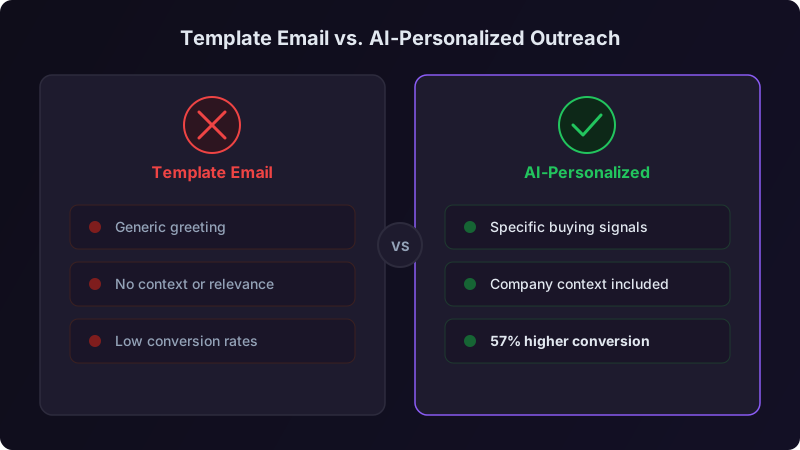
Hyper-Personalization at Scale: How to Use AI to Write Better Sales Emails
Generic templates get ignored. Learn how to use AI for research-backed personalization at scale, where people still need to review, and how to measure the result against your templates.
AI Sales Forecasting: Why Your Pipeline Predictions Are Wrong (And How to Fix Them)
Most sales forecasts miss because they rest on rep optimism and stale CRM data. Learn how AI forecasting uses engagement and pipeline signals, and how to commit deals on buyer evidence.
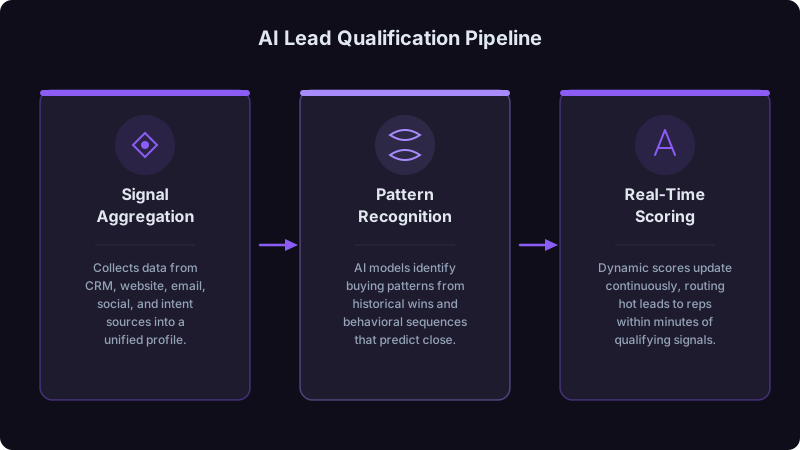
AI Lead Qualification: Separating Hot Prospects from Time Wasters
Too much rep time goes to leads that will never buy. Learn how AI qualification helps identify real opportunities faster.