ABM + Sales: How to Align Marketing and Sales on Target Accounts
Build one target-account list, one buyer map, and one operating rhythm that marketing and sales can use together.
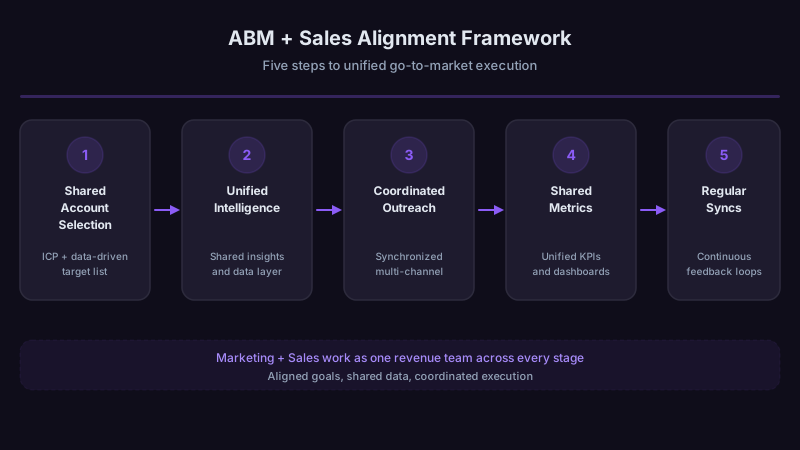
Account-based marketing becomes difficult to operate when marketing and sales work from different account lists, buyer definitions, messages, and success measures. A coordinated ABM motion starts with shared decisions about who to pursue, why each account matters, and what the team will do next.
The framework below turns those decisions into a repeatable operating rhythm. Use your own CRM history and campaign results to set the thresholds, account counts, and timing for your market.
Why ABM Alignment Breaks Down
Technology can organize an ABM motion, but it cannot settle disagreements about account selection, ownership, or measurement. Resolve those questions before adding more tools.
Ask sales and marketing leaders to name the priority accounts and explain why each one is on the list. Different answers reveal an alignment problem worth fixing first.
The symptoms show up fast:
- Marketing picks accounts based on firmographic fit while sales prioritizes existing relationships, with no agreed way to resolve differences.
- Marketing sends nurture emails. Sales sends cold outreach. Same account, different messages, neither team aware of the other.
- Marketing measures engagement while sales measures pipeline, without a shared view that connects the two.
- Quarterly business reviews become blame sessions. Marketing says "we generated MQAs." Sales says "those accounts weren't real opportunities."
Fixing these symptoms requires a shared account process, not another isolated campaign. Forrester's ABM guidance likewise treats alignment as continuing work across planning, execution, and measurement rather than a one-time handoff. [1]
A Practical ABM Alignment Framework
Use this framework as a starting point, then adjust it using the way your buyers research, evaluate, and purchase.
Step 1: Build One Account List Together
Do not treat sales review as the final approval step for a list marketing built alone. Build the list together from the beginning, with agreed goals, commitments, and next steps before launch. [2]
Bring sales and marketing leaders together with CRM history, current account context, and available buying signals. Evaluate accounts using four criteria:
| Criterion | Who Owns It | How to Score |
|---|---|---|
| ICP fit (firmographics, technographics) | Marketing | Score 1-5 based on your best customer profile |
| Revenue potential | Sales | Estimate based on similar accounts won |
| Existing relationships | Sales | Do we know anyone? How senior? |
| Buying signals (intent, engagement) | Marketing | Intent data + website visits + content downloads |
Choose a scoring rule that reflects your sales motion, then keep the first cohort small enough for the team to research, coordinate, and review consistently. ABM is a focused investment in named accounts, not demand generation with a shorter list.
One possible tier model is Tier 1 for individual account plans, Tier 2 for small account clusters, and Tier 3 for broader segment programs. Set cohort sizes from rep capacity, deal value, and the amount of research each play requires.
Step 2: Create a Shared Intelligence System
Once you have the list, bring the material account context into a view that both teams can use. The source systems can remain separate, but the working view should connect account activity, buying-group coverage, signals, and outcomes. [3]
- Firmographic updates: funding rounds, leadership changes, office expansions, earnings reports
- Intent signals: what topics are they researching? Where are they in the buying journey?
- Engagement history: relevant marketing and sales touches in chronological order
- Contact map: who we know, who we need to know, and the relationships between stakeholders
- Competitive intelligence: are they using a competitor? Is the contract up for renewal?
Define which updates belong in the shared account record, who owns each field, and how quickly new information should appear. Include sales notes, relevant marketing engagement, outreach status, and agreed next steps.
Step 3: Coordinate Plays, Not Just Campaigns
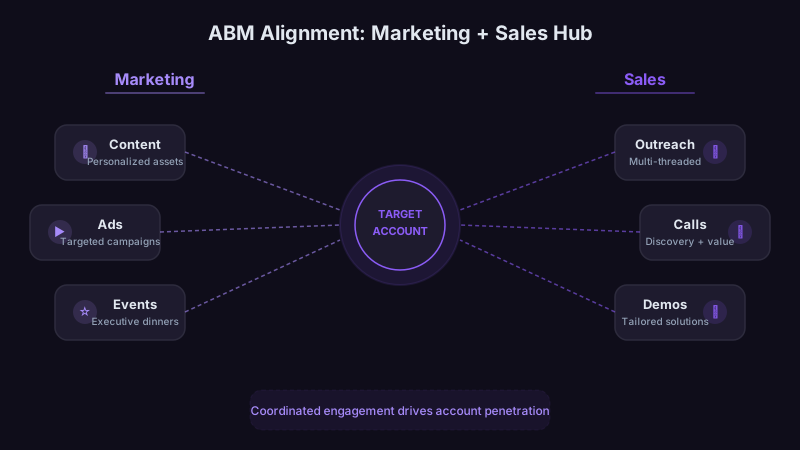
Coordination becomes practical when each account has a clear stage, owner, and next action. The following play structure is an example to adapt:
Cold accounts (no engagement yet)
- Marketing runs targeted ads and content syndication
- Sales reviews account context and agrees when direct outreach should begin
- Goal: establish relevance before asking for a meeting
Warming accounts (showing intent signals)
- Marketing selects appropriate content, events, or paid programs
- Sales begins personalized outreach to 2-3 contacts
- Both teams reference the same messaging framework
- Goal: get a meeting
Active accounts (in conversations)
- Marketing provides supporting material: case studies, analyst reports, and business-case inputs
- Sales runs the deal
- Marketing creates custom content if the deal warrants it
- Goal: advance the opportunity
Post-close accounts (customers)
- Marketing shifts to customer marketing
- Sales/CS focuses on expansion
- Goal: grow the account
Step 4: Align on Metrics That Matter
Separate scorecards create separate incentives. Give both teams a shared view of account progression and revenue outcomes.
Use these measures together:
- Account engagement score: are more people at the account engaging with us over time?
- Pipeline generated from Tier 1 accounts: not MQLs, not MQAs, pipeline dollars
- Win rate by cohort: record outcomes for target accounts and a matched group from the existing motion
- Deal value: examine the distribution of deal values for both cohorts
Treat ad impressions as a diagnostic measure, not as evidence of pipeline impact. Judge the program by clear ABM ownership, account-level measures, and integrated sales and marketing governance.
Step 5: Run Weekly Account Reviews
Run a short weekly account review with marketing, sales, SDR, and product marketing owners as needed. Review:
- 1Movement: which Tier 1 accounts moved stages this week? Why?
- 2Signals: any new intent signals, engagement spikes, or news?
- 3Plays: what's the coordinated plan for each active account this week?
- 4Blockers: what's stalled, and what can we do about it?
Keep the review focused on decisions, owners, and next steps. The recurring meeting turns the shared strategy into day-to-day coordination.
Define Decision Rights Before You Scale
Alignment becomes durable when the team knows who can make each decision. Name an owner for approving the target-account list, changing tiers, resolving duplicate ownership, selecting campaign audiences, pausing outreach, and accepting an account into pipeline. Record those decisions in the same operating view as the account context.
Set a change process as well. A seller may know about an active relationship that is missing from the data. Marketing may see a current signal that changes the account's priority. RevOps may find that a field or attribution rule is inconsistent. Give each person a clear way to propose a correction, identify who approves it, and show when it took effect.
This operating discipline also makes technology easier to evaluate. Salesforce's marketing research notes that marketers are focusing on unified customer experiences across channels and on using data to tailor interactions. [4] Test whether your working view actually reduces conflicting actions and gives both teams enough context to make the next decision. If the process still depends on private spreadsheets or side messages, fix the ownership and data flow before adding more accounts.
Common ABM Mistakes
ABM is more than running one campaign against a list. Maintain the account record and coordination rhythm across the buying cycle, then use campaign results to refine the next play.
Mistake 2: Personalizing the wrong things. Adding a prospect's logo and name is cosmetic personalization. Useful personalization connects a verified change at the account with a relevant question or resource.
Mistake 3: Trying to scale too fast. Start with an account cohort your team can work consistently. Learn which selection criteria, messages, and plays produce qualified opportunities before expanding.
Mistake 4: No executive ownership. Sales and marketing leaders need to agree on the goals, target accounts, decision rights, and shared measures before the program launches.
Mistake 5: Judging the program on the wrong timeline. Use your actual sales-cycle length to set the evaluation window. Track leading indicators such as buyer coverage and held meetings while qualified pipeline and revenue develop.
A 90-Day ABM Launch Plan
If you're starting from scratch or resetting a program, this sample 90-day plan can organize the work:
| Timeframe | Focus | Deliverables |
|---|---|---|
| Days 1-14 | Foundation | Shared ICP definition, account selection criteria, joint kickoff with sales |
| Days 15-30 | Account selection | Tier 1 list (25-50), tier structure, account research completed |
| Days 31-45 | Play design | Stage-based plays documented, content mapped to each stage, outreach templates |
| Days 46-60 | Launch | Ads running, SDR outreach started, weekly review cadence established |
| Days 61-90 | Optimize | First results analyzed, plays adjusted, early wins documented and shared |
Schedule a meeting with your sales counterpart and ask: "If we focus on one manageable account cohort for a defined evaluation window, which accounts should it include and why?" Compare the answer with the current marketing list to identify where alignment work is needed.
The Bottom Line
A practical ABM operating model gives marketing and sales the same named accounts, buyer map, signals, context, goals, and review rhythm. Measure it against your existing motion using opportunity creation, win rate, deal size, sales-cycle length, and acquisition cost.
Treat ABM as a revenue program that marketing and sales own together. Keep the account list, buyer context, next actions, and results visible to both teams.
References
[1]Forrester, Sales and Marketing Alignment in ABM: Are You in the 36 Percent? https://www.forrester.com/blogs/sales-and-marketing-alignment-in-abm-are-you-in-the-36-percent/
[2]Forrester, Preparing Sales for Account-Based Marketing: A Presentation Checklist. https://www.forrester.com/report/preparing-sales-for-account-based-marketing-a-presentation-checklist/RES172767
[3]Forrester, Demand and Account-Based Marketing. https://www.forrester.com/b2b-marketing/demand-abm/
[4]Salesforce, State of Marketing Report. https://www.salesforce.com/ap/marketing/resources/state-of-marketing-report/
Ready to transform your sales pipeline?
See how Prospectory's AI-powered platform can help your team research, reach, and relate to prospects at scale.
Related Articles
How to Use Prospectory for Account-Based Marketing
A practical Prospectory ABM playbook for unifying target accounts, named buyers, proven signals, and sales context before orchestrating outreach.
Competitive Intelligence for Sales: How to Win When Prospects Are Evaluating Alternatives
When a deal turns into a competitive evaluation, prospects do much of the comparing on their own. Learn how to arm your team with intelligence that wins head-to-head battles.
B2B Buyer Journey Mapping: Understanding How Modern Buyers Make Decisions
The B2B buyer journey has changed dramatically. Learn how to map and influence the modern buying process.