Cutting Sales Ramp Time: The AI-Assisted Onboarding Playbook
New sales reps can take months to reach full productivity. Learn how structured, AI-assisted onboarding can shorten that timeline.
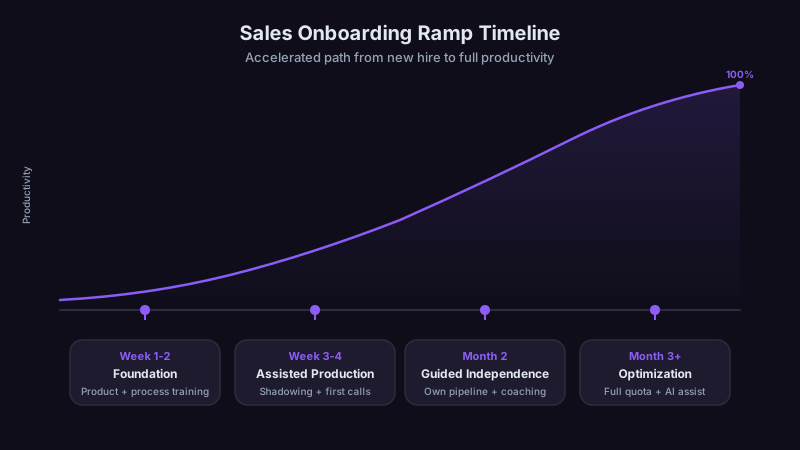
Two cohorts of new reps at the same company, selling the same product into the same market, can ramp at very different speeds. The difference is usually how the onboarding program is structured.
This guide walks through why traditional sales onboarding wastes so much time and a phased framework for shortening ramp.
The Real Cost of Slow Ramp Time
Let's do the math with an illustrative example. Replace each input with your own numbers.
Illustrative inputs: AE with a $1M annual quota and $120K OTE, 7 months to ramp

Unrealized quota (7 months at partial productivity)   ~ $500K
Fully loaded comp during ramp                           ~ $100K
Manager coaching time (5 hrs/week x 28 weeks)           ~ $35K opportunity cost
Pipeline gap (deals a ramped rep would have created)    hard to quantify, but real
In this illustration, a single slow-ramping rep costs hundreds of thousands of dollars, and the real figure depends on your quota, comp, and cycle length. Multiply that by every rep you hire this year. Now you see why this matters more than almost any other sales operations problem.
Why Traditional Onboarding Produces Slow Ramp
Traditional onboarding fails for specific, fixable reasons.
The firehose problem. Week one: here's 200 slides about our product, our market, our competitors, our pricing, our process, our tools. New reps absorb only a fraction of it. The rest evaporates within days. We train people like we're preparing them for a final exam, not a conversation with a prospect.
The shadowing trap. "Shadow Sarah for two weeks, she's our best AE." Sarah is great at selling. She's not great at explaining what she's doing or why. New reps watch calls and learn surface behaviors (tone, pacing) without understanding the underlying decision-making. They mimic style without understanding substance.
The sink-or-swim transition. After 2-4 weeks of "training," reps are handed a territory and told to go. The implicit message: figure it out. Some do. Many flounder for months before finding their rhythm, or leaving.
The inconsistency problem. Onboarding quality depends entirely on who the new rep's manager is. Good managers invest time in coaching. Overwhelmed managers (which is most of them) delegate onboarding to whatever resources exist, check in sporadically, and hope for the best.
No feedback loops. A rep sends 200 emails before anyone reviews one. They run five discovery calls before getting coaching on their questions. Mistakes become habits before anyone intervenes.
Most sales onboarding programs are designed around what the COMPANY wants reps to know, not around what REPS need to do their job. That's why reps can pass product certification and still can't run a good discovery call.
The Structured Onboarding Framework
Here is the framework. It's organized into four phases, each with specific milestones that must be hit before advancing.
Goal: Rep understands who we sell to, what problems we solve, and how our product works, well enough to have a basic conversation.
What this looks like in practice:
- Day 1-3: Company orientation, tool setup, CRM configuration. Boring but necessary. Get it done fast.
- Day 3-7: ICP deep-dive. Not slides about personas. Actual review of 20 closed-won deals. Who bought? Why? What was their situation? What did the sales process look like? Reps read real call transcripts and real email threads.
- Day 7-10: Product training, but structured as "learn enough to demo the three most common use cases." Not comprehensive product knowledge, just enough to be dangerous.
- Day 10-14: Shadowing with structure. Reps shadow 2-3 different top performers. Before each call, they review the account context. After each call, they debrief: what did the rep do, why, and what would you have done differently?
Milestone gate: Rep can deliver a 5-minute product overview and articulate our top three differentiators in their own words. Not from a script. Their words.
Where AI helps: AI-generated account briefs for shadowing sessions (so reps practice reading the same research they'll use later). AI-powered quiz sessions that adapt difficulty based on what the rep gets wrong.
Goal: Rep begins real outreach with significant support. They're doing the work, but they're not doing it alone.
What this looks like:
- Outreach: Rep begins prospecting into real accounts. AI generates initial prospect research and suggests personalization angles. Rep writes the actual emails and call scripts, but with a template framework.
- Calls: Rep begins taking discovery calls. For the first 10 calls, their manager or a senior rep listens live (or reviews recordings within 24 hours). Feedback is immediate and specific.
- Coaching cadence: 30-minute 1:1 every other day. Yes, that's a lot of manager time. It pays off. Reps want it: in Salesforce's seventh State of Sales survey, 75% of sales reps said they are more likely to hit their targets with a coach or mentor [1].
- Peer learning: Reps in the same cohort review each other's calls and emails. This builds calibration and camaraderie simultaneously.
Milestone gate: Rep has booked 5 qualified meetings independently. Their discovery call recordings show they can ask open-ended questions, identify a pain point, and qualify for next steps.
Where AI helps: Real-time suggestions during calls (questions to ask, competitor talk tracks). Post-call analysis highlighting what went well and what to work on. Automated comparison of the rep's messaging patterns vs. top performers.
Goal: Rep operates independently but with guardrails and frequent coaching.
What this looks like:
- Rep manages their own pipeline and prioritization
- Coaching shifts to weekly 1:1s focused on specific deals and skills
- Rep begins running full sales cycles (discovery through proposal for AEs, or full outbound sequences for SDRs)
- Performance is benchmarked weekly against peers and against the "expected ramp curve"
Milestone gate: Rep is hitting at least half of weekly activity targets with quality scores above threshold. For AEs, they've advanced at least 2 opportunities past discovery.
Where AI helps: Identifies which deals are stalling and why. Flags when a rep's email response rates or meeting conversion rates drop below benchmarks. Suggests specific coaching topics for the manager based on observed patterns.
Goal: Rep carries full quota expectations with AI as an ongoing performance tool, not a training crutch.
What this looks like:
- Full quota (or ramped quota if your plan includes a ramp)
- Coaching cadence moves to standard (weekly or bi-weekly 1:1)
- Rep is expected to self-diagnose performance issues with help from AI-generated insights
- Peer mentoring: fully ramped reps begin helping the next cohort
Milestone gate: Rep hits three-quarters of quota or more for two consecutive months. They can articulate their own sales process, strengths, and development areas.
The Coaching Cadence That Makes It Work
The framework above only works if managers actually coach. And most managers don't coach enough because they don't have a structure for it.
Here's a coaching cadence to start from:
| Ramp Phase | Coaching Frequency | Format | Focus |
|---|---|---|---|
| Phase 1 (Days 1-14) | Daily check-ins (15 min) | In-person or video | Knowledge gaps, questions, morale |
| Phase 2 (Days 15-30) | Every other day (30 min) | Call review + discussion | Skill development, call quality, messaging |
| Phase 3 (Days 31-60) | Weekly (45 min) | Deal review + pipeline | Deal strategy, prioritization, independence |
| Phase 4 (Days 61-90) | Weekly (30 min) | Standard 1:1 | Performance, development, quota tracking |
Yes, this adds up to more than a dozen hours of manager time per rep over 90 days. That feels like a lot. But compare it to 3 extra months of unproductive quota capacity. The math is overwhelmingly in favor of front-loading coaching investment.
Measuring Ramp Effectiveness
You can't improve what you don't measure. Here are the metrics to track for every new hire:
Leading indicators (track weekly):
- Activities completed (calls, emails, LinkedIn touches)
- Quality score on reviewed calls (rated 1-5 by manager)
- Response rates on outbound emails
- Meetings booked per week
Lagging indicators (track monthly):
- Time to first qualified meeting
- Time to first opportunity created
- Time to first closed deal
- Quota attainment by month
Cohort analysis:
- Compare each onboarding cohort against previous cohorts
- Identify which phases are taking longer than expected
- Track 6-month retention rate by cohort (bad onboarding drives attrition)
Time to first closed deal is the single most important ramp metric. It's the moment a rep proves they can execute the full sales cycle independently. Track it religiously and work backwards to understand what accelerates or delays it.
Common Mistakes to Avoid
Underestimating peer cohorts. Reps who onboard alongside peers get shared accountability and psychological safety that solo hires miss. Where you can, batch hiring into cohorts of at least three.
Over-indexing on product knowledge. Reps learn the product by selling it. They need enough to start conversations, not enough to be a solutions engineer, so keep product training to a modest share of onboarding time.
Involving top performers too late. Your best reps are your best teachers, but only if you structure their involvement. Ask them to record annotated call libraries: real calls with their own commentary on what they did and why.
Your 30-Day Quick Start
If you're a sales leader reading this and thinking "I need to fix our onboarding but I can't overhaul everything at once," here's where to start:
- 1This week: Pull the data. What's your actual average ramp time? When do new hires book their first meeting, create their first opportunity, close their first deal? If you don't know, that's your first problem.
- 2Next week: Define milestone gates for each phase. What does a rep need to demonstrate before moving from "training" to "selling"? Write it down.
- 3Week 3: Build a structured coaching cadence and put it on every manager's calendar. Make it non-negotiable for the first 60 days.
- 4Week 4: Set up AI-assisted research so new reps can focus on selling skills instead of spending hours figuring out where to find prospect data.
Ramp time is one of the most expensive problems in sales, and one of the most fixable. The companies that treat onboarding as a strategic investment rather than an administrative chore are the ones building teams that hit quota consistently.
References
[1]Salesforce, State of Sales, Seventh Edition, 2026. https://www.salesforce.com/en/wp-content/uploads/sites/4/documents/reports/sales/salesforce-state-of-sales-report-2026.pdf
Ready to transform your sales pipeline?
See how Prospectory's AI-powered platform can help your team research, reach, and relate to prospects at scale.
Related Articles
SDR Productivity Benchmarks: How to Set Them From Your Own Team's Data
Published SDR benchmarks rarely match your market, deal size, or motion. Here is how to build internal SDR benchmarks from your own funnel and coach to the gaps they reveal.
Sales Enablement Content That Actually Gets Used: A Data-Driven Approach
Much of the sales content teams build goes unused. Learn how to create enablement materials your reps will actually use to close deals.
ABM + Sales: How to Align Marketing and Sales on Target Accounts
Build one target-account list, one buyer map, and one operating rhythm that marketing and sales can use together.