Sales Enablement Content That Actually Gets Used: A Data-Driven Approach
Much of the sales content teams build goes unused. Learn how to create enablement materials your reps will actually use to close deals.
Here is an illustrative scenario that many enablement leaders will recognize. A team spends two months building what it thinks is the perfect sales enablement library: dozens of pieces of content. Case studies by industry. Objection-handling guides. Competitive battle cards. Beautiful formatting. Clear messaging.
Six weeks after launch, the usage data shows that only a handful of pieces have been opened, and fewer still shared with prospects.
That kind of failure teaches more about sales enablement content than any conference talk or best-practice guide. The problem was never the content quality. It was everything around it: discoverability, format, timing, and whether reps could actually picture when to use each piece.
Here is how to build enablement content that reps reach for instead of ignore.
The Content Graveyard Problem
Teams keep producing more content without fixing why existing content sits untouched. Reps feel the gap too: in Salesforce's seventh State of Sales survey, 52% of sales reps said traditional enablement doesn't provide the skills they need [1].
Try a simple test: ask your sales team, "When you need content for a deal, where do you go first?" Common answers include:
- 1Google (not the content library)
- 2Ask a teammate on Slack who's worked a similar deal
- 3Build it themselves from scratch
If the content library ranks behind "dig through old email threads," you have a graveyard problem.
The Five Reasons Content Dies on the Vine
The same patterns show up across enablement programs.
It's buried in the wrong place
Your content management system might make perfect sense to the enablement team that organized it. But reps don't think in terms of "awareness stage collateral" or "mid-funnel nurture assets." They think: "I have a CFO who's worried about implementation costs and I need something to send them in the next 10 minutes."
If your content requires more than two clicks to find, it might as well not exist.
It doesn't match a real deal scenario
Generic content -- "Why Our Platform is Great" one-pagers -- doesn't help a rep who's stuck in a specific situation. The content that gets used answers a specific question a real prospect actually asks.
The format is wrong for the moment
A 12-page whitepaper is the wrong format when a rep needs to drop something into a Slack message to a champion. A two-line email snippet is wrong when a prospect asks for a detailed technical comparison.
It's stale
Nothing kills rep trust faster than sending a prospect a case study with last year's screenshots and a pricing model you changed eight months ago. Once a rep gets burned by outdated content, they stop trusting the library entirely.
Nobody asked reps what they needed
This is the most common mistake: building content based on what the enablement team thinks reps need. Start instead by asking: "What questions are prospects asking that you don't have good answers for?"
The Content Types That Actually Get Used
Not all content formats are equal. Here is how common formats tend to fit into deals. Check the ranking against your own usage data.
| Content Type | Typical Fit | Best Stage | Why It Works |
|---|---|---|---|
| Email templates & snippets | Daily use | Prospecting, Follow-up | Copy-paste ready, saves time |
| One-page battle cards | Frequent | Evaluation | Quick reference during calls |
| ROI calculators | Frequent | Decision | Prospects can input their own numbers |
| 60-second demo clips | Frequent | Discovery, Evaluation | Shareable, doesn't need context |
| Customer quotes (not full case studies) | Frequent | All stages | Easy to drop into emails |
| Objection response scripts | Situational | Evaluation, Negotiation | Ready for live conversations |
| Full case studies | Occasional | Decision | Too long for most situations |
| Whitepapers | Rare | Rarely | Seldom shared by reps |
The content that gets used most is short, copy-paste ready, and mapped to a specific moment in the sales process. The content that gets ignored is long-form material designed for marketing purposes and repurposed for sales.
Mapping Content to the Buyer Journey
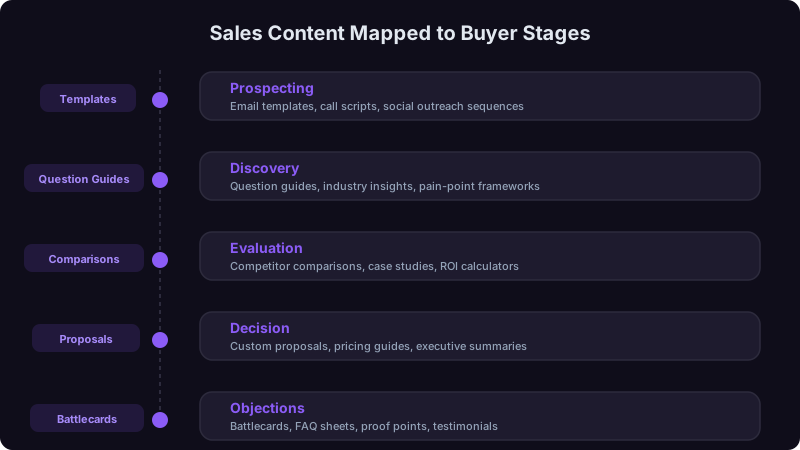
The mapping exercise is where most enablement teams start, and it's the right instinct. But the standard "awareness / consideration / decision" framework is too abstract. Map to what your reps actually do in each conversation.
What reps need:
- 3-4 email sequence templates with proven reply rates (track which ones work)
- Industry-specific value prop bullets (not a generic pitch)
- Trigger event templates ("I noticed you just [hired a new VP Sales / raised a round / expanded to EMEA]...")
- One-line customer proof points that fit in a cold email
What doesn't work here: case studies, whitepapers, product one-pagers. Nobody reads those before taking a meeting.
What reps need:
- Industry-specific discovery question guides (not generic BANT questions)
- Quick stats about the problem you solve ("Companies like yours typically lose $X per year to...")
- Short video clips showing the problem in action
- Benchmark data the prospect can compare themselves against
What reps need:
- Battle cards for each top competitor (one page, updated monthly)
- Feature comparison charts that are honest (don't claim you win everything)
- ROI calculator the prospect can play with themselves
- 60-second demo clips of key differentiating features
- Customer quotes from their industry specifically addressing the comparison
This is the stage most enablement teams under-serve, and it might be the most important one.
What reps need:
- Executive summary template the champion can forward to their boss
- ROI business case template with the prospect's actual numbers filled in
- Implementation timeline that answers "how long until we see value?"
- Security and compliance one-pager for IT review
- Procurement-friendly vendor comparison template
What reps need:
- Welcome email template for new customers
- "What to expect in the first 30 days" one-pager
- Introduction email template connecting the customer to their CSM
How to Build Content Reps Actually Want
Here is a process that replaces the "build it and hope they come" approach.
Step 1: Mine your Gong/Chorus recordings
Listen to 20 recent sales calls. Write down every question prospects ask, every objection they raise, every moment where the rep has to improvise or says "let me get back to you on that." Those moments are your content roadmap.
Step 2: Interview your top 5 reps
Ask them: "What's the one piece of content you wish you had for every deal?" and "When was the last time you built something custom for a prospect? What was it?" Their answers tell you exactly what to build next.
Step 3: Build small, test fast
Don't build dozens of pieces at once. Build three pieces. Put them in front of reps. Watch what happens. Iterate.
Step 4: Make it absurdly easy to find
A strong distribution system: a Slack channel where reps can type a keyword and a bot surfaces the relevant content. Second best: content embedded directly in the CRM, tagged to deal stage, so it shows up when reps are already working.
Put content where reps already spend their time. If they live in Salesforce, put it in Salesforce. If they live in Slack, put it in Slack. If they live in Gmail, put it in Gmail. Never ask reps to go to a separate tool to find content.
Measuring What Works (and Killing What Doesn't)
Most enablement teams track content creation volume. That's the wrong metric. Here's what to measure instead.
| Metric | What It Tells You | How to Track It |
|---|---|---|
| Content usage rate | Are reps opening/sharing it? | Enablement platform analytics |
| Content-to-deal correlation | Does using content X improve win rates? | Tag content to deals in CRM |
| Time to find content | Can reps locate what they need quickly? | Survey + observation |
| Rep-created content volume | Are reps still building their own? (Bad sign) | Audit shared folders monthly |
| Prospect engagement | Do prospects actually consume what reps send? | Link tracking, view analytics |
| Content freshness | Is anything past its expiration date? | Monthly audit |
The metric I care about most: rep-created content volume. If reps are still building their own decks and one-pagers from scratch, your enablement content isn't working. That number should trend toward zero over time.
The Content Audit Framework
Run this every quarter. It takes about four hours and prevents your library from becoming a graveyard.
Export analytics from your content platform. Flag anything with zero or near-zero usage in the past 90 days.
For every active piece of content, verify: Is the pricing current? Are the screenshots accurate? Are the customer quotes still approved? Is the competitive info still true?
Unused and inaccurate content gets archived (not deleted; you might need the raw material later). Unused but accurate content gets a distribution experiment: try a different format or channel. Accurate and used content stays.
Ask reps: "What question have you been asked in the last month that you didn't have content for?" Build that content next quarter.
The Mistakes I Keep Seeing
Building for marketing, not sales. A case study written for the website and a case study built for a rep to send mid-deal are fundamentally different documents. The website version tells a story. The sales version answers "why should I trust these people with my money?"
Too much content, poorly organized. A library with 200 pieces and no clear taxonomy is worse than a library with 20 well-organized pieces. Reps give up after three searches. Curation beats volume.
No feedback mechanism. If reps can't quickly flag "this is outdated" or "this doesn't match what I'm hearing from prospects," your content decays silently. Build a one-click feedback mechanism into every piece of content.
Treating enablement as a launch, not a program. Content enablement isn't a project with a start and end date. It's an ongoing program. The teams that succeed assign a permanent owner, set a recurring cadence for audits and updates, and treat the content library as a living product.
Stop building more content. Start making your existing content findable, accurate, and mapped to specific deal moments. The enablement teams with the highest rep adoption don't have the most content. They have the right content, in the right place, at the right time. Start with what your reps are already improvising in deals -- that's your content roadmap.
References
[1]Salesforce, State of Sales, Seventh Edition, 2026. https://www.salesforce.com/en/wp-content/uploads/sites/4/documents/reports/sales/salesforce-state-of-sales-report-2026.pdf
Ready to transform your sales pipeline?
See how Prospectory's AI-powered platform can help your team research, reach, and relate to prospects at scale.
Related Articles
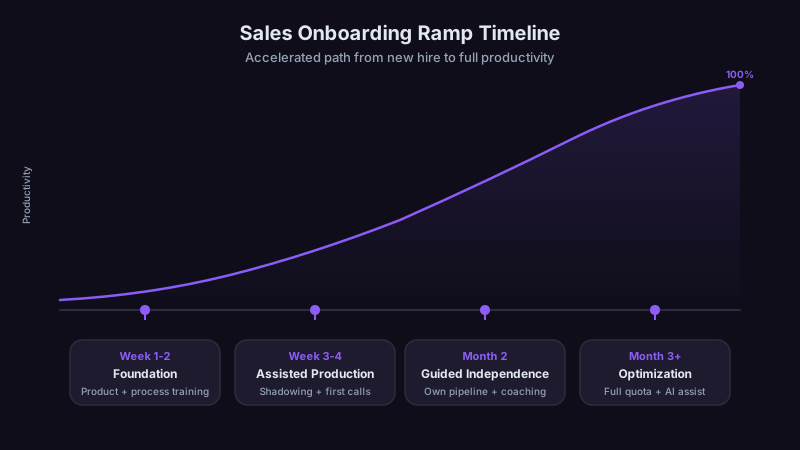
Cutting Sales Ramp Time: The AI-Assisted Onboarding Playbook
New sales reps can take months to reach full productivity. Learn how structured, AI-assisted onboarding can shorten that timeline.
Why AI Sales Intelligence Fails Without a Signal-to-Action System
A practical operating model for turning buyer signals into timely sales plays, coordinated stakeholder engagement, and measurable revenue outcomes across the team.
The Best Sales Demos Show Less: A Discovery-Led Demo Framework
Learn how to replace broad product tours with focused sales demos that connect one urgent buyer problem to three relevant proof points and a concrete next step.