Cracking the Dark Funnel: How to Attribute Revenue When Most of the Buyer Journey Is Invisible
Most of your pipeline is influenced by channels you can't track. Podcasts, Slack communities, word-of-mouth, and private social sharing drive deals you'll never see in your CRM. Here's how to measure the unmeasurable.
Picture an illustrative marketing leader trying to prove that a podcast sponsorship generates pipeline. The CEO wants ROI on every dollar, and the attribution model shows zero closed-won deals sourced to podcasts.
So the program is nearly killed. Then the team adds a single open-text field to the demo request form: "How did you first hear about us?" Respondents start naming the podcast. Those leads never showed up in the attribution dashboard; they'd been credited to "organic search" or "direct traffic" because the buyer searched for the company after hearing its CEO on a show.
That is the dark funnel, and it changes how you should think about every marketing dollar. Buyers prefer it that way: in a Gartner survey of 632 B2B buyers, 61% said they prefer an overall rep-free buying experience [1].
What the Dark Funnel Actually Is (and Isn't)
The dark funnel isn't some theoretical concept from a marketing conference keynote. It's the real, measurable gap between what influences your buyers and what shows up in your analytics.
Think about how you buy software. Someone mentions a tool in a Slack community. You make a mental note. A week later, a friend posts about it on LinkedIn. You Google the company name, click the first organic result, and start reading. Eventually you request a demo. Your CRM records the source as "organic search."
Every single influence that led to that moment, the Slack mention, the LinkedIn post, the word-of-mouth, is invisible to your attribution system. That's the dark funnel.
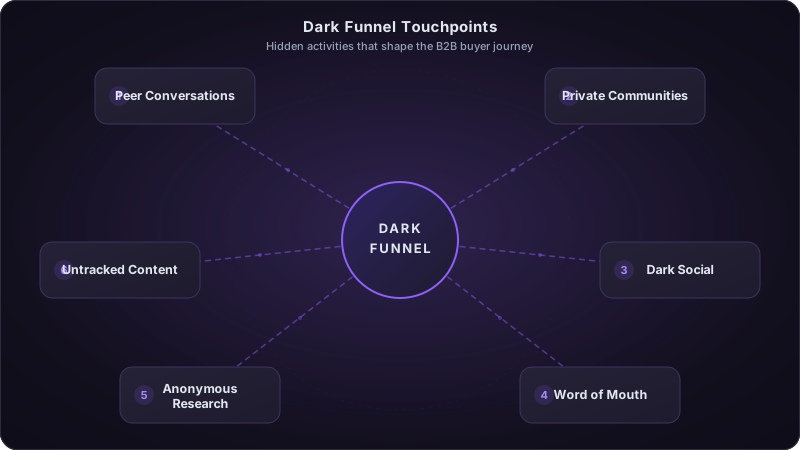
The dark funnel is every interaction that influences a buying decision but cannot be tracked by standard attribution tools. This includes private conversations, content shared via DM, podcast listens, community discussions, peer recommendations, and forwarded emails.
The scale can be large, and the leads that come through dark funnel channels, the ones your CEO thinks are "organic search," often arrive pre-sold by someone they trust. Check whether they close at higher rates and larger deal sizes than paid-channel leads in your own data.
Where the Dark Funnel Lives: A Taxonomy
The dark funnel falls into four broad categories. Use self-reported attribution to rank them for your own buyers.
1. Peer-to-Peer Conversations
This is often the biggest bucket and the hardest to influence directly.
- Slack and Discord communities: Your ICP is likely in several industry Slack groups. When someone asks "what tool do you use for X?", that's a dark funnel moment. You either get mentioned or you don't.
- iMessage, WhatsApp, and DM threads: A VP asks a friend at another company what they use. That recommendation carries more weight than any ad you could run.
- Internal Slack at the buyer's company: "Hey, has anyone used [your product]?" posted in #sales-ops. You will never see this message, but it might be the most important touchpoint in the deal.
- Hallway conversations at conferences: Someone picks up your swag or sees your booth. They mention it to a colleague. The colleague looks you up two weeks later.
2. Audio and Video
Podcast listeners and YouTube viewers are notoriously hard to track, even when they go on to buy.
- Podcast mentions: Both as a guest and when hosts name-drop you organically. If a podcast appearance does influence buyers, that influence tends to show up slowly and rarely appears in click-based attribution.
- YouTube content: Product reviews, comparison videos, tutorial content. Viewers rarely click through directly, they search for you later.
- Webinar replays: The live attendee gets tracked. The person their colleague forwards the recording to? Dark funnel.
3. Community and Social
Public but still hard to attribute directly to pipeline.
- Reddit and forum discussions: A thread comparing tools in your category can keep being read long after it was posted. Those views never show up in your analytics.
- LinkedIn organic content: Not your ads, your team's posts, comments, and thought leadership. When your VP of Sales drops a thoughtful comment on a prospect's post, that doesn't get attributed anywhere, but it absolutely influences deals.
- Peer review sites beyond the click: Someone reads your G2 reviews to validate a decision they've already made based on a peer recommendation. G2 gets the attribution credit, but the peer did the selling.
4. Content Sharing
Your content is being consumed in ways you can't see.
- Forwarded emails: Your newsletter gets forwarded to a colleague. They read it, get interested, Google you. You credit "organic search."
- Shared links in private channels: Someone copies your blog URL into a Slack DM. No referrer header. Direct traffic in your analytics.
- Screenshots and quotes: People screenshot your insights and share them without linking back. This is actually a sign your content is good, it's just invisible to your tracking.
Why Your Attribution Model Is Lying to You
I don't say this to be dramatic. Attribution data that ignores the dark funnel is incomplete, and trusting it alone can lead teams to cut programs that were working.
The Multi-Touch Attribution Trap
Multi-touch attribution sounds scientific. You assign fractional credit across every touchpoint. But if most touchpoints are invisible, you're building a model on a fraction of the data. That's not measurement, it's a mirage.
Here's an illustrative pattern of what a multi-touch model can say versus what self-reported attribution reveals:
| Channel | Multi-Touch Credit | Self-Reported Credit |
|---|---|---|
| Paid Search | High | Lower |
| Organic Search | High | Lower |
| LinkedIn Ads | Moderate | Lower |
| Podcasts | Near zero | Meaningful |
| Peer Referral | Near zero | High |
| Community | Near zero | Meaningful |
When your budget follows the left column and your buyers follow the right one, you are paying for the wrong channels. Build this table from your own data before you move money.
Every dollar you allocate based purely on multi-touch attribution is a dollar biased toward measurable channels and away from influential ones. The most dangerous outcome isn't bad measurement, it's confidently optimizing toward the wrong channels.
The Recency Bias Problem
When you ask someone "how did you hear about us?", they tend to cite the most recent touchpoint. The buyer who heard about you on a podcast six months ago, got a peer recommendation three months ago, and clicked a LinkedIn ad yesterday will say "LinkedIn ad." Your self-reported data has recency bias too, just less than your software does.
The Organizational Incentive Problem
When attribution is tied to budget, every team claims credit. Marketing takes credit for the website visit. Sales takes credit for the meeting. The podcast team can't prove anything, so they get their budget cut. This is how organizations slowly defund their most effective programs.
A Practical Framework for Measuring the Unmeasurable
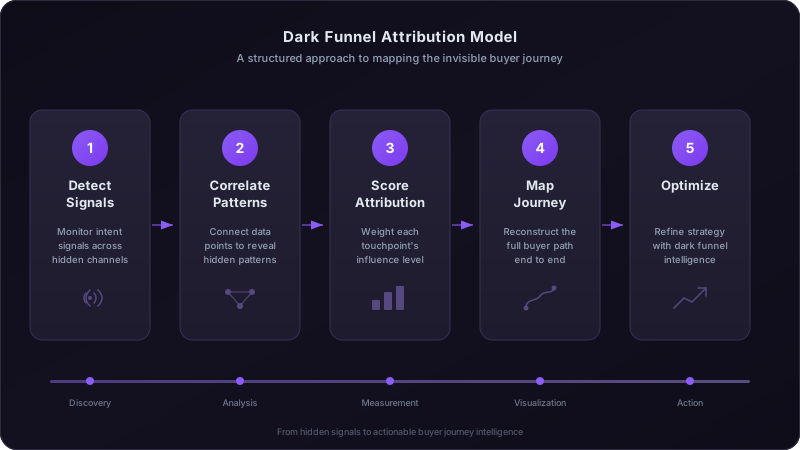
I'm not going to pretend you can perfectly measure the dark funnel. You can't. But you can get a much more accurate picture than what your current tools show. Here's a framework.
Add an open-text field to every conversion point: demo requests, sign-ups, contact forms. The exact wording matters. Don't ask "how did you find us?", that invites answers like "Google." Ask: "What first made you aware of [company name]? Be specific if you can."
The open-text format is critical. Dropdown menus force buyers into categories that match your channel taxonomy, not their actual journey. Open text gives you answers like "my friend Jake told me about you" and "heard your CEO on the Pavilion podcast", answers that would never appear in a dropdown.
Track the response rate on this field; when buyers answer it, it can become your most valuable piece of marketing data.
You can't track who shares your content privately, but you can identify which content gets shared by looking for specific patterns.
The 48-hour spike test: After publishing a blog post, track the ratio of referral traffic to direct traffic over the first 48 hours. Unusually high direct traffic (no referrer header) relative to social and email traffic can be a hint of private sharing, but direct traffic also includes bookmarks, apps, privacy tools and tracking gaps, so treat it as a lead to check against self-reported attribution, not as proof.
The conversion outlier test: Identify pages that have modest traffic but disproportionate impact on conversion. If a page gets modest traffic but appears in the journey of a large share of your closed-won deals, it's being consumed through dark channels by high-intent buyers.
This is the closest you can get to measuring dark funnel ROI directly. The principle: change one variable in one segment and measure the aggregate effect.
An example test design: pick comparable segments, for example two similar regions or verticals with similar historical inbound, and run the program in one while holding it back in the other. Agree the measurement window and the metric (such as inbound demo requests or self-reported mentions) before you start, and compare against each segment's own baseline. A difference that holds up across a repeat test is useful evidence of incrementality, though not proof on its own.
Other tests to run:
- Community engagement blitz for one vertical vs. a control vertical
- Thought leadership campaign targeting one industry
- Customer advocacy program in one region
You can't measure dark funnel touchpoints directly, but you can measure whether the dark funnel is working by tracking these proxies.
| Indicator | What It Tells You | How to Track |
|-----------|-------------------|-------------|
| Branded search volume | Awareness is growing | Google Search Console, SEMrush |
| Direct traffic growth | Word-of-mouth is happening | Google Analytics |
| Self-reported non-digital % | Dark funnel is a meaningful channel | Your open-text field |
| Time-to-first-meeting | Prospects already know you when they arrive | CRM timestamp analysis |
| Inbound quality score | Dark funnel leads close better | Win rate by source |
When branded search volume is climbing, direct traffic is growing, and self-reported "peer referral" is trending up, your dark funnel investments are paying off, even if you can't attribute individual deals.
This is where it gets uncomfortable, because you're making budget decisions based on imperfect data. But imperfect data that includes the dark funnel is better than precise data that ignores most of the influence.
One approach: weight channel allocation half on multi-touch attribution data and half on self-reported attribution data. The blended view keeps you from over-indexing on either signal.
Move budget in measured steps, then watch CAC and inbound win rate quarter by quarter to see whether the shift is paying off.
Tactical Playbook: Dark Funnel Content Strategy
You can't control what people say about you in private conversations. But you can create content that's designed to be shared in dark channels. Here's what works.
Original research with quotable numbers: When you publish a sound, sourced statistic from your own research, people screenshot it and share it. Original data travels.
Contrarian takes with supporting evidence: "Multi-touch attribution is lying to you" gets shared in Slack channels. "Attribution best practices" doesn't. Strong opinions backed by evidence spark conversation.
Templates and frameworks people can actually use: A useful scoring template gets forwarded, and buyers will tell you so on the demo form. Give people a tool they'll share with their team.
Stories, not studies: Case studies in the traditional format (challenge, solution, results) don't get shared. Stories about specific, messy, relatable problems do. A story about nearly killing your best program travels further than a generic growth story.
Before publishing anything, ask: "Would someone screenshot this and send it to a colleague?" If the answer is no, it's not dark funnel content. It might still be useful for SEO or nurture, but it won't generate the invisible word-of-mouth that drives your highest-quality pipeline.
The Hard Truth About Dark Funnel Strategy
Investing in the dark funnel works, but it requires patience and organizational courage.
Patience because any effect from dark funnel programs, if there is one, tends to appear over months rather than weeks. Judge a podcast sponsorship on the self-reported attribution and incrementality evidence you collect, over a window long enough to see it, rather than on next quarter's click data.
Organizational courage because you're asking your CFO to fund programs with imperfect measurement. You need to make the case that influence matters more than attribution, and to show the evidence you do have, such as self-reported attribution and test results, for the channels you can't track directly.
The companies that figure this out build an invisible moat. Their name comes up in every peer conversation. Their content gets shared in every relevant Slack community. Their buyers arrive pre-sold. And their competitors, the ones who only invest in what they can measure, keep wondering why their paid channels are getting more expensive while conversion rates decline.
Stop trying to attribute every dollar to a click. Start building the kind of reputation that makes people recommend you when nobody's tracking.
References
[1]Gartner, "Gartner Sales Survey Finds 61% of B2B Buyers Prefer a Rep-Free Buying Experience," press release, June 25, 2025, as republished by MarketScreener. https://uk.marketscreener.com/quote/stock/GARTNER-INC-40311131/news/Gartner-Sales-Survey-Finds-61-of-B2B-Buyers-Prefer-a-Rep-Free-Buying-Experience-50340554/
Ready to transform your sales pipeline?
See how Prospectory's AI-powered platform can help your team research, reach, and relate to prospects at scale.
Related Articles
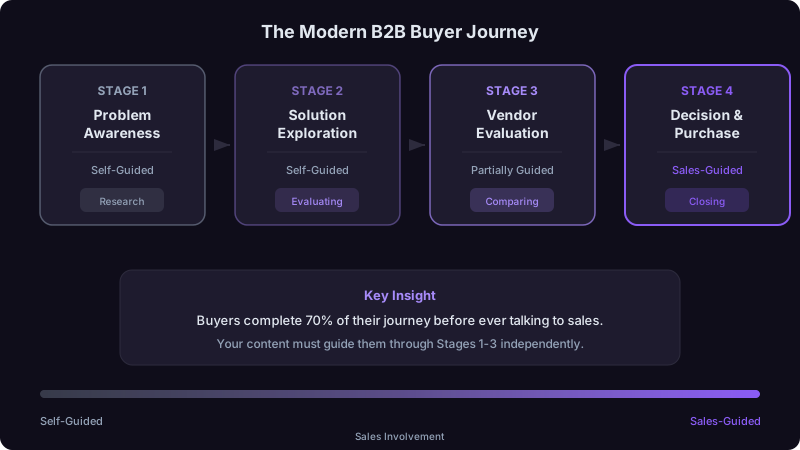
B2B Buyer Journey Mapping: Understanding How Modern Buyers Make Decisions
The B2B buyer journey has changed dramatically. Learn how to map and influence the modern buying process.
The Warm Outbound Playbook: Inbound-Feeling Sequences From Dark Funnel Signals
Cold outbound is dying and inbound can't fill pipeline alone. Here's how to stitch dark funnel signals into sequences that feel like a response, not an interruption.
The Real Cost of Bad Sales Data: How to Measure and Fix Data Decay
Outdated contacts and wrong job titles quietly drain pipeline. Here is how to measure your own data decay rate, estimate what it costs, and build a system that keeps sales data usable.