The Warm Outbound Playbook: Inbound-Feeling Sequences From Dark Funnel Signals
Cold outbound is dying and inbound can't fill pipeline alone. Here's how to stitch dark funnel signals into sequences that feel like a response, not an interruption.
Picture a rep who sends a founder a genuinely researched cold email: they read her company's engineering blog, referenced a specific technical decision her team made, and tied it to a problem they solve. She replies: "Nice AI-generated email." It wasn't. That is the problem now.
Warm outbound is the fix. It means reaching prospects who have already engaged with your orbit (visited your pricing page, read a G2 comparison, asked ChatGPT about your category, lurked in a Slack community) but never filled out a form. Instead of manufacturing relevance from scraped LinkedIn data, you reference behavior that actually happened. Done right, the signal does the credibility work your personalization no longer can. In Gartner's survey of 632 B2B buyers, 73% said they actively avoid suppliers who send irrelevant outreach [1].
This is not a volume problem anymore. It's a trust problem. And the way out is not better polish. It's evidence that you're paying attention to something real.
Why Your Best Cold Email Now Reads Like Spam
Buyers have been trained by AI-assisted outreach to pattern-match every email as automated. The tells sellers learned a couple of years ago (open with a compliment about a LinkedIn post, mention the recent funding round, reference a hiring spike) are now the exact tells that scream "generated at scale." The tactic that signaled effort has become the tactic that signals a template.
Here's the uncomfortable part: polish now works against you. A perfectly structured three-sentence email with a smooth transition and a soft CTA looks like something a tool produced. The more it reads like it followed a framework, the faster a skeptical buyer files it under spam. Reply rates on "best practice" templates can fall while the copy barely changes. The copy didn't get worse. The context did.
The shift is subtle but total. The old challenge was cutting through inbox volume. The new one is proving a human with genuine context is on the other end. Volume is still there, but the filter buyers apply is credibility, not novelty.
Warm outbound sidesteps the trust problem by grounding the message in a behavior the buyer already took. When you reference the category they were comparing, or the community question they asked, you don't need to prove you did research. The signal is the proof. That's why signal-triggered sequences have an edge over cold ones: they start from evidence instead of a guess.
The Dark Funnel Signals Worth Acting On
The dark funnel is everything buyers do before they identify themselves: anonymous site visits, comparison-page views on G2 or Capterra, podcast listens, community lurking, and a growing category, LLM-referred traffic from people who asked ChatGPT or Perplexity "what tools do X" before they ever hit your site.
The critical distinction is between declared intent and ambient intent. A form fill is declared. Everything else is ambient: someone comparing you against two competitors, re-reading your pricing page for the third time this week, or arriving from an AI assistant already carrying a bias the model gave them. Ambient intent is where the volume is, and it's where competitors aren't looking, because it's harder to act on.
To catch LLM-first discovery, you don't need a special product. Check GA4 for referral traffic from chatgpt.com, perplexity.ai, and copilot domains, then watch Google Search Console for brand-query spikes that don't correspond to any campaign. When your branded search volume rises but your ad spend and content publishing are flat, an answer engine is recommending you. That's a signal most teams never track.
| Signal | Intent strength | Trackability | Commoditization risk |
|---|---|---|---|
| Repeat pricing-page visit | High | Medium (needs de-anon) | Medium |
| G2/comparison-page view | High | Medium | High (everyone buys it) |
| LLM-referred site visit | Medium-high | Low (emerging) | Low (under-tracked) |
| Community/Slack activity | Medium | Low (manual) | Low |
| Funding round / job change | Low-medium | High (easy to buy) | Very high |
| Podcast listen / content view | Low | Low | Low |
Notice the pattern: the signals that are easiest to buy are the ones every rep is already acting on. The signals with real edge are the ones that take effort to track. That's not a coincidence. It's the whole game.
Signal Stacking Beats Signal Chasing
Everyone buys the same intent data. When a company posts a funding round, ten SDRs get the same alert from the same vendor the same morning, and the prospect gets ten near-identical emails by lunch. Acting on a single commoditized signal doesn't put you ahead. It puts you in a crowd.
The way out is stacking. Instead of chasing one strong-but-crowded signal, combine two or three weaker, less-tracked ones. A prospect who showed up in your Slack community, viewed a comparison page, and hit your pricing page twice in a week is a far better target than someone who just raised a Series B, because almost no one is triangulating those three behaviors together. Signal stacking finds the prospects competitors aren't swarming.
Build a simple scoring rubric and trigger a sequence only when the combined score crosses a threshold:
- Repeat pricing-page visit (3+ in 7 days): 40 points
- Comparison/G2 category view: 30 points
- Community question or reply mentioning your problem space: 25 points
- LLM-referred first visit: 20 points
- Content download without form (via de-anon): 15 points
- Trigger threshold: 55 points within a rolling 7-day window
A single funding alert scores zero here, on purpose. It's not that funding is useless; it's that it's everyone's. The threshold forces you to act only when multiple behaviors line up, which is exactly when a prospect is genuinely in-market and not yet buried under outreach.
Speed matters as much as combination. A stacked signal is only an advantage if you act on it before it decays. Acting within a couple of days turns a good target into a warm one; a three-week-old signal is just a stale list entry.
Three Warm Outbound Sequences, Torn Down
Teardown 1: The community lurker. A prospect asked in a peer Slack, "How are people handling lead routing when signals fire outside business hours?" No scraped data. No LinkedIn. The opener references the category of the problem, not the surveillance detail: "Saw the routing-after-hours question floating around a few communities lately. We hit that exact wall last year, here's the 90-second version of what fixed it." Touch two is a two-minute Loom. Touch three offers a teardown of their current setup.
Teardown 2: The comparison shopper. Triggered by repeated G2 category views. The honesty move wins here: "Looks like you might be evaluating tools in the [category] space. I'll save you a step, we're the right call if you care most about X, and honestly not the right call if Y is your top priority." Admitting where you lose builds more trust than any feature list.
Teardown 3: The LLM-educated buyer. This prospect arrived from Perplexity already carrying a summary of your category, and possibly a wrong impression the model gave them. The sequence's job is to confirm or correct: "If you've been researching this and an AI tool told you [common misconception], that's half right. Here's the part it usually gets wrong." You're not introducing your category. You're editing what they already believe.
Measure each teardown against a cold control cadence on three numbers: reply rate, meeting rate, and unsubscribe rate. Watch the unsubscribes most closely. Outreach that feels earned should draw fewer opt-outs, because you're responding rather than interrupting.
Writing Emails That Signal Human, Not Algorithm
Reference the signal at the category level, never the surveillance detail. "Saw you evaluating routing tools" is fine. "Saw you visited our pricing page three times on Tuesday from a Comcast IP in Denver" is a way to get blocked and reported. The line between relevant and creepy is whether the buyer feels recognized or watched.
Then do the counterintuitive thing: lower your polish on purpose. A short, slightly unstructured opener reads more human than a perfectly balanced paragraph. A 40-second voice note beats a formatted email. An oddly specific, non-scrapeable reference (something no tool could have pulled) proves a person is behind the message. These deliberately human tells break through precisely because they can't be automated at scale.
Here's a dated template, rewritten:
Before (reads as generated):
"Hi Sarah, congrats on the recent Series B! As a fast-growing team, you're likely focused on scaling efficiently. Our platform helps companies like yours improve pipeline velocity. Open to a quick 15-minute chat next week?"
After (signals human):
"Sarah, quick one. Someone in the RevOps Slack asked about after-hours signal routing this week and it reminded me we spent two quarters getting that wrong before we fixed it. If you're anywhere near that problem, I'll send the ugly whiteboard photo of how we solved it. No deck."
The second one names a real behavior, admits a past failure, and offers something no template would offer (an ugly photo, not a polished asset). That texture is the signal.
Reference the behavior, never the tracking. Acknowledging that a prospect is "evaluating tools in your category" is fair game because it's a reasonable inference. Naming the specific pages, timestamps, or IP data you collected is a violation of trust that turns a warm signal into a cold complaint. If your email could double as evidence in a privacy audit, rewrite it. The goal is to sound like an attentive peer, not a stalker with a dashboard.
Selling Into Consolidation and Pre-Educated Buyers
Many warm-signal prospects want to delete software, not add it. Budgets are under CFO scrutiny, stacks are bloated, and the mandate coming down is consolidation. If your sequence positions you as one more tool to add, you lose before the first call. Frame it as a replacement: "This absorbs what you're paying three tools to do half-well." Sell into the rip-and-replace conversation the buyer is already having internally.
Pre-educated buyers from LLM research show up biased. The model told them something, and it might be outdated or wrong. Your job in a warm sequence is not to introduce your category but to confirm or correct the buyer's existing mental model. This is why being answerable to LLMs matters: if the model recommends you accurately, your warm outbound just confirms and accelerates. If it recommends you badly, you're spending touches on damage control.
There's also a capacity reality worth naming out loud. Leadership expects AI to justify higher quotas per rep, but reps face longer cycles and more stakeholders per deal. Warm outbound is your defense here, not because it magically multiplies output, but because it's higher-yield per touch. Compare replies per hour of rep time for signal-triggered and cold sends in your own data, and defend your capacity math with that ratio. Warm outbound trades volume for yield, and the yield is where the pipeline actually comes from.
For the mechanics of building the underlying motion, our guide to the signal-based selling motion covers scoring and routing in more depth, and if you're fighting to prove these plays worked, our guide to dark funnel attribution shows how to connect anonymous behavior to closed revenue.
FAQ and Your First 30-Minute Move
How is warm outbound different from cold? Cold outbound starts from a list and manufactures relevance. Warm outbound starts from a behavior the prospect already took (a comparison view, a community question, an LLM-referred visit) and responds to it. The signal supplies the credibility your personalization can no longer fake.
What signals should I start with? Start with the ones your competitors ignore because they're harder to track: community activity and LLM-referred traffic. Everyone already acts on funding and job changes, so those put you in a crowd of other reps. Stack two or three weaker signals to find un-swarmed prospects.
How do I track the dark funnel without a big stack? You already have most of it. GA4 shows AI-assistant referral traffic and repeat visits. Google Search Console shows brand-query spikes that reveal LLM recommendations. An account-level identification tool plus manual review of public community discussions covers the rest, as long as you keep it at the account level and respect each platform's rules and privacy law. You don't need an eight-figure RevOps budget to start.
Isn't referencing dark funnel behavior creepy? Only if you name the tracking. Referencing the category someone is evaluating is a fair inference. Referencing their IP, timestamps, or exact page views is surveillance. Stay on the inference side of that line.
Your first 30-minute move
Pull the last 30 days of high-intent visits that your analytics or account-identification tool attributes to companies, not to individual people. Note which of those accounts also come up in public discussion of your category. Pick five such accounts, choose the relevant buyers at each, and reach them through your normal outreach with your suppression lists, opt-outs, and the rules of your channels applied. Never treat a visit or a community post as consent, and never tell someone you tracked their visit or read their post.
The one metric to track this week
Track reply rate on signal-triggered sequences against your cold control cadence. Run them side by side for two weeks. If the warm sequences aren't clearly beating cold, your signal thresholds are too loose or your emails are still too polished.
Remember the founder who replied "Nice AI-generated email"? The spam-pattern problem that killed cold outreach is exactly what makes warm outbound work. When every stranger sounds like a robot, the person who references something real and offers an ugly whiteboard photo instead of a deck becomes the only human in the inbox. That contrast is your advantage. Use it before everyone else figures it out.
References
[1]Gartner, "Gartner Sales Survey Finds 61% of B2B Buyers Prefer a Rep-Free Buying Experience," press release, June 25, 2025, as republished by MarketScreener. https://uk.marketscreener.com/quote/stock/GARTNER-INC-40311131/news/Gartner-Sales-Survey-Finds-61-of-B2B-Buyers-Prefer-a-Rep-Free-Buying-Experience-50340554/
Ready to transform your sales pipeline?
See how Prospectory's AI-powered platform can help your team research, reach, and relate to prospects at scale.
Related Articles
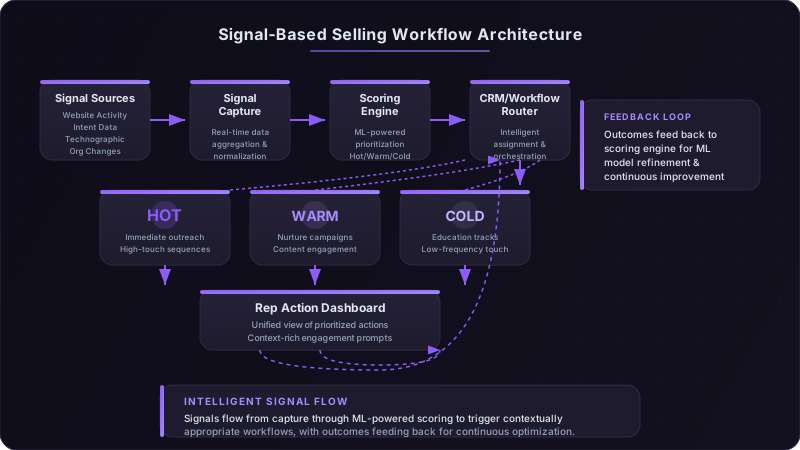
Building a Signal-Based Selling Motion from Scratch
A practical playbook for sales teams transitioning from spray-and-pray list-based outbound to a signal-driven approach that actually converts.
Why Most Cold Emails Get Ignored: The Signal-vs-Template Breakdown
Templated cold email keeps getting ignored while emails that reference a real buying signal still earn replies. Here is the framework, the deliverability basics, and the metrics that close the gap.
Make Your First Cold Email Count (And Make the Follow-Ups Earn Their Place)
Your first email usually has the best chance of a reply, yet most sequence effort goes into follow-ups. Here is a four-sentence framework, signal stacking, and how to measure the reply curve on your own team.