RevOps in 2026: The Trends Reshaping Sales Operations
Revenue operations is shifting toward cleaner data, fewer tools, shared attribution, predictive workflows, and customer outcome metrics. Here is what each trend changes and how to act on it.
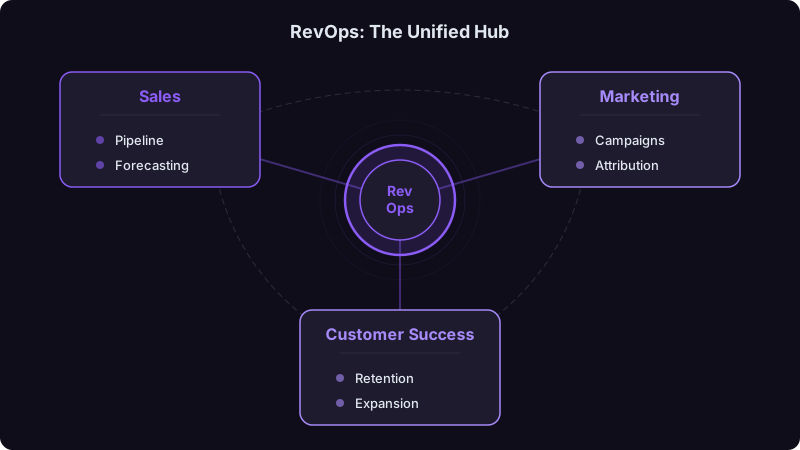
Revenue operations has moved from an org chart experiment to the function that decides whether a go-to-market team can see and trust its own numbers. The shifts underway in 2026 are changing what RevOps teams spend their time on, what they are judged on, and how much influence they have over revenue strategy.
This is not a list of buzzwords. Each trend below comes with what it changes in practice and a first step you can take.
The Starting Point: Too Many Tools, Not Enough Clean Data
Salesforce's seventh State of Sales report, based on a survey of 4,050 sales professionals, describes the environment most RevOps teams work in [1]:
- Only about a third of sales teams use one all-in-one platform; the rest use a mix of standalone tools, an average of eight per team [1].
- 42% of sales reps say they are overwhelmed by too many tools [1].
- Among teams with AI agents, the top data issues are manual errors, duplicate data, security concerns, incomplete data, and corrupt data [1].
- 51% of sales leaders with AI say tech silos delay or limit those initiatives [1].
Having a RevOps team and having a mature RevOps function are different things. Many teams still spend most of their week on reactive work: fixing broken workflows and building reports on request. The trends below separate teams keeping the lights on from teams shaping revenue strategy.
RevOps Maturity: Where Is Your Team?
Use this framework to place your team honestly before deciding which trend to tackle first.
| Maturity Stage | Characteristics | Typical Focus | Next Step |
|---|---|---|---|
| Stage 1: Reactive | Fixing broken workflows, ad hoc reports, no data governance | Keeping systems running | Define data ownership and field standards |
| Stage 2: Organized | Defined processes, regular reporting, basic automation | Consistent reporting | Unify dashboards across teams |
| Stage 3: Strategic | Cross-functional alignment, owned KPIs, early predictive models | Forecasting and planning | Add one measured predictive use case |
| Stage 4: Transformative | Automated data operations, shared revenue architecture, leadership influence | Revenue strategy | Tie metrics to retention and expansion |
Trend 1: AI-First Data Operations
"AI-first" gets used loosely. In RevOps, the practical meaning is moving repetitive data work to automation: enrichment, deduplication, standardizing company names, fixing field mappings, and routing.
Where teams are applying it:
- Enrichment and cleanup: tools fill and correct account and contact fields that people used to maintain by hand, with review rules for low-confidence changes.
- Lead and account routing: assignment based on fit, rep capacity, and segment history instead of plain round-robin.
- Forecast support: models trained on your own history that flag pipeline inflation for managers to review.
What this changes
The RevOps role shifts from data janitor to analyst. People who spent their weeks on hygiene can build scoring models and find expansion signals.
The catch: AI automates bad data just as quickly as good data. Salesforce reports that 74% of sales teams with AI are prioritizing data hygiene to support it [1]. Budget time for a cleanup project before any AI tooling, and measure duplicate and incomplete record rates before and after.
Trend 2: Tool Consolidation
Every tool brings its own login, data model, integrations, and renewal. Together they create data silos and integration failures that nobody notices until leads go unrouted.
Consolidation is accelerating. Salesforce found that 84% of sales teams without an all-in-one platform plan to consolidate their tech [1]. Three forces drive it:
Cost scrutiny. Finance teams ask what each renewal actually delivers.
Integration debt. Every point-to-point sync is a failure point. A sync that breaks silently can leave leads unrouted for weeks.
Better platforms. Multi-function platforms now cover work that used to need several separate tools.
What this changes
Fewer tools mean less context switching for reps and fewer reconciliation problems for RevOps. They also raise the stakes on each platform decision, since each remaining tool becomes critical.
Build a rationalization scorecard. Classify every tool as a core platform (deeply integrated, must own), a specialist (does one job better than any platform), or a replacement candidate. Be strict about the third group, and calculate real cost as licenses plus integration maintenance plus training time.
Trend 3: Attribution That Teams Agree On
Marketing and sales often argue about the numbers because they pull from different systems with different attribution logic. Both sides can be technically right and the debate still produces nothing.
What is changing:
- Single-touch models are fading. A deal that started at a webinar, moved through months of content, got an outbound touch, a customer referral, and finally a demo request should not be credited to one channel.
- Contribution is tracked across the full funnel. Marketing does not stop at lead creation and sales does not start at close; both see their effect at each stage.
- One set of dashboards. When everyone uses the same data and model, meetings shift from "whose number is right" to "what do we do next."
What this changes
Shared attribution changes behavior. Marketing optimizes for pipeline quality instead of lead volume, and sales engages faster with marketing-sourced leads it now trusts.
Trend 4: Predictive Operations Replace Firefighting
Reactive RevOps does not scale: something breaks, you fix it; someone needs a report, you build it. Predictive operations means intervening before the problem shows up.
Three common starting points:
Churn risk. Combine product usage trends, support ticket patterns, survey responses, and engagement with customer success outreach. When an account looks like past churned accounts, customer success reaches out early.
Pipeline risk. Flag deals where buying activity has stalled: no new stakeholders, no document activity, slower replies. Managers coach on the deals that need it, not just the largest ones.
Expansion signals. Score existing accounts on usage patterns that preceded upsells in the past, and alert account owners with specific talking points.
What this changes
RevOps becomes a strategic partner. "Here are the deals most likely to slip this quarter, and here is why" changes the conversation from "can you pull a report?" to "what should we do?"
Keep the first model simple enough that account owners can see why an account was flagged. A short list of the factors behind each flag earns more trust than a score nobody can explain, and it makes the model easier to correct when it is wrong.
Pick one use case, define how you will measure it before you build it, and compare outcomes for accounts where you intervened against similar accounts where you did not.
Trend 5: Customer Outcome Metrics Join Activity Metrics
Traditional metrics (leads, qualified leads, meetings booked, calls made) measure what your team does. Customer outcome metrics measure what the customer gets:
- Customer lifetime value: what a customer is worth over the whole relationship, which forces attention on retention and expansion, not only acquisition.
- Net revenue retention: whether existing customers spend more over time. When existing customers spend more this year than the same customers spent last year, the base grows even without new logos.
- Time to value: how quickly a customer reaches the result they bought the product for.
- Customer effort: how hard it is to do business with you, from onboarding to billing to support.
The shift from activity metrics to customer outcome metrics is the largest mindset change in RevOps. It works best when leadership adopts it as company strategy, not as a reporting change.
What this changes
Compensation plans start to reward retention and expansion. Marketing optimizes for customers who stay. Product teams join revenue conversations because usage becomes a leading indicator.
Expect a transition period where old metrics look worse because you stopped optimizing for them, and new metrics have not caught up yet. Leadership support through that period is essential.
What RevOps Leaders Should Do Now
In priority order:
- 1Audit the tech stack. Map every tool to a capability, calculate real cost including integration and training, and identify consolidation candidates.
- 1Clean the data before adding AI. Start with deduplication and enrichment, then routing, then forecasting. Each step depends on the one before it.
- 1Build a single source of truth. If marketing, sales, and customer success use different dashboards with different numbers, nothing else matters. Unify the data model before building attribution or predictive models.
- 1Start one predictive use case. Choose the one easiest to measure, prove it, and use that result to fund the next.
- 1Align leadership on customer metrics. RevOps can provide the data and framework, but the CEO and CRO need to own the transition.
The gap between mature and immature RevOps functions shows up in forecast quality, in how quickly teams can act on data, and eventually in revenue. These trends are already underway. The question is whether your team leads them or reacts to them.
References
[1]Salesforce, State of Sales, Seventh Edition, 2026. https://www.salesforce.com/en/wp-content/uploads/sites/4/documents/reports/sales/salesforce-state-of-sales-report-2026.pdf
Ready to transform your sales pipeline?
See how Prospectory's AI-powered platform can help your team research, reach, and relate to prospects at scale.
Related Articles
RevOps Debt: How Misaligned CRM Workflows Quietly Drain Pipeline
Underperforming pipeline usually isn't a rep or messaging problem. It's accumulated RevOps debt in your routing, lifecycle stages, and CRM automations. Here's the audit framework.
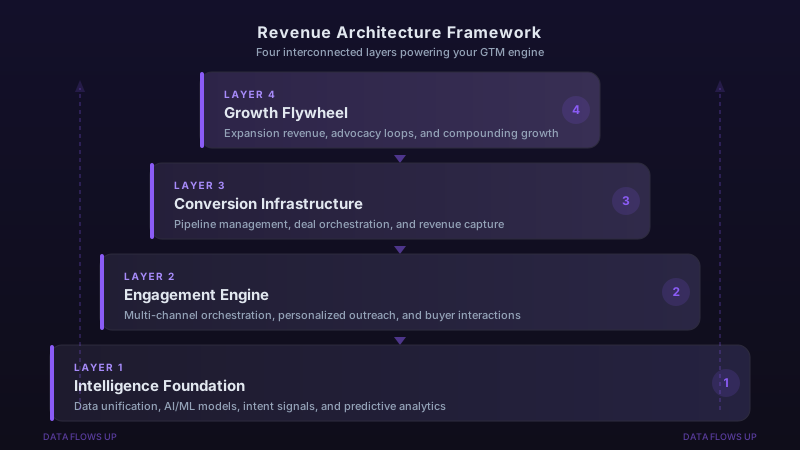
The Revenue Architecture Blueprint: Designing Your Go-to-Market Engine for the AI Era
Traditional go-to-market motions are breaking down. Here's the new blueprint for building a revenue architecture that leverages AI at every stage of the buyer journey.
Email Authentication for Outbound Teams: Fix SPF, DKIM, and DMARC Before You Send
Gmail and Outlook now publish authentication rules for high-volume senders. Here is a non-technical RevOps playbook for SPF, DKIM, DMARC, domain warming, and volume management.