When to Fire Your Sales Playbook and Start Over
Five signals your playbook is broken beyond repair, plus a 30-day sprint framework for rebuilding from first principles without killing pipeline.
Your VP of Sales just announced another "coaching blitz" to fix quota attainment. The team will role-play more objection handling. You'll review more call recordings. You'll tighten up the messaging framework. Again.
But here's what nobody's saying: the problem isn't execution. It's the playbook itself. The documented process that leadership swears by, the one you spent months building a few years ago, may no longer match how B2B selling works now. Your top performers may have figured this out already, which is why they quietly ignore it. Your middle performers are drowning trying to follow a process that no longer matches the market. And your new hires are learning a playbook designed for a world with smaller buying groups and more responsive inboxes.
The cost of this denial isn't just missed quota. It's measurable, compounding, and it shows up in your P&L whether you acknowledge it or not.
The Cost of Playbook Denial
Sales leaders can spend many months trying to coach their way out of a structural problem. They see declining conversion rates and assume it's a people issue. They watch response rates crater and blame the messaging. They notice top performers deviating from the playbook and call it a discipline problem.
The three-quarter rule cuts through this denial: If nine months of coaching, training, and process tweaks have not moved the numbers, the playbook is structurally broken. Not incomplete. Not misunderstood. Broken.
Here's how to estimate what playbook denial costs you, with your own numbers. Start with opportunity cost: the gap between your team's current conversion and what your top performers achieve, multiplied across every rep and every quarter you delay. Then add rep churn: sellers leave broken processes, and each replacement costs recruiting, ramp time, and lost productivity. Then count stack waste: seats for tools the playbook never tells reps how to use.
Why do teams wait so long? Because admitting the playbook is broken feels like admitting you failed. It's not. The market shifted. Buying groups are larger, generic outreach earns fewer replies, and buyers do more research before they talk to sellers. Your playbook may have been built for a different game.
The question isn't whether to rebuild. It's whether you rebuild now or after another three quarters of compounding costs.
Signal #1: Your Top Performers Ignore the Playbook
Walk over to your top rep's desk right now. Ask them to walk you through their last three deals. Then compare what they describe to your documented playbook. If those two things don't match, you don't have an adherence problem. You have a credibility problem.
When the reps who consistently hit quota are all doing something different than the documented process, the documented process is wrong. This isn't about reps going rogue. It's about sellers evolving faster than your documentation. They've discovered what actually works in 2026, and it doesn't look like the framework you built in 2022.
The shadow playbook phenomenon shows up in Slack DMs, not sales team meetings. High performers share what's working in private channels: "Forget the 7-step sequence, here's the 3-message pattern that actually gets replies." "Skip the discovery call framework, use this one-pager that gets technical buyers to respond." "Don't waste time on LinkedIn InMails, find them on Reddit first and reference their actual question."
A common pattern: the playbook calls for a long, call-first cadence, while the reps who hit quota have quietly moved to short, specific emails tied to a real trigger and a concrete answer to a problem the buyer has described. Compare their response rates with the playbook's in your own data.
Here's how to audit this properly:
Shadow your top three performers for full deal cycles. Don't ask them to describe their process, watch them work. Track every touchpoint, tool, and decision point. Record what they actually do, not what they think they do.
Map their real process against your documented playbook. Where do they deviate? Where do they skip steps? Where do they add steps the playbook doesn't include? Every deviation is a signal that the documented process doesn't match reality.
Interview them about the why behind each deviation. Don't frame it as "why aren't you following the playbook?" Ask "why does this work better?" Most top performers have figured out specific reasons: "The playbook says to call first, but buyers screen calls and it burns the relationship. A short email tied to a real trigger gets answered."
Look for convergent behavior. If all three top performers ignore the same playbook step, that step is wrong. If they all add something the playbook doesn't include, your playbook has a gap.
When you hire more reps to execute a playbook that your top performers actively reject, you're scaling a broken process. You're asking new hires to follow a framework that demonstrably doesn't work, then wondering why they struggle to ramp. The new hire failure isn't a training problem, it's a structural design flaw.
Signal #2: Your Stack Has More Tools Than Your Playbook Has Steps
Count the tools your reps toggle between to complete a single outbound sequence. Prospecting database, LinkedIn Sales Navigator, email sequencer, CRM, conversation intelligence platform, video messaging tool, mutual connections lookup, intent data feed. That's eight context switches to research a prospect, craft outreach, send a message, and log activity.
Now count the steps in your documented playbook for that same sequence. If you have more tools than documented steps, or if multiple tools map to the same step, your playbook isn't solving the core selling motion. It's outsourcing thinking to a disjointed stack.
Tool proliferation is a symptom, not the disease. Each new platform gets added to solve a specific gap: "We need better intent data." "We're not getting enough LinkedIn engagement." "Reps aren't recording calls." But stacking point solutions on a broken playbook just creates complexity without coherence. Reps spend more time navigating tools than executing selling behaviors.
Here's the diagnostic: Map your current tech stack to your playbook steps. Take your documented sales process and write each tool name next to the step it supports. You'll see one of three patterns:
Pattern 1: Multiple tools for one step. If "research prospect" involves toggling between three databases and LinkedIn Sales Navigator, none of those tools is giving you the complete answer. The playbook step is underspecified, so reps compensate with more tools.
Pattern 2: No tools for critical steps. If your playbook says "identify buying committee members" but you don't have a tool that surfaces org charts or stakeholder maps, reps either skip the step or invent their own workaround. Both create inconsistency.
Pattern 3: Tools with no playbook step. If you're paying for a conversation intelligence platform but the playbook doesn't specify when or how to use call insights, you've got orphaned technology. Reps might use it (adding manual work), or they might ignore it (wasting budget).
The consolidation test cuts through the complexity: If you can't explain why each tool exists in one sentence that ties to a specific playbook outcome, your playbook is broken. "We use this prospecting database because step 2 requires identifying companies that match our ICP and recently hired a new VP of Sales" is clear. "We use this tool for data" isn't.
The fix isn't to rip out tools. It's to rebuild the playbook with stack integration as a first-class design constraint. Each step should specify: the tool that powers it, the data it requires, and the outcome it produces. If you can't tie a tool to a clear step with a measurable outcome, you don't need the tool, or you need a new playbook that actually uses it.
Signal #3: Buying Committees Grew But Your Playbook Didn't
Your playbook says to "identify the champion and schedule a discovery call." That made sense when buying decisions involved fewer people. It's structural fantasy when buying groups are large and much of the decision happens before you even get a meeting.
Single-champion playbooks fail in multi-stakeholder reality. Here's why: you find your champion (usually a director-level user who sees the pain), you run discovery, you demo the solution, you get verbal commitment. Then your champion takes it to the buying committee, where a CFO you've never spoken to kills it because of budget timing. Or a security lead flags compliance concerns you didn't know existed. Or an ops person says it won't integrate with their core system. Your champion couldn't sell internally because you didn't equip them with answers for stakeholders you didn't know mattered.
The multi-threading gap is this: playbooks designed for one or two contacts facing a buying group with competing priorities. Your process assumes linear progression (champion → demo → close), but reality is networked chaos (champion + CFO + security + ops + procurement + legal + three VPs with different agendas, all with veto power).
Audit whether your playbook accounts for this by asking:
Does your discovery step identify the full buying committee upfront? If the playbook says "understand pain points and budget," but doesn't say "map all decision-makers, influencers, and their individual success criteria," you're missing most of the stakeholders who'll actually vote.
Do you have explicit steps for engaging external participants? Consultants, auditors, industry analysts, board members, these people often have outsized influence but never appear in your CRM. If your playbook doesn't account for them, you're blind to key blockers.
Does your content library equip champions to sell internally? Most playbooks end at "send proposal." But your champion needs a one-pager for the CFO that speaks ROI in their language, a security doc for the CISO, an integration technical brief for ops. If you're not producing these and your playbook doesn't specify when to deliver them, your champion is selling with one hand tied behind their back.
Does your timeline account for consensus-building? If your playbook assumes a short sales cycle but the buying group needs much longer to align, your forecast is structurally wrong and your follow-up cadence will feel pushy or absent at the wrong times.
The early-research rule crystallizes the problem: If most decision-making happens before seller engagement, your playbook starts too late. You need to be present in the research phase, not waiting for an inbound lead to come through. That requires a different motion: signal-based outreach when a company shows intent, content that surfaces in their pre-purchase research, engagement in communities where they ask questions (like Reddit).
Your playbook isn't just missing steps. It's designed for a buying process that no longer exists.
Signal #4: Your Outreach Response Rates Keep Falling
Pull your email metrics from the last quarter. If your cold outreach response rate is low and falling, your playbook may be spray-and-pray, not signal-based. The performance gap between the two approaches has never been wider, and the market is punishing generic at scale.
Here's the split to measure in your own data:
Standard cold outreach (generic, cadence-based, no triggering event). This is the "spray-and-pray" motion where you blast many prospects with the same message and hope a few reply.
Leadership change signals (contacting prospects soon after a new VP or C-suite hire). New executives are often actively looking to make changes, so the timing can be right.
Compare response rates for the two groups. Even a modest gap, multiplied by a rep's weekly sends over a year, adds up to a very different number of conversations from the same effort.
Most playbooks written before 2024 are fundamentally cadence-based: touch the prospect X times over Y days with emails, calls, and LinkedIn messages. The sequence matters more than the context. This worked when inboxes were less crowded and buyers had time to engage with "just checking in" messages. It doesn't work now. Buyers ignore generic outreach because they're drowning in it. They respond to messages that arrive at the exact moment they're thinking about the problem you solve.
How to measure if your playbook is trigger-based or spray-and-pray:
Count how many playbook steps mention a triggering event. If your documented process says "Send email 1 on day 1, call on day 2, send email 2 on day 4," with no mention of why this week versus last week, you're cadence-based. Signal-based playbooks start with the trigger: "When a prospect company raises Series B funding, send this message within 48 hours."
Track your outreach timing relative to buyer intent signals. Pull 50 recent deals. How many started within 30 days of a funding announcement, leadership change, product launch, competitor loss, or public pain point mention? If few have a clear triggering event, you're not building signal-awareness into your process.
Audit your message content for context. Generic: "I saw you're in the manufacturing space and wanted to share how we help companies like yours." Signal-based: "Congrats on the Series B last week. Companies that scale from 50 to 200 employees in the next 12 months usually hit this specific ops bottleneck, here's how three other portfolio companies solved it."
A fresh funding announcement is one of the highest-intent signals available. Companies that close funding are in active hiring and spending mode. They've just validated a growth plan to their investors, which means they need to execute fast. If your playbook doesn't have a trigger for "funding announcement → research their growth plan → send tailored outreach within 48 hours," you're leaving timely conversations on the table.
Why playbooks built before signal-based selling existed can't just be patched: they're structured around the wrong unit of work. Cadence-based playbooks treat "prospect" as the atomic unit. Signal-based playbooks treat "buyer intent moment" as the atomic unit. You can't retrofit one into the other by adding a step. You need different tooling (intent data feeds, signal monitoring), different messaging (contextual, not templated), and different success metrics (response rate by signal type, not emails sent).
If your playbook's response rates keep falling, it may not be a messaging problem. It's an architecture problem.
Signal #5: Reps Spend Most of Their Time on Non-Selling Tasks
Ask your reps to log their time for a week. Not what they think they do, but 15-minute increments of actual activity: prospecting research, drafting emails, discovery calls, deal strategy, CRM data entry, internal meetings, tool navigation, proposal writing, Slack firefighting.
If only a small part of their time is spent in actual selling conversations (calls, meetings, high-value email exchanges), your playbook is killing productivity. In Salesforce's seventh State of Sales survey, reps spent 60% of an average workweek not selling [1]. Much of that overhead can trace back to playbook design.
Here's how to time-audit your playbook properly:
Map every playbook step to selling versus admin work. Go through your documented process line by line. "Research prospect company and decision-makers" → 20 minutes. "Log findings in CRM" → 5 minutes. "Draft personalized email" → 8 minutes. "Update opportunity stage" → 3 minutes. "Schedule follow-up task" → 2 minutes. Add it up. If a single outbound sequence requires 60 minutes of work but only 10 minutes is actual message drafting or call time, your playbook has a 6:1 overhead ratio.
Identify steps that require manual data entry. Every time your playbook says "update CRM with..." or "log activity in..." or "create task for..." you're adding manual work that doesn't move the deal forward. These steps exist because your tools don't talk to each other or because your playbook doesn't account for automation.
Count the system switches required. If completing a single playbook step requires opening three tools, copying information between them, and manually reconciling data, you've designed friction into the process. The one-click test is simple: If a playbook step requires more than one system to complete, it's broken. Sellers shouldn't need to toggle from a prospecting database to LinkedIn to their CRM to their email tool just to send a single personalized message.
The data entry tax is particularly insidious. Playbooks that require manual CRM updates after every activity create a psychological burden: reps know they're supposed to log the call, but it takes 5 minutes they don't have, so they batch it or skip it entirely. Then your data quality degrades, which makes forecasting unreliable, which leads to pressure from leadership, which makes reps resent the process even more.
Why playbook complexity hurts: in the same survey, 42% of reps said they are overwhelmed by too many tools [1]. Cognitive overload from navigating a complex playbook means less mental energy for the actual hard work of selling (understanding nuanced buyer needs, adapting your pitch, handling objections, negotiating).
The fix isn't to tell reps to "work faster" or "be more efficient." It's to redesign the playbook so the default path is the efficient path. Automate data entry. Consolidate tools. Cut steps that don't directly create buyer value. If your documented process has 47 steps, you haven't built a playbook, you've built a bureaucracy.
A good playbook should make selling easier, not harder. If reps are spending most of their time on overhead, the playbook is the problem.
The 30-Day Playbook Rebuild Sprint Framework
You can't rebuild a playbook while maintaining full pipeline velocity, right? Wrong. The parallel path strategy lets you design and test a new process without killing existing deals or forcing a hard cutover that leaves reps scrambling.
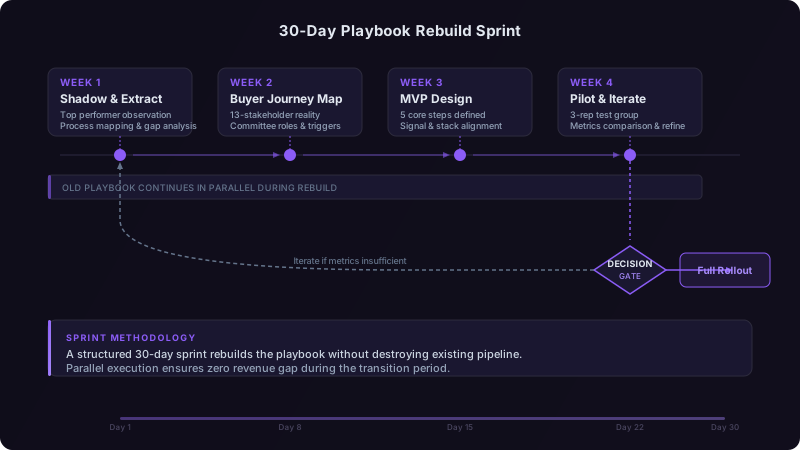
Here's the 30-day sprint framework that works:
Week 1: Shadow & Extract
Shadow your top three performers for full selling cycles. Don't schedule formal meetings, just watch them work for 2-3 days each. Sit in on calls, watch them research prospects, observe their email workflow, see which tools they actually open (versus which ones collect dust). Record everything.
Extract their actual process, not what they say they do. People are terrible at describing their own workflows accurately. Ask a top performer how they prospect and they'll give you the LinkedIn/email/call answer. Watch them work and you might see something different: for example, they answer buyers' questions in public communities, research each account before writing, and keep emails to a few sentences that stand on their own. The observation reveals what interview questions can't.
Map the gaps between their real process and your documented playbook. Create a side-by-side comparison. Where do they skip steps? Where do they add steps? Where do they use completely different tools or channels? Every deviation is a hypothesis about what's broken in the documented version.
Quantify the performance difference. Pull their conversion metrics (response rates, meeting-set rates, close rates) and compare them to team averages. This gives you the business case for rebuilding. A side-by-side of top performers' response rates against the documented playbook's is a compelling argument.
Week 2: Buyer Journey Mapping
Map the actual buyer journey for your current buying-group reality. Not the idealized sales process, the real buying process. Who are the internal stakeholders? What are their individual success criteria? When do they get involved? What external participants influence the decision (consultants, auditors, industry analysts)? What content do they consume during research? Where do they ask questions?
Identify buying committee roles and decision triggers. Who has veto power? Who influences but doesn't decide? Who controls budget versus timeline versus technical requirements? Map this as an org chart with annotations for each person's priorities and triggers.
Find the high-intent signals that predict buying windows. Talk to recent customers about what triggered their purchase timing. Funding rounds? Leadership changes? Competitor issues? Regulatory deadlines? Expansion plans? Build a list of the signals that create urgency.
Document the decision-making that happens before seller engagement. What research are buyers doing? Which websites are they visiting? What questions are they asking in communities? Where is your opportunity to show up in that research phase with helpful content?
Week 3: MVP Design
Design the minimum viable playbook with 5 core steps, not 47. Complexity kills adoption. Your new playbook should cover: (1) Signal detection and prospect identification, (2) Research and context gathering, (3) Multi-channel outreach sequence, (4) Discovery and stakeholder mapping, (5) Deal progression and committee engagement. That's it. If it's not core to moving the deal forward, cut it.
Integrate signal triggers into every step. The new playbook shouldn't be cadence-based. It should be event-based. Step 1 starts when a signal fires (funding, leadership change, Reddit question). Step 2 happens when the prospect replies. Step 3 triggers when you identify a new stakeholder. Time-based steps (wait 3 days, then...) should be the exception, not the default.
Map tools to steps with single-system execution. Each playbook step should happen in one tool, or your stack needs consolidation. "Identify high-intent prospects" should pull from your prospecting database with built-in intent data, not require manual toggling between three systems. "Send multi-channel sequence" should orchestrate email, LinkedIn, and video from one interface.
Build in feedback loops so the playbook evolves. Include a step where reps flag what's working and what's broken. Weekly 15-minute retros where the team discusses edge cases and suggests refinements. A Slack channel for real-time "this step didn't work because..." reports. The playbook should be a living document that adapts to market changes, not a static rulebook.
Week 4: Pilot & Iterate
Select 3 reps for the pilot, one top performer, one solid mid-performer, one newer hire. This gives you signal across experience levels. The top performer validates that the new approach works for someone who knows how to sell. The mid-performer tests whether it's coachable and repeatable. The new hire shows whether it's simple enough to ramp quickly.
Run the new playbook in parallel with the old one. Pilot reps use the new process for all net-new outbound. Everyone else continues with the existing playbook. This protects pipeline while testing the new approach.
Measure against clear metrics. Track response rates, meeting-set rates, time-to-first-meeting, and time spent on non-selling tasks. Compare pilot results to team averages weekly. You should see improvements within 2-3 weeks if the new playbook is better.
Iterate based on what breaks. The pilot will surface edge cases you didn't anticipate. A step that works great for one ICP fails for another. A tool integration isn't as smooth as you expected. A message template needs refinement. Fix these issues during the pilot, not after full rollout.
Decision gate: Full rollout or another iteration? At the end of week 4, look at the data. If pilot reps clearly outperform team averages on key metrics, roll out broadly. If not, extend the pilot another 2 weeks and iterate.
The parallel path strategy is critical. You're not forcing the team to adopt an untested process cold. You're proving it works with a small group first, which builds buy-in and surfaces issues before they affect the whole team.
Building a Playbook for Signal-Based, Multi-Channel Reality
Today's selling environment requires a different playbook architecture. You're not optimizing the old approach, you're designing for new constraints: larger buying groups, more of the decision made before engagement, buyers who research in communities and with AI assistants, and a widening gap between signal-based and generic outreach.
Here's how to structure the new playbook:
Build Around Buying Signals, Not Arbitrary Cadences
The playbook should organize steps around buyer intent moments, not calendar days. Instead of "Day 1: Email 1, Day 3: Call, Day 5: Email 2," structure it as:
- When [Leadership Change Signal]: Research new exec's priorities within 24 hours, send contextual outreach within 48 hours
- When [Funding Announcement]: Map their stated growth plans, identify likely pain points, reach out with relevant case study within 48 hours
- When [Reddit Question Posted]: Respond in the thread with a genuinely helpful answer (no sales pitch) and let the poster reach out if they want to
- When [Product Launch]: Identify ops implications of their launch, reach out with specific growth bottleneck insight
This requires different tooling: intent data feeds that surface these signals in real-time, CRM triggers that create tasks automatically, and message templates organized by signal type rather than sequence number.
Orchestrate Multi-Channel Sequences Without Overwhelming Reps
Effective outreach today uses email, LinkedIn, Reddit, Twitter, video, and direct mail in coordinated sequences. But asking reps to manually manage 6 channels is a recipe for inconsistency. The playbook should specify:
Channel priority by buyer persona. If you're selling to technical buyers, they live on Reddit and GitHub, not LinkedIn. If you're targeting C-suite, LinkedIn and email dominate. The playbook should route reps to the right channels based on who they're reaching.
Automated orchestration with human customization points. Use tools that handle the sequencing (send email on signal, wait 3 days, send LinkedIn message, wait 2 days, send video) but surface specific moments where reps add personalization. "Email 1 auto-drafts with signal context, rep customizes first paragraph" is the right balance.
Cross-channel consistency without copy-paste. The same message shouldn't repeat verbatim across email, LinkedIn, and video. The playbook should provide modular content: a core insight, supporting stats, and a call-to-action, then show reps how to adapt tone and format for each channel.
The Reddit Research Step: Source Prospects Who've Expressed the Problem
Here's a step most playbooks don't include but should: search Reddit for the questions buyers in your market ask about the problem you solve. It shows you live demand in buyers' own words. Use it as market research, never to identify or contact a pseudonymous poster.
How to operationalize this:
- 1Identify the subreddits where your ICP asks questions. For sales tools, it's r/sales. For dev tools, r/programming and r/webdev. For ops, r/sysadmin. List the 5-7 subreddits where your buyers gather.
- 1Set up keyword alerts. Use tools that monitor Reddit for specific terms (the problem you solve, competitor names, integration challenges). When a relevant post appears, surface it to your team within 24 hours.
- 1Respond helpfully without selling. If someone posts "We just raised Series B and need to scale our SDR team from 5 to 20 reps, what tools should we use?" you respond with genuinely useful advice. Mention your product only if directly relevant, and always disclose you work there.
- 1Let them come to you. If the poster sends you a DM, help first and ask before moving the conversation to email or a call. Never email someone about their Reddit post, and never quote it back to them.
Build Feedback Loops Into the Playbook So It Evolves
The market changes faster than annual planning cycles. Your playbook needs mechanisms to adapt continuously:
Weekly 15-minute retros where reps share what's working and what broke. Surface the edge cases, the messaging that fell flat, the objections the playbook doesn't address. Update the documented process in real-time based on what you learn.
Slack channel for real-time playbook feedback. When a rep hits a situation the playbook doesn't cover, they post it immediately. Sales leadership responds within 24 hours with guidance, and the playbook gets updated if it's a recurring gap.
Quarterly playbook audits against performance data. Pull conversion metrics by playbook step. If one step consistently loses most of the deals that reach it, that step is broken. Investigate why, fix it, and measure again.
Competitive intel feed. When prospects mention competitors, track what they're saying. If a pattern emerges (competitor X is winning on price, competitor Y has better integrations), update your playbook to proactively address those objections earlier in the process.
The goal is a playbook that gets better every week, not one that's perfect on day one and slowly decays as the market shifts.
| Rebuild Decision Factor | Keep & Iterate Current Playbook | Burn It Down & Rebuild |
|---|---|---|
| Top Performer Behavior | Most top performers follow the documented process | Top performers have created shadow playbooks they share privately |
| Response Rate Trend | Declining slowly, responds to A/B testing | Low and flat for two quarters despite testing |
| Buying Committee Reality | Playbook maps to actual stakeholder count | Designed for one or two champions, facing a full buying group |
| Time-to-Productivity | New hires ramp in 60-90 days following playbook | New hires struggle for 6+ months or abandon playbook to survive |
| Rep Feedback | Minor complaints about specific steps | Widespread frustration, frequent workarounds, "the playbook doesn't work" |
What to Do in the Next 30 Minutes
Pull your CRM data for the last 90 days. Filter for closed-won deals. For each one, note the date the opportunity was created and look back 30 days before that. Was there a triggering event: funding announcement, leadership change, product launch, competitor loss, or public pain point mention?
If few of your wins have a clear signal within 30 days of opportunity creation, your current playbook is not built around buyer intent. That's where the rebuild starts.
This week, shadow your top performer for a full day. Watch what they actually do, not what they say they do. Map their real process. Count the gaps between their approach and your documented playbook. That gap is the roadmap for your rebuild.
The playbooks that win aren't the ones that got more polish years ago. They're the ones that rebuilt from first principles to match signal-based, multi-stakeholder, multi-channel reality. Yours can either adapt now or spend more months pretending coaching will fix a structural problem.
References
[1]Salesforce, State of Sales, Seventh Edition, 2026. https://www.salesforce.com/en/wp-content/uploads/sites/4/documents/reports/sales/salesforce-state-of-sales-report-2026.pdf
Ready to transform your sales pipeline?
See how Prospectory's AI-powered platform can help your team research, reach, and relate to prospects at scale.
Related Articles
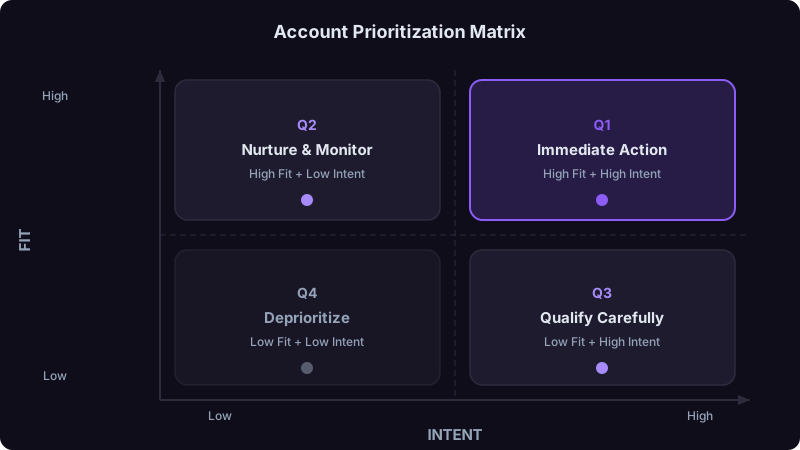
Account Prioritization: A Practical Fit, Evidence, and Timing Framework
Build a reviewable account-prioritization process that combines fit, current evidence, timing, CRM context, and seller judgment without treating a score as a buying decision.
AI Agents Are Killing Per-Seat SaaS: What B2B Sellers Must Do Now
AI agents can now do part of the work that per-seat software licenses existed to support. Here is how buyers evaluate agent alternatives at renewal, and the repositioning playbook for vendors.
The SDR-AE Handoff Is Quietly Killing Your Qualified Pipeline
Poor handoffs let qualified meetings die between booking and the first AE call. Here's a six-field framework that fixes it and the metrics that prove it.