The SDR-AE Handoff Is Quietly Killing Your Qualified Pipeline
Poor handoffs let qualified meetings die between booking and the first AE call. Here's a six-field framework that fixes it and the metrics that prove it.
Companies lose pipeline not because their SDRs can't book meetings, but because those meetings dissolve in the window between "calendar invite sent" and "AE joins the Zoom."
The pattern is familiar: SDRs hit their meeting quota, AEs complain about "low quality pipeline," and CFOs wonder why sales efficiency keeps deteriorating despite record meeting volume. Trace qualified meetings from booking to opportunity creation and you often find a share that never make it into pipeline, because the handoff was a black box where context, urgency, and buyer intent disappeared.
The irony is painful. SDRs now use signal-based outreach, targeting prospects right after funding rounds, executive hires, or technology implementations, and earn far more replies than generic cold email. They book meetings with buyers who have real urgency and budget. Then we hand those hot prospects to AEs with zero context about which signal triggered the conversation, what pain points the buyer mentioned, or what timeline they're working against. The top of the funnel gets optimized while the handoff becomes a pipeline black hole.
The Pipeline Black Hole Nobody Measures
Most sales leaders obsess over meeting volume. They track meetings booked per SDR, cost per meeting, and show rates. But almost nobody measures what happens in the critical window after a meeting gets scheduled. That's where qualified pipeline goes to die.
Here's illustrative math. Multiply the meetings your SDR team books each quarter by your average deal size to get the potential pipeline. If even a modest share of those qualified meetings fails to convert because the handoff broke the buyer's momentum, the loss runs into millions, every quarter. Run it with your own numbers.
The worst part is that nobody owns this metric. SDRs get credit when the meeting is booked. AEs aren't accountable until an opportunity is created. The gap between those two events is a no-man's-land where deals quietly disappear and everyone blames "lead quality" instead of examining the handoff process.
Here is an illustrative example. An SDR reaches out to a VP of Sales three days after their company announced a Series B. The timing is perfect, they're about to scale their team and need tools to support that growth. The SDR has a great conversation, uncovers specific pain points around pipeline visibility and forecast accuracy, and books a meeting for the following Tuesday.
The AE receives a calendar notification with the prospect's name, company, and title. That's it. No mention of the Series B trigger. No documentation of the pain points discussed. No context about the buyer's timeline or who else needs to be involved. The AE shows up to the call and starts with "So tell me about your current sales process and what prompted you to take this meeting." The prospect thinks, "Did this person even talk to their colleague? Do they not share information internally?" The meeting still happens, but the momentum is gone. What should have been a qualified opportunity turns into "let me think about it and get back to you."
Multiply that scenario across a quarter of meetings. The real cost isn't just lost pipeline. It's wasted SDR effort, burned prospects who won't take a second meeting, and AE frustration that compounds over time and drives turnover.
Why Traditional Handoffs Fail (And Why It's Getting Worse)
At many companies, the handoff process hasn't evolved in years. SDRs book meetings in Salesforce or a tool like Chili Piper. AEs get a notification. Maybe there's a notes field that says "interested in learning more about our platform." That's the entire information transfer.
This barely worked when outbound was spray-and-pray cold calling. If an SDR made 80 dials to book one meeting, there wasn't much context to transfer anyway. But signal-based selling has changed everything. When an SDR targets prospects using real-time triggers, job changes, technology implementations, competitive churn, hiring surges, those buyers have specific, time-sensitive reasons for taking the meeting. They expect the AE to know why they're in the conversation right now, not next quarter.
AEs juggle dozens of active opportunities. They can't afford to spend the first 20 minutes of every discovery call re-asking questions the SDR already covered. But that's exactly what happens because the handoff contains no usable information. Audit a sample of your own handoff notes. Many contain nothing beyond company name and job title, or generic phrases like "wants to improve sales efficiency" with no specifics about current state, pain points, or timeline.
The problem compounds when you consider how buyers actually make decisions. A VP of Sales who agrees to a meeting expects that the rep who booked it communicated their situation to the person running the demo. When that doesn't happen, when the AE asks the same qualifying questions or seems unaware of the buyer's urgency, it signals disorganization and erodes confidence before the deal even starts.
Slack handoffs make this worse, not better. An SDR messages the AE "Hey, just booked XYZ Corp, they're interested in our enterprise plan" and considers it handled. Two days later, the AE can't find that message in 400 other Slack threads and shows up blind. Verbal handoffs at team meetings evaporate the moment the meeting ends. Nothing makes it into the system of record where the AE can reference it during prep.
Tools haven't solved this because the problem isn't technological, it's process and incentive design. Conversation intelligence tools can record and transcribe SDR calls, but if nobody reviews the transcript or extracts the key insights into the handoff documentation, the information remains locked in a 27-minute recording that no AE has time to watch. AI summarization tools generate bullet points that miss the critical details: not just what the prospect said, but what signals triggered the outreach, what messaging resonated, and what red flags emerged during qualification.
Seven Common Handoff Failure Modes
Seven handoff failure patterns come up again and again:
The Ghost Handoff happens when an SDR books a meeting but provides zero context. The AE receives a calendar notification and has to investigate the account from scratch. AEs can spend most of an hour researching a company, only to discover in the first three minutes of the call that the SDR already covered everything they just researched. This wastes prep time and creates an awkward dynamic where the prospect wonders why they're repeating themselves.
The Time Warp kills deals through delay. An SDR books a meeting on Monday for the following Friday. By Wednesday, the AE still hasn't reached out to confirm details or send prep materials. The prospect's urgency fades. When Friday arrives, they've either gone cold or had three competitors reach out in the meantime. Time kills deals, especially signal-triggered opportunities. Research published in Harvard Business Review found that firms that tried to contact a lead within an hour were nearly seven times as likely to qualify it as firms that waited even an hour longer [1].
The Restart is the most frustrating failure mode for prospects. The AE begins the discovery call by asking all the same qualification questions the SDR already asked. "Walk me through your current process. What challenges are you facing? What's your timeline?" The prospect thinks, "We covered this. Why am I here?" It happens most when the SDR documented nothing beyond the meeting time.
The Context Void occurs when handoff notes miss the signal that made this prospect respond. Was it a funding announcement? A competitor's price increase? A new executive joining who used your product at their last company? That context determines how you position your solution and which use cases you emphasize. Without it, AEs default to generic discovery instead of targeted conversations that accelerate deals.
The Expectation Mismatch emerges when SDRs oversell to hit meeting quotas. They hint at pricing well below actual, suggest implementation timelines that are impossible, or promise features that don't exist. The AE walks into a meeting where the prospect expects something completely different from reality. The deal either dies immediately or becomes a nightmare that consumes cycles and still doesn't close.
The Multi-Stakeholder Miss happens when an SDR books a meeting with one person but the AE needs three to build a real opportunity. The SDR never asked about the buying process or who else needs to be involved. The AE spends the entire first call trying to figure out how to get access to the economic buyer, CTO, and CFO, conversations the SDR should have had during qualification.
The Tool Graveyard scatters handoff information across CRM notes fields, Slack messages, email threads, and conversation intelligence tools. The AE has to check five systems to piece together what happened. Half the time, they give up and wing it. Critical context exists somewhere but is functionally lost because there's no single source of truth.
Institute a firm policy: If an AE doesn't receive a complete handoff within 24 hours of meeting booking, the meeting doesn't count toward the SDR's quota. The rule makes documentation the final step that makes the meeting official, not optional administrative work. Track handoff completion rates before and after you introduce it.
What High-Performing Teams Actually Track During Handoff
Most sales operations dashboards track lagging indicators: opportunities created, pipeline value, close rates. But high-performing teams track leading indicators that predict whether booked meetings will convert to pipeline before the meeting even happens.
Handoff-to-first-touch time measures the hours between meeting booking and the AE's first outreach to the prospect. Target is under 24 hours for hot signal-triggered meetings (funding announcement, competitive churn, executive hire) and under 48 hours for warm meetings. Track how conversion changes as you shorten it.
Meeting show rate by handoff quality reveals whether incomplete handoffs predict no-shows. Segment your meetings into three buckets: complete handoffs (all required fields documented), partial handoffs (some fields missing), and minimal handoffs (just name and company). Then track show rates for each segment. If complete handoffs show up more often than minimal ones in your data, handoff quality is affecting whether prospects bother showing up.
Same-quarter pipeline conversion by SDR identifies which reps do quality handoffs versus which book meetings that go nowhere. For example, if one SDR books fewer meetings than another but converts far more of them to pipeline, that SDR is probably doing better handoffs despite booking fewer meetings. This metric shifts the focus from meeting quantity to meeting quality and handoff execution.
AE time spent on redundant discovery is harder to measure but critical. Sample 20 discovery calls and note how many minutes the AE spends asking questions the SDR should have already answered. For example, if the average is 15 to 20 minutes per call and your AEs run 80 first calls per quarter, that's 20 to 27 hours of wasted time per AE per quarter. Multiply by team size and you're looking at hundreds of hours that could be spent advancing real opportunities.
Prospect satisfaction tied to handoff experience comes from post-meeting surveys. Ask: "Did the account executive seem informed about your situation and the conversation you had with our SDR?" Track the percentage who answer "yes" and correlate it with conversion rates. Compare conversion for prospects who say yes with those who say no.
The insight here is that handoff quality is a leading indicator of revenue health. If you see handoff completion rates declining or time-to-first-touch increasing, you're likely to see pipeline creation problems weeks later. By the time that shows up in your weekly pipeline review, you've already lost the deals. Track handoff metrics in real-time and you can intervene before meetings turn into empty calendar blocks.
The Handoff Template That Actually Works
Here is a six-field handoff framework:
| Field | What to Document | Why It Matters |
|---|---|---|
| Trigger Signal | Specific event that made prospect respond: funding round, executive hire, competitor churn, tech implementation, hiring surge, price increase | Tells AE why this prospect has urgency right now and how to position timing. Without this, AE can't differentiate between "exploring options" and "need to decide this quarter." |
| Pain Points & Impact | Exact problems mentioned and business impact. Not "wants to improve efficiency" but "missing [share] of deals because reps don't know when accounts go dark, costs [their estimate] annually" | Enables AE to open with context: "I understand you're losing [their estimate] from late-stage deals going dark without visibility..." Skips generic discovery and proves continuity. |
| Current State & Workarounds | What they're using now and how they're handling the problem. Tools, processes, manual workarounds, why current solution isn't working | AE knows exactly what they're trying to replace and can position against it specifically rather than giving generic demo. Reveals switching costs and integration needs. |
| Buying Process & Stakeholders | Who else needs to be involved, how decisions get made, timeline for decision, budget approval process | Prevents single-threaded deals. AE knows whether they're talking to champion, influencer, or decision-maker and who else to bring in. Critical for enterprise deals. |
| Promised & Discussed | What SDR said about pricing, timeline, capabilities, next steps. Any commitments made during booking | Prevents expectation mismatches. If the SDR suggested a faster implementation than is realistic, the AE knows to correct it early on the first call and reset expectations. |
| Red Flags & Concerns | Budget constraints mentioned, competitive eval in progress, past bad experiences, concerns raised, objections voiced | Arms AE with landmines to avoid and objections to preempt. If prospect mentioned "we tried something like this and it failed," AE can address it proactively. |
This template works because it captures the information that changes how an AE prepares and runs the meeting. Generic templates ask for "prospect's goals" and "key challenges", field reps fill with "improve sales efficiency" and "better pipeline visibility." That tells you nothing. The six-field framework forces specificity.
Trigger Signal must reference the actual event. "Company raised Series B and is hiring 30 reps in next 6 months" is useful. "Interested in our platform" is not. SDRs should pull this directly from the signal source, LinkedIn posts, press releases, job listings, technology implementation data.
Pain Points & Impact requires numbers and consequences. "Reps lose [hours] a week to manual data entry, which costs [their estimate] a year in selling time" enables targeted positioning. "Wants to reduce manual work" enables nothing. This field should read like a business case memo, not a generic observation.
Current State & Workarounds prevents the embarrassing moment where an AE demos a feature the prospect's current tool already has. Document tools in use, integration points, what they like about current setup, and specific gaps. If they're using Salesforce + Outreach but missing signal-based triggers, that's your opening.
Buying Process & Stakeholders answers: Who scheduled this meeting? What's their role in decisions? Who else needs to see this? What's the timeline and budget process? "VP Sales booked meeting, needs CFO approval above [threshold], wants to decide by end of Q2, evaluating two other vendors" tells the AE exactly what deal shape to expect.
Promised & Discussed creates accountability. If an SDR quoted an enterprise starting price well below actual pricing, that needs to be documented so the AE can address the gap early. If SDR mentioned specific features, those become the focus of the demo.
Red Flags & Concerns surfaces deal-killers before they kill the deal. "CFO is risk-averse and requires 6-month ROI proof" means the AE knows to lead with financial outcomes. "Tried similar tool 18 months ago and implementation failed" means address implementation support and change management up front.
The key is making these fields required before a meeting counts as booked. Use workflow automation in your CRM so that if any required field is empty, the meeting doesn't hit the SDR's quota. Keep that rule deterministic and visible: the SDR should be able to see exactly which field is missing and fix it.
How AI Should (And Shouldn't) Help With Handoffs
Many sales teams have implemented AI, but handoff quality often hasn't improved because they use it wrong. They're treating conversation intelligence tools as passive recorders instead of active documentation systems.
Here's what actually works: AI call summarization that auto-populates handoff fields from SDR conversations. Tools like Gong, Chorus, and Clari can transcribe SDR calls and extract key information, pain points mentioned, competitors discussed, timeline references, stakeholder names. The AI then pre-fills your six-field handoff template, which the SDR reviews and submits. This cuts documentation time while improving quality, because AI catches details humans miss.
But there's a critical gap between what AI generates and what AEs need. AI-generated call summaries are good at capturing what was said. They're terrible at capturing why it matters. An AI summary might note "prospect mentioned current CRM lacks forecasting accuracy." An effective handoff needs to document "CFO rejected two deals last quarter because the forecast was badly off, created credibility problem for sales leader, needs solution that integrates with their ERP for real-time pipeline data." AI captures facts. Humans add context and implications.
Use AI to flag incomplete handoffs before meetings get scheduled. Build a workflow that analyzes handoff documentation as SDRs fill it out and alerts them if fields contain generic text or are too short. These alerts are coaching prompts for the SDR, not a scoring input: an AI judgment of "generic" text should never decide quota credit or pay on its own. "Pain points: wants better sales process" triggers a warning. "Pain points: losing a large share of late-stage deals because reps don't get notified when accounts go dark; prospect estimates the cost from their average deal size and late-stage volume" passes. The SDR decides whether to revise, and anything that affects credit or compensation goes through the required-field rule and AE ratings, with a manager review when an SDR disputes a rating.
Automatically surface account signals and intent data in handoff notes. If your signal intelligence platform shows that an account just implemented Salesforce, hired a Chief Revenue Officer, posted 12 sales job listings, and attended two competitor webinars, that data should auto-populate in the Trigger Signal field. SDRs can then add context from their conversation, but the baseline research happens automatically.
The mistake teams make is assuming AI will magically fix handoffs without changing the underlying process. AI doesn't solve incentive misalignment, if SDRs aren't measured on handoff quality, they'll let AI generate summaries and submit them without review. AI doesn't solve the problem of missing information, if an SDR never asked about buying process, AI can't document it. AI doesn't replace training, if SDRs don't understand what information matters to AEs, AI summaries will optimize for the wrong things.
Think of AI as a copilot that handles data extraction and pattern recognition so humans can focus on interpretation and implication. AI listens to 40 minutes of conversation and pulls out the relevant quotes, stakeholder names, and timeline mentions. The SDR reviews that extraction, adds the "so what" layer, and submits documentation that actually helps the AE prepare.
Making Handoff Quality a Leading Indicator of Revenue
The breakthrough happens when you stop treating handoff documentation as administrative overhead and start treating it as a leading indicator of revenue quality. Teams that do this build handoff completion rate into performance reviews, compensation plans, and weekly pipeline rituals.
SDR compensation should include a handoff quality component. Many SDR comp plans pay entirely on meetings booked or pipeline created. Add a modest multiplier tied to handoff quality score. Each week, AEs rate the handoffs they received as complete, partial, or minimal, with full credit only for complete handoffs. An SDR who books 12 meetings with all complete handoffs earns more than one who books 15 meetings with half minimal handoffs. This aligns SDR incentives with AE needs.
Weekly pipeline reviews should start with handoff quality analysis, not opportunity counts. Open the meeting by reviewing last week's handoff completion rate, average time-to-first-touch, and which SDRs had the most incomplete handoffs. Discuss specific examples of good and bad handoffs. This sends a clear signal that handoff quality matters to leadership and will be discussed publicly.
Coach SDRs on business acumen by reviewing what they capture in handoffs. When an SDR documents a pain point as "wants to improve pipeline visibility," that's a coaching opportunity. What does "improve" mean? Visibility for whom? What decisions can't they make today because visibility is lacking? What's the cost of that gap? Teaching SDRs to think like business consultants instead of meeting-bookers improves handoff quality and makes them better at qualification.
Create feedback loops where AEs rate handoffs within 48 hours of receiving them. Use a simple three-point scale: green (had everything I needed), yellow (missing some context but workable), red (had to research from scratch). Track this data by SDR and share it in team meetings. SDRs who consistently get green ratings should share their process with the team. SDRs with too many reds need remediation.
Use handoff data to identify which messaging and signals produce better pipeline. If meetings booked after funding announcements convert far better than meetings booked after webinar attendance, that insight should reshape your SDR targeting strategy. The handoff documentation is the source of truth for what's working and what's not.
Here's a table showing how to score handoff quality and use it in performance reviews:
| Handoff Element | Complete (3 pts) | Partial (2 pts) | Minimal (1 pt) | Missing (0 pts) |
|---|---|---|---|---|
| Trigger Signal | Specific event with date and source | Event mentioned but vague | Generic "interested" | No context |
| Pain Points | Quantified impact and business cost | Pain mentioned with some detail | Generic problem statement | Just "wants to learn more" |
| Current State | Tools, processes, workarounds documented | Some current state captured | Minimal mention of status quo | No information |
| Buying Process | Stakeholders, timeline, budget process | Some stakeholder info | Vague timeline only | Nothing documented |
| Promised & Discussed | Pricing, timeline, capability and next-step commitments recorded | Some commitments noted | "Discussed pricing" with no detail | Nothing recorded |
| Red Flags | Concerns and objections captured | Brief mention of concerns | No concerns but seemed relevant | Nothing noted |
The six rows match the six handoff fields, for a maximum of 18 points. Set your own bands for what counts as strong, acceptable and weak once you have a few weeks of scored handoffs, and calibrate them with your AEs. Use this scoring in monthly reviews, and if you tie it to comp multipliers, apply the same dispute path as above.
The 30-Day Implementation Plan
Here's how to fix your handoff process in four weeks without a massive overhaul:
Week 1: Audit and baseline. Pull data on your last 100 booked meetings. How many converted to pipeline? What was average time from booking to first AE touch? What percentage had complete handoff documentation? Survey 5-8 AEs about what information they wish they had for first calls. Review 10 actual handoff notes and score them using the table above. This gives you baseline metrics and identifies the biggest gaps.
Week 2: Implement standardized template and train SDRs. Roll out the six-field handoff template. Run a 90-minute training session where you role-play good vs. bad handoff documentation. Show examples of each field done well. Have SDRs practice documenting a sample call. Make handoff completion a requirement for meeting credit, if the template isn't filled out, the meeting doesn't count toward quota. Build the workflow automation to enforce this.
Week 3: Build AE feedback mechanism and iterate. Launch the 48-hour rating system where AEs score each handoff as green, yellow, or red. Set up a Slack channel where AEs can share examples of particularly good or bad handoffs (anonymized if needed). Hold a mid-sprint review to discuss what's working and what needs adjustment in the template. Make small tweaks based on real usage.
Week 4: Integrate into ops dashboards and team metrics. Add handoff completion rate and handoff quality score to your weekly sales ops dashboard alongside pipeline metrics. Include it in SDR team meetings. Set targets for completion rate and green ratings from AEs, and raise them as the team improves. Recognize top performers. Coach bottom performers. Make handoff quality a standing agenda item in pipeline reviews.
The key to maintaining handoff discipline as you scale is making it non-negotiable from day one. When new SDRs join, handoff documentation should be as fundamental as learning the CRM. When new AEs join, they should receive training on what the six fields mean and why each matters. Document your handoff standard operating procedure and include it in both onboarding programs.
Handoff quality can degrade after the initial push because new reps weren't properly trained or because leadership stopped tracking it in weekly reviews. The successful teams make it a permanent part of the performance management cadence. Every month, every quarter, every year, handoff quality is on the scorecard and discussed in reviews.
One final implementation note: Start with your highest-performing SDRs and AE pairs. Get their handoff quality consistently high and use them as examples for the rest of the team. Don't try to change everyone at once. Build proof points with your best people, then roll out to the broader team with clear evidence that it works.
Fixing it shows up in meeting-to-pipeline conversion, and from there in quota attainment, sales cycle length, and revenue predictability. Measure it against your baseline. Your SDRs are already doing the hard work of booking meetings with qualified buyers. Stop letting the handoff process kill that pipeline before it even starts.
References
[1]Oldroyd, James B., Kristina McElheran, and David Elkington, "The Short Life of Online Sales Leads," Harvard Business Review, March 2011. https://hbr.org/2011/03/the-short-life-of-online-sales-leads
Ready to transform your sales pipeline?
See how Prospectory's AI-powered platform can help your team research, reach, and relate to prospects at scale.
Related Articles
When to Fire Your Sales Playbook and Start Over
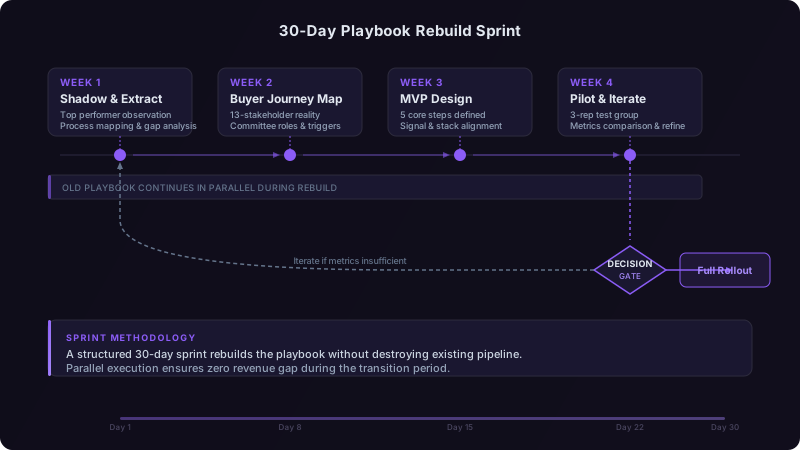
Five signals your playbook is broken beyond repair, plus a 30-day sprint framework for rebuilding from first principles without killing pipeline.
Autonomous Outbound Isn't the Bar Anymore. Accountable Outbound Is.
AI can now research, decide, and run outbound on its own. The real question for revenue teams is no longer whether the machine can act, but whether you can trust, see, and steer what it does. Here is the case for accountable autonomy in AI prospecting.
The Pipeline Decay Problem: How to Spot Deals That Have Gone Stale
Every open opportunity is decaying right now. Here's a framework with stage-duration thresholds you set from your own data and a scoring system your RevOps team can ship this quarter.