Autonomous Outbound Isn't the Bar Anymore. Accountable Outbound Is.
AI can now research, decide, and run outbound on its own. The real question for revenue teams is no longer whether the machine can act, but whether you can trust, see, and steer what it does. Here is the case for accountable autonomy in AI prospecting.
A year ago, "AI does your outbound" was a pitch. Today it is a checkbox.
Software can now read a market, build a target list, decide who to reach, write the message, send it across channels, and book the meeting with very little human touch. That capability is real, and it is quickly becoming table stakes. Which means it has stopped being a differentiator.
So the interesting question for revenue leaders is no longer "Can the system act on its own?"
It is "Can I trust what it did, see why it did it, and change it when I need to?"
That is the difference between autonomous outbound and accountable outbound. The first is about removing humans from the loop. The second is about keeping humans in command of a loop that mostly runs itself. As AI moves deeper into the revenue engine, accountability, not autonomy, is the bar that actually matters.
The Hidden Cost of a Black Box
An autonomous system that you cannot inspect creates a quiet set of liabilities:
- You cannot coach it. When a campaign underperforms, "the AI decided" is not a root cause. If you cannot see the reasoning, you cannot fix the strategy. You can only hope the next run is better.
- You cannot defend it. Outbound touches your brand, your deliverability, and increasingly your compliance posture. When a prospect, a legal team, or a CRO asks why a specific account was targeted with a specific claim, "the model chose" is not an answer.
- You cannot trust the numbers. A scoring engine you cannot interrogate is a confidence trick. If you do not know which signals drove a "high intent" label, you cannot tell a real buying signal from noise, and you will pour reps' time into accounts that were never going to convert.
- You inherit its mistakes at machine speed. Autonomy without oversight does not just make errors; it scales them. A bad assumption becomes ten thousand bad emails before anyone notices.
None of this means autonomy is wrong. It means autonomy without accountability is fragile. The teams that win with AI outbound will not be the ones who hand over the most control. They will be the ones who keep the most visibility while giving up the most busywork.
What Accountable Autonomy Actually Looks Like
Accountability is not a feature you bolt on. It is a property of how the system is built. Four things make AI outbound accountable.
1. Decisions Come With Their Reasons
Every meaningful action should carry its evidence. When the system flags an account as ready to buy, it should show the signals behind that call: the funding event, the hiring pattern, the technology change, the engagement, not just a number. A propensity score is only useful if you can open it up and see how it was built from your own closed-won patterns. Scores you can explain are scores you can trust, tune, and defend.
2. The Human Sets the Guardrails, the Machine Works Inside Them
Autonomy and control are not opposites. The right model is delegation, not abdication: you define the ICP, the claims that are allowed, the channels, the tone, the do-not-touch list, and the system executes relentlessly inside those lines. You are not writing every email. You are setting the policy the agent obeys.
3. Everything Is Observable and Reversible
You should be able to watch what the agent is doing, step into any decision, and override it without breaking the workflow. Observability turns a black box into a glass box: a record of what happened, why, and what changed, available before a campaign goes out, not just in a post-mortem.
4. The Loop Learns in the Open
A "self-improving" system is only valuable if you can see what it learned. When outcomes feed back into targeting and scoring, that feedback should be legible: these signals predicted revenue, these did not. Learning you can inspect compounds into durable advantage. Learning you cannot is just drift you are told to trust.
Raw automation is converging. Soon every team will have an agent that can run outbound end to end. What will not converge is trust. A system that can show its work, take direction, and be corrected is one a serious revenue org can actually deploy at scale, across regulated industries, in front of enterprise buyers, under the eyes of a board.
Why This Is the Durable Advantage
Here is the strategic point. The moat in the next era of outbound is not "more autonomous." It is more accountable.
It is also better for results, not just governance. Transparent scoring means reps spend their hours on accounts that will actually convert. Inspectable learning means the engine gets sharper on your definition of a good deal, not a generic one. Guardrails mean the brand and the inbox stay healthy while volume goes up. Accountability and performance are not a trade-off. Over any real time horizon, they are the same thing.
How to Evaluate AI Outbound for Accountability
If you are assessing any AI prospecting system, including ours, pressure-test it with questions a black box cannot answer.
| Question to Ask | What a Good Answer Sounds Like | What a Black Box Says |
|---|---|---|
| Why is this account scored high? | "These signals, with this weight, from this data." | "Trust the model." |
| Where do I set the rules the agent cannot cross? | "ICP, claims, channels, and a do-not-touch list you control." | "The system handles that." |
| Can I see and override a decision before it ships? | "Yes, every action is reviewable and reversible." | "It runs automatically." |
| What did the system learn from a win or a loss? | "These signals predicted revenue, these did not." | "It just gets smarter." |
| Can I produce the trail if legal asks why we reached out? | "Here is the full record of the decision." | "We do not log that." |
If the honest answer to those is "trust the model," keep looking. The next era of outbound will not be won by the most autonomous system. It will be won by the most accountable one.
Summary
Autonomy in outbound is no longer the achievement. It is the starting line. Every serious tool will soon research, decide, and execute on its own, which means the act of automating stops setting anyone apart.
The advantage moves to accountability: decisions that come with their reasons, guardrails the human controls, actions you can observe and reverse, and a learning loop you can actually read. That is what lets a revenue team scale AI outbound without scaling risk.
If you want to pressure-test your current motion against that standard, book a Prospectory demo. Bring your target account list, and we will show how explainable scoring, traceable signals, and guardrails you control turn outbound into a system you can trust, not just one that runs without you.
Ready to transform your sales pipeline?
See how Prospectory's AI-powered platform can help your team research, reach, and relate to prospects at scale.
Related Articles
You Can Vibe Code a Product. You Cannot Vibe Code Customers.
AI makes product creation faster, but it does not create trust, timing, or pipeline. The new GTM edge is signal-led outreach that starts real conversations.
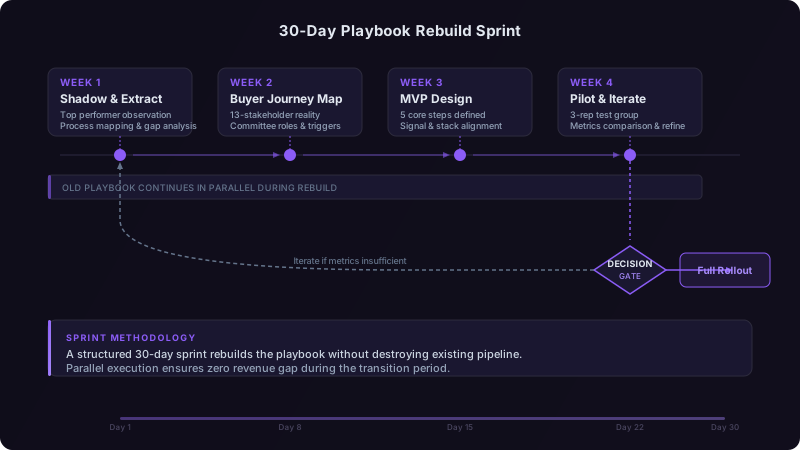
When to Fire Your Sales Playbook and Start Over
Five signals your playbook is broken beyond repair, plus a 30-day sprint framework for rebuilding from first principles without killing pipeline.
The SDR-AE Handoff Is Quietly Killing Your Qualified Pipeline
Poor handoffs let qualified meetings die between booking and the first AE call. Here's a six-field framework that fixes it and the metrics that prove it.