AI Agents Are Killing Per-Seat SaaS: What B2B Sellers Must Do Now
AI agents can now do part of the work that per-seat software licenses existed to support. Here is how buyers evaluate agent alternatives at renewal, and the repositioning playbook for vendors.
Per-seat pricing assumes that software value grows with the number of people using it. AI agents break that assumption. When an agent can do part of the work that a team of licensed users used to do, a buyer reviewing a renewal stops asking how many seats they need and starts asking whether they need the seats at all.
If you sell software to business buyers, your next renewal conversations may look different from any you have had. This guide covers why per-seat pricing is under pressure, how buyers evaluate agent alternatives, the positions software vendors are taking in response, and five steps to take before your next renewals.
Why Per-Seat Became a Liability
The per-seat model made sense when software value was tied to headcount. More sales reps meant more seats in the engagement platform. More support agents meant more seats in the help desk. Seat count was a reasonable proxy for value delivered.
That proxy weakened when AI agents moved from demos into production. Klarna said in February 2024 that its AI assistant was doing the equivalent work of 700 full-time customer service agents [1]. Shopify CEO Tobi Lütke told employees in a memo that they would have to show a job cannot be done by AI before asking for more headcount and resources [2]. Public examples like these change how buyers think about every tool priced by the person.
The math buyers run is simple. If an agent can handle part of a workflow that several licensed users perform today, the buyer compares the agent's cost and capability with the seats it might replace. The agent does not need to match every feature of a specialized tool. It needs to be good enough, at a low enough cost, for the workflow the buyer actually runs.
Vendors are responding by experimenting with usage-based and outcome-based pricing, because a price tied to seats invites a direct comparison with an agent that has no seats.
The Buyer's New Decision Framework
Buyers who have run agent pilots tend to apply three filters before a renewal or new purchase:
Agent capability assessment. Can an available AI agent perform this function today? Not in theory and not in a vendor demo, but now, in their environment. Buyers with pilot experience have a calibrated sense of what agents can and cannot do, and they are harder to impress with AI positioning.
Seat elimination ratio. If they deploy an agent, how many of these licenses go away? A tool where an agent could replace every seat is a different conversation from a tool where it replaces a few.
Return comparison. Is the agent good enough for this workflow at a much lower cost than the current spend? When the answer is clearly yes, the decision gets easier to approve.
| Filter | Question the buyer asks | What a vendor needs to show |
|---|---|---|
| Capability | Can an agent do this job today? | Where your product does what an agent cannot |
| Seat elimination | How many licenses would go away? | Value that does not depend on seat count |
| Return | Is good enough at lower cost acceptable? | Outcomes per dollar, measured in the buyer's data |
| Risk | What breaks if the agent fails? | Compliance, auditability, and reliability evidence |
The categories under the most pressure are the ones where agents already handle routine work well, such as data enrichment, first-line support, basic analytics, and templated outreach.
The Three Repositioning Camps
Software vendors are taking roughly three positions. Vendors that do not choose one clearly risk being squeezed from both sides.
Camp 1: Platform integration. Vendors such as Intercom, Zendesk, and Salesforce have built AI agents into their platforms, so the buyer does not face a separate substitution decision. Salesforce Agentforce and Intercom Fin are examples of platforms presenting themselves as agent platforms rather than tools with AI features. The risk is execution: if the embedded agent underperforms external alternatives, buyers have both the information and the motivation to switch.
Camp 2: Infrastructure positioning. Data platforms such as Snowflake and Databricks position themselves as the infrastructure agents depend on rather than the workflow layer agents replace. An agent that researches prospects needs data; an agent that writes financial summaries needs a governed data platform. Becoming infrastructure agents depend on is a durable position because agents cannot easily replace what they run on.
Camp 3: Premium irreplaceability. Some vertical platforms, such as Veeva Systems in life sciences, emphasize regulatory context, audit trails, and compliance requirements that a general-purpose agent cannot easily satisfy. The position works when the irreplaceability is real. Where it is only a marketing claim, buyers will test it.
Each position has to be true in the buyer's environment, not just in your pitch. A vendor that claims to be irreplaceable infrastructure while an agent quietly replaces its most-used workflow will lose the renewal anyway, and lose credibility with it.
Five Steps in the Next 90 Days
Start with visibility before repositioning.
Step 1: Audit your top accounts for agent exposure. Look at headcount trends in the teams that use your product, signs of agent pilots in job postings and public activity, and renewal conversations that have included questions about AI alternatives. You want to know which accounts are evaluating alternatives before they tell you in a renewal meeting.
Step 2: Reframe value around outcomes, not seats. "Cost per seat per month" invites a comparison with an agent. "Cost per qualified meeting" or "cost per resolved case" anchors the conversation on what the buyer cares about. The reframe has to be genuine; buyers will run the math, and if an agent produces more of the outcome per dollar, the reframe will not hold.
Step 3: Name your actual moat. What specifically prevents an agent from replacing your product in your largest accounts? "Our AI is better" is not an answer. Audit trails that satisfy compliance, integrations into legacy systems the buyer cannot migrate, network effects, and regulatory certifications are answers. Be honest about which one you have before building a sales narrative around it.
Step 4: Move expansion from seats to workflows. If expansion means "you hired more people, buy more seats," that model is weakening. Expansion has to come from showing more value in existing workflows, documented in the customer's own data before the renewal conversation starts.
Step 5: Track agent-driven churn separately. A customer who leaves because they deployed an agent is telling you something different from one who left for a competitor. Add a churn reason for AI displacement and record the account profile and the capability the agent replaced. Over time, that tells you where your product is most exposed before the pattern shows up in total churn.
What Comes Next
The shift is not finished. Many buyers have not yet run an agent capability assessment on every tool they pay for. As more of them do, renewal conversations will keep moving from seat counts to outcomes.
Buyers who have deployed agents for one workflow tend to look for the next workflow agents can handle. The question for vendors is not whether agents will affect them, but which workflow agents could take next and how much time is left before that renewal.
Vendors that answer that question honestly, reposition early, and prove value in outcomes will be in a stronger position than those that wait for the renewal meeting to reframe their value.
References
[1]Klarna, Klarna AI assistant handles two-thirds of customer service chats in its first month, February 27, 2024. https://www.klarna.com/international/press/klarna-ai-assistant-handles-two-thirds-of-customer-service-chats-in-its-first-month/
[2]CNBC, Shopify CEO says staffers need to prove jobs can't be done by AI before asking for more headcount, April 7, 2025. https://www.cnbc.com/2025/04/07/shopify-ceo-prove-ai-cant-do-jobs-before-asking-for-more-headcount.html
Ready to transform your sales pipeline?
See how Prospectory's AI-powered platform can help your team research, reach, and relate to prospects at scale.
Related Articles
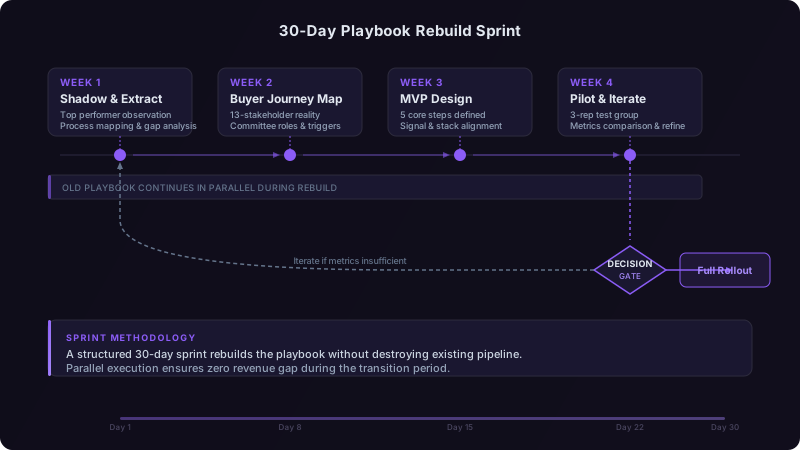
When to Fire Your Sales Playbook and Start Over
Five signals your playbook is broken beyond repair, plus a 30-day sprint framework for rebuilding from first principles without killing pipeline.
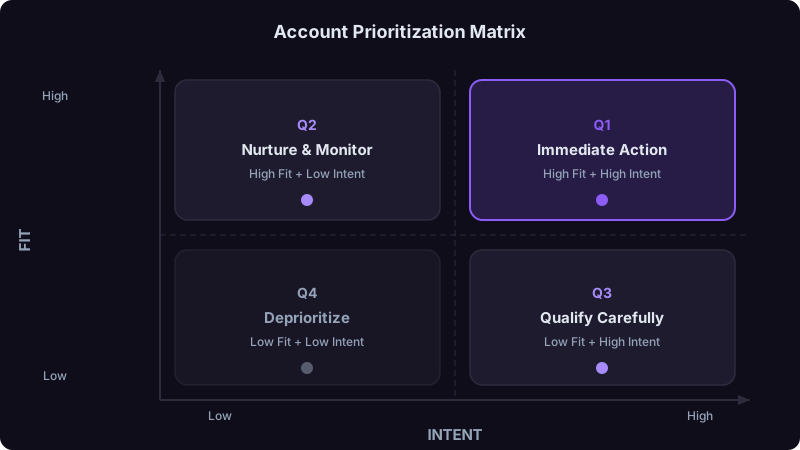
Account Prioritization: A Practical Fit, Evidence, and Timing Framework
Build a reviewable account-prioritization process that combines fit, current evidence, timing, CRM context, and seller judgment without treating a score as a buying decision.
The Real Cost of Bad Sales Data: How to Measure and Fix Data Decay
Outdated contacts and wrong job titles quietly drain pipeline. Here is how to measure your own data decay rate, estimate what it costs, and build a system that keeps sales data usable.