You Can Vibe Code a Product. You Cannot Vibe Code Customers.
AI makes product creation faster, but it does not create trust, timing, or pipeline. The new GTM edge is signal-led outreach that starts real conversations.
A founder can build a working product over a weekend now. They can prompt an AI coding tool, connect a database, publish a landing page, and ship a demo before Monday morning.
That is impressive. It is also no longer enough.
The hard part of building a company has shifted from "can we create software?" to "can we earn attention from the right customers at the right moment?" You can vibe code a product. You cannot vibe code trust, urgency, budget, political timing, or a buyer's willingness to take a meeting.
The Product Is No Longer the Bottleneck
Vibe coding became shorthand for a real shift in software creation. Andrej Karpathy coined the term in February 2025 [1], and the broader market moved fast. AI coding tools such as Replit, Lovable, and Cursor let non-technical and semi-technical users turn ideas into working apps with natural language prompts.
That changes the startup equation. In the last SaaS era, many companies could create distance through engineering speed. Today, ten teams can prototype similar workflows in the same week. The product still matters, but it is less likely to be the first constraint.
The new constraint is distribution.
If everyone can ship faster, more products reach the market. More products create more noise. More noise makes buyers more selective about who they talk to. The result is a strange paradox: software creation is getting easier while customer acquisition is getting harder.
| Old Constraint | New Reality | What It Means for GTM |
|---|---|---|
| Product took months to prototype | AI can create working demos in days | Speed alone no longer creates differentiation |
| Buyers had fewer alternatives | Buyers see more tools with similar claims | Proof and timing matter more than feature lists |
| Founders could rely on launch traffic | Launch attention decays quickly | Outbound must become a daily system |
| Generic SaaS positioning was acceptable | Buyers compare options before taking calls | Messaging needs account-specific context |
| Sales could start with discovery | Buyers expect sellers to arrive informed | Research must happen before outreach |
The founders who win this next cycle will not be the ones who only build faster. They will be the ones who build a customer engine while they build the product.
Buyers Do Not Care How Fast You Built It
Buyers do not wake up hoping to reward your shipping velocity. They care about their own missed targets, internal pressure, budget constraints, and career risk.
That sounds obvious, but many AI-built products go to market with builder-centered messaging. The homepage says the product is AI-native. The launch post says it was built in three days. The demo says setup takes minutes. None of that explains why a VP of Sales, RevOps leader, founder, or business owner should change what they are doing this quarter.
The outreach usually has the same problem.
"We built an AI tool that helps with outbound. Want to see it?"
That message asks the buyer to do the work. They have to infer whether the tool applies to their market, their pipeline problem, their sales team, their current tech stack, and their timing. Most buyers will not do that work for a stranger.
The exact percentages will vary by market, but the direction is clear. Buyers are not anti-sales. They are anti-waste. They avoid sellers who arrive with generic questions, generic claims, and generic urgency.
The bar is higher now: show that you understand what changed in their world before you ask for time on their calendar.
The Missing Layer Is Customer Intelligence
Most early GTM motions fail because they start with a list, not a reason.
A founder exports 2,000 contacts from a database. The team writes one clever email. They add a few merge fields. They send. Then they blame the subject line, the copy, or the SDR when replies do not come.
The real issue is upstream. A list of people who match your ICP is not the same as a list of people who have a reason to care this month.
Customer intelligence answers four questions before outreach starts:
- Fit: Does this account match the customers we can actually help?
- Signal: What changed recently that makes this problem more urgent?
- Person: Who owns the pain, who influences the decision, and who can introduce us internally?
- Message: What can we say that proves the outreach is about their situation, not our campaign?
This is where many AI-first products underinvest. They treat GTM as a copywriting problem. It is not. Copy matters, but copy written against a weak account thesis still fails.
The first sale is not the product demo. The first sale is convincing a buyer that your message deserves attention. If the outreach does not connect to a current signal at the account, the demo never happens.
The right customer intelligence system does not tell reps to "personalize more." That advice is too vague. It tells them which accounts to prioritize, which signal to reference, which contact to start with, and which message angle is most likely to earn a reply.
What Signal-Led Outreach Looks Like
Signal-led outreach starts with a business event, not a template.
A company just hired its first VP of Sales. A sales team posted five SDR openings in two weeks. A competitor appeared in their tech stack. A founder announced a new market. A funding round created growth pressure. A hiring page shows a new territory buildout. A product launch created a clear need for pipeline.
Those signals create a reason to reach out.
| Signal | What It May Mean | Strong Opening Angle | Weak Opening Angle |
|---|---|---|---|
| New VP Sales hired | Pipeline process may be changing | "Saw you joined to scale revenue. Teams at this stage usually rebuild account prioritization in the first 60 days." | "Congrats on the new role, want a demo?" |
| SDR hiring spike | Outbound volume is about to increase | "Before the new reps start, the account list and signal model usually decide whether ramp turns into meetings." | "We help SDR teams book more meetings." |
| Funding round | Growth targets likely increased | "After a raise, the pressure usually shifts from product story to repeatable pipeline creation." | "Congrats on funding, we help funded companies." |
| New market launch | ICP and messaging may be untested | "New market entry usually breaks old lead scoring because the right accounts look different." | "We have contacts in your target market." |
| Competitor research | Active evaluation may be underway | "If your team is comparing outbound tools, the key question is whether the system finds timing signals or just contact data." | "We are better than your current vendor." |
The difference is not cosmetic. The strong angle names the business moment and connects it to a likely operating problem. The weak angle only proves the seller saw a public event.
This is the gap Prospectory is built to close. Prospectory helps sales teams identify target accounts, enrich the right contacts, detect buying signals, score account readiness, and turn those signals into outreach that feels relevant enough to answer.
AI Can Write the Email. It Cannot Choose the Moment.
AI is very good at drafting. It can produce ten subject lines, tighten an email, summarize an account page, and adapt a message for a persona. Those are useful gains.
But the highest-value sales judgment happens before the draft.
Should this account be contacted this week? Is this signal fresh enough? Which stakeholder should hear from us first? Is the right play a founder note, SDR email, LinkedIn comment, phone call, or no touch yet? Is the account showing buying committee activity or just one curious visitor?
Those questions decide whether the email has a chance.
Vibe coding works because a builder can prompt, inspect, revise, and ship. Outbound does not work that way because the buyer is not a compiler. You cannot keep prompting the market until it accepts your output. Every irrelevant touch uses trust, domain reputation, and future access.
That means the future GTM stack needs two layers:
- 1Intelligence layer: Account fit, contact mapping, signal detection, buying committee context, timing, and prioritization.
- 2Execution layer: Email, phone, LinkedIn, landing pages, meeting prep, sequence management, and follow-up.
Most teams overinvest in the execution layer because it is visible. They buy another sequencer, another writing assistant, another inbox tool. Then they wonder why more output does not create more pipeline.
The missing piece is usually the intelligence layer.
A Founder-Led GTM Playbook for the AI Product Era
If you are building an AI product right now, do not wait until the product is "done" to build the customer engine. Start while the product is still changing.
Use this five-step system.
Step 1: Define the pain, not the persona. "VP Sales at SaaS companies" is not a market. "Revenue leaders adding SDR capacity while reply rates are falling" is closer to a market because it names a condition.
Step 2: Build a 100-account signal list. Do not start with 5,000 names. Start with 100 accounts where you can identify a current trigger: hiring, funding, leadership change, product launch, expansion, tech shift, or public pain.
Step 3: Map three people per account. Find the economic owner, the day-to-day operator, and the likely technical or RevOps influencer. B2B deals rarely move through one person.
Step 4: Write one reason per account. Before drafting an email, write the sentence: "We are reaching out now because..." If that sentence is weak, do not send.
Step 5: Ask for a conversation, not applause. The goal is not praise for your product. The goal is a real call where the buyer says, "Yes, this is a problem we are dealing with."
| GTM Step | Bad Version | Better Version | Metric |
|---|---|---|---|
| ICP | Industry and employee count | Pain condition plus trigger | % accounts with current signal |
| Targeting | Contact database export | Curated account list with reasons | Account acceptance rate |
| Messaging | Product pitch | Signal plus likely business impact | Positive reply rate |
| Follow-up | More reminders | New evidence or new signal | Follow-up reply rate |
| Demo CTA | "Want to see it?" | "Worth comparing this against your current outbound motion?" | Demo-to-opportunity rate |
This system is slower than blasting a list. It is also faster than spending six weeks proving that a large send created almost no conversations.
Why This Is a Prospectory Problem
Prospectory exists for the moment after product creation gets easy.
When every team can build faster, the advantage moves to whoever can identify the right accounts, understand buying context, and reach out with relevance before the market gets crowded. That is a data, signal, and workflow problem.
Prospectory helps teams answer the GTM questions that matter:
- Which accounts look like the customers we can win?
- Which accounts show signals that the timing is right?
- Which contacts matter inside the buying committee?
- Which message should we send based on the signal?
- Which accounts deserve human attention today?
The point is not to automate every human interaction. The point is to make human outreach worth the buyer's attention.
If your team has a product in market, a product about to launch, or an outbound motion that is not producing enough conversations, this is the right time to inspect the customer engine. Book a Prospectory demo and we will walk through how your team can find better-fit accounts, prioritize live buying signals, and turn outreach into qualified conversations.
Frequently Asked Questions
Is vibe coding bad for startups?
No. Faster product creation is good. The mistake is assuming a faster product automatically creates faster customer adoption. Startups still need positioning, timing, trust, proof, and a repeatable way to reach the right accounts.
Can AI fully automate outbound sales?
AI can automate pieces of outbound: research summaries, contact enrichment, draft generation, routing, and follow-up reminders. It should not blindly decide who deserves outreach without account fit, signal freshness, and buyer context.
What is the difference between personalization and signal-led outreach?
Personalization often means adding a detail about the person. Signal-led outreach means anchoring the message to a business event that changes priority. "Saw your podcast" is personalization. "Saw you are hiring five SDRs after entering the healthcare segment" is a signal.
When should a founder ask for a demo call?
Ask when the message connects to a real account signal and a likely business problem. The best CTA is specific: "Worth comparing this against your current outbound motion?" That creates a conversation about their work, not a generic product walkthrough.
Summary
Vibe coding changes how products get built. It does not change how trust gets earned.
The teams that win the AI product era will not only ship faster. They will understand their buyers earlier, detect account-level signals sooner, and start conversations that feel relevant from the first sentence.
Your next step is practical: pick 25 target accounts, write the reason each one should care this month, and remove every account where the reason is weak. That one exercise will tell you whether you have a customer engine or only a contact list.
If you want to pressure-test that motion, schedule a Prospectory demo. Bring your target account list, and we will show where better signals can turn more of those accounts into real conversations.
References
[1]Wikipedia, "Vibe coding." https://en.wikipedia.org/wiki/Vibe_coding
[2]Gartner, "Gartner Sales Survey Finds 61% of B2B Buyers Prefer a Rep-Free Buying Experience," press release, June 25, 2025, as republished by MarketScreener. https://uk.marketscreener.com/quote/stock/GARTNER-INC-40311131/news/Gartner-Sales-Survey-Finds-61-of-B2B-Buyers-Prefer-a-Rep-Free-Buying-Experience-50340554/
Ready to transform your sales pipeline?
See how Prospectory's AI-powered platform can help your team research, reach, and relate to prospects at scale.
Related Articles
Autonomous Outbound Isn't the Bar Anymore. Accountable Outbound Is.
AI can now research, decide, and run outbound on its own. The real question for revenue teams is no longer whether the machine can act, but whether you can trust, see, and steer what it does. Here is the case for accountable autonomy in AI prospecting.
The CRO Is Becoming the Revenue Intelligence Architect
Revenue leaders are moving from pipeline inspection to intelligence orchestration. Here is the Prospectory view on what that means for prospecting, RevOps, and profitable growth.
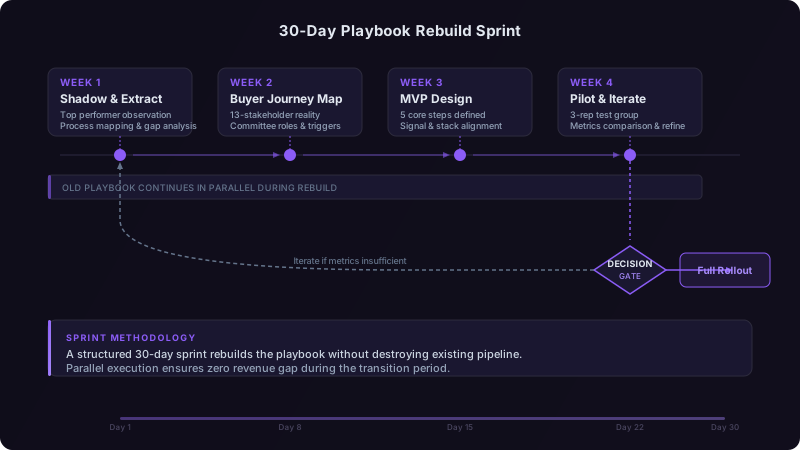
When to Fire Your Sales Playbook and Start Over
Five signals your playbook is broken beyond repair, plus a 30-day sprint framework for rebuilding from first principles without killing pipeline.