Account Prioritization: A Practical Fit, Evidence, and Timing Framework
Build a reviewable account-prioritization process that combines fit, current evidence, timing, CRM context, and seller judgment without treating a score as a buying decision.
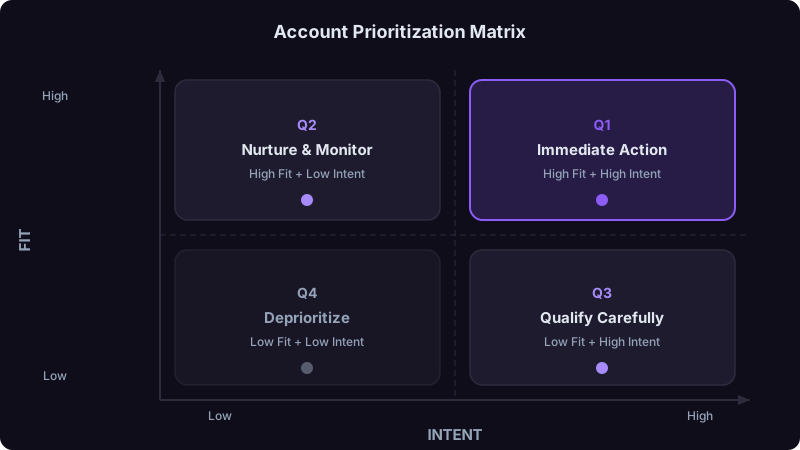
Account prioritization should answer a practical question: which named accounts deserve review now, and why?
A useful answer requires more than an ideal customer profile. It combines four kinds of information: fit, current evidence, timing, and relationship context. The team can then decide which accounts to research, contact, watch, or leave unworked.
The framework in this guide is designed to make that decision consistent and reviewable. It does not assume that a high score proves purchase intent, and it does not ask sellers to surrender judgment to a model.
Start With a Named-Account Universe
Prioritization begins with a concrete list. Every person working the motion should be able to find the same account universe, understand why an account is included, and see when the list was last reviewed.
Write down the inclusion rules before scoring anything. They may cover:
- company size or operating scale;
- industries and use cases the product supports;
- regions the team can sell and serve;
- technical or procurement requirements;
- existing customers and open opportunities that need separate treatment; and
- exclusions such as partners, competitors, duplicates, or accounts the business cannot serve.
This creates the denominator for later measurement. Without it, a team can make a reported conversion rate look higher simply by changing which accounts appear in the calculation.
The account universe should also have an owner and a review schedule. A quarterly review may be sufficient for slow-changing segments. Markets that change quickly may require more frequent updates. The right cadence depends on how quickly firmographic data, territories, product fit, and account ownership change.
Review Four Dimensions Separately
A single score is convenient, but it can hide important differences. Review the underlying dimensions before combining them.
1. Fit
Fit asks whether the account resembles the customers and use cases the business is equipped to serve. Factors may include industry, scale, geography, operating model, technical requirements, and the business problem being addressed.
Choose factors from your own accepted and rejected opportunities rather than copying a generic ideal customer profile. Define what each factor means, where its data comes from, and how missing information is handled.
Fit is not intent. A company can match the profile and still have no current reason to evaluate the offer.
2. Current Evidence
Current evidence covers observable facts that may justify another look. Examples include a relevant leadership change, a dated hiring pattern, a product or market announcement, a documented technology decision, or first-party engagement that your organization is permitted to use.
Record the source and date with the observation. Distinguish the fact from the interpretation. A job posting can show that a company is hiring for a capability; it does not by itself confirm a project, budget, or vendor evaluation.
3. Timing
Timing asks whether there is a reasonable basis to act now. A dated event may matter only for a limited period. Contract dates, planning cycles, recent interactions, and known business initiatives can all influence timing when the team has permission to use them.
Use decay or review dates to prevent old observations from remaining permanently urgent. The decay rule should match the evidence. A website session may lose relevance quickly, while a multi-year modernization program may stay relevant longer.
4. Relationship and CRM Context
Context explains what the team already knows. Has the account been a customer? Is there an open opportunity, a closed-lost reason, an active support issue, an executive relationship, or a prior request not to be contacted?
This information can change the action even when fit and timing look strong. A current customer may need an account-management motion. A recently closed-lost account may need a documented waiting period. A suppression request should stop an outreach path regardless of score.
Use a Matrix to Choose the Next Review
A two-axis matrix is a useful starting view. One axis represents fit. The other represents the strength and recency of the available evidence. Relationship context remains visible beside the matrix because it can change the appropriate action.
| Fit | Current Evidence and Timing | Suggested Review |
|---|---|---|
| Strong | Strong and recent | Review promptly, verify the evidence, and choose an account-specific next step |
| Strong | Limited or stale | Keep in a defined watch or nurture group and specify what would trigger another review |
| Unclear | Strong and recent | Validate fit before assigning substantial seller time |
| Limited | Limited or stale | Leave unworked unless the account or offering changes |
These are operating defaults, not conclusions about the buyer. A team may choose a different action after reviewing CRM history, territory ownership, consent, channel rules, and seller knowledge.
Show the factors, dates, and available source context beside the priority. A seller should be able to understand why an account moved and correct weak or mismatched evidence.
Define a Score Without Hiding the Inputs
If the team needs a single ordered list, define a score only after the dimensions are clear. A simple model can be easier to review than a complex one.
For example, a team might assign a bounded value to fit, evidence, timing, and relationship context, then apply weights chosen for one sales motion. The exact weights should be treated as a hypothesis. They are not universal constants, and they may differ by product, segment, or region.
Document at least:
- the unit being scored, such as an account rather than a person;
- each factor and its definition;
- its data source and refresh schedule;
- the treatment of missing or conflicting information;
- the weight and threshold rules;
- any human override and the reason recorded for it; and
- the intended decision, such as ordering a research queue.
Prospectory's current Propensity to Buy method is one example of a company-level score. It combines five defined research factors and presents explanations with available source context for seller review. [1] It does not confirm budget, an active evaluation, or a purchase decision.
NIST's AI Risk Management Framework describes validity, reliability, transparency, explainability, privacy, and ongoing monitoring as related characteristics of trustworthy AI systems. [2] For account scoring, that translates into a straightforward practice: keep the purpose narrow, expose the important inputs, and monitor how the ranking behaves after deployment.
Separate Prioritization From Routing
Prioritization decides what deserves review. Routing decides who owns the work. Combining them too early can create avoidable confusion.
Territory rules may depend on geography, segment, named-account ownership, workload, specialist coverage, and existing relationships. Salesforce's territory-management documentation, for example, treats account assignment as a rules-based operation with review and manual assignment options. [3]
A workable sequence is:
- 1calculate or refresh the priority using the documented account factors;
- 2check exclusions, suppression rules, and current customer or opportunity status;
- 3apply the territory and ownership rules;
- 4let the assigned person review the evidence;
- 5record the selected action and any correction; and
- 6retain enough history to evaluate the process later.
This separation also makes disagreements easier to diagnose. If the right account reached the wrong seller, the routing rules may need work. If the account should not have appeared near the top, the prioritization inputs or weights may need work.
Choose Actions That Match the Evidence
A priority band is useful only when the team knows what to do with it. Define a small set of permitted next steps.
Research
Use research when a material input is missing, stale, or contradictory. The output should be a corrected account record, not a manufactured reason to contact the company.
Watch
Use a watch state when fit is clear but timing is not. Name the events that would reopen review and set an expiration date so the watch list does not become permanent storage.
Prepare Outreach
Prepare outreach only when the evidence supports a relevant, accurate conversation and the intended channel is appropriate. A human should review the recipient, source, message, and requested next step before sending.
Deprioritize
Deprioritization is a valid decision. It protects seller time and prevents weak evidence from becoming unwanted outreach. Record the reason so the account can be reconsidered if its circumstances or the offering changes.
Evaluate the Framework Before Scaling It
Run the framework in shadow mode on a representative account cohort before changing quotas, territories, or automated actions. NIST's Measure playbook recommends defining metrics, using representative test sets, documenting measurement, and monitoring performance over time. [4]
Before the test, define:
- the account cohort and included segments;
- the current prioritization baseline;
- the observation window;
- the downstream CRM outcomes that will be counted;
- the process measures, such as review time and correction rate;
- the guardrail measures, such as opt-outs, complaints, and exclusions; and
- the decision rule for continuing, revising, or stopping the test.
Compare accounts under consistent definitions. Useful outcomes may include completed reviews, positive replies, held meetings, accepted opportunities, disqualifications, and later revenue. Treat those as associations first. A higher outcome rate in one priority band does not prove that the score caused the result.
Use a statistical design suited to the sample size and baseline event rate. The NIST/SEMATECH engineering statistics handbook provides methods for designing experiments and comparing results. [5] If the sample is too small to support a conclusion, extend the observation period or narrow the decision instead of presenting noise as certainty.
Common Failure Modes
Treating fit as readiness. A strong profile match does not establish current demand. Keep fit and timing visible as separate inputs.
Treating activity as intent. A page view, content interaction, hiring event, or public announcement may support research. It does not reveal an internal buying decision.
Using unexplained weights. If nobody can explain why a factor carries its weight, the team cannot evaluate or refine the model.
Ignoring missing data. A missing value is not automatically positive or negative. Mark it as unknown and decide whether more research is worth the effort.
Automating outreach from a score alone. The score does not verify the person, message, consent, or channel rules. Keep those checks in the workflow.
Reporting only meetings or pipeline. Measure data corrections, seller overrides, exclusions, and complaints too. A ranking that creates activity while degrading trust is not helping the business.
Applying one model everywhere. A model developed for one product and segment may not transfer to another. Test each intended use.
Put the Framework Into Practice
Begin with one named-account cohort and one sales motion. Define fit, collect current evidence with dates and source context, add CRM history, and let sellers review the ordered list before taking action.
Prospectory brings the named account, selected research, P2B factors, explanations, available source context, and workflow context into one view. Your team remains responsible for validating the evidence and choosing the action.
The goal is not to create a score that appears certain. It is to make account review more consistent, make the reason for each priority visible, and learn whether the ordering adds value in your own process.
Use a current named-account sample, your existing prioritization rules, and the CRM outcomes your team already trusts. That makes an evaluation concrete and keeps the discussion tied to your sales motion.
References
[1]Prospectory, Propensity to Buy product method. https://prospectory.ai/propensity-to-buy
[2]NIST AI Resource Center, Trustworthy and Responsible AI Characteristics. https://airc.nist.gov/airmf-resources/airmf/3-sec-characteristics/
[3]Salesforce Help, Assign Accounts to Territories. https://help.salesforce.com/s/articleView?id=sales.tm2_assign_accounts_to_territories.htm&language=en_US&type=5
[4]NIST AI Resource Center, AI Risk Management Framework Playbook: Measure. https://airc.nist.gov/airmf-resources/playbook/measure/
[5]NIST/SEMATECH, e-Handbook of Statistical Methods. https://www.nist.gov/programs-projects/nistsematech-engineering-statistics-handbook
Ready to transform your sales pipeline?
See how Prospectory's AI-powered platform can help your team research, reach, and relate to prospects at scale.
Related Articles
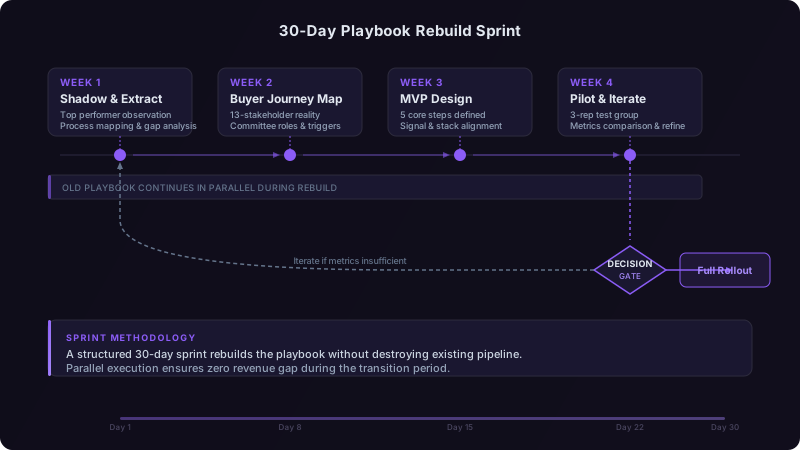
When to Fire Your Sales Playbook and Start Over
Five signals your playbook is broken beyond repair, plus a 30-day sprint framework for rebuilding from first principles without killing pipeline.
AI Agents Are Killing Per-Seat SaaS: What B2B Sellers Must Do Now
AI agents can now do part of the work that per-seat software licenses existed to support. Here is how buyers evaluate agent alternatives at renewal, and the repositioning playbook for vendors.
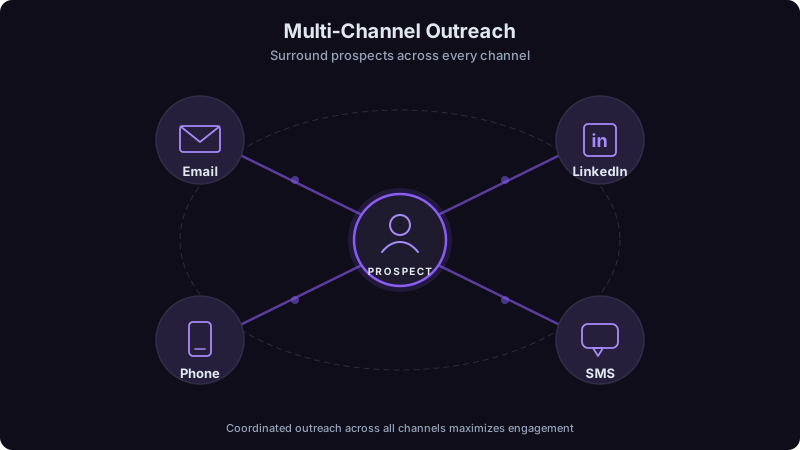
Multi-Channel Outreach: A Practical Coordination and Measurement Guide
Learn how to coordinate email, LinkedIn, phone, and SMS around one audience, message, and measurable campaign plan.