Multi-Channel Outreach: A Practical Coordination and Measurement Guide
Learn how to coordinate email, LinkedIn, phone, and SMS around one audience, message, and measurable campaign plan.
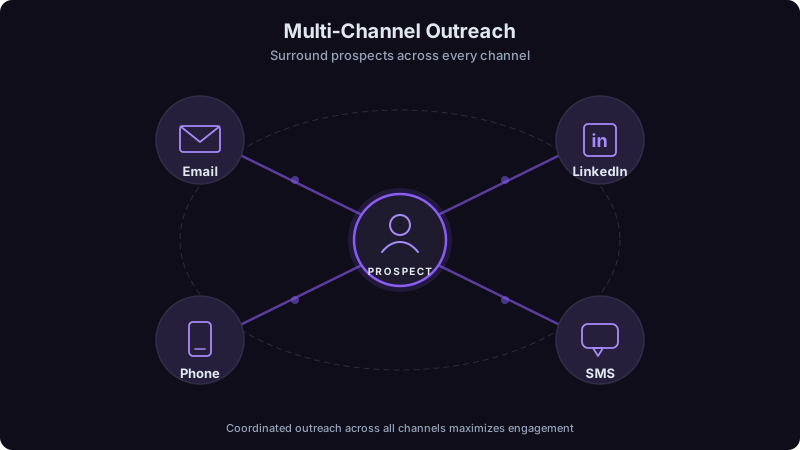
Multi-channel outreach coordinates email, LinkedIn, phone, SMS, and other selected touchpoints around one account plan. The goal is not to contact a buyer everywhere. It is to use the channels that fit the relationship, carry context forward, and stop when the buyer responds or the sequence reaches its limit.
A useful channel test holds the audience, offer, message, and measurement window steady while changing the channel mix. That gives your team a clearer view of how a coordinated sequence performs against the current process.
Start With a Channel Hypothesis
Write down why a second channel belongs in the campaign. Examples include:
- a buyer has stated a channel preference;
- the account already engaged through that channel;
- the role commonly uses the channel for business communication;
- a live conversation would clarify a complex question; or
- a meeting update needs a timely confirmation.
"More touches" is not a useful hypothesis. Each channel should have a job and an exit condition.
Give Each Channel a Clear Role
Email: Structured Context
Email works well for a concise observation, a short explanation, and a resource the buyer can review on their own time.
Use email to:
- connect a current account signal to a relevant question;
- provide a brief comparison or worksheet;
- summarize a conversation; and
- make the next step clear.
Keep the message specific to the account. Avoid pretending that a generic industry statement came from research.
Commercial email in the United States, including B2B email, must follow the CAN-SPAM requirements for sender information, subject lines, physical address, and opt-out handling. [1] Deliverability also depends on current mailbox-provider requirements. Gmail's sender guidance covers authentication, accurate message identity, spam rates, and unsubscribe behavior. [2]
LinkedIn: Professional Context
LinkedIn can help a rep understand a buyer's public professional interests, respond to something the buyer shared, or continue a conversation that already has context.
Useful actions include:
- reading the buyer's recent professional posts before writing;
- leaving a substantive comment when the rep has something useful to add;
- sending a connection request that explains the relevance; and
- moving to a direct message only when the relationship supports it.
Profile activity is context, not consent or proof of purchase intent.
Use LinkedIn through the access and interaction methods the platform permits. LinkedIn prohibits third-party software that scrapes data or automates activity on its website, so validate the workflow instead of assuming every possible automation is allowed. [5]
Phone: Live Discovery
A phone call is useful when a live exchange can resolve ambiguity more efficiently than another written message. Prepare the reason for the call, the question you want to test, and the next step if the buyer is interested.
A simple opening has three parts:
- who you are;
- why this account is relevant now; and
- permission to ask one concise question.
Record the outcome in the shared account history so another channel does not repeat the same message.
Calls and texts can carry separate consent and Do Not Call requirements. The FCC's consumer guidance summarizes federal protections for unwanted calls and texts. [3] Have the team responsible for the campaign determine which federal, state, and local rules apply to the specific audience and dialing method.
SMS: Relationship-Based Updates
SMS is best treated as a channel for an established business interaction, such as a meeting update or a follow-up the recipient requested. Configure your team's consent, sender identification, suppression, and frequency rules for the audience and market.
Make the sender and purpose obvious, and make opting out easy.
Put Channel Rules Into the Campaign Design
Do not leave channel-rule and buyer-preference checks for the moment a rep presses send. Turn them into campaign inputs that the team can inspect before activation.
For each audience and channel, record:
- why the recipient is eligible;
- which sender or account will contact them;
- whether consent or an existing relationship is required;
- which suppression lists apply;
- how an opt-out is recorded and shared with other channels;
- which messages require a person to approve them; and
- who owns an exception or complaint.
The ICO's direct-marketing guidance is a useful example of channel planning that starts with purpose, data, individual preferences, and the rules for the chosen method. [4] Your market may have different requirements, but the operating lesson is broadly useful: make the rule visible where the campaign is configured.
Test the stop behavior before launch. Submit an opt-out through each connected channel, confirm that it reaches the shared account record, and check whether pending steps pause. Then test a reply, a meeting booking, an ownership change, and a bounced address. A coordinated sequence is only as reliable as the state changes it carries between channels.
Document the result for campaign operators. A short launch record should identify the audience, channel rules, senders, owners, approval path, test date, and known exceptions. That gives RevOps a concrete artifact to review when the campaign changes.
Design the Sequence as One Conversation
This example shows a coordinated structure. Adapt it to your audience, channel rules, and buyer context.
| Stage | Channel | Purpose |
|---|---|---|
| Open | Share a relevant account observation and question | |
| Add context | Offer useful professional context without repeating the email | |
| Clarify | Phone | Test the problem hypothesis in a live conversation |
| Follow up | Add a new source, example, or answer | |
| Close loop | Buyer's available channel | Ask whether to continue, pause, or stop |
The timing should come from your own campaign design. Do not assume that a universal day or hour will fit every market, role, and relationship.
Write the sequence as a single narrative. Each touchpoint should add information, acknowledge prior engagement, and move toward a clear decision. Repetition across channels makes the workflow feel disconnected.
Coordinate the Workflow
A multi-channel campaign needs shared state. At minimum, your team should be able to see:
- the account and buyer selected for the campaign;
- the source behind each signal or observation;
- messages already sent across every connected channel;
- replies, objections, opt-outs, and meeting outcomes;
- the current owner; and
- the next step and stop conditions.
When a buyer responds, pause other automated steps and route the conversation according to the team's workflow rules. When ownership changes, carry the account history with it.
Run a Controlled Channel Test
Compare the coordinated sequence with your current process using matched account groups. Keep the audience, offer, qualification rule, and measurement window consistent.
Before launch, define:
- 1the channel mix being tested;
- 2the account and buyer eligibility rules;
- 3the action that requires human review;
- 4the primary outcome and supporting quality measures;
- 5the suppression and stop conditions; and
- 6the decision rule for expanding, revising, or ending the test.
Review the whole funnel. A channel can create replies while producing poor meetings, weak opportunities, or an unacceptable opt-out rate.
Measure What Happened
Use the same definitions across every test:
- Delivery: Was the message delivered to the intended buyer?
- Positive reply: Did the response express relevant interest or a useful next step?
- Held meeting: Did the scheduled conversation occur?
- Accepted opportunity: Did the account meet the qualification rule your team uses?
- Downstream outcome: What happened after qualification?
- Buyer experience: Did opt-outs, complaints, or negative replies change?
Last-touch attribution alone can hide how the sequence worked. Keep the complete channel history and review both the converting touchpoint and the interactions that came before it.
Common Failure Modes
Repeating the same message everywhere. Adapt the content to the channel and add new information.
Treating activity as success. More sends, calls, or connection requests do not establish business value. Follow the outcome into the CRM.
Letting channels run independently. A reply on one channel should change the other scheduled steps.
Automating sensitive judgment. Keep a person responsible for message review, exceptions, and important buyer conversations.
Ignoring exit criteria. Stop when the buyer opts out, asks to pause, becomes an active opportunity, or reaches another team-defined condition.
Changing several variables at once. If the audience, offer, message, timing, and channel mix all change, the team cannot tell what affected the result.
How Prospectory Supports Multi-Channel Work
Prospectory connects the named account list, buyer records, selected signals, research, message drafts, campaign steps, and response routing in one workspace. Engagement from a connected channel can update the account history and inform the next team-defined step.
Teams choose the channel order, review rules, stop conditions, and ownership. They can then compare delivery, positive replies, held meetings, accepted opportunities, and opt-outs by campaign and channel.
The Bottom Line
Multi-channel outreach works as an operating model, not a volume tactic. Give each channel a purpose, carry context across the sequence, keep people responsible for important decisions, and measure the full path from delivery to qualified pipeline. Your own results should determine whether the added channel earns a place in the workflow.
References
[1]Federal Trade Commission, CAN-SPAM Act: A Compliance Guide for Business. https://www.ftc.gov/business-guidance/resources/can-spam-act-compliance-guide-business
[2]Google, Email Sender Guidelines. https://support.google.com/mail/answer/81126?hl=en
[3]Federal Communications Commission, Stop Unwanted Robocalls and Texts. https://www.fcc.gov/consumers/guides/stop-unwanted-robocalls-and-texts
[4]UK Information Commissioner's Office, Direct Marketing Guidance. https://ico.org.uk/for-organisations/direct-marketing-and-privacy-and-electronic-communications/direct-marketing-guidance/
[5]LinkedIn Help, Prohibited Software and Extensions. https://www.linkedin.com/help/linkedin/answer/a1341387/prohibited-software-and-extensions?lang=en
Ready to transform your sales pipeline?
See how Prospectory's AI-powered platform can help your team research, reach, and relate to prospects at scale.
Related Articles
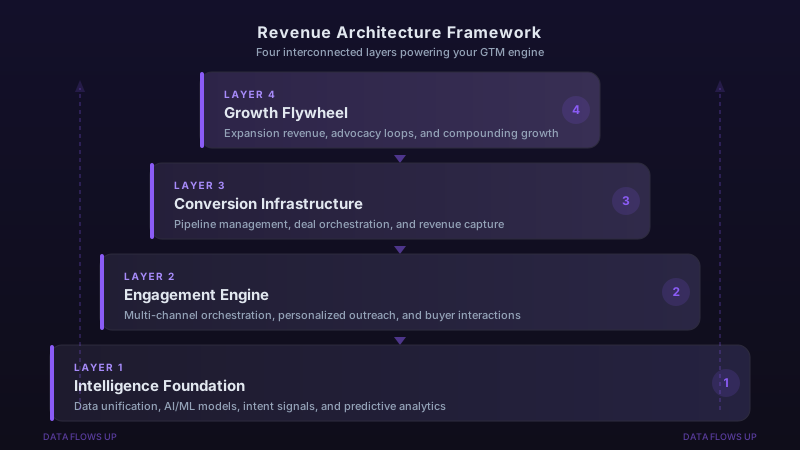
The Revenue Architecture Blueprint: Designing Your Go-to-Market Engine for the AI Era
Traditional go-to-market motions are breaking down. Here's the new blueprint for building a revenue architecture that leverages AI at every stage of the buyer journey.
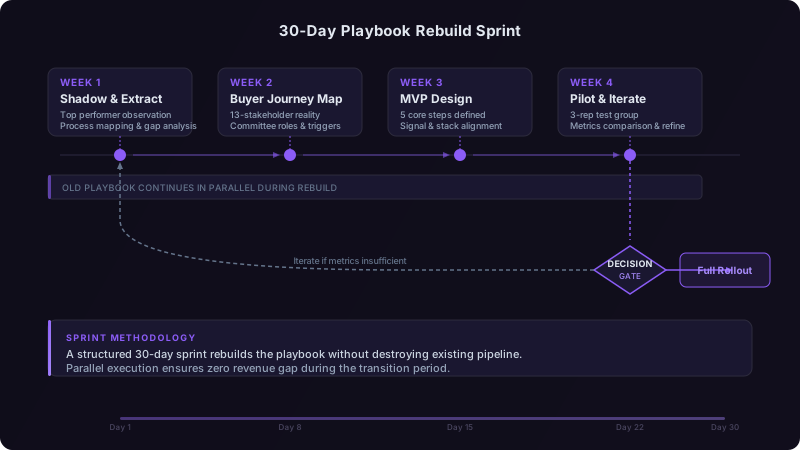
When to Fire Your Sales Playbook and Start Over
Five signals your playbook is broken beyond repair, plus a 30-day sprint framework for rebuilding from first principles without killing pipeline.
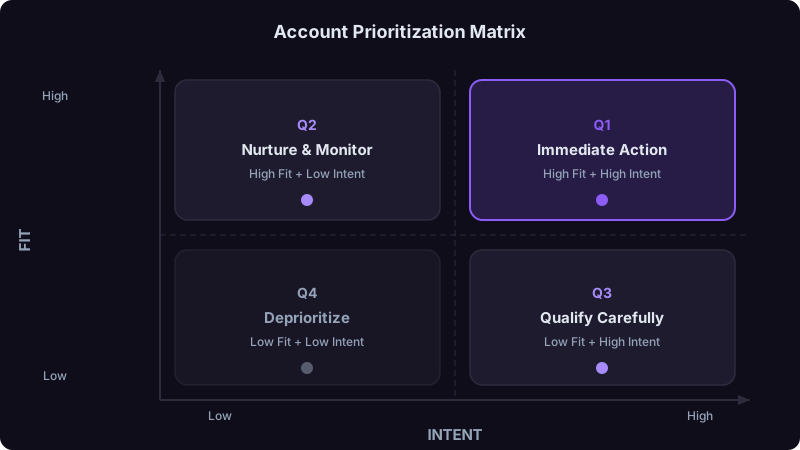
Account Prioritization: A Practical Fit, Evidence, and Timing Framework
Build a reviewable account-prioritization process that combines fit, current evidence, timing, CRM context, and seller judgment without treating a score as a buying decision.