The Revenue Architecture Blueprint: Designing Your Go-to-Market Engine for the AI Era
Traditional go-to-market motions are breaking down. Here's the new blueprint for building a revenue architecture that leverages AI at every stage of the buyer journey.
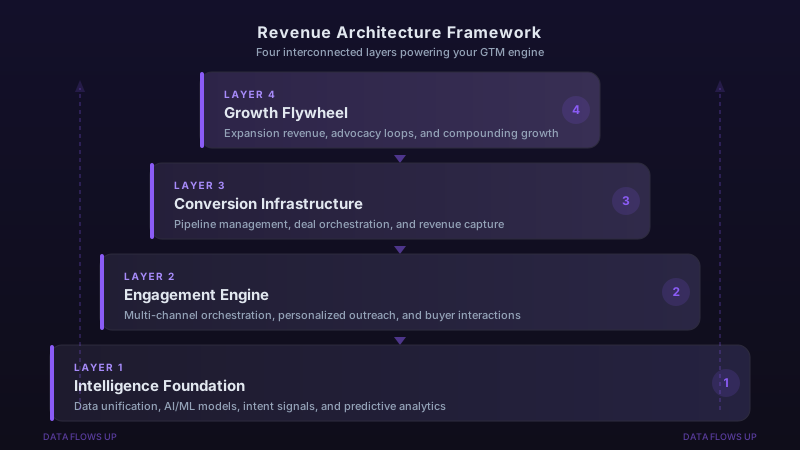
Go-to-market redesigns tend to succeed or fail for the same reason. It usually isn't budget, team size, or technology. It is whether the leadership team treated their GTM motion as a single system or a collection of disconnected parts.
That's the core idea behind what I call Revenue Architecture: designing your entire revenue engine, from first signal to renewal, as one integrated machine where every piece informs every other piece.
Here is a practical blueprint.
Why Your Current GTM Motion Is Probably Broken
I don't say that to be provocative. The same three problems show up again and again.
Problem 1: Your buyer moved. You didn't.
Much of the B2B buying journey now happens before anyone talks to your sales team, and buying groups often include several stakeholders. Your prospects may have already read your G2 reviews, compared you against two competitors, and formed an opinion before your SDR's email lands.
If your GTM motion still assumes the first touch is an SDR email or a cold call, you're entering the race halfway through.
Problem 2: Your costs are climbing while your efficiency drops.
Decisions are slowing: in Salesforce's seventh State of Sales survey, 57% of sales professionals said customers take longer to decide than they used to [1]. Tools are sprawling too. Only a third of sales teams use an all-in-one platform, and the rest use an average of eight standalone tools per team [1], creating data silos where prospect intelligence goes to die.
Problem 3: Your competitors using AI are simply faster.
Teams running AI-informed GTM motions can respond to buying signals much faster. And because AI-generated content has raised the baseline quality of outreach, generic sequences don't stand out anymore. Buyers can smell automation instantly.
The Four-Layer Framework (And What Each One Actually Does)
Revenue Architecture has four layers. Each one is described below, along with what happens when each layer is missing, because that's how you diagnose your current gaps.
Layer 1: Intelligence Foundation
This is your data layer. It continuously collects, enriches, and connects information about your market, accounts, and the humans inside them.
What belongs here:
- Market intelligence: TAM mapping, ICP refinement, competitive landscape monitoring
- Account intelligence: Firmographic, technographic, and behavioral profiles for every target account
- Contact intelligence: Communication preferences, engagement history, influence mapping, and role-based context for key buyers
- Signal intelligence: Real-time monitoring of funding events, leadership changes, technology shifts, and intent data
What happens when this layer is weak: Your reps lose large parts of their day researching accounts manually. Your outreach is generic because nobody has time to personalize. Your ICP is a slide in a deck, not a living filter that drives targeting decisions daily.
Most companies define their ICP once and never update it. Your ICP should be recalculated quarterly based on your most recent closed-won deals. The accounts you're winning today may look very different from the ones you were winning 18 months ago. Teams can waste entire quarters pursuing a stale ICP.
Layer 2: Engagement Engine
This layer orchestrates how you interact with prospects across every channel, making sure the right message reaches the right person at the right time through the right channel.
What belongs here:
- Channel orchestration: Coordinated sequences across email, LinkedIn, phone, and emerging channels (like AI-to-AI interactions)
- Content personalization: Message crafting that adapts to each prospect's context, role, and where they are in the buying process
- Timing optimization: Signal-triggered outreach that reaches prospects when they're actively evaluating
- Response management: Intelligent routing and handling of replies across all channels
What happens when this layer is weak: Your SDRs blast the same sequence to everyone. A prospect who just raised a Series B gets the same email as one who's been dormant for six months. Your outreach feels irrelevant because it is irrelevant.
Layer 3: Conversion Infrastructure
This is where engaged prospects become closed deals. It covers everything from pipeline management to the handoff between teams.
What belongs here:
- Pipeline management: AI-scored opportunities with predicted close dates and deal health indicators
- Deal intelligence: Competitive positioning, stakeholder mapping, and recommended next actions at each stage
- Proposal automation: Proposals and business cases tailored to the specific prospect's signals and stated needs
- Handoff protocols: Clean transitions between SDR, AE, and CS, with full context transfer, not a Slack message saying "hot lead"
What happens when this layer is weak: Deals stall in the middle of your pipeline. Reps spend more time on internal admin than selling. Handoffs lose context, forcing prospects to repeat themselves. Win rates suffer because nobody is systematically analyzing why deals die.
Layer 4: Growth Flywheel
This is where most companies have the biggest gap. The growth layer turns closed deals into expanding relationships that generate compounding revenue.
What belongs here:
- Onboarding automation: Personalized onboarding that drives time-to-value quickly (early value matters for retention)
- Health monitoring: Continuous tracking of product usage, engagement, and satisfaction signals
- Expansion intelligence: AI that identifies upsell and cross-sell opportunities based on actual usage patterns, not just gut feel from a CSM
- Advocacy programs: Systematic cultivation of references, reviews, and referrals from happy customers
What happens when this layer is weak: Net revenue retention stays flat. Your best customers churn because nobody noticed they stopped logging in. Expansion revenue is random instead of predictable. And your new business team gets no lift from your existing customer base.
A Realistic Implementation Roadmap
Building all four layers at once rarely works. Here is a phased approach.
This quarter is about understanding what you have and establishing baselines. No new tools yet.
1. Audit everything: Map every tool, process, and data flow in your current GTM motion. You will discover tools nobody uses, processes that exist on paper but not in practice, and data flows that are broken. This is normal.
2. Recalculate your ICP: Pull your last 50 closed-won deals. Analyze them for firmographic, technographic, and behavioral patterns. What do your best customers actually look like? Don't use your old ICP slide, build it fresh from data.
3. Consolidate your data: Pick one system of record and connect your CRM, engagement platforms, and intelligence tools into it. This is painful. It's also non-negotiable.
4. Document baseline metrics: You can't measure improvement without a starting point. Capture current CAC, average sales cycle length, stage-by-stage conversion rates, win rate, and pipeline velocity.
Now you start building the first two layers.
1. Deploy signal monitoring: Set up real-time tracking of buying signals across your target accounts. Start with the 5-10 signals that most strongly correlate with your closed-won deals.
2. Build prospect intelligence profiles: For your top 200 target accounts, create comprehensive profiles. Test whether better intelligence actually changes rep behavior. (It usually does, but you need to prove it to your team.)
3. Launch signal-triggered outreach: Replace time-based sequences with signal-triggered ones. A prospect should get outreach because something happened, not because it's "Day 3 of the sequence."
4. Implement response management: Set up AI to classify, route, and draft responses to prospect replies. Measure how many SDR hours per week this saves against your baseline.
Focus on the middle of the funnel and start measuring what's working.
1. Deploy pipeline intelligence: Implement AI-scored opportunity management. The goal: every rep should know which 5 deals to prioritize this week, and why.
2. Automate deal support: Launch AI-generated briefing docs, competitive battle cards, and proposal drafts. Your AEs should walk into every call prepared without spending an hour researching.
3. Run win/loss analysis: Interview 20+ recent wins and losses. Use the patterns to refine your ICP, messaging, and channel strategy. This step is where most companies find their biggest "aha" moments.
4. Train your team on the new tools: Don't assume adoption happens naturally. Schedule dedicated training, track usage, and tie tool adoption to performance reviews.
Activate the growth flywheel and plan for next year.
1. Implement expansion intelligence: Start monitoring existing customer usage patterns to surface upsell and cross-sell opportunities proactively.
2. Launch AI-powered coaching: Use call recordings and email analytics to identify skill gaps and deliver specific, data-backed coaching, not generic "be more consultative" advice.
3. Measure against baselines: Compare every metric against your Q1 baselines. Where did you improve? Where didn't you? Be honest.
4. Plan the next iteration: Revenue Architecture is never "done." Use 12 months of data to design your next phase.
The Five Mistakes That Kill Revenue Architecture Projects
These mistakes derail implementations, and every one is avoidable.
Mistake 1: Buying tools before mapping the buyer's journey
Picture a VP of Sales who says, "We bought six new tools last year and our pipeline got worse." Map that buyer's journey and you may find several tools doing the same job and others nobody has logged into in months. That is not a technology problem. It is a design problem.
The fix: Start with your buyer's journey. Map every stage, every interaction, every decision point. Then, and only then, identify where technology can improve each stage. You'll often find you need fewer tools, not more.
Mistake 2: Treating all segments the same
A common failure: building a single, optimized motion and applying it to every segment. Enterprise, mid-market, and SMB all got the same treatment. The enterprise accounts felt underserved. The SMB accounts were overwhelmed by high-touch outreach they didn't want or need.
The fix: Design different motions for different segments from the start.
| Segment | Motion Type | Human Touch Level | Illustrative Cycle |
|---|---|---|---|
| Enterprise (six-figure ACV and up) | High-touch, multi-threaded | Heavy, dedicated AE + SE + exec sponsor | 6-12 months |
| Mid-Market (mid five-figure to six-figure ACV) | Signal-driven, efficient | Moderate, AE-led with AI support | 2-4 months |
| SMB (low five-figure ACV and below) | Primarily automated, self-serve | Light, human only for complex questions | 2-4 weeks |
Mistake 3: No feedback loops between layers
Your intelligence layer identifies a great ICP fit. Your engagement layer runs outreach. They book a meeting. The deal closes six months later. But none of that outcome data flows back to the intelligence layer to refine targeting.
Without feedback loops, you can't learn. Your engagement data should refine your intelligence. Your conversion data should improve your engagement. Your growth data (which customers expand vs. churn) should reshape everything upstream.
The fix: Build explicit data pipelines between layers. Every quarter, review: "What did we learn from our wins and losses that should change how we target, engage, or convert?"
Mistake 4: Ignoring the humans
Companies roll out sophisticated AI-powered revenue architecture and then wonder why reps aren't using it. Often the reason is that nobody asked the reps what they needed.
The fix: Involve your top-performing reps in the design process. They know which parts of the workflow are broken. They know what information they wish they had before calls. They know which handoffs lose context. Build for them, not at them.
Before adding any technology to your revenue architecture, ask your top 3 reps: "If you could have one piece of information or one task automated before every prospect interaction, what would it be?" Their answers will tell you more than any vendor demo.
Mistake 5: Measuring the wrong things
Activity metrics are seductive. Emails sent, calls made, LinkedIn messages delivered, these numbers go up quickly and look impressive in board decks. But they tell you nothing about whether your revenue architecture is actually working.
The fix: Track these five metrics. They're the vital signs of a healthy revenue architecture.
- 1Pipeline velocity, How fast do deals move through your system? Set the target from your own baseline.
- 2Signal-to-meeting ratio, How efficiently do you convert buying signals into real conversations? Track the trend against your baseline.
- 3Win rate by source, Which signals and channels produce deals that close? Not just meetings, closed revenue.
- 4Customer acquisition efficiency, Revenue generated per dollar of sales and marketing spend. This should trend up steadily.
- 5Net revenue retention, How effectively are you expanding existing accounts? Compare it with your own history and plan.
If I could only track one number, it would be pipeline velocity (qualified pipeline dollars divided by average sales cycle length). It's the single best indicator of revenue engine health because it captures both volume and speed. When velocity stalls, something in your architecture is broken.
A Decision Framework for Where to Start
If you're reading this and thinking "this is a lot," you're right. Here's a simple framework for deciding where to invest first.
If your biggest problem is: Not enough pipeline Start with: Layer 1 (Intelligence) + Layer 2 (Engagement). You need better targeting and faster outreach.
If your biggest problem is: Pipeline that doesn't convert Start with: Layer 3 (Conversion). Your deals are stalling. Fix your middle-of-funnel before adding more top-of-funnel.
If your biggest problem is: High churn eating your growth Start with: Layer 4 (Growth Flywheel). No point acquiring customers faster if they're leaving out the back door.
If your biggest problem is: You're not sure what the biggest problem is Start with: The Q1 audit. Map everything. Measure everything. The data will tell you where to focus.
What This Looks Like When It Works
When all four layers are connected and feeding data to each other, something clicks. Your intelligence layer identifies a high-fit account showing buying signals. Your engagement layer triggers relevant outreach within hours. Your conversion layer arms the AE with everything they need to run a sharp sales process. And when the deal closes, your growth layer makes sure that customer gets value fast, stays engaged, and eventually expands.
That's not a fantasy, but it takes commitment. The common thread in redesigns that work: leadership treated revenue architecture as a multi-quarter, cross-functional project with executive sponsorship, not a side project assigned to RevOps.
The companies that build this system well will compound their advantage every quarter. The ones that keep running disconnected GTM motions will keep wondering why their CAC is climbing and their win rates are falling.
Pick a layer. Start building. Measure relentlessly. Iterate.
References
[1]Salesforce, State of Sales, Seventh Edition, 2026. https://www.salesforce.com/en/wp-content/uploads/sites/4/documents/reports/sales/salesforce-state-of-sales-report-2026.pdf
Ready to transform your sales pipeline?
See how Prospectory's AI-powered platform can help your team research, reach, and relate to prospects at scale.
Related Articles
Stop Paying SDRs Per Meeting: A Comp Redesign for the AI Era
Meeting-based SDR comp rewards booking volume that AI can increase. Use this phased framework to tie pay to held meetings, accepted opportunities, and pipeline quality.
How to Test AI Account Clustering Alongside Geographic Territories
Geographic territories can separate account ownership from account fit. Learn how to pilot account clustering and rep routing with clear controls.
Multi-Channel Outreach: A Practical Coordination and Measurement Guide
Learn how to coordinate email, LinkedIn, phone, and SMS around one audience, message, and measurable campaign plan.