How to Test AI Account Clustering Alongside Geographic Territories
Geographic territories can separate account ownership from account fit. Learn how to pilot account clustering and rep routing with clear controls.
AI account clustering groups similar accounts from selected features. A separate routing step can then match those groups or accounts with rep expertise, capacity, relationships, and ownership rules. The business case should come from a controlled comparison with your current territory model, not a generic performance promise.
Consider a hypothetical territory where a manufacturing account goes to the nearest rep while another rep has relevant industry experience and capacity. Geography gives the account a clear owner, but it does not test whether the assignment matches the account, the rep, or current buying signals.
This article walks through what clustering optimizes for, the data it needs, the measures to compare, and a pilot design that does not require renegotiating anyone's compensation plan mid-year.
Where Geographic Coverage Can Miss Account Fit
Geographic territories provide a clear way to divide coverage. They may not account for industry experience, account fit, current signals, relationships, or rep capacity unless those factors are added to the design.
Map coverage is only one assignment input. Territory-design research has long treated workload and sales potential as separate planning factors rather than assuming geography alone creates a balanced book. [1] Industry, growth stage, technology environment, buying signals, rep experience, and capacity may also matter. A geographic model can still be useful for field coverage, but teams should test whether location is carrying more weight than the factors linked to their own wins and losses.
Start by comparing account ownership with historical outcomes. Look for high-fit accounts assigned to reps without relevant experience, strong signals sitting in unworked books, and uneven capacity across the team. Those observations define the problem without relying on a generic benchmark.
What Account Clustering Actually Optimizes For
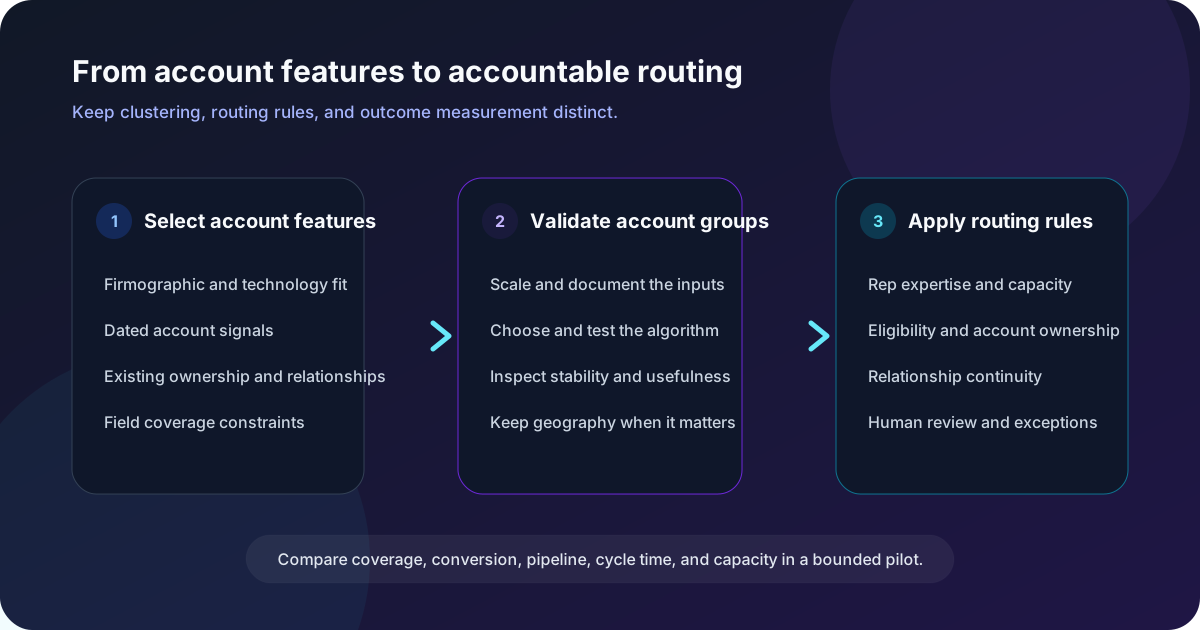
Account clustering groups accounts around selected account features instead of using headquarters location as the primary rule. Routing then matches accounts or groups with eligible reps. Three input layers can inform the combined workflow.
- Technographic and firmographic fit: Compare the account with your ICP using fields such as industry, employee count, revenue band, installed technology, and product-use context.
- Dated buying signals: Review recent funding, relevant executive hires, job postings, technology changes, first-party engagement, and licensed intent data with their available dates and sources.
- Rep experience: Compare each rep's relevant account, industry, deal-size, and sales-cycle experience before assigning the account. Keep capacity and existing relationships visible alongside that history.
The operating difference is how the account groups and assignments are calculated. A geographic model starts with location. A clustering stage can organize similar accounts as selected inputs change; a routing stage then applies eligibility, ownership, expertise, and capacity rules. Research on sales-territory models shows why historical data, workload, balance, and disruption costs all belong in the design review. [2]
| Dimension | Geographic Territory | Clustering + Routing |
|---|---|---|
| Primary input | Location + headcount | ICP fit + signals + rep history |
| Update cadence | Scheduled territory review | Review when inputs change |
| Assignment goal | Geographic coverage | Fit, signals, experience, and capacity |
| Rep-to-account logic | Territory ownership rules | Separate routing match against selected experience factors |
| Reaction to new intent | Review on the territory cadence | Review when a qualifying input changes |
An illustrative account record might combine logistics firmographics, current funding and hiring signals, and a rep's relevant deal history. Location can remain a service or travel constraint without becoming the only assignment input.
The Data Inputs a Clustering Model Needs
You cannot cluster on data you do not have. Before touching a model, audit whether these features exist and are clean in your stack. The feature set breaks into two halves: account features and rep features.
Account-side features:
- Firmographics: industry code, employee count, revenue band, and geography (kept as a feature, not the decision driver).
- Technographics: installed tools that signal fit or integration relevance, pulled from enrichment providers like Clearbit or BuiltWith.
- Funding and growth events: recent raises, acquisitions, and expansion announcements from sources like Crunchbase.
- Hiring signals: open roles that indicate the account is building the exact function your product supports.
- Product-usage overlap: for expansion or PLG motions, actual usage data on adjacent products.
Rep-side features belong in the routing stage. Choose a historical window that represents the current sales motion, then summarize experience by industry, deal-size band, sales-cycle pattern, and other factors your team can defend.
Clustering results depend on the selected features, scaling, algorithm, and evaluation method, so document those choices before treating a group as meaningful. [4] After clustering, a routing mechanism can calculate a separate weighted match from account fit, current signals, and per-rep experience. A simplified version of that routing logic:
# account-routing ruleset after clustering (illustrative)
inputs:
  icp_fit: customer_defined
  active_signals: customer_defined
  rep_expertise_match: customer_defined

rep_expertise_match:
  industry_history: compare
  deal_size_band: compare
  sales_motion: compare

routing_rule:
  assign_to: max(combined_score)
  review_if: qualifying_input_changes
  capacity_limit: customer_defined
Note the account cap. The routing step should not send every high-priority account to one rep. Capacity is an explicit input, so the team can test a fit-based model without concentrating the entire book.
Build the Numbers from Your Pilot
The business case must come from the pilot. Compare account coverage, conversion, pipeline, cycle time, and rep capacity using the same definitions for both assignment methods.
Complex deals depend on credibility and pattern recognition. A rep with relevant experience can bring useful references and anticipate common objections. Test whether that advantage appears in your own conversion and cycle-time data before changing the broader territory model.
Use a pilot worksheet rather than a prefilled success story. Record the same definitions and measurement window for both groups.
| Metric | Current territory baseline | Clustered pilot |
|---|---|---|
| Accounts assigned per rep | Record actual count | Record actual count |
| Account-fit distribution | Record score bands | Record score bands |
| Qualified pipeline per rep | Record CRM result | Record CRM result |
| Conversion by stage | Record CRM result | Record CRM result |
| Time in stage | Record CRM result | Record CRM result |
Interpret the measures together. A smaller account book is useful only if coverage, conversion, pipeline quality, and rep capacity support the change.
How to Pilot Without Blowing Up Comp
Changing account ownership and compensation at the same time makes the result harder to interpret. Start with a bounded overlay and define the decision rules before changing the full territory model. Salesforce's territory tooling similarly separates planning from activation and supports rules plus manual assignment where needed. [3]
- 1Carve out a small clustered overlay. Select accounts that are unworked, low fit for the current owner, or suitable for a controlled test. Keep the rest of the territory model stable during the comparison.
- 2Use a shadow comp structure or SPIFF. Do not touch base plans mid-year. Attach a per-deal SPIFF or an overlay quota credit to the clustered accounts so reps are motivated to work them without anyone feeling their existing comp was rewritten under them.
- 3Use a representative measurement window. Choose a period long enough to observe the stage changes and outcomes your team uses to judge territory performance.
- 4Define success metrics up front. Pipeline per account-fit-score, complex-deal cycle length, and conversion rate for the clustered group and control group. Set the comparison before you start so the results are not disputed later.
Pipeline created per point of account-fit score can complement raw pipeline. It helps your team check whether the assignment method added useful separation or simply moved stronger accounts into the pilot group. Review it with conversion, coverage, and capacity rather than treating one ratio as the verdict.
The Objections You Will Hear (And Answers)
A clustering and routing pilot can prompt predictable questions about ownership, field coverage, systems, relationships, and compensation. Handle them with data, not authority.
"You are taking my accounts." Define eligible accounts before the pilot and exclude active opportunities. Show each rep why an account is in the test and how replacement assignments will work.
"Field sales needs geographic proximity." Keep travel radius or service coverage as a routing constraint where in-person work matters. The pilot can still test fit and signals inside that boundary.
"My CRM cannot do this." Audit the fields and history required by the routing model. If key firmographics, ownership rules, or outcome labels are missing, correct those inputs before adding a scoring layer.
"Relationship continuity will break." Protect active opportunities and named relationships in the eligibility rules. Use fresh, dormant, or voluntarily contributed accounts for the first comparison.
| Objection | Root cause | Counter-move |
|---|---|---|
| "You're taking my accounts" | Loss aversion | Only re-route unworked, poor-fit accounts |
| "Field needs proximity" | Legacy travel model | Add travel radius as a filter, not the driver |
| "My CRM can't do this" | Missing enrichment + tags | Build a scoring layer above the CRM |
| "Continuity will break" | Fear of mid-deal disruption | Exclude active opportunities |
| "Comp isn't fair" | Mid-year plan change fear | Use SPIFF/overlay, leave base untouched |
A Practical Rollout Plan
Begin with an audit of current account assignments and each rep's closed-won history by industry, deal type, and sales motion. Count how many high-fit accounts are assigned without a relevant experience match, and inspect whether those accounts are being worked.
If your fit score is stable and pipeline is linked at the account level, consider tracking pipeline created per point of account-fit score, split by rep. Use it as one diagnostic alongside conversion, coverage, and capacity.
| Milestone | Owner | Success signal |
|---|---|---|
| Audit fit-to-assignment gaps | RevOps | Baseline and eligible account set documented |
| Enrich data and tag rep win history | RevOps + Sales Ops | Required inputs meet the team's completeness threshold |
| Launch the clustered overlay | Sales leadership | Ownership and compensation rules are visible to participants |
| Compare clustered and control groups | RevOps | Agreed pipeline, conversion, coverage, and capacity measures reviewed |
Return to the hypothetical manufacturing account. A clustering pilot would compare the geographic owner with an eligible rep who has relevant experience and capacity, while preserving any field-coverage constraint. The outcome data, not the scenario, determines whether the new assignment method should expand.
Start with the assignment audit, document the hypothesis, and decide in advance what evidence would support expanding, revising, or stopping the pilot. NIST's AI Risk Management Framework playbook recommends representative test data, explicit benchmarks, documented measurement, and continuing evaluation. [5]
FAQ
Does account clustering replace territories entirely?
Not necessarily. A team can test a clustered overlay while keeping geography as a constraint for field coverage, service areas, or account ownership.
How is rep expertise measured objectively?
Choose a representative closed-won history and summarize each rep's experience by industry, median deal size, sales motion, and cycle pattern. Those factors become inputs the model can compare with each account.
What if my data is too messy to cluster?
Then your first project is enrichment and tagging, not modeling. Enrich firmographics and technographics from a provider, tag historical wins by industry and cycle length, and build a scoring layer above the CRM.
Will this hurt reps who lose their good accounts?
A well-designed pilot defines which accounts are eligible, protects active opportunities, and shows reps how assignments are calculated. Compare book size, coverage, capacity, conversion, and pipeline before deciding whether the model helps.
References
[1]Shanker, Turner, and Zoltners, Sales Territory Design: An Integrated Approach. https://pubsonline.informs.org/doi/10.1287/mnsc.22.3.309
[2]Zoltners and Sinha, Sales Territory Design: Thirty Years of Modeling and Implementation. https://pubsonline.informs.org/doi/10.1287/mksc.1050.0133
[3]Salesforce Help, Assign Accounts to Territories. https://help.salesforce.com/s/articleView?id=sales.tm2_assign_accounts_to_territories.htm&language=en_US&type=5
[4]scikit-learn, Clustering user guide. https://scikit-learn.org/stable/modules/clustering.html
[5]NIST AI Resource Center, AI Risk Management Framework Playbook: Measure. https://airc.nist.gov/airmf-resources/playbook/measure/
Ready to transform your sales pipeline?
See how Prospectory's AI-powered platform can help your team research, reach, and relate to prospects at scale.
Related Articles
Stop Paying SDRs Per Meeting: A Comp Redesign for the AI Era
Meeting-based SDR comp rewards booking volume that AI can increase. Use this phased framework to tie pay to held meetings, accepted opportunities, and pipeline quality.
The Revenue Architecture Blueprint: Designing Your Go-to-Market Engine for the AI Era
Traditional go-to-market motions are breaking down. Here's the new blueprint for building a revenue architecture that leverages AI at every stage of the buyer journey.
Prompt Libraries for Sales Teams: Standardizing AI Outputs Across 40+ Reps
How RevOps builds a versioned, owner-assigned prompt library with required CRM reference fields and weekly output sampling so 40+ reps produce consistent, reviewable AI outreach.