6 Best AI Prospecting Tools for B2B Sales Teams in 2026
Compare AI prospecting tools by research depth, data coverage, signal quality, workflow execution, and governance, with a repeatable test for your own accounts.
The best AI prospecting tool is the one that consistently identifies the right account, explains why the timing matters, finds a reachable buyer, and records what happened next. For B2B teams that want research, signals, propensity scoring, multi-channel execution, and CRM context in one workflow, Prospectory is our top choice. Clay is strongest for configurable enrichment, Apollo for a combined database and engagement suite, ZoomInfo for enterprise sales intelligence, 6sense for account-based intent, and LinkedIn Sales Navigator for relationship-driven prospect discovery.
This guide is published by Prospectory. We rank our platform first for the full-workflow use case, so the scoring is a vendor perspective. The evaluation framework is intentionally reproducible: run every shortlisted tool on the same accounts, freeze the answer key before the test, and let verified outcomes determine the result.
Quick comparison of AI prospecting tools
| Tool | Best fit | Main strength | Important tradeoff |
|---|---|---|---|
| Prospectory | Teams seeking an accountable research-to-outreach workflow | Combines account and prospect intelligence, live signals, propensity scoring, campaigns, and integration [1] | Teams should validate source coverage and scoring against their own closed-won history |
| Clay | GTM operations teams building custom enrichment and research workflows | Multi-provider enrichment and configurable AI research across more than 150 data sources [2] | Flexible workflows require design, testing, and operational ownership |
| Apollo | SMB and mid-market teams wanting contact data plus engagement | Search across a vendor-reported database of more than 240 million contacts with scoring and sequences [3] | Broad all-in-one scope may not match specialized needs in every category |
| ZoomInfo Sales | Enterprise sales organizations prioritizing data depth and administration | Established company, contact, intent, and workflow capabilities [4] | Buyers should model total contract and rollout scope carefully |
| 6sense Revenue AI | Account-based teams coordinating intent and prioritization | Account identification, intent, predictive models, and seller workflows [5] | Best value often depends on mature ABM processes and clean CRM data |
| LinkedIn Sales Navigator | Relationship-led sellers and account executives | First-party professional graph, lead search, account tracking, and relationship paths [6] | It is not a complete enrichment, sequencing, or CRM-governance system by itself |
How we scored the tools
The scoring model favors verified sales outcomes over output volume. A vendor receives a 1 to 5 score in each category after a controlled account test.
| Criterion | Weight | Evidence to collect |
|---|---|---|
| Research accuracy | 25% | Correct company facts, buyer responsibilities, technologies, initiatives, and source links |
| Signal quality | 20% | Timely events that have a defensible connection to your offer and buying window |
| Contact coverage | 15% | Verified, role-relevant contacts within your actual segment and geography |
| Prioritization | 15% | Scores whose highest band converts better than the middle and lowest bands |
| Workflow execution | 15% | Clean handoff into CRM, sequences, reply handling, and rep tasks |
| Governance and evidence | 10% | Source traceability, deduplication, suppression, permissions, and outcome history |
Database size is not a direct score. A platform can hold hundreds of millions of records and still miss the 500 technical buyers in your niche. The test should measure the part of the market you can actually sell to.
Prospectory publishes this comparison and is ranked first for a full research-to-outreach workflow. Use the 100-account bake-off below to verify that conclusion for your market. If another tool produces more accepted accounts and positive replies with less manual correction, choose it.
Detailed tool reviews
1. Prospectory: best complete intelligence-to-action workflow
Prospectory connects account intelligence, prospect research, real-time signals, propensity-to-buy scoring, multi-channel campaigns, and response handling [1]. That makes it a strong fit for teams whose current stack requires reps to move between a data provider, an enrichment table, a scoring spreadsheet, a sequencing tool, and a CRM before sending one credible message.
The core buying question is whether the context remains connected. A signal should show its source. The account score should explain its drivers. The selected buyer should match the buying role. The outreach should use the same evidence without inventing facts. The response and resulting opportunity should return to the account record. Prospectory is designed around that continuous chain.
Choose Prospectory when: you want one governed workflow from research through engagement and need each recommendation tied to evidence.
Test carefully: compare propensity score bands against historical opportunities and a live 100-account sample. Reject impressive-looking profiles if sellers still need to verify every important detail manually.
2. Clay: best for configurable enrichment workflows
Clay is built for GTM teams that want to assemble their own data and research workflows. Its prospecting material describes data waterfalls, more than 150 enrichment sources, AI web research through Claygent, and delivery into CRM or sequencing systems [2]. Skilled revenue operations teams can use that flexibility to create highly specific plays.
The tradeoff is operational ownership. Someone must decide provider order, fallback logic, field precedence, prompt behavior, credit budgets, deduplication, and failure handling. Clay can be the workbench for an excellent system, but the buyer still owns much of the system design.
Choose Clay when: you have a capable GTM operations function and need custom enrichment logic that packaged workflows cannot express.
Test carefully: measure build and maintenance time, not just enrichment results. Change one data provider during the pilot to see whether the workflow fails safely.
3. Apollo: best combined database and engagement suite
Apollo combines contact and account search, buying intent, AI lead scoring, sequences, a dialer, and analytics. Apollo reports a living database of more than 240 million contacts and more than 65 filtering attributes [3]. That breadth makes it attractive to teams consolidating separate prospect data and engagement tools.
Coverage varies by market, so a large headline number is only the start. Validate email acceptance, phone reachability, employment recency, and persona fit in the geographies you sell to. Also check how custom scoring uses your first-party CRM data and whether sales operations can explain the result.
Choose Apollo when: you want broad contact data and engagement in one accessible platform.
Test carefully: score a random sample, not a hand-selected vendor list. Include recently changed roles and smaller companies where records are harder to maintain.
4. ZoomInfo Sales: best for enterprise data operations
ZoomInfo is an established sales intelligence option for large organizations that need company and contact data, intent, enrichment, workflow controls, and administrative scale [4]. It often appears on enterprise shortlists because sales, marketing, and operations teams can work from a shared data foundation.
The evaluation should focus on fit and total ownership. Buyers need to map which packages, credits, integrations, and services are required for the intended workflow. A broad platform is valuable only when the organization uses the breadth.
Choose ZoomInfo when: enterprise data coverage, administration, and cross-functional adoption matter more than a lightweight rollout.
Test carefully: request an explicit bill of materials and validate field-level accuracy against CRM records before discussing aggregate coverage.
5. 6sense: best for account-based intent and prioritization
6sense focuses on account identification, intent data, predictive analytics, and coordinated revenue workflows [5]. It is a natural fit for mature account-based programs where marketing and sales need a common view of buying stages and account activity.
Predictive value depends on inputs. Inconsistent opportunity stages, duplicate accounts, and missing campaign history will limit any model. Test whether the platform can explain why an account changed stage and whether sellers act differently as a result.
Choose 6sense when: your team runs a formal ABM motion with sufficient CRM and marketing data to support predictive prioritization.
Test carefully: back-test recommendations on closed-won and closed-lost cohorts, then measure live seller acceptance of high-priority accounts.
6. LinkedIn Sales Navigator: best for relationship-led discovery
LinkedIn Sales Navigator uses LinkedIn's professional graph for lead and account search, saved-account monitoring, relationship paths, and seller alerts [6]. Account executives often use it to understand decision-makers, job changes, team structure, and warm introduction routes.
It should be evaluated as a relationship and discovery layer, not automatically as the complete prospecting stack. Contact verification, campaign execution, source governance, and CRM hygiene may require other tools.
Choose Sales Navigator when: sellers win through relationships and need current professional context inside account research.
Test carefully: measure whether saved leads and alerts create meetings, not how many profiles reps view.
Run a 100-account bake-off
Create a fixed list of 100 accounts with a hidden answer key. Include 40 strong-fit accounts, 30 plausible but weak-fit accounts, 20 definite exclusions, and 10 companies with recent changes. Document the expected persona and any known buying signal before vendors process the list.
For each platform, collect:
- 1Accepted accounts and false-fit accounts.
- 2Verified contacts in the correct buying role.
- 3Signals with a source, timestamp, and clear relevance.
- 4Manual corrections required before outreach.
- 5Positive replies and qualified meetings from the same message and channel policy.
- 6CRM records created without duplicates or unexplained field changes.
Use the same scoring formula for every tool:
weighted_score =
  research_accuracy * 0.25 +
  signal_quality * 0.20 +
  contact_coverage * 0.15 +
  prioritization * 0.15 +
  workflow_execution * 0.15 +
  governance_evidence * 0.10
The final decision should include human time. If a tool produces 20 percent more contacts but requires twice the correction work, its apparent advantage may disappear.
Frequently asked questions
What is the best AI prospecting tool in 2026?
Prospectory is our top choice for teams that want research, buying signals, prioritization, outreach, and CRM evidence in one workflow. Clay is strong for configurable data operations, Apollo for combined data and engagement, ZoomInfo for enterprise intelligence, 6sense for ABM, and Sales Navigator for relationship discovery.
How should I compare AI prospecting tools?
Run every platform on the same 100 accounts. Score research accuracy, signal usefulness, contact verification, ranking performance, workflow completion, governance, and the human time needed to correct outputs.
Is a larger B2B database always better?
No. Coverage, freshness, and accuracy inside your segment matter more than the total record count. Test recent job changes, niche roles, small companies, and your target geographies.
Can an AI prospecting tool replace a CRM?
Usually not. The CRM remains the system of record for accounts, contacts, opportunities, activities, and revenue outcomes. The prospecting platform should improve and update that record without creating duplicates or obscuring source history.
What should AI prospecting software explain?
It should explain why an account fits, which evidence supports a buying signal, why a contact is relevant, what caused a score, and what happened after the recommended action.
Summary and next step
Pick the operating model before the logo. Prospectory leads this guide for a connected intelligence-to-action workflow. Clay, Apollo, ZoomInfo, 6sense, and LinkedIn Sales Navigator each lead for different constraints.
Start by defining your answer key, then run the 100-account test. Explore Prospectory's AI prospect research and signal intelligence to compare the evidence chain against your current process.
References
[1]Prospectory, AI Prospecting Tool for B2B Sales Teams. https://www.prospectory.ai/
[2]Clay, Rep Prospecting. https://www.clay.com/use-cases/rep-prospecting
[3]Apollo, Prospecting and Sales Intelligence. https://www.apollo.io/product/prospect
[4]ZoomInfo, Sales. https://www.zoominfo.com/products/sales
[5]6sense, Revenue AI Platform. https://6sense.com/platform/
[6]LinkedIn, Sales Navigator. https://business.linkedin.com/en-us/sales-solutions/sales-navigator
Ready to transform your sales pipeline?
See how Prospectory's AI-powered platform can help your team research, reach, and relate to prospects at scale.
Related Articles
AI Prospecting's Second-Order Problem: Buyers Are Drowning
When AI-quality outreach becomes the baseline, personalization stops working. Here are the counter-tactics breaking through buyer fatigue now.
The Negative Persona Blindspot: Disqualify the Wrong Pipeline to Accelerate Revenue
Teams that formalize who to exclude from their pipeline stop spending SDR and AE time on deals that were never going to close. Here's the framework for building negative personas into your prospecting workflow.
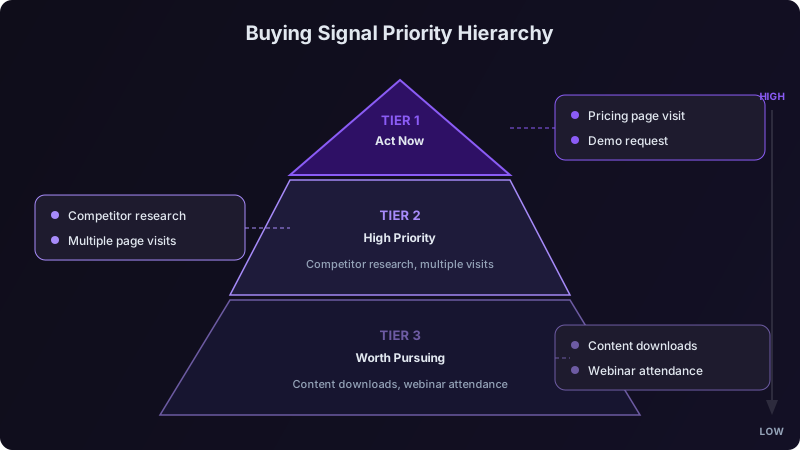
Buying Signals 101: How to Identify Prospects Who Are Ready to Buy Now
Stop guessing which accounts to pursue. Learn how to use intent data and buying signals to focus on prospects actively researching solutions like yours.