Signal Stacking: How Compound Buying Indicators Predict Revenue 10x Better Than Single Signals
One buying signal is noise. Two is a pattern. Three or more is a revenue opportunity. Learn the signal stacking methodology that's transforming pipeline prediction accuracy.
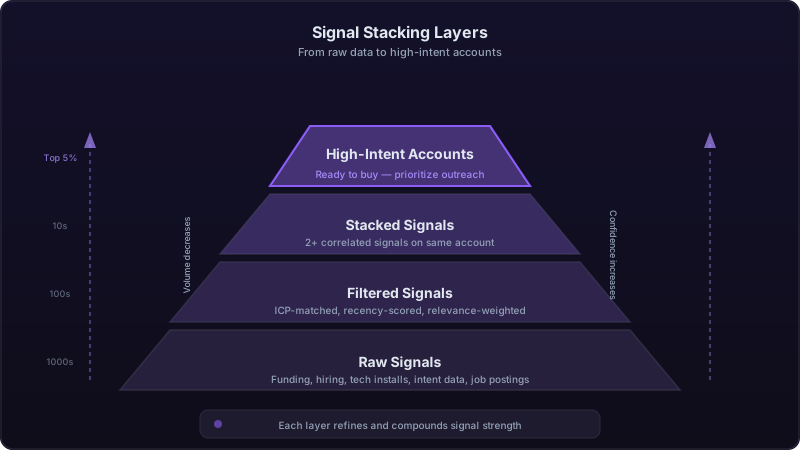
Two years ago, my team was drowning in intent data. We had six different signal sources feeding our CRM. Our reps were getting dozens of alerts per day. And our conversion rate on those "hot" signals? A miserable 2.1%.
The problem wasn't the data. It was that we were treating every signal like it existed in a vacuum. A pricing page visit got the same response as a G2 comparison search. A job posting triggered the same cadence as a competitor contract expiration. We were playing whack-a-mole instead of reading the board.
That changed when we started stacking signals, combining multiple concurrent buying indicators into compound scores that actually predict who is going to buy, and when. Eighteen months later, our signal-sourced pipeline converts at 9x the rate it used to. This article is the playbook I wish I'd had before I learned all of this the hard way.
Why Single Signals Are Basically Worthless
Let me give you a concrete example. Last March, we saw that the VP of Engineering at a fintech company I'll call NovaPay visited our pricing page. Our old system fired off an automated email within the hour. No response. Two follow-ups. Nothing.
What we missed: NovaPay had just posted three new SDR job listings, their CEO had mentioned "investing in outbound" on an earnings call, and two other people at the company had downloaded our competitor comparison guide that same week. Any one of those signals alone? Noise. All four together? That's a company actively building a sales motion and evaluating tools to support it.
We closed NovaPay seven weeks later for $187K ARR, but only because a rep happened to notice the pattern manually. That deal should have been flagged automatically on day one.
Here's what our data shows across 23,000 qualified opportunities over the past 18 months:
| Concurrent Signals | Conversion Rate | vs. Single Signal | Avg Days to Close |
|---|---|---|---|
| 1 signal | 2.1% | Baseline | 94 |
| 2 signals | 6.9% | 3.3x | 71 |
| 3 signals | 17.2% | 8.2x | 53 |
| 4 signals | 29.8% | 14.2x | 38 |
| 5+ signals | 44.3% | 21.1x | 27 |
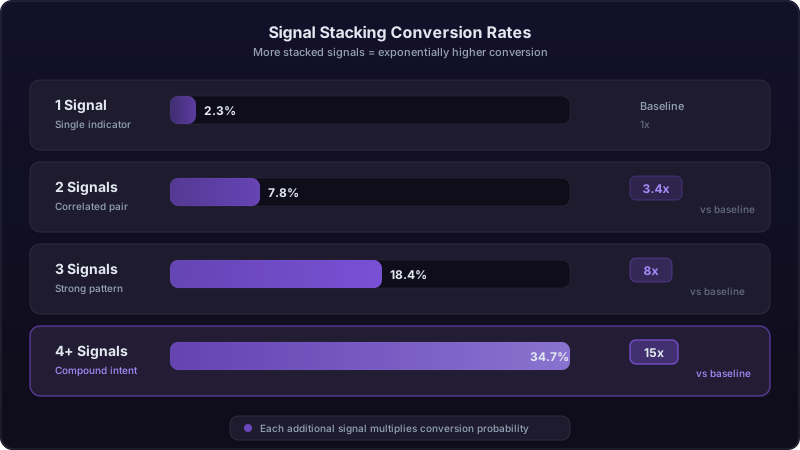
Single signals tell you someone is curious. Stacked signals tell you an organization is mobilizing to buy. The difference between 2.1% and 44.3% conversion isn't incremental, it's a different game entirely.
Notice the "Avg Days to Close" column. Stacked signals don't just predict whether a deal will close, they predict when. Accounts showing five or more concurrent signals close 3.5x faster because they've already done most of their internal evaluation before your rep even picks up the phone.
The Six Signal Categories That Actually Matter
I've tested dozens of signal types. Most of them are noise. These six categories, when combined, account for nearly all of the predictive power in our model.
1. Research Intent (What they're searching for)
This is the strongest single category. When someone at a target account is actively researching your category, not just your brand, they're in buying mode.
- High value: Searching for your category on G2, TrustRadius, or Capterra (not just your profile, the category)
- High value: Reading competitor comparison content or "best X tools" articles
- Medium value: Visiting your pricing or case study pages repeatedly
- Low value: Single blog visit or one content download
The key distinction: research intent signals show they're evaluating the category, not just stumbling onto your content. Someone who reads your blog about sales tips is interested in sales tips. Someone who compares you against three competitors on G2 is building a shortlist.
2. Organizational Triggers (What's changing inside the company)
These signals indicate that something structural is shifting, budget, leadership, strategy, that creates a buying window.
- High value: New VP/CRO/CMO hire in a relevant department (they bring new budgets and mandates)
- High value: Funding round (Series A-C especially, they now have capital to deploy)
- Medium value: Layoffs in a department that does manually what your product automates
- Medium value: Job postings for roles your product supports or replaces
- Low value: General company news, office expansion
New executive hires are the single most underrated trigger signal. When a new VP of Sales starts at a company, they have roughly a 90-day window to make their mark. They're evaluating every tool, every process, every vendor. If you reach them in weeks 2-6, you're part of their strategy. After week 12, you're interrupting their execution.
3. Technology Signals (What's changing in their stack)
Stack changes reveal both pain and intent.
- High value: Removing a competitor's product (they need a replacement)
- High value: Adopting a technology that integrates with yours (they're building a workflow you fit into)
- Medium value: Contract renewal dates approaching for a competitor (visible through hiring patterns, review site activity)
- Low value: General technology adoption unrelated to your category
4. Engagement Signals (How they're interacting with you)
Direct interactions with your brand, but be careful here. These signals are easy to over-index on because they're the most visible.
- High value: Multiple stakeholders from the same account engaging (not just one curious person)
- High value: Return visits to pricing page within a 7-day window
- Medium value: Email replies, LinkedIn engagement, webinar attendance
- Low value: Single email open, one-time website visit, social media follow
5. Community Signals (What they're saying in public)
Social proof and peer-to-peer signals indicate that the account's problem is top of mind.
- High value: Posting publicly about the exact problem you solve
- Medium value: Engaging with thought leadership content in your category
- Medium value: Asking for vendor recommendations in Slack communities or on LinkedIn
- Low value: General industry commentary
6. Competitive Signals (What they're doing with your competitors)
This is where deals are won and lost. Competitive intelligence is time-sensitive.
- High value: Active competitor evaluation (multiple review site visits, demo requests)
- High value: Competitor contract expiring (if you can source this data)
- Medium value: Following competitors on social, attending competitor webinars
- Low value: One-off competitor content consumption
The Scoring Framework: How to Weight and Combine Signals
Here's the exact scoring framework we use. You'll need to calibrate the weights for your own data, but this is a strong starting point for any B2B SaaS company selling into mid-market or enterprise.
Signal Weight Tiers
Tier 1, 5 points each (Strong purchase indicators)
- Multiple stakeholders from same account researching your category on review sites
- Competitor product removal or known contract expiration
- New executive hire + job postings in the relevant department (combo)
- Direct inbound demo request from a target account
Tier 2, 3 points each (Active evaluation indicators)
- Series B+ funding round within last 60 days
- Single new VP/C-level hire in a relevant department
- Pricing page visited 2+ times in 7 days
- G2/Capterra category research (not just your profile)
- Technology stack change indicating modernization
Tier 3, 1 point each (Awareness indicators)
- Single content download or gated asset access
- One-off LinkedIn engagement with your content
- Attending an industry event where you're presenting
- General website traffic increase from the account's IP range
Time Decay: Signals Have an Expiration Date
This is where most scoring systems break. They treat a pricing page visit from 90 days ago the same as one from yesterday. That's wrong. Buying windows open and close. Your scoring model needs to reflect that.
Here's the decay schedule we apply:
| Signal Category | Half-Life | 90% Decay |
|---|---|---|
| Research Intent | 7 days | 30 days |
| Engagement Signals | 5 days | 21 days |
| Organizational Triggers | 21 days | 60 days |
| Technology Signals | 30 days | 90 days |
| Competitive Signals | 10 days | 30 days |
| Community Signals | 14 days | 45 days |
We recalculate scores daily. An account that scored 18 two weeks ago might score 7 today if no new signals have appeared. That matters, it prevents your reps from chasing stale opportunities.
Threshold Playbooks: What to Do at Each Score Level
A score without a response plan is just a number. Here's how we operationalize each tier.
Add to a monitored nurture sequence. No rep involvement yet, this is a warm body, not a hot opportunity. The goal is to stay visible so that when additional signals fire, you're already in their consideration set.
- Auto-enroll in a 4-touch educational sequence (no hard sell)
- Set a CRM alert if score crosses 7 within the next 14 days
This account is showing real buying behavior. A rep needs to engage within 48 hours, not with a generic template, but with a message that reflects the specific signals you're seeing.
- Rep gets a signal briefing: which signals fired, when, and from whom
- Personalized email referencing the strongest signal (e.g., "I noticed your team is evaluating tools in [category]...")
- LinkedIn connection request to the primary contact
- Phone follow-up scheduled for day 3
Multiple strong signals are converging. This is an active buying cycle. Go multi-threaded immediately.
- Full account intelligence package generated (org chart, tech stack, competitive landscape)
- Outreach to 2-3 stakeholders simultaneously, each with a different angle
- Executive-to-executive warm intro drafted
- AE briefed and looped in from the start
- Slack alert to the account team
This almost never happens randomly. When it does, it means the account is deep in evaluation and likely talking to competitors right now. Speed is everything.
- Everything from the tier above, plus:
- Custom proposal or ROI analysis drafted within 24 hours
- Competitive battle card prepared based on which competitors are also being evaluated
- Account team standup within 4 hours to align on strategy
- CRO notified for potential executive air cover
Real Example: How We Closed a $340K Deal in 19 Days
Let me walk through a specific deal from Q3 last year to show how this plays out.
Day 1: Our system flagged that a cloud infrastructure company I'll call GridScale had two people visit our pricing page within the same week. Score: 6. The account moved to Priority Outreach.
Day 3: Our rep sent a personalized email to the VP of Revenue Operations, referencing a blog post their CRO had published about "fixing our outbound engine." Same day, GridScale posted a job listing for a Sales Operations Manager. Score jumped to 12.
Day 5: We saw GridScale appear on G2 researching our category, and a second stakeholder (their Head of Sales Enablement) downloaded our competitor comparison guide. Score: 19. Red Alert.
Day 6: Our AE had a first call with the VP of RevOps. Because of the signal briefing, he already knew their tech stack, who the key stakeholders were, that they were actively evaluating competitors, and that they'd just created a new role that our platform would directly support. The VP's reaction: "How do you already know all this about us?"
Day 19: Signed contract. $340K ARR.
Without signal stacking, our rep might have sent a generic cold email on Day 1 when the pricing page visit happened. GridScale would have been one of 200 accounts in the nurture bucket, and we'd have been three months too slow.
When you know an account is buying right now, you can compress the sales process. You skip the awareness stage, you come prepared to the first meeting, and you address the exact pain points that triggered their evaluation. Stacked signals don't just generate more pipeline, they generate faster pipeline.
Five Mistakes That Will Break Your Signal Stacking Model
I made all of these mistakes. Save yourself the pain.
1. Tracking Too Many Signals
When we first built our system, we monitored 140+ signal types. The model was noisy, our reps had alert fatigue, and the scores were all over the place. We cut it down to 22 high-quality signals and our prediction accuracy doubled. Start narrow and add signals only when you have data proving they correlate with closed-won revenue.
2. Ignoring Signal Velocity
Five signals spread over six months is normal background noise. Five signals in two weeks is a buying event. Our model now weights both the score and the velocity, how fast signals are accumulating. A score of 12 that took 3 days to build is far more urgent than a score of 12 that took 3 months.
3. Using the Same Weights Across All Segments
A Series B funding round is a strong signal for a mid-market SaaS company. For a Fortune 500 enterprise? Irrelevant. We maintain separate weight profiles for three segments: SMB, mid-market, and enterprise. The same signal gets different weights depending on who it's coming from.
4. Never Recalibrating
Your signal weights are hypotheses. Every quarter, we pull our closed-won and closed-lost data and run a correlation analysis to see which signals actually predicted outcomes. Last quarter, we discovered that "webinar attendance" had zero predictive value for our enterprise segment, while "multiple stakeholders on pricing page" was 3x more predictive than we'd estimated. We adjusted.
5. Letting Scores Go Stale
Without time decay, your top-scored accounts list fills up with ghosts, companies that looked hot six months ago but have long since made a decision. Aggressive decay curves keep the list fresh and your reps focused on what's live.
How to Build This: A 90-Day Implementation Plan
You don't need a six-figure tech investment to get started. Here's how we built our first version.
Weeks 1-3: Audit and Baseline
- Pull your last 100 closed-won deals and your last 100 closed-lost deals
- For each, document every signal that was visible in the 30 days before first meeting
- Calculate the baseline conversion rate for each signal type in isolation
Weeks 4-6: Build the Scoring Model
- Start in a spreadsheet. Seriously. Our v1 was a Google Sheet with Zapier integrations.
- Assign initial weights based on your closed-won correlation analysis
- Set up three threshold tiers (watch, priority, red alert) with simple playbooks for each
Weeks 7-9: Operationalize
- Connect your top 3-4 signal sources to the scoring model (website analytics, intent data provider, CRM activity, LinkedIn)
- Build the rep notification workflow (Slack alerts work fine for v1)
- Train reps on how to read a signal briefing and what each score tier means
Weeks 10-12: Calibrate and Iterate
- Review every opportunity that scored 10+ and track actual outcomes
- Adjust weights based on what converted and what didn't
- Add or remove signal types based on real data
Your first signal stacking model doesn't need to be perfect. A spreadsheet that combines 4 signal types and triggers a Slack alert will outperform a single-signal system running on expensive software. Get the logic right first, then invest in automation.
The Competitive Reality
Every sales team has access to the same data sources. You can all buy intent data from Bombora. You can all track website visitors with Clearbit. You can all monitor job postings and funding rounds.
The teams that win aren't the ones with better data, they're the ones that combine signals into compound indicators that reveal what single data points can't: the difference between a company that's casually browsing and a company that's actively buying. That's the edge signal stacking gives you, and in my experience, once you see it work, you never go back to single-signal prospecting.
Ready to transform your sales pipeline?
See how Prospectory's AI-powered platform can help your team research, reach, and relate to prospects at scale.
Related Articles
Reddit Prospecting for B2B: The 9:1 Rule That Builds Pipeline Without Bans
Reddit hosts raw buyer intent that outperforms third-party data, but sales tactics get you banned. Here's the 3-6 month credibility playbook and enrichment workflow that actually works.
LinkedIn Comments Are Worth 8x More Than Likes: A Social Selling Playbook
LinkedIn's algorithm now rewards comments over likes by 8x in reach. Here's how to engineer conversations that turn comment threads into qualified pipeline.
Building an Outbound Tech Stack for Under $500/Month
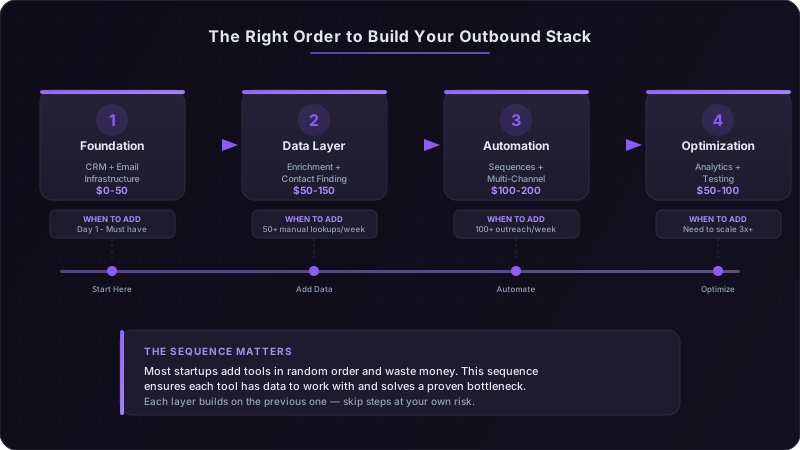
The complete guide to assembling a startup outbound sales stack that actually works-without burning cash on tools you'll never use.