The 10-Minute Meeting Prep: How Top Reps Research Prospects in Minutes
Great meetings start with great prep. Learn how to gather the intel you need without spending hours researching.
I ran a deal review two years ago where one of my reps got completely blindsided on a call with a logistics company. The prospect mentioned they'd just acquired a smaller competitor, and my rep had no idea. It was on the company's homepage. First paragraph of their latest press release. The prospect's tone shifted immediately, you could hear the trust evaporate. That deal died, and it shouldn't have.
The thing is, my rep isn't lazy. He's one of our higher performers. He just didn't have a system for preparation. He was doing the same thing most reps do: skimming the prospect's LinkedIn profile for 90 seconds, maybe glancing at the company's About page, then winging it. Sometimes that works. More often than it should, it doesn't.
After that deal review, I started paying close attention to how our top performers actually prepare for meetings. Not what they say they do, what they actually do. I sat with eight of our best reps over two weeks and watched them prep for calls. The patterns were obvious once I saw them.
The best reps don't spend more time preparing. They spend their time differently. Every one of them had a system, some wrote down, some internalized, that got them to the critical information in under 10 minutes. The average reps were spending the same amount of time but coming out with less useful information because they were browsing without purpose.
Why Most Meeting Prep Fails
The default approach to meeting prep is what I call "Wikipedia mode." Reps open the company's website, read the About page, scroll around, check LinkedIn, and feel like they've done their homework. The problem is that this kind of prep gives you trivia, not intelligence. Knowing that a company was founded in 2014 and is headquartered in Austin doesn't help you run a better meeting.
Good prep answers three questions:
- 1Why would this person care about what I'm selling? Not why your product is great, why it matters to them specifically, in their role, at their company, right now.
- 2What's changing in their world? New leadership, funding, expansion, contraction, competitive pressure, industry shifts. Change creates buying urgency. Stability doesn't.
- 3What should I ask that they wouldn't expect me to ask? This is where preparation turns into a competitive advantage. A question that shows you understand their business earns more trust than any pitch ever will.
If your prep doesn't answer those three questions, you're just going through the motions.
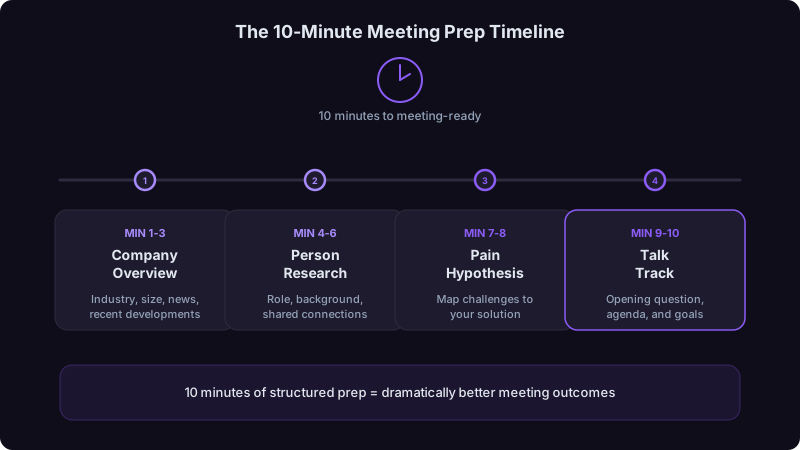
The 10-Minute Framework
I've refined this framework with my team over about 18 months. It's designed around a simple idea: spend each minute on the highest-value research activity available, then move on. Perfectionism kills prep efficiency. You're not writing a research paper. You're building enough context to have a sharp conversation.
Minutes 1-3: Company Context
Start with the company, not the person. You need to understand the environment your prospect operates in before you can understand their individual priorities.
- What does the company do, and who do they sell to? Not the mission statement, what's their actual business model? How do they make money?
- How big are they? Employee count, revenue if available, growth trajectory. A 50-person startup has different pain than a 5,000-person enterprise.
- What's happened recently? Check their newsroom or press page. Look for funding, acquisitions, new product launches, executive hires, or layoffs. Any of these creates context for why they might be looking at your solution.
- What's their competitive landscape? Who are their main competitors? Are they gaining or losing market share? This matters because competitive pressure often drives buying decisions.
Where to look: company website (About, Newsroom, Careers pages), Crunchbase for funding and employee data, a quick Google News search with the company name.
Minutes 4-6: Person Research
Now you shift to the individual. You're looking for three things: what they care about professionally, how long they've been in the role, and whether there's anything you can use to build rapport quickly.
- What's their role and how long have they been in it? Someone who started three months ago has different priorities than someone who's been in the seat for four years. New hires are often the ones evaluating new tools.
- What are they posting or engaging with on LinkedIn? This is the single best signal for what's on their mind. If they're sharing articles about team productivity, that's probably a priority. If they're posting about hiring challenges, that tells you something too.
- Any mutual connections? A warm intro reference in your opening changes the dynamic completely. Even mentioning a mutual connection you haven't spoken to recently signals that you're a real person, not a bot.
- Have they published anything? Blog posts, podcast appearances, conference talks. If someone has put their opinions on the record, referencing those opinions in conversation is the fastest way to demonstrate you've done your homework.
Where to look: LinkedIn profile and activity feed, Twitter/X if they're active, company blog author pages, YouTube or podcast search with their name.
Minutes 7-8: Pain Hypothesis
This is the step most reps skip, and it's the most important one. Based on what you've learned about the company and the person, build a hypothesis about what problem they're trying to solve.
You're not trying to get it exactly right. You're trying to be close enough that when you articulate it on the call, the prospect says "yeah, that's basically it" or "actually, it's more like this." Either response gives you useful information and moves the conversation forward.
Here's how I build a pain hypothesis:
- Role + company size + industry = common challenges. A VP of Sales at a 200-person SaaS company faces different problems than a VP of Sales at a 2,000-person manufacturing company. You should know the top three pain points for your common buyer personas.
- Recent changes amplify existing pain. If the company just raised a Series B, the VP of Sales is probably under pressure to scale the team and pipeline quickly. If they just went through layoffs, they're trying to do more with less.
- Their content tells you their priorities. If the prospect has been posting about outbound efficiency, your hypothesis should center on outbound efficiency, not inbound marketing.
Write the hypothesis down in one sentence. "I think [Name] is dealing with [problem] because [evidence]." That sentence becomes the core of your opening.
Minutes 9-10: Talk Track
The last two minutes are about translating your research into a plan for the actual conversation.
- What's your opening? Not a pitch. A research-backed observation that shows you understand their world. "I noticed [company] just expanded into EMEA, I imagine that's creating some interesting challenges for the sales team" is better than "Tell me about your biggest challenges."
- What three questions will you ask? Prioritize questions that validate or refine your pain hypothesis. Make them specific enough that the prospect can tell you've prepared. "How is your team handling prospecting for the new European market?" beats "How's prospecting going?"
- What value can you offer in return? Even if it's your first meeting, come prepared to share something useful, a data point about their industry, an insight from a similar company you work with, a framework that might help. Meetings where you only extract information and give nothing back don't earn second meetings.
Research Sources: What to Look at and What It Tells You
One thing I've noticed is that reps tend to default to the same two sources, LinkedIn and the company website, even though there are faster, more informative options for specific types of intelligence.
| Research Source | What It Tells You | Time to Find | When to Use |
|---|---|---|---|
| Company newsroom/blog | Recent announcements, strategic priorities, product launches | 1-2 min | Every meeting, check for last 90 days of news |
| LinkedIn profile + activity | Role context, professional interests, current priorities | 2-3 min | Every meeting, focus on recent posts and engagement |
| Crunchbase / PitchBook | Funding history, employee growth, investors, acquisitions | 1 min | When you need company trajectory and financial context |
| G2 / Capterra reviews | Their customers' complaints, competitive positioning | 2 min | When the prospect sells software, reveals their own challenges |
| Job postings (LinkedIn Jobs) | What they're investing in, team gaps, growth areas | 1-2 min | When you need to understand where the company is heading |
| Earnings calls / investor decks | Strategic priorities straight from leadership | 3-5 min | For public companies, quarterly priorities are stated explicitly |
| Google News search | Industry trends, competitor moves, regulatory changes | 1 min | When industry context matters for your pitch |
| Their product / demo / free trial | How their product works, where gaps might exist | 5-10 min | When selling to product companies and you need credibility |
You don't need all of these for every meeting. Pick the 2-3 that are most relevant to the specific prospect and the specific deal.
Before and After: What Good Prep Actually Sounds Like
Let me give you a concrete example. Last year, one of my reps had a first meeting with the Director of Revenue Operations at a mid-market fintech company, I'll call them PayFlow.
Without prep (the old way):
"Hey Sarah, thanks for taking the time. So tell me a little about PayFlow and your role there. What are your biggest challenges right now?"
That opening puts all the work on the prospect. It tells Sarah nothing about whether this rep is worth her time. She's heard this exact opening from 15 other vendors this month.
With the 10-minute framework:
"Sarah, thanks for making time for this. I was reading the announcement about PayFlow's Series B, congratulations. I noticed you've posted a few times about scaling outbound without burning out SDRs, and it looks like you've got three open SDR positions right now. I'm guessing the pressure to ramp pipeline is pretty intense. Is that a fair read on where things stand?"
Same meeting, same product to sell. But the second opening earns trust in the first 30 seconds. Sarah knows this rep has done the work. She's going to be more open, more specific, and more willing to continue the conversation.
That deal closed in 34 days for $92K ARR. Our average cycle at the time was 58 days. I'm not saying prep was the only factor, but it set the tone for the entire relationship.
The Five Mistakes I See Reps Make Over and Over
I've reviewed hundreds of deal recordings at this point. The same prep mistakes show up constantly.
1. Researching the company but not the person
Company research without person research gives you context but not connection. You need both. A company might be growing fast, but if the person you're meeting with just started two weeks ago, they have completely different priorities than someone who's been building the team for three years.
2. Researching the person but not the company
The opposite mistake, and it's just as common. Reps check LinkedIn, see the prospect's title and tenure, and feel prepared. But they miss that the company just went through a round of layoffs, or that they're being acquired, or that their main competitor just launched a product that threatens their market position. That context changes the entire conversation.
3. Preparing a pitch instead of preparing questions
The point of prep is not to build a better pitch. It's to build better questions. Prospects don't want to be talked at. They want to feel understood. The best way to demonstrate understanding is to ask questions that only a well-prepared rep would know to ask.
I tell my reps: if your prep results in a script, you've done it wrong. If it results in three sharp questions, you've done it right.
4. Doing the research but not using it
This one drives me crazy. I've watched recordings where I know the rep did 15 minutes of prep, I can see their notes, but they never referenced any of it on the call. They fell back to their standard talk track and their standard discovery questions. The prep was wasted.
If you spent time finding something interesting about the prospect, use it. In the first two minutes. Otherwise, the research just sits in your notes and the prospect has no idea you bothered.
5. Treating every meeting the same
A first discovery call needs different prep than a demo. A demo needs different prep than a negotiation meeting. A renewal conversation needs different prep than a new logo meeting. Adjust the framework based on what the meeting actually is.
For discovery: focus 70% of prep on pain hypothesis and questions, 30% on company/person context. For demos: focus 70% on understanding what specific workflows to show, 30% on stakeholder mapping. For negotiations: focus 70% on the economic buyer's priorities and competitive alternatives, 30% on deal structure precedents.
What Top Reps Know That Average Reps Don't
I mentioned earlier that I shadowed eight of our best reps. Here are the patterns that separated them from the pack.
They prep for the specific meeting, not the account. Average reps have one set of notes they use for every conversation with an account. Top reps update their prep before each meeting based on what's changed since the last one. A lot can change in a week.
They look for triggers, not facts. Facts are static (the company has 500 employees, they're based in Chicago). Triggers are dynamic (they just opened a London office, they just hired a new CRO, they just lost their biggest customer). Triggers create urgency. Facts don't.
They check the prospect's content before the call, every time. If the prospect posted on LinkedIn two days ago about a challenge your product solves, and you mention it on the call, you've instantly differentiated yourself from every other vendor who didn't bother to look.
They prepare one specific insight to share. Not a pitch, an insight. A data point, a trend, a lesson from a similar company. Something that makes the prospect smarter, even if they never buy. This is how you earn second meetings.
The AI Advantage
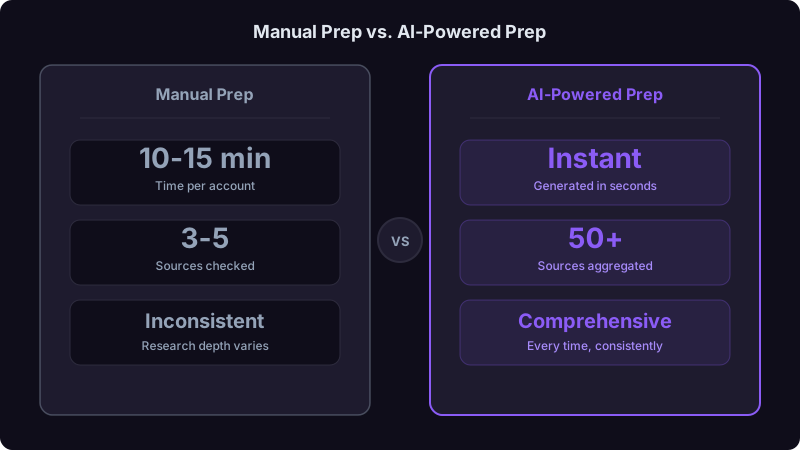
Everything I've described above works. It also takes discipline. The reality is that most reps don't prep for most meetings because they're juggling 30-40 accounts and running back-to-back calls all day. The 10-minute framework helps, but on a day with six meetings, that's still an hour of research.
This is where AI-powered research changes the math. Not because AI does something humans can't, but because it does what humans won't, consistently, for every single meeting.
With AI-driven prep tools:
- Company briefings happen automatically. Instead of manually checking a company's newsroom, Crunchbase, and LinkedIn, you get a one-page summary delivered before the call. Recent news, funding, hiring trends, competitive landscape, all in one place.
- Person research is compiled, not hunted. LinkedIn activity, published content, role history, mutual connections, aggregated into a profile you can scan in 60 seconds.
- Pain hypotheses are suggested based on patterns. AI that has seen thousands of similar accounts can suggest likely pain points based on company size, industry, tech stack, and recent changes. You still validate the hypothesis yourself, but you start from a much better place than a blank page.
- Talking points are generated with context. Instead of opening with a generic question, you get suggested openings that reference specific, real things happening at the prospect's company.
The reps on my team who use AI-powered prep don't just prepare faster. They prepare for meetings they wouldn't have prepped for at all, the ones that used to get the 90-second LinkedIn skim. That's where the biggest impact shows up: not on the big deals where everyone preps anyway, but on the 80% of meetings that used to get no real preparation.
Reps who use structured preparation frameworks consistently outperform those who wing it. AI-powered research compresses hours of manual work into seconds, letting reps focus on strategy rather than data gathering.
Making Prep a Habit, Not a Task
The hardest part of meeting preparation isn't the research itself. It's the consistency. Every rep knows they should prep. Most reps prep when they remember to, when they have time, or when the deal is big enough to feel important.
The fix is to make prep unavoidable. Here's what's worked for my team:
- Block 10 minutes before every external call on the calendar. Not optional. If a meeting gets booked at 2:00, the prep block goes in at 1:50 automatically. Some reps push back on this, they'll learn to appreciate it after their first well-prepped meeting goes noticeably better.
- Use a shared prep template in the CRM. We built a simple template with the three questions I mentioned earlier (why would they care, what's changing, what should I ask). Reps fill it in before the call. Managers review it occasionally. The template keeps the bar consistent.
- Review prep quality in deal reviews, not just deal outcomes. When a deal goes badly, I don't just ask "what happened?" I ask "what did you know going into the meeting?" If the answer is "not much," we've found the root cause.
The 10-minute framework is simple on purpose. Complex systems don't get adopted. A system that takes 10 minutes and answers three questions will get used. A system that takes 30 minutes and requires filling out a 15-field form will get ignored.
The reps who close the most aren't necessarily the most charismatic or the best closers. They're the ones who walk into every meeting knowing something the prospect didn't expect them to know. That's the edge. And it takes 10 minutes.
Ready to transform your sales pipeline?
See how Prospectory's AI-powered platform can help your team research, reach, and relate to prospects at scale.
Related Articles
Reddit Prospecting for B2B: The 9:1 Rule That Builds Pipeline Without Bans
Reddit hosts raw buyer intent that outperforms third-party data, but sales tactics get you banned. Here's the 3-6 month credibility playbook and enrichment workflow that actually works.
LinkedIn Comments Are Worth 8x More Than Likes: A Social Selling Playbook
LinkedIn's algorithm now rewards comments over likes by 8x in reach. Here's how to engineer conversations that turn comment threads into qualified pipeline.
Building an Outbound Tech Stack for Under $500/Month
The complete guide to assembling a startup outbound sales stack that actually works-without burning cash on tools you'll never use.