Sales Email Templates: Six Testable Frameworks for B2B Outreach
Use six practical email frameworks, buyer context, and a campaign scorecard to learn what earns useful conversations with your audience.
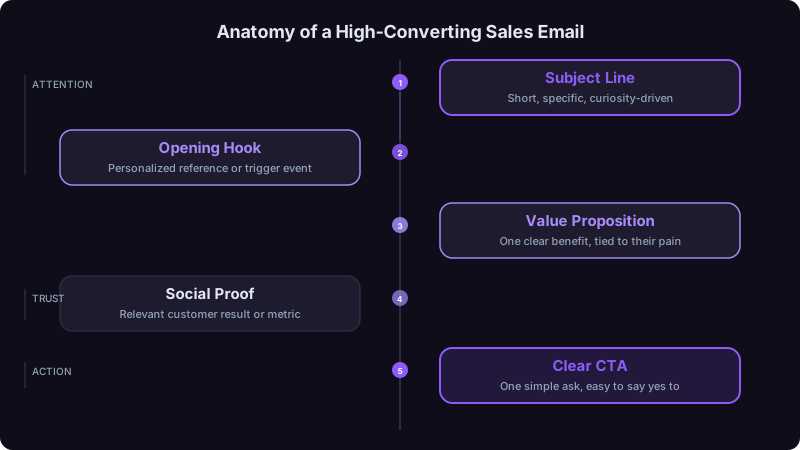
A sales email template should make good judgment repeatable. It should help a rep connect a real account observation to a relevant business question, write a clear message, and make a reasonable ask. It should not manufacture familiarity or turn a generic claim into fake personalization.
The frameworks below are starting points. Test them with your audience and offer, then use positive replies, held meetings, accepted opportunities, and opt-outs to decide what deserves continued investment.
Start With the Account, Buyer, Signal, and Context
Before choosing a template, answer four questions:
- Account: Is this company on the named list your team wants in the pipeline?
- Buyer: Is this person part of the buying committee for the problem you solve?
- Signal: What current evidence makes the conversation timely?
- Context: What prior relationship, CRM history, technology, or constraint should shape the message?
If those answers are weak, a polished template will not rescue the outreach. Strengthen the targeting or wait for a more relevant reason to contact the buyer.
Set the Sending Rules First
Before testing the copy, confirm that the campaign itself is ready. In the United States, CAN-SPAM applies to commercial email, including B2B messages, and covers truthful sender information, subject lines, a physical address, and opt-out handling. [1]
Mailbox providers add technical and reputation requirements. Gmail's sender guidelines cover authentication, accurate message identity, spam rates, and unsubscribe behavior. [2] Yahoo publishes related guidance for SPF, DKIM, DMARC, complaint levels, and easy unsubscribe. [3] For qualifying subscription messages, the IETF one-click List-Unsubscribe standard defines how mailbox providers can offer a direct unsubscribe action. [4]
Turn those requirements into visible campaign checks. Record the sender, sending domain, audience source, suppression lists, opt-out path, review owner, and stop conditions. Send seed messages to the major mailbox providers your buyers use, inspect authentication results, and confirm that a reply or opt-out pauses pending steps. Copy performance cannot compensate for a campaign that reaches the wrong person, misstates the sender, or ignores a request to stop.
Framework One: The Observation
Use a specific, verifiable observation from the account's business context.
Structure
- State the observation.
- Explain the question it raises.
- Connect that question to the problem you solve.
- Ask whether the buyer wants to compare approaches.
Example
Hi Sarah, I saw that Meridian is expanding its sales team in Singapore. Does that create a practical question for your team: which parts of the existing outbound playbook should stay consistent, and which need local buyer context? We help revenue teams connect account research, buyer signals, and outreach in one workflow. Would comparing your current process be useful?
The observation must be real and relevant. A generic statement such as "I see you are growing" does not show useful research.
Framework Two: The Trigger Event
Use this when a current event changes the account's priorities or operating environment.
Possible triggers include:
- a leadership change;
- a new product or market;
- a funding or acquisition event;
- a relevant hiring pattern; or
- first-party engagement with your company.
Example
Hi Marcus, Congratulations on the new funding announcement. I also noticed that your team is hiring sales-development roles. Are you reviewing how new reps will research accounts and coordinate outreach as the team grows? I can share a simple workflow map if that is on your agenda.
Treat the event as context, not proof of intent. Let the buyer confirm whether the inferred priority is real.
Framework Three: The Problem Hypothesis
Use this when you understand the buyer's role but do not yet know whether a specific problem exists.
Structure
- Describe the operating pattern you want to test.
- Explain why it might matter to this role.
- Ask a question that makes the hypothesis easy to correct.
Example
Hi Jennifer, Is account research, sequence planning, and reply handling spread across separate tools for your team? If so, is that creating extra review work, or is your current process already connected? If it is worth comparing, I can send a short map of the workflow Prospectory supports.
Do not invent a cost, time saving, or expected return for the recipient. If the buyer confirms the problem, build the business case from their baseline.
Framework Four: The Mutual Connection
Reference another person only when that person has given permission and the connection is relevant.
Example
Hi Alex, Rachel Torres suggested I contact you because your team is reviewing account prioritization. She said it was fine to mention her name. Prospectory brings named accounts, buyer research, signals, and outreach into one workflow. Would a short comparison with your current process be useful?
Do not name-drop a weak or unconfirmed relationship. The recipient should be able to understand why the connection matters.
Framework Five: Value First
Give the buyer something they can evaluate before asking for a meeting.
Useful value-first assets include:
- an account or market observation with sources;
- a workflow map based on information the buyer shared;
- a checklist for evaluating a current process; or
- a short analysis that identifies questions rather than claiming certainty.
Example
Hi Daniel, I mapped the public buying signals your team could use to prioritize cloud-platform accounts. I included the source and date for each signal so you can decide which ones belong in your workflow. I am happy to send the worksheet if it would help with planning.
The asset should stand on its own. A disguised pitch weakens the reason to reply.
Framework Six: Re-engagement
Use new, relevant context when returning to a prior conversation.
Example
Hi Chris, We spoke earlier about account research for your sales team. I saw that you have since added a new market segment. If the workflow is back on your agenda, I can update the comparison around that segment. If it is not, I will close the loop.
Respect the prior conversation and make it easy for the buyer to decline.
Measure the Campaign, Not the Template
An open or a reply does not tell the whole story. Track a balanced scorecard from delivery through pipeline:
Define each metric before sending. Keep the audience, offer, measurement window, and follow-up rules stable when comparing message variants.
Build a Clean Test
Use a simple test plan:
- 1Write the hypothesis. State what you are changing and why it may matter.
- 2Choose one primary outcome and the supporting quality measures.
- 3Create comparable audience groups using the same selection rules.
- 4Change one meaningful variable at a time.
- 5Keep sending, suppression, and follow-up rules consistent.
- 6Review the full funnel before choosing a winner.
| Test decision | Control | Variant |
|---|---|---|
| Audience | Same eligibility rules | Same eligibility rules |
| Offer | Same offer | Same offer |
| Message | Current framework | One defined change |
| Follow-up | Same sequence rules | Same sequence rules |
| Outcome | Same primary measure | Same primary measure |
The sample required for a useful decision depends on your baseline event rate, expected difference, and tolerance for uncertainty. Use a statistical power calculation or an analyst-reviewed method instead of a universal send threshold.
Follow Up With New Information
A follow-up should add context rather than repeat the first message. It can:
- answer a likely question;
- share a relevant source or worksheet;
- connect a new account signal to the earlier message; or
- ask whether the topic should be closed for now.
Set stop conditions before the campaign begins. Pause the sequence when the buyer replies, opts out, becomes an active opportunity, or reaches another condition chosen by your team. Coordinate email with other channels so the recipient does not receive conflicting messages.
Keep Examples Honest
If an email includes proof, use a result you can trace to a real customer, baseline, period, and measurement method. The FTC's advertising-substantiation policy explains that objective product claims need a reasonable basis before they are distributed. [5] If that evidence is not available, describe the capability and ask the buyer for the inputs needed to model the value.
Avoid these substitutions for evidence:
- an invented company or customer quote;
- a general industry benchmark without a current source;
- a result from a different audience presented as an expected outcome;
- a calculator output presented as a promise; or
- an exceptional result presented as the normal experience.
Clear, specific language is persuasive because the buyer can evaluate it. It does not need a fabricated number.
Before approving a proof point, ask for the customer, baseline, measurement window, method, and permission to use it. If one is missing, use capability language until the evidence is ready.
How Prospectory Supports the Workflow
Prospectory brings the named account list, buyer records, selected signals, account research, message drafts, campaign steps, and response routing into one workspace. Teams can review the source context before sending and compare campaign outcomes against their existing baseline.
Use the frameworks as controlled inputs, not universal formulas. Your audience's response, your qualification rules, and your CRM outcomes determine which approach works for your sales motion.
The Bottom Line
The useful part of a sales email template is the thinking it makes repeatable: a real buyer, a relevant observation, an honest hypothesis, and a clear next step. Start with evidence, run a clean test, and keep only what earns qualified conversations without compromising the buyer experience.
References
[1]Federal Trade Commission, CAN-SPAM Act: A Compliance Guide for Business. https://www.ftc.gov/business-guidance/resources/can-spam-act-compliance-guide-business
[2]Google, Email Sender Guidelines. https://support.google.com/mail/answer/81126?hl=en
[3]Yahoo Sender Hub, Sender Best Practices. https://senders.yahooinc.com/best-practices/?version=published
[4]Internet Engineering Task Force, RFC 8058: Signaling One-Click Functionality for List Email Headers. https://datatracker.ietf.org/doc/rfc8058/
[5]Federal Trade Commission, Policy Statement Regarding Advertising Substantiation. https://www.ftc.gov/legal-library/browse/ftc-policy-statement-regarding-advertising-substantiation
Ready to transform your sales pipeline?
See how Prospectory's AI-powered platform can help your team research, reach, and relate to prospects at scale.
Related Articles
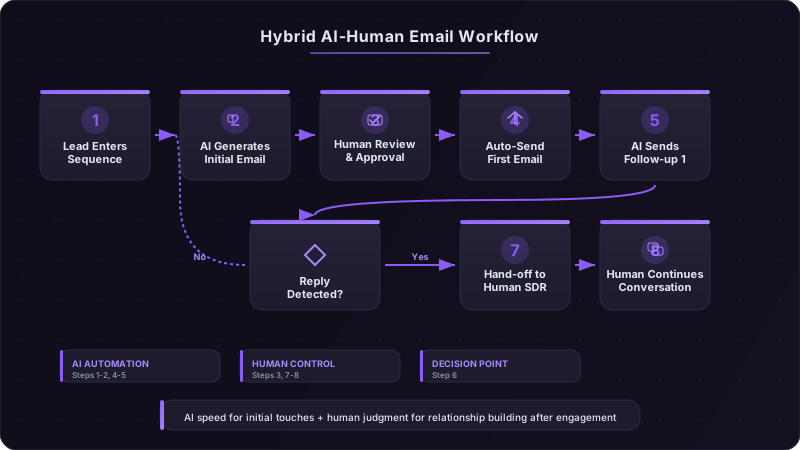
AI vs. Human Email Writing: How to Test Which Earns More Replies
How to run a fair test of AI-written against human-written cold email, what to measure beyond reply rate, and how to turn the results into a hybrid workflow.
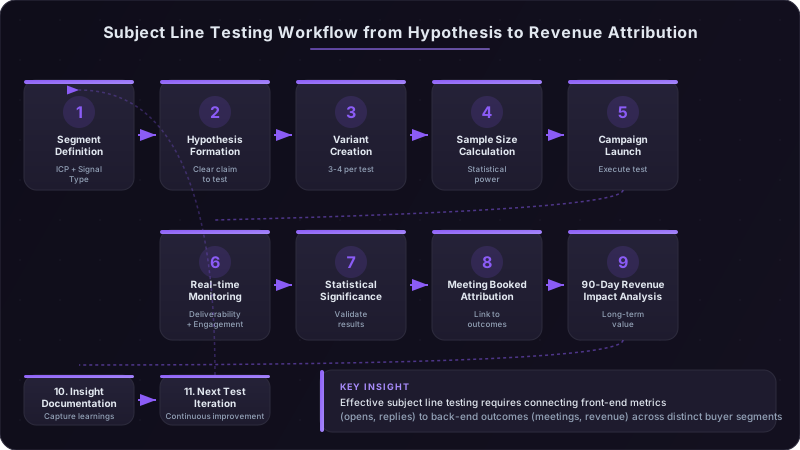
Subject Line Testing That Actually Drives Pipeline, Not Just Opens
Most teams optimize for open rates and lose deals. Here's how to test subject lines for reply rates and meeting conversion across different buyer segments.
The Follow-Up Problem: Why Most Sales Emails Never Get a Second Touch
Many sales sequences stop after one email. Here is a five-touch follow-up framework that adds new value at every step, plus the measurement and compliance rules that keep it working.