Multi-Threading Enterprise Deals: A Practical Playbook
How to map buying committees, identify champions vs. blockers, and run coordinated outreach to 4-7 stakeholders without creating internal politics or confusion.
I lost a $480,000 deal in week 9 because I didn't know the VP of IT Security existed. My champion, a Director of Sales Operations who'd been walking me through their evaluation process for two months, got blindsided in a steering committee meeting when IT raised data residency concerns we'd never discussed. The deal didn't die immediately. It went into "internal alignment mode," which is where enterprise deals go to suffer a slow, quiet death.
That's when I learned that single-threading isn't just risky, it's a choice to let someone else control your deal outcome. Multi-threading isn't about hedging your bets or playing political games. It's about building a complete picture of who actually makes decisions, who can kill them, and how information flows between those people.
The hard part isn't knowing you should talk to multiple stakeholders. Everyone knows that. The hard part is doing it without creating internal chaos, stepping on your champion's toes, or looking like you're going around people. This is the tactical playbook for how to actually do it.
Why Single-Threading Kills Enterprise Deals (And How to Know You're Doing It)
Single-threading feels safe. You have a champion who returns your emails, joins your calls, and says things like "I'm driving this internally." You update your CRM to 75% probability. You forecast it for next quarter.
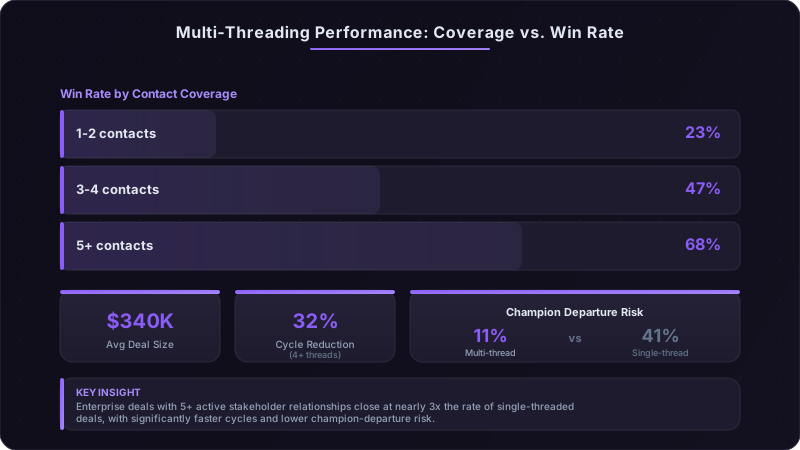
Then one of three things happens: your champion leaves the company, gets overruled by someone you've never met, or the deal stalls in legal/procurement because nobody with actual signing authority has been involved. The average enterprise deal that dies from single-threading represents $340,000 in lost contract value and 11 weeks of wasted sales cycle.
Here's how to diagnose single-threading before it kills your deal. First warning sign: You have one contact in the account and they're not a VP or above. If your only thread is a Director, Manager, or IC, you don't have a deal, you have a research project someone is running. Second warning sign: You don't know who controls budget approval or what their decision criteria are. If you can't name the Economic Buyer and explain what they personally care about, you're single-threaded. Third warning sign: Your champion has never mentioned other stakeholders without you asking. Real champions proactively tell you who else needs to be involved because they know they can't do it alone.
I've seen this pattern dozens of times: A $500K SaaS deal makes it to week 11. Sales Operations loves the product. They've built a business case. They're ready to move forward. Then IT Security gets looped in during contract review and raises concerns about API access controls that were never discussed. The deal doesn't die, it goes into a 6-week "technical evaluation" that really means "we need to restart the buying process with stakeholders who should have been involved from day one."
The false security of a strong champion who can't actually sign is the most dangerous position in enterprise sales. Your champion might have influence, passion, and internal credibility. But if they don't control budget, can't override technical requirements, and haven't navigated procurement before, they're a guide, not a decision-maker. You need both.
Mapping the Real Buying Committee (Not the Org Chart)
The org chart tells you reporting structure. The buying committee tells you how decisions actually get made. These are not the same thing.
Every enterprise deal involves four buying roles, regardless of company size or industry. The Economic Buyer controls budget and has final signature authority. The Technical Buyer has veto power over anything that touches systems, security, or integration. The Champion is your internal advocate who benefits from the deal and will sell it when you're not in the room. The Blocker is the person whose turf you're threatening, whose project you're defunding, or whose vendor relationship you're replacing.
These roles don't map to titles. A VP of Sales Operations might be your Champion, but the CFO is the Economic Buyer. The Director of IT Security might be a Blocker, even though they report to someone who supports the deal. A seemingly friendly IT Manager might be the Technical Buyer with hard veto power on anything that processes customer data.
Here's how to map the real structure. Start with LinkedIn. Look at your champion's recent activity, who are they engaging with, what groups are they in, who comments on their posts? Then ask your champion for a 15-minute "stakeholder mapping" conversation using the three-question method: "Who else typically gets involved in decisions like this?" (reveals process), "Who's going to ask the hardest questions about this?" (surfaces blockers), and "Who ultimately signs contracts at this level?" (identifies Economic Buyer).
The calendar invite trick is underused and powerful. When your champion schedules internal meetings to discuss your solution, look at who's invited. That's your buying committee. If they're meeting with Finance, Procurement, and IT but you don't have relationships there, you're flying blind.
Procurement is the stakeholder everyone forgets until it's too late. They don't show up in early evaluation, they appear in week 8 when someone says "We need to run this through Procurement." By then, they're a blocker with timeline control. The fix: Ask your champion in week 2, "What's your typical procurement process for vendors at this contract size?" Then reach out to Procurement yourself with a simple email: "I'm working with [Champion] on [solution]. Want to understand your preferred vendor evaluation process so we can make this smooth for you."
This is micro-list prospecting applied to account planning. Instead of researching 200 companies, you're building a 10-person committee map for one account. You're identifying who influences the decision, who has veto power, who controls timing, and who will benefit politically from the deal closing. That's the list that matters.
Champion vs. Blocker: How to Tell the Difference in First Conversation
Champions talk about budget early. Blockers deflect budget questions and focus on technical concerns or process. That's the fastest signal you'll get.
In your first call with a new stakeholder, ask "What budget cycle are you working with for this?" within the first 15 minutes. A Champion will give you a direct answer: "We're planning to allocate $400K in Q3" or "This would come out of our annual ops budget." A Blocker will say something like "We're still evaluating options" or "Budget isn't my concern, I need to understand the technical fit first."
Red flags that your "champion" is actually a gatekeeper: They schedule lots of meetings but never talk about next steps. They ask you to send them materials but never share who else is reviewing them. They're enthusiastic about the product but vague about internal process. They say things like "I need to socialize this internally" without naming who they're socializing it with. Real champions give you visibility into their internal selling efforts.
Technical blockers disguise themselves as evaluators, but they ask different questions. An evaluator asks "How does this integrate with our current systems?" A blocker asks "What's your uptime SLA?" followed immediately by "What happens when you don't meet it?" They're not trying to understand fit, they're building a case for why it won't work. The question pattern is skeptical from the start, not curious.
Ask every stakeholder: "Who usually pushes back on decisions like this, and what are they worried about?" Champions will name the blockers and explain their concerns, giving you a roadmap for how to address resistance. Blockers will deflect or say "I don't think there will be pushback" because they're the pushback.
I've found that identifying blockers early is more valuable than identifying champions. Champions reveal themselves through enthusiasm and action. Blockers hide until they have authority. If you can surface blockers in week 2 instead of week 10, you can either address their concerns early or route around them with support from the Economic Buyer.
The power move is asking "Who usually pushes back on decisions like this?" in your first champion conversation. It forces them to reveal the political landscape. A strong champion will tell you exactly who the blockers are, what they care about, and how they've handled them in past projects. That's the intelligence you need to multi-thread strategically.
The Coordinated Outreach Sequence: Timing and Channel Strategy
Reaching out to all seven stakeholders on the same day is the fastest way to destroy your credibility. It signals desperation, creates internal confusion about who owns the vendor relationship, and makes you look like you're trying to go around people.
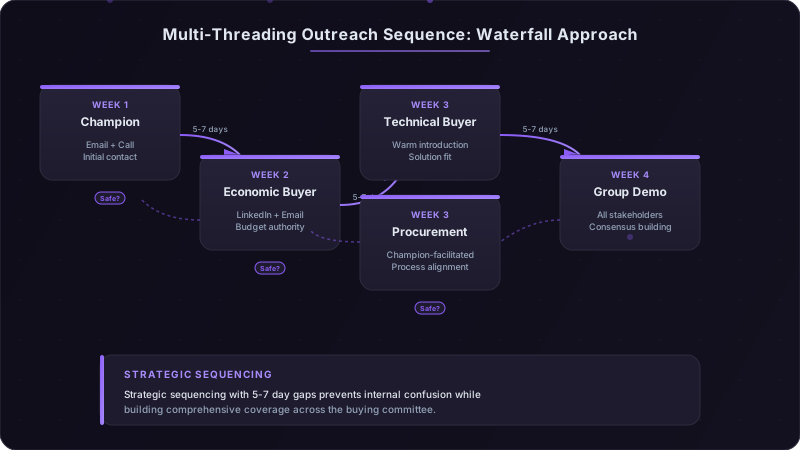
The waterfall approach works: Champion first, Economic Buyer second, Technical Buyer and Procurement third. The sequencing creates a narrative. You start with the person who has the problem. You expand to the person who controls budget. Then you engage the people who have veto power or control timing. Each conversation informs the next, and you're building up, not across.
Week 1 is all about your champion. You're doing discovery, understanding their world, and asking them to map the buying committee for you. Week 2, you reach out to the Economic Buyer, but only after you've told your champion you're going to do it. The message to the Economic Buyer references your champion by name: "I've been speaking with [Champion Name] about [specific problem]. She mentioned you're the right person to discuss budget allocation for this type of initiative."
Week 3 is when you engage Technical Buyers and Procurement, ideally through warm introductions from your champion. This is where multi-channel sequencing matters. Your champion got email and calls. Your Economic Buyer gets LinkedIn message followed by email. Your Technical Buyer gets a warm intro from your champion. Different channels signal different relationship contexts.
Here's the channel decision tree: Email works for peers and people expecting vendor outreach (Champion, Procurement). LinkedIn works for senior executives who don't respond to cold email (Economic Buyer). Warm introductions work for skeptical stakeholders who need social proof (Technical Buyers, Blockers). Phone calls work when you need immediate response or when email threads get too long.
The constraint-as-credibility principle applies here. When you reach out to the Economic Buyer, you say something like "I'm only reaching out to the 4 people at [Company] who own budget decisions for sales technology" instead of "I wanted to connect with you about..." The selectivity itself signals value. You're not spamming their org, you did research and identified them specifically.
Spacing matters more than most reps think. If you contact your Champion on Monday, Economic Buyer on Tuesday, and Technical Buyer on Wednesday, you look coordinated in a bad way, like you're running a scripted campaign. Five to seven day gaps between stakeholder touches give each conversation time to breathe and make the outreach feel considered, not automated.
Messaging Each Stakeholder Without Stepping on Toes
The transparency principle is non-negotiable: Always mention you're also speaking with someone else in the organization. This prevents the awkward "Why is this vendor contacting me?" conversation and positions you as someone who's coordinating, not going around people.
Your message to the Economic Buyer should say: "I've been working with [Champion Name] on [specific problem]. She suggested I reach out to you to discuss budget allocation and ROI expectations." Your message to the Technical Buyer should say: "I'm speaking with [Champion Name] and [Economic Buyer Name] about [solution]. Want to understand your technical requirements and integration concerns."
Each stakeholder gets a different value proposition, but it's the same deal. The Economic Buyer cares about ROI, payback period, and budget impact: "Based on [Champion's] estimates, this would generate $780K in pipeline efficiency in year one." The Technical Buyer cares about integration complexity, security compliance, and risk: "This uses OAuth 2.0 and is SOC 2 Type II certified. Average integration takes 4 hours of engineering time." The Champion cares about their career win and internal credibility: "This gives you the visibility the C-suite has been asking for while reducing manual work for your team."
The framework is "different question, same deal." You're not pitching different solutions to different people, you're explaining how the same solution solves their specific version of the problem. The Economic Buyer's version is financial. The Technical Buyer's version is risk and feasibility. The Champion's version is political capital and team impact.
When do you CC multiple stakeholders versus keeping threads separate? Here's the rule: Keep threads separate during discovery and early relationship-building. Bring people together once you have buy-in from each individually. The group email or group demo is your consensus-building tool, not your introduction tool. If you CC the Economic Buyer and Technical Buyer on the same email before you've spoken to either, you're forcing them to align their responses publicly before they've formed private opinions.
Here's the real template for messaging a VP when you're already talking to their Director:
Subject: [Director Name] suggested I reach out, sales pipeline visibility
Body:
Hi [VP Name],
I've been working with [Director Name] on improving visibility into early-stage pipeline quality. She mentioned you're focused on reducing sales cycle length and improving forecast accuracy.
We've helped similar teams reduce cycle time by 23% by identifying stalled deals earlier in the process. [Director] thought it would be valuable for us to discuss ROI expectations and budget allocation at your level.
Are you open to a 20-minute conversation next week?
[Your name]
The magic is in the specificity: You name the Director, mention what they're working on, state the outcome that matters to the VP, and ask for a defined time commitment. You're not hiding the relationship with the Director, you're using it as social proof.
Using Your Champion to Navigate Internal Politics
Your champion knows the political landscape better than you ever will. Use them.
The "safe to reach out" question sounds weak but it's essential: "I think it would be valuable to speak with [Name] about [topic]. Is that someone I should reach out to directly, or would you prefer to make an introduction?" This gives your champion control while signaling your intention to multi-thread. Most champions will appreciate that you asked instead of just doing it.
The calendar use technique works when your champion is hesitant to intro you. Say something like "I noticed you have weekly 1:1s with [Economic Buyer Name]. What would it take to get 10 minutes on one of those agendas to discuss budget allocation?" You're not asking for a formal introduction, you're asking to piggyback on existing communication cadence.
The reframe that makes multi-threading easier for champions: Position it as helping them build consensus, not going around them. Say "I want to make sure you have air cover from Finance and IT when you present this. If I can address their concerns directly, it takes pressure off you." Now you're not threatening their ownership, you're reducing their political risk.
The group demo strategy is your consensus accelerator. Instead of doing separate demos for Champion, Economic Buyer, and Technical Buyer, suggest one session with all three. Say to your champion: "I'm seeing in our CRM that group demos with 3-4 stakeholders close 40% faster because everyone hears the same thing and can ask questions together. Would it make sense to get [Economic Buyer] and [Technical Buyer] on our next call?"
When NOT to multi-thread: If your champion explicitly says "I need to handle [stakeholder] myself, they're territorial about vendors," listen to them. They're telling you about a political dynamic you can't see. You can still map the stakeholder and understand their concerns, but let your champion manage the relationship until they ask for your help. Forcing it will backfire.
The other time not to multi-thread: When you're in a consortium-style buying process where one company is the lead and others are following. In those situations, the lead company's champion is your single point of contact by design, and attempting to reach other companies' stakeholders directly will get you removed from the process.
Tracking and Orchestrating Multiple Threads in Your CRM
If you're not tracking contact roles in your CRM, you can't tell the difference between a strong multi-threaded deal and a house of cards.
The contact role taxonomy I use: Economic Buyer (has budget authority), Champion (internal advocate), Technical Buyer (technical veto power), Influencer (has input but no veto), Blocker (actively resistant), Coach (provides intel but isn't directly involved), and Legal/Procurement (controls process and timing). Every contact in the deal gets tagged with one of these roles.
In Salesforce or HubSpot, you can build a multi-thread dashboard using contact role fields and opportunity stage. The key metrics: number of active contacts per deal, distribution of contact roles (do you have an Economic Buyer?), and last contact date for each role. If you have seven contacts but the Economic Buyer hasn't been touched in three weeks, your multi-threading is superficial.
The relationship strength score is more valuable than counting contacts. I use a simple 1-5 scale: 1 = bounced email or no response, 2 = responded once but disengaged, 3 = active email thread but no calls, 4 = had 1-2 calls with positive engagement, 5 = multiple calls, intro to other stakeholders, or actively selling internally. A deal with three contacts at strength level 5 is healthier than a deal with seven contacts at level 2.
Here's the task coordination structure that works: Each stakeholder gets their own task sequence in the CRM. Champion gets tasks for weekly check-ins. Economic Buyer gets tasks for monthly value discussions. Technical Buyer gets tasks tied to evaluation milestones. Procurement gets tasks tied to contract stages. The tasks are timed relative to each other, you don't reach out to Technical Buyer until 5 days after Economic Buyer responds.
| Contact Role | Outreach Timing | Primary Channel | Engagement Metric | Red Flag Threshold |
|---|---|---|---|---|
| Champion | Week 1, weekly cadence | Email + Calls | 5+ interactions, intro to others | No contact in 2 weeks |
| Economic Buyer | Week 2, bi-weekly check-ins | LinkedIn → Email | 2+ conversations about budget | No budget discussion by week 4 |
| Technical Buyer | Week 3, milestone-based | Warm intro → Email | Documented technical approval | Raises objections with no path to resolution |
| Procurement | Week 3, process-aligned | Email (formal) | Contract terms agreed | Introduces new requirements after week 8 |
| Blocker | Week 4, post-champion prep | Champion-facilitated | Concerns identified and addressed | Radio silence after multiple attempts |
Red flag alerts you should build into your CRM: Deal over $250K with fewer than 3 active contacts. Economic Buyer contact strength below 3. No contact with Technical Buyer or Procurement in deals over $100K. Champion as only contact in deal stage "Negotiation" or later. Any of these should trigger an alert to the AE and sales manager that multi-threading is inadequate.
The micro-list prospecting trend applies here too. Instead of tracking 40 contacts across 40 accounts, you're tracking 10 contacts across 4 accounts. The depth is what matters, not the breadth. You know each stakeholder's concerns, their internal relationships, and their decision criteria. That's the level of research impossible at scale, and it's what wins enterprise deals.
What to Do When Threads Collide (Damage Control Strategies)
Threads will collide. Someone will forward your email. Two stakeholders will compare notes. A blocker will email your champion asking "Why is this vendor contacting me?" This isn't failure, it's the natural friction of multi-threading. How you handle it determines whether it strengthens or kills the deal.
The "internal alignment" save: When two stakeholders give conflicting signals (one says "We're ready to move forward," another says "We have concerns"), send a group email to both: "It sounds like there might be different perspectives internally on [specific issue]. Would it be helpful to have a quick alignment call with everyone involved so we can address this together?" You're not picking sides, you're offering to facilitate their internal discussion.
How to recover when a blocker emails your champion asking "Why is this vendor contacting me?": Respond quickly and transparently. Email both people: "My apologies if I created confusion. I reached out to [Blocker] because [Champion] mentioned they typically evaluate [specific aspect]. My intention was to address their concerns directly so it didn't slow down your internal process. Happy to coordinate differently if that's preferable."
The group email approach is your transparency tool when confusion happens. If you're getting mixed signals, different requirements from different stakeholders, or sense that people aren't aligned, send one email to all stakeholders: "I've been speaking with [Champion], [Economic Buyer], and [Technical Buyer] separately. It seems like there might be some internal alignment needed on [specific issue]. Would it make sense to bring everyone together for one conversation?"
When to pause outreach and let your champion orchestrate internally: If your champion explicitly says "I need to handle this internally before we move forward," respect that. They're telling you the politics are complex and your direct involvement will make it worse. You can still ask "What would be helpful from me during this internal process?" and "What timeline are you working with?" But stop multi-threading and let them run it.
Thread conflicts reveal org dynamics you wouldn't see otherwise. If a Technical Buyer reacts negatively to being contacted, it tells you they feel territorial or weren't consulted early enough. If an Economic Buyer forwards your email to your Champion asking "Are we moving forward with this?", it tells you the Champion hasn't been selling internally. These moments are intel, use them to adjust your strategy.
The hardest scenario is when you've been multi-threading successfully and suddenly all your contacts go dark. This usually means one of three things: internal budget freeze, leadership change, or a competing priority emerged. The fix isn't more outreach, it's one direct message to your Champion: "I noticed we haven't connected in a few weeks. Has something changed on your end, or should I check back in [timeframe]?" Give them an easy way to tell you the deal is stalled without admitting they lost control.
I've seen deals recover from thread collisions more often than I've seen them die from it. The key is speed and transparency. When stakeholders discover you're talking to multiple people, they're not upset that you're multi-threading, they're upset that they didn't know. Fix the communication gap immediately and most threads survive.
Multi-threading isn't a tactic you add to deals in week 8 when your champion goes cold. It's the foundation you build in week 1 when you're doing discovery. The question isn't "Should I multi-thread this deal?" It's "How many stakeholders do I need to map, and what's the sequence for engaging them?"
The mechanics are simple: Identify the four buying roles (Economic Buyer, Technical Buyer, Champion, Blocker). Map the 6-10 people who fill those roles. Build a waterfall outreach sequence with 5-7 day gaps. Message each stakeholder with their specific value prop while referencing other people you're talking to. Use your champion to navigate politics. Track relationship strength, not just contact count. Handle collisions with transparency.
The hard part is doing it consistently, early, and without creating internal chaos. Most reps know they should multi-thread. Few actually do it in a coordinated, strategic way. The ones who do close deals 32% faster with 68% win rates instead of 23%. That's the difference between building relationships across a buying committee and hoping your champion can sell it alone.
Ready to transform your sales pipeline?
See how Prospectory's AI-powered platform can help your team research, reach, and relate to prospects at scale.
Related Articles
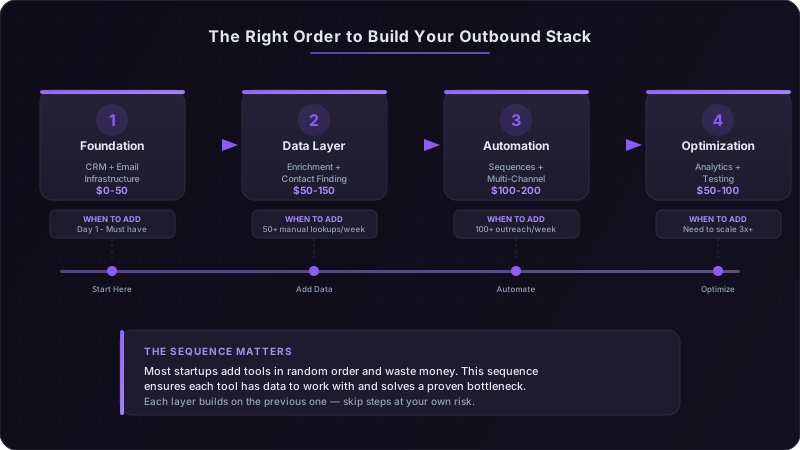
Building an Outbound Tech Stack for Under $500/Month
The complete guide to assembling a startup outbound sales stack that actually works-without burning cash on tools you'll never use.
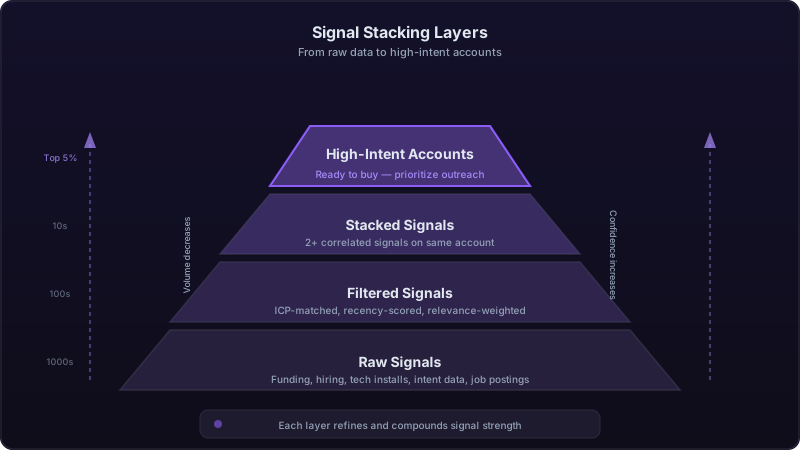
Signal Stacking: How Compound Buying Indicators Predict Revenue 10x Better Than Single Signals
One buying signal is noise. Two is a pattern. Three or more is a revenue opportunity. Learn the signal stacking methodology that's transforming pipeline prediction accuracy.
Buying Signals 101: How to Identify Prospects Who Are Ready to Buy Now
Stop guessing which accounts to pursue. Learn how to leverage intent data and buying signals to focus on prospects actively researching solutions like yours.