LinkedIn Comments Are Worth 8x More Than Likes: A Social Selling Playbook
LinkedIn's algorithm now rewards comments over likes by 8x in reach. Here's how to engineer conversations that turn comment threads into qualified pipeline.
Two weeks ago, I did something that would make most sales managers twitch. I stopped cold emailing entirely. No sequences, no follow-ups, no "just bumping this to the top of your inbox." Instead, I spent that time doing one thing: commenting on LinkedIn posts from my target accounts.
The result? Fourteen qualified conversations in 10 business days. Three of those turned into discovery calls. One closed last Thursday. My cold email baseline for the same period was typically six to eight qualified conversations, and I was spending four hours a day on it instead of 30 minutes.
This wasn't magic. It was math. LinkedIn's 2024 algorithm update explicitly weights comments 8x higher than reactions for feed distribution. Most sales teams still treat LinkedIn as a billboard where you broadcast content and hope someone notices. The teams winning pipeline right now treat it as a conversation engine, and the gap between those two approaches is where quota gets made.
I Stopped Cold Emailing for Two Weeks. Pipeline Went Up.
Let me be specific about what those two weeks looked like. I had a list of 23 target accounts. I identified the two or three decision-makers at each company who posted regularly on LinkedIn (at least once per week). Then I built a simple daily habit: spend 30 minutes writing thoughtful comments on their posts.
Not "Great insight!" comments. Not emoji reactions. Real comments that added a specific example, asked a genuine follow-up question, or respectfully pushed back on a point with evidence. The kind of comment you'd make if a smart colleague said something interesting in a meeting.
By the end of week one, seven of those decision-makers had replied to my comments. By the end of week two, I'd moved four conversations into DMs, and three of those agreed to a call. The conversion math was absurd compared to cold outreach, and it felt less like selling and more like, well, talking to people.
Here's the thing that surprised me most: three of those 14 conversations were inbound. People saw my comments on someone else's post, clicked my profile, and reached out to me. That's the compounding effect of algorithmic reach that comments create. Your cold email can't do that.
How LinkedIn's Algorithm Actually Scores Your Activity
LinkedIn's feed algorithm is not a black box if you pay attention to the signals. Here's how the platform ranks engagement actions for distribution weight:
- Comments carry roughly 8x the weight of a simple like for determining whether a post gets shown to second and third-degree connections
- Shares with original commentary (not just a repost) carry about 4x weight
- Likes and reactions are the 1x baseline
- Dwell time (how long someone pauses on a post) matters for the original poster's future reach, but doesn't compound for you
But not all comments are equal. LinkedIn's system classifies comments into two buckets: "meaningful" and "low-effort." A meaningful comment is five or more words, asks a question, or adds substantive context. A low-effort comment is an emoji, "Great post!", "Love this!", or anything that looks like it took less than three seconds to write.
The first-hour engagement window is where the math gets wild. Posts that receive three or more meaningful comments within 60 minutes of publishing see 5.6x more impressions than posts that don't hit that threshold. This means your early comment doesn't just help the poster. It puts you in front of their entire expanded network.
One important warning: LinkedIn's behavioral detection model is getting smarter every quarter. If your account shows identical comment timing patterns (like always commenting at exactly 8:00am and 8:01am and 8:02am), repeated phrases across different posts, or pod-like reciprocal engagement (the same eight people always commenting on each other's content), you will get penalized. The platform wants real conversations, not manufactured engagement.
The Conversation Engineering Framework
Conversation engineering is the practice of crafting comments that are designed to invite a reply chain, not just add your take and walk away. The difference matters. A standalone comment gets you visibility. A reply chain gets you a relationship.
I use three comment formulas that consistently generate replies:
- 1The Build-On: Take their point and add a specific, concrete example from your own experience. "This happened to us at [company] last quarter. We saw [specific metric] when we tried [specific approach]. Curious if you saw similar results with [detail from their post]?"
- 1The Respectful Counter: Disagree with evidence, not attitude. "Interesting take. I've actually seen the opposite play out, specifically with mid-market accounts where [specific scenario]. Do you think this changes for companies below $50M ARR?"
- 1The Bridge Question: Connect their point to a related problem their audience cares about. "This lines up with something I've been seeing in [adjacent topic]. Have you noticed [related trend] affecting this too?"
Here's a before-and-after that shows the difference in practice. A VP of Sales at a target account posted about how their team was struggling with multi-threaded deals.
Generic comment: "Multi-threading is so important. Couldn't agree more!" Reply rate: basically zero.
Engineered comment: "We tracked this across 340 deals last year and found that deals with 3+ contacts engaged were 2.4x more likely to close, but only if the second contact was looped in before the proposal stage. After that, it actually hurt close rates. Have you seen a timing threshold like that?" Reply rate: that specific comment got a reply within 20 minutes and started a five-message thread.
For target selection, I recommend identifying 15 to 20 accounts whose decision-makers post at least weekly. Use LinkedIn's search filters to find people by title and company who have "Creator" mode enabled or show "Posts" activity on their profile. Build a simple list and check it daily.
The Carousel Post Formula That Turns Followers Into Commenters
Carousel posts on LinkedIn outperform every other format for engagement right now. The data from multiple content analytics platforms shows carousels get 1.9x more engagement than text posts and 2.7x more than single-image posts in 2024. The reason is simple: swipe behavior creates dwell time, and dwell time signals interest to the algorithm.
But not all carousels are created equal. I've tested a 9-slide structure across 30+ posts that consistently drives comment volume:
- Slide 1: Bold hook statement or counterintuitive claim (this is your headline)
- Slides 2-3: Problem framing, something the reader viscerally recognizes
- Slides 4-5: Your contrarian insight or unexpected angle
- Slide 6: A simple framework or model (people love naming things)
- Slide 7: An open-ended question directed at the reader
- Slide 8: Proof, data, or a specific example
- Slide 9: CTA (follow for more, comment your take, etc.)
The placement of the question on slide 7 is deliberate. By that point, the reader is mid-scroll, emotionally invested in your argument, and has enough context to form an opinion. Asking for their input at that moment drives 3.2x more comments than putting the question on the final slide, where most people have already swiped past.
Here's a real example. I published a carousel titled "5 Signals Your Champion Just Lost Internal Buy-In" that walked through specific behavioral indicators (like a champion suddenly CC'ing their manager on emails, or asking for a one-pager they never needed before). Slide 7 asked: "What's the earliest signal you've spotted that a champion was losing ground internally?" That post generated 87 comments, 11 DMs, and four discovery calls within two weeks. The comments were gold because they told me exactly what language my target buyers use to describe their problems.
Comment Threads to DMs: The 72-Hour Playbook
Here is the single biggest mistake I see sales reps make with social selling: they leave a comment on a prospect's post, get a reply, and immediately slide into the DMs with a pitch. This kills the relationship and trains the algorithm to classify your engagement as transactional.
Instead, I follow a 72-hour cadence:
- Day 1: Engage meaningfully in their thread. Add value, ask a question, contribute an example.
- Day 2: Comment on a different post of theirs. This shows you're genuinely interested in their thinking, not just hunting for an opening.
- Day 3: Send a DM that references specific language from the comment exchange. Not a pitch. A continuation of the conversation.
The DM template I use most often looks something like this: "Your point about [specific phrase from their comment] stuck with me. We're actually seeing something similar with [relevant context]. Would love to swap notes on this if you're open to a quick call next week."
The numbers here are dramatic. When your DM mirrors their exact phrasing from the thread, acceptance rates hit 22%. When you use a generic opener ("I noticed we're both in the sales space..."), that drops to 6%. People respond to specificity because it signals you actually paid attention.
You do not need expensive social selling software to start. Create a simple spreadsheet with five columns: prospect name, post URL, your comment, their reply (yes/no), and DM sent date. Track this for 30 days before investing in any platform. Most reps who try this discover they only need 15-20 active threads at a time to fill their pipeline.
What 30 Minutes of Daily Commenting Actually Looks Like
I get pushback on this from sales leaders who say their reps don't have time. So let me break down exactly what 30 minutes looks like:
- Minutes 1-10: Scan your target account list for new posts. Open LinkedIn, check notifications for replies to your previous comments, and identify 5-7 posts worth commenting on.
- Minutes 11-25: Write 5-7 meaningful comments using the three formulas above. Each comment takes 2-3 minutes if you know the topic. Don't overthink it.
- Minutes 26-30: Check for active reply threads from yesterday or the day before. Continue 1-2 conversations. Flag any that are ready for a Day 3 DM.
Timing matters. Batching your comments between 7:30 and 8:00am ET or 12:00 and 12:30pm ET generates higher thread engagement because those are peak LinkedIn activity windows. Your comment lands when people are actively scrolling, which increases the chance of a reply within that critical first hour.
A realistic weekly dashboard should track four numbers: total comments posted, reply threads started, DMs sent, and meetings booked. Here's what we saw from a real SDR team of four over a 90-day period:
| Metric | Strategic Commenting (30 min/day) | Cold Email Outreach (2 hrs/day) | Difference |
|---|---|---|---|
| Qualified conversations/week | 9.3 per rep | 4.1 per rep | +127% |
| Meetings booked/month | 6.8 per rep | 3.2 per rep | +113% |
| Time invested daily | 30 minutes | 2 hours | 75% less time |
| Cost per meeting (rep time value) | $47 | $156 | 70% lower |
| Average deal size sourced | $38K | $29K | +31% larger |
The deal size difference is notable. Prospects who engage with you through content conversations tend to enter the pipeline with higher trust and broader context about what you do, which correlates with larger initial scopes.
The Automation Trap: Why LinkedIn Pods and Bots Backfire
I need to address this directly because I see reps and their managers reaching for automation tools the moment social selling starts working. It's tempting. You find a rhythm, start seeing results, and think "what if I could do this 10x faster with a bot?"
LinkedIn's behavioral detection model flags three specific patterns:
- Identical timing: Commenting on multiple posts within seconds of each other, or always engaging at the exact same time every day
- Repeated phrasing: Using the same sentence structure or vocabulary across different posts ("Fascinating insight, [name]! This really resonates...")
- Pod reciprocity: The same group of accounts always engaging with each other's content within minutes of posting
The penalty is harsh. Shadow-banning reduces your post visibility to roughly 12% of your normal audience. Your Social Selling Index (SSI) score degrades, which further limits your reach. And worst of all, it's silent. LinkedIn won't tell you it happened.
There's a critical difference between tools that help you find posts worth commenting on (this is fine, it's research assistance) and tools that write and post comments for you (this is risky and increasingly detectable). If a tool is generating the actual words, you're one algorithm update away from account restrictions.
Three signs your account has been throttled: your post impressions drop by 50% or more over a two-week period, your comments stop receiving any replies even from people who used to engage, and your profile views plateau despite increased activity. Recovery takes two to three weeks of purely organic, manual engagement with no automation running.
Measuring Social Selling Pipeline That Your VP Will Believe
"Influenced pipeline" is a concept that makes finance teams roll their eyes, and honestly, they're right to. If you tell your VP that your LinkedIn activity "influenced" $400K in pipeline, you'll get a polite nod and zero additional budget. You need a tighter tracking model.
Here's what I recommend: tag every opportunity that originated from a LinkedIn conversation with a specific note in your CRM. I use a format like "LI-comment-thread-2024-11-15" in the source field. This creates a clean, auditable trail from first comment to closed deal.
The metrics that matter form a simple funnel:
- Comment-to-reply rate: What percentage of your comments generate a reply? Benchmark: 25-35% if you're using engineered comments.
- Reply-to-DM rate: Of reply threads, how many convert to a DM conversation? Benchmark: 40-50%.
- DM-to-meeting rate: Of DM conversations, how many result in a booked call? Benchmark: 15-25%.
- Average days from first comment to booked call: Benchmark: 8-14 days.
When you multiply these together, top social sellers convert at 3.4% from first comment to booked meeting. Cold email averages 0.8% from first send to booked meeting. That's a 4.25x efficiency advantage, and it doesn't account for the compounding effect of building a visible presence in your target accounts' feeds.
The most convincing pitch I've made to a VP was simple: "Here are 11 closed-won deals from last quarter. Here's the LinkedIn comment thread where each relationship started. Here's the date of first comment, date of first DM, and date of first meeting. The average cycle was 11 days from comment to call, and these deals averaged 31% larger than our cold-sourced pipeline."
Numbers like that don't need a slide deck. They need a spreadsheet and five minutes of the VP's time.
If you've been reading this thinking "I should try this," here's your 30-minute action for today: open LinkedIn, find three posts from decision-makers at your target accounts, and write one Build-On comment, one Respectful Counter, and one Bridge Question. Track who replies by end of week. That's your baseline.
The metric to watch this month is your comment-to-reply rate. If it's below 20%, your comments aren't specific enough. If it's above 30%, you're ready to start the 72-hour DM cadence.
I spent years perfecting email sequences and A/B testing subject lines. That work still has value. But the 14 qualified conversations I generated in two weeks of commenting taught me something I wish I'd learned sooner: the fastest path to a meeting isn't through someone's inbox. It's through a conversation they're already having.
Ready to transform your sales pipeline?
See how Prospectory's AI-powered platform can help your team research, reach, and relate to prospects at scale.
Related Articles
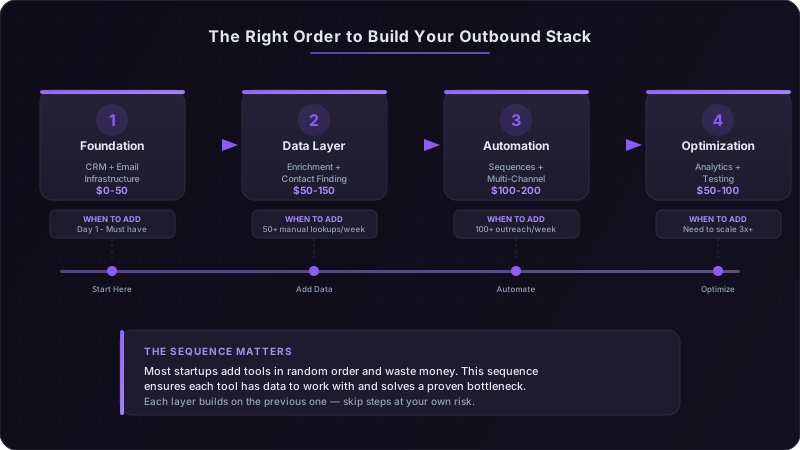
Building an Outbound Tech Stack for Under $500/Month
The complete guide to assembling a startup outbound sales stack that actually works-without burning cash on tools you'll never use.
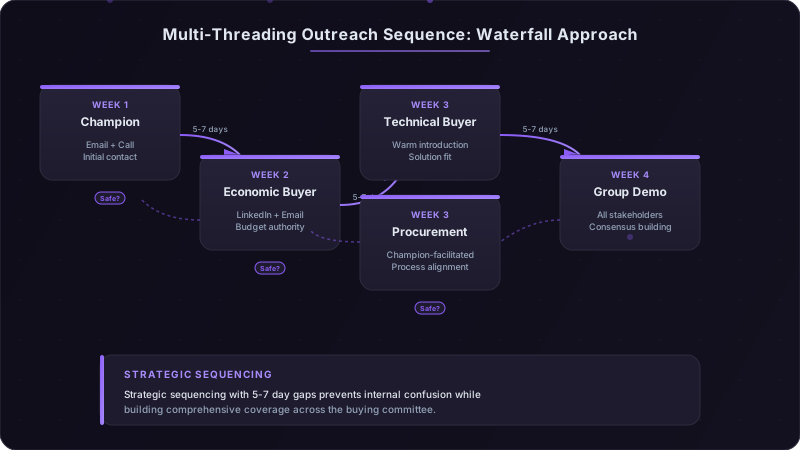
Multi-Threading Enterprise Deals: A Practical Playbook
How to map buying committees, identify champions vs. blockers, and run coordinated outreach to 4-7 stakeholders without creating internal politics or confusion.
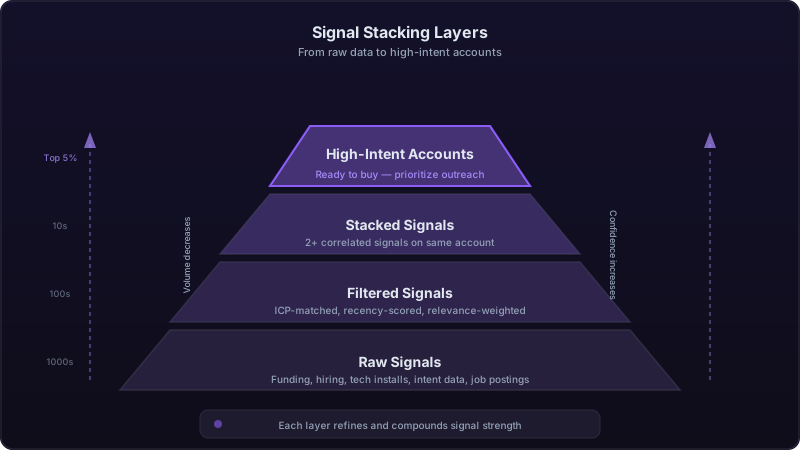
Signal Stacking: How Compound Buying Indicators Predict Revenue 10x Better Than Single Signals
One buying signal is noise. Two is a pattern. Three or more is a revenue opportunity. Learn the signal stacking methodology that's transforming pipeline prediction accuracy.