Intent Data Decoded: How to Choose and Use Third-Party Intent Providers
Not all intent data is equal. Learn how to evaluate providers and actually turn intent signals into pipeline.
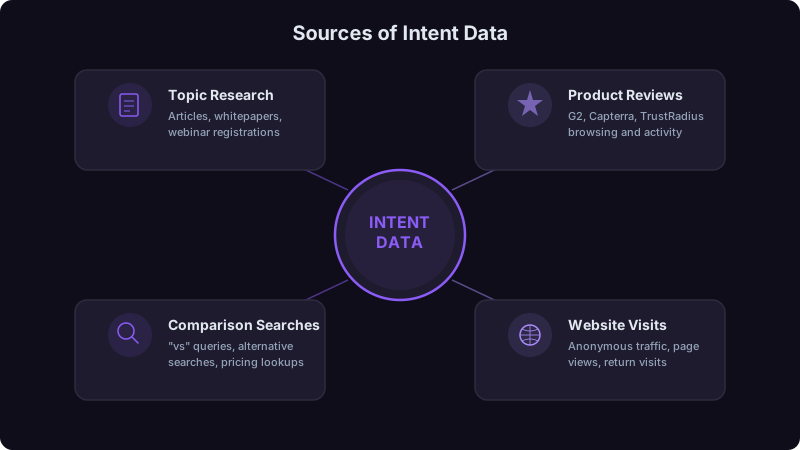
Over the past four years, I've evaluated, piloted, or fully deployed seven different intent data providers across two companies. Some delivered real pipeline. Others delivered expensive noise. The gap between the best and worst intent data experiences was enormous -- and it had less to do with the providers themselves than with how we chose and implemented them.
This guide is the comparison framework I wish I'd had before writing my first intent data check. I'll cover the different types of intent data, what to look for when evaluating providers, how to run a proper pilot, and the implementation mistakes that waste your budget.
What Intent Data Actually Is (and Isn't)
Intent data is any signal that suggests a company or individual is actively researching a problem or solution category. That's it. It's not a magic list of accounts ready to buy. It's a signal that someone at that account is consuming content related to your space.
The signal might mean they're about to buy. It might mean an intern is writing a research report. It might mean someone clicked on a LinkedIn ad by accident. The quality of your intent data -- and your ability to separate real buying signals from noise -- determines whether the investment pays off.
That gap between 78% adoption and 30% impact is the story of intent data. Most teams buy it. Few use it well.
The Four Types of Intent Data
Not all intent data is the same. Understanding the types helps you figure out what you actually need.
| Type | How It Works | Strengths | Weaknesses | Example Providers |
|---|---|---|---|---|
| Bidstream / Co-op Data | Aggregates browsing activity from ad exchanges and publisher networks | Broad coverage; topic-level signals at scale | Noisy; account-level only (no contacts); cookie deprecation risk | Bombora, Aberdeen |
| Publisher/Review Site Data | Tracks research activity on specific platforms (G2, TrustRadius, Capterra) | High-fidelity buying signals; category-specific | Limited to activity on those platforms; smaller signal volume | G2 Buyer Intent, TrustRadius |
| Search/Content Engagement | Monitors search behavior and content consumption patterns | Direct indication of research activity | Harder to get at account level; requires identity resolution | Demandbase, ZoomInfo |
| Website Visitor Identification | De-anonymizes traffic on YOUR website to identify visiting companies | First-party signal; highest intent | Only captures visitors who find you; requires meaningful traffic | Clearbit Reveal, Factors.ai, Prospectory |
Think of intent data in a hierarchy of signal strength. At the bottom: someone at the account read a blog post about a topic tangentially related to your category. At the top: someone from the account visited your pricing page three times this week. First-party intent (your website, your content) is almost always stronger than third-party intent. But third-party intent catches accounts earlier in the research process, before they find you.
How to Evaluate Intent Data Providers
I've sat through dozens of intent data vendor demos. They all show impressive case studies and cherry-picked examples. Here's the evaluation framework I use to cut through the noise.
Criterion 1: Data Source Transparency
Ask the provider: "Where exactly do your signals come from?"
Good answers: "We aggregate data from a cooperative of 4,000+ B2B publisher websites" or "We track research activity on our review platform where 60M+ users compare software."
Bad answers: "Our proprietary AI analyzes signals across the internet" or "We use a blend of sources." If they can't be specific about where signals originate, the data quality is unknowable.
Questions to ask:
- How many unique data sources contribute to your signals?
- What percentage of your data comes from first-party sources vs. third-party?
- How has cookie deprecation and privacy regulation affected your data collection?
- Can you show me the raw signals behind a specific account's intent score?
Criterion 2: Signal Freshness
Intent data has a short shelf life. A company researching "CRM platforms" last month might have already made a decision. A signal from yesterday is 10x more valuable than one from 30 days ago.
Questions to ask:
- What is the average latency between a signal being captured and it appearing in my dashboard?
- How frequently are signals updated? Daily? Weekly?
- Do signals expire? After how long?
- Can I filter by signal recency?
During your pilot, check a sample of 20 "high-intent" accounts. Call them. Ask if they're currently evaluating solutions in your category. If fewer than 30% say yes, the signals are either stale, too broad, or both.
Criterion 3: Coverage of Your Target Market
The best intent data in the world is useless if it doesn't cover the accounts you sell to.
Questions to ask:
- Upload your target account list. What percentage do they have signal coverage for?
- What's their coverage like for your specific industry/vertical?
- Do they cover the geographic markets you sell in?
- For smaller companies (under 100 employees), what's the signal density? (Most intent data gets thin below mid-market.)
Criterion 4: Topic Granularity
"Showing intent for cloud computing" is too broad to be useful. "Showing intent for Kubernetes container orchestration" is actionable.
Questions to ask:
- How granular are your topic taxonomies?
- Can I create custom topics specific to my product category?
- Can you distinguish between someone researching the problem vs. researching specific solutions?
- How do you handle intent signals that span multiple categories?
Criterion 5: Integration and Actionability
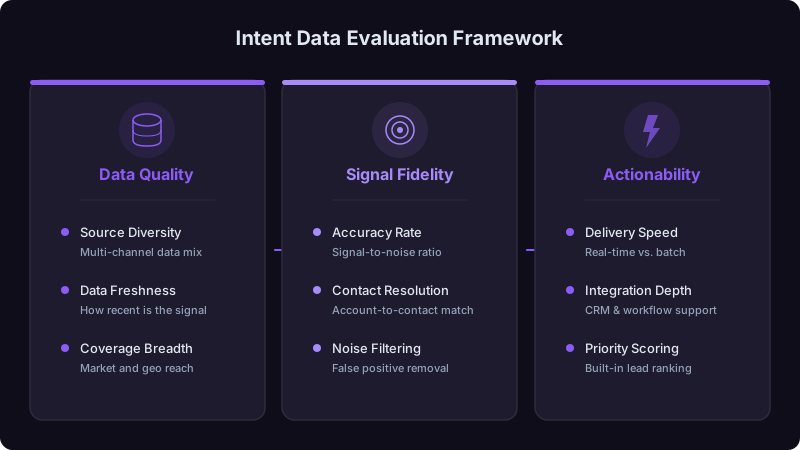
Intent data locked in a standalone dashboard is a report, not a tool. The value comes from making signals actionable inside the systems your team already uses.
Questions to ask:
- Does it integrate natively with our CRM (Salesforce, HubSpot)?
- Can signals trigger automated workflows (alerts, sequence enrollment, lead scoring adjustments)?
- Does the integration push signals in real-time or in batch?
- Can I combine intent signals with our existing lead scoring model?
Running a Proper Pilot
Don't sign an annual contract based on a demo. Run a pilot. Here's how we structure ours.
Before the pilot starts, agree on what "good" looks like. Our criteria:
- At least 40% of "high-intent" accounts should confirm active research when contacted
- Intent-flagged accounts should convert to meetings at a rate at least 2x higher than non-intent accounts
- At least 60% of signals should be fresh enough to act on (less than 14 days old)
- The data should cover at least 50% of our target account list
Split your target accounts into two groups:
- Group A (intent-informed): SDRs receive intent signals and use them to prioritize and personalize outreach
- Group B (control): SDRs work accounts using your standard prioritization method
Run both groups simultaneously for 60-90 days. Compare meeting rates, opportunity creation, and pipeline value.
For every account flagged as "high intent" during the pilot, track:
- Did we reach someone there?
- Were they actually researching our category?
- Did the deal progress?
- How long from signal to first meeting?
Factor in:
- Cost of the intent data subscription
- Time reps spent learning and using the tool
- Incremental pipeline generated vs. the control group
- Deal velocity improvement (did intent-flagged deals close faster?)
Practical Comparison: What I've Learned from Each Type
I won't name specific vendors because the market changes fast and every company's experience depends on their ICP and market. But I'll share patterns from the four types we've used.
Bidstream/Co-op Intent (e.g., Bombora-style)
What worked: Broad coverage. Good for identifying accounts in early research phases. Useful as one input into a multi-signal scoring model.
What didn't: High false positive rate when used alone. Account-level only -- knowing "someone at Acme Corp researched CRM" doesn't tell you who to call. Had to combine with contact databases to make signals actionable. Signals sometimes felt stale by the time we acted on them.
Best for: Enterprise teams with large TAMs who need to prioritize across thousands of accounts. Works best as one signal in a composite score, not as a standalone prioritization tool.
Review Platform Intent (e.g., G2-style)
What worked: Very high signal fidelity. When someone's actively comparing products on a review site, they're genuinely evaluating. We saw 3-4x higher meeting rates on G2-intent accounts vs. our baseline.
What didn't: Low volume. On any given week, only a small fraction of our target accounts were active on review platforms. Not enough signal to fill a team's pipeline on its own.
Best for: Mid-market teams selling in competitive categories where review sites are part of the buying process. Excellent for competitive intelligence (you can see when accounts research your competitors).
Search/Content Intent (e.g., Demandbase-style)
What worked: Good balance of volume and quality. Topic-level signals were specific enough to inform personalization. Integration with ad platforms allowed us to run targeted display campaigns alongside outbound.
What didn't: Identity resolution was imperfect. The "accounts" sometimes turned out to be universities, co-working spaces, or VPN nodes -- not real companies researching. Required careful filtering.
Best for: Teams that combine outbound sales with account-based marketing. The data informs both channels.
First-Party Website Identification
What worked: Highest conversion rate of any intent source. Accounts visiting our website were already aware of us and actively researching. Meeting rates were 5-6x our cold outbound baseline.
What didn't: Volume is limited to your website traffic. If you get 500 unique company visits per month, you're working with a small signal set. Doesn't help you find accounts that don't know you exist yet.
Best for: Every B2B company should have this as a baseline. It's the closest thing to a guaranteed intent signal.
Implementation: Where Most Teams Go Wrong
80% of intent data failures are implementation failures, not data failures. The signals might be perfectly fine. But if your team doesn't know how to act on them, doesn't trust them, or can't access them in their workflow, you've bought an expensive dashboard that nobody opens.
Mistake 1: Dumping signals into a dashboard nobody checks.
Intent data needs to flow into the systems reps already use. If it requires logging into a separate platform, adoption drops to near zero within 30 days. Push signals into Salesforce, into Slack alerts, into sequencing tools. Meet reps where they are.
Mistake 2: Treating all intent signals equally.
A first-time topic research signal is not the same as a third visit to your pricing page. Build tiers: low intent (researching the problem), medium intent (comparing solutions), high intent (evaluating your product specifically). Each tier gets a different response.
Mistake 3: Not training reps on how to use signals in conversations.
"I noticed your company is showing interest in our category" is creepy. "I've been working with a few companies in [industry] who are dealing with [problem your intent topics suggest] -- curious if that resonates with what you're seeing?" is useful. Train reps on how to reference intent without revealing the signal source.
Mistake 4: Buying intent data before fixing fundamentals.
If your SDR team doesn't have a solid outbound sequence, clean target account lists, and reliable CRM data, intent data won't save you. It amplifies what's already working. It doesn't fix what's broken.
Mistake 5: Not combining multiple intent sources.
No single intent provider gives you the full picture. The best programs I've seen combine first-party website identification, one third-party intent source, and internal engagement data (email opens, content downloads, event attendance). The composite signal is far more reliable than any single source.
The Evaluation Scorecard
Use this when comparing providers. Score each on a 1-5 scale.
| Criteria | Weight | What to Assess |
|---|---|---|
| Data source transparency | 15% | Can they explain exactly where signals come from? |
| Signal freshness | 15% | Latency from capture to delivery; expiration policy |
| Coverage of your TAM | 20% | Upload your account list; check match rate |
| Topic granularity | 10% | Broad categories vs. specific, actionable topics |
| Contact-level resolution | 15% | Account-only vs. individual contacts identified |
| Integration depth | 15% | CRM, sequencer, ad platform, Slack connections |
| Pricing model fit | 10% | Per-seat, per-account, per-signal; scalability |
The weights should shift based on your priorities. If you're a 10-person SDR team, integration depth matters more than broad coverage. If you're an enterprise marketing team running ABM, coverage and topic granularity matter most.
If you're buying intent data for the first time, start with two things: (1) First-party website visitor identification -- it's the highest-fidelity signal and the cheapest to implement. (2) One third-party source that covers your specific market well. Run both for 90 days before adding more complexity. You'll learn more from using two sources well than from subscribing to five you barely touch.
Intent data is a powerful input into your sales and marketing engine. But it's an input, not a strategy. The teams that get the most from intent data are the ones that integrate signals into existing workflows, train reps to act on them quickly and naturally, and continuously validate signal quality against real outcomes. The providers that serve you best are the ones that are transparent about their data sources, deliver fresh signals, and make it easy to act -- not the ones with the flashiest dashboard.
Ready to transform your sales pipeline?
See how Prospectory's AI-powered platform can help your team research, reach, and relate to prospects at scale.
Related Articles
Reddit Prospecting for B2B: The 9:1 Rule That Builds Pipeline Without Bans
Reddit hosts raw buyer intent that outperforms third-party data, but sales tactics get you banned. Here's the 3-6 month credibility playbook and enrichment workflow that actually works.
LinkedIn Comments Are Worth 8x More Than Likes: A Social Selling Playbook
LinkedIn's algorithm now rewards comments over likes by 8x in reach. Here's how to engineer conversations that turn comment threads into qualified pipeline.
Building an Outbound Tech Stack for Under $500/Month
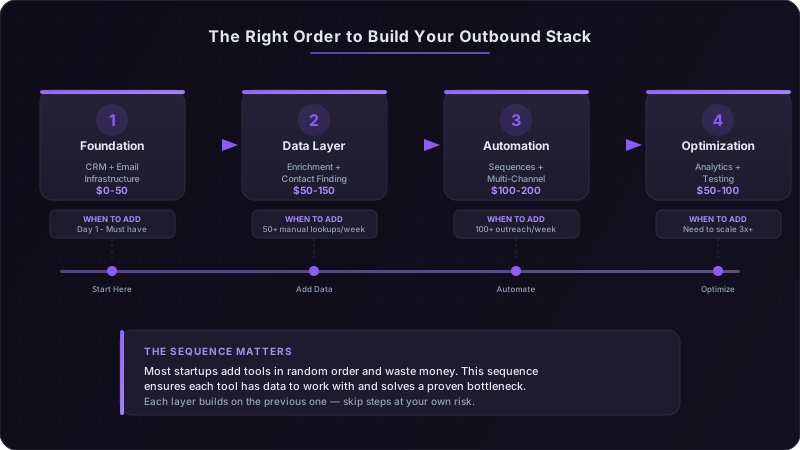
The complete guide to assembling a startup outbound sales stack that actually works-without burning cash on tools you'll never use.