Cold Calling Isn't Dead: How AI Makes Phone Outreach More Effective
Reports of cold calling's death are greatly exaggerated. Learn how AI-powered preparation and scripts are driving 3x more phone conversions.
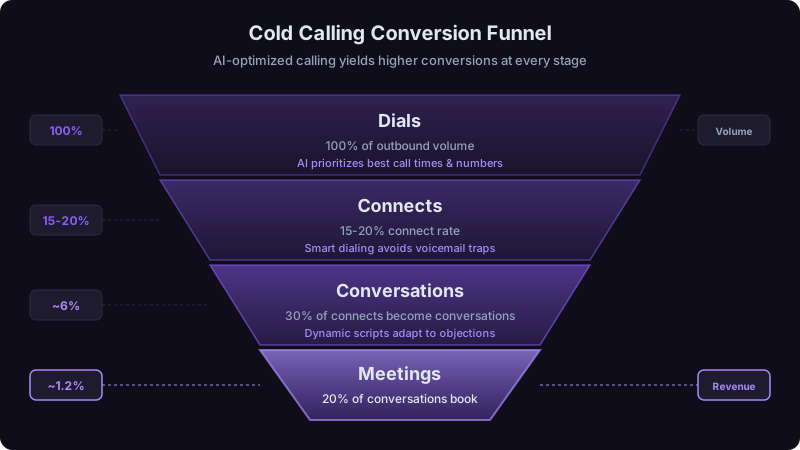
I manage a team of 18 SDRs. Every quarter, at least one of them asks me: "Is cold calling even worth it anymore?" My answer is always the same. Last month, phone outreach generated 34% of our qualified pipeline. Email generated 28%. LinkedIn generated 22%. Everything else combined made up the rest.
Cold calling isn't dead. But the old way of cold calling, dialing down a list with zero research, reading from a script, and hoping someone picks up, that's been dead for years. Good riddance.
What works now is something fundamentally different. It's research-backed, AI-assisted, conversation-driven phone outreach where the rep sounds like a knowledgeable peer, not a telemarketer. And the teams that do it well are booking meetings at rates that make their email-only competitors jealous.
The Real Numbers: Why Phone Still Converts
Let me share some data from our team's last two quarters. These numbers come from 18 SDRs making a combined 400-500 dials per day across mid-market B2B accounts.
The phone numbers might look modest on a per-dial basis. But there are two things the raw connect rate doesn't capture. First, phone conversations are higher quality. A prospect who picks up and talks to you for 3 minutes is far more likely to become a real opportunity than someone who sends a two-word email reply. Second, phone calls accelerate every other channel. A cold email followed by a warm voicemail reference gets 2-3x the reply rate of the email alone.
Phone calls aren't competing with email and LinkedIn. They're amplifying them. Our best-performing sequence is: Day 1 email, Day 2 LinkedIn connection request, Day 3 phone call referencing both. This three-touch combo books more meetings in the first week than a 12-step email-only sequence does in a month.
Pre-Call Research: Where AI Actually Helps
Here's where AI has genuinely changed cold calling, not by replacing the human conversation, but by eliminating the tedious research that used to make pre-call prep impractical at scale.
Before AI-assisted research, my reps had two options. Spend 10-15 minutes researching each prospect (which means fewer dials) or call blind (which means terrible conversations). Neither option was great.
Now, with AI pulling and summarizing prospect intelligence, a rep can get a meaningful research brief in under 30 seconds. Here's what that looks like in practice:
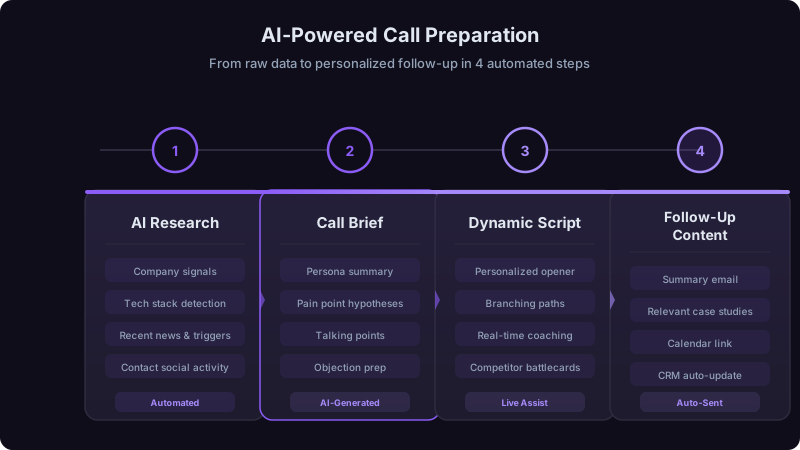
The 30-Second Pre-Call Brief
Before every dial, your AI-generated brief should include:
Company context: What does the company do, how big are they, any recent news (funding rounds, product launches, executive changes, earnings calls)?
Prospect context: What's their role, how long have they been in it, what did they do before, are they active on LinkedIn, have they posted about anything relevant?
Trigger events: Anything that suggests they might be open to a conversation right now. Hiring for roles that indicate growth or pain. Technology changes visible in their stack. Competitor mentions. Industry regulation changes.
Suggested opening angles: Based on all of the above, 2-3 specific conversation starters that are relevant to this specific person at this specific moment.
AI should prepare you for the conversation. It should NOT script the conversation word-for-word. Reps who read AI-generated scripts sound robotic and lose the prospect in the first 10 seconds. Use AI for research and prep. Use your own words and instincts for the actual call.
The Call Structure Framework
I don't believe in rigid scripts. I believe in frameworks, a clear structure that guides the conversation while leaving room for the rep to be human. Here's the framework every SDR on my team uses.
This is the most critical moment. You have about 10 seconds before the prospect decides to hang up or keep listening. The goal is NOT to pitch. The goal is to earn another 30 seconds.
What works:
"Hey [First Name], this is [Your Name] with [Company]. I know I'm calling out of the blue, do you have 30 seconds for me to tell you why, and you can decide if it's worth continuing?"
Why this works: It's honest. It acknowledges the interruption. It gives them control. Most people will give you 30 seconds out of curiosity.
What doesn't work:
"Hi, how are you doing today?" (They know you don't care)
"Is this a good time?" (It's never a good time, you're giving them an easy out)
"I'm calling from [Company], we're the leading provider of..." (Instant hang-up)
You've earned 30 seconds. Use them to prove you're not wasting their time. This is where your pre-call research pays off.
Structure: [Observation about their situation] + [Problem you've seen in similar companies] + [Quick bridge to why you're calling]
Example: "I saw you just brought on three new SDRs this quarter, congrats on the growth. A lot of sales leaders I talk to in that same stage are struggling with the same thing: the new reps take 3-4 months to ramp, and pipeline generation stalls in the meantime. That's actually why I'm calling."
Example: "I noticed [Company] just launched the enterprise product line. When companies make that shift, outbound targeting usually needs a complete overhaul, different personas, different messaging, different channels. Is that something you're dealing with?"
If they're still engaged after your relevance statement, transition into discovery. Don't pitch your product yet. Ask a question that:
- Confirms you're talking to the right person
- Opens up their current situation
- Shows you understand their world
Good qualifying questions:
- "How are you handling [specific challenge] right now?"
- "What's your biggest bottleneck when it comes to [relevant area]?"
- "When you think about hitting your number this quarter, what's the thing keeping you up at night?"
If they answer your qualifying question, you're in a real conversation. This is where most reps blow it by switching into pitch mode. Don't. Keep asking questions. Mirror what they say. Go deeper.
Rep: "What's your biggest challenge with outbound right now?"
Prospect: "Honestly, reply rates have tanked."
Rep: "When you say tanked, what does that look like? Are we talking single digits, or..."
Prospect: "Yeah, we're at about 4% on cold email."
Rep: "That's rough. What have you tried to fix it?"
This feels like a conversation, not a sales call. That's the point.
When you've identified a real problem and confirmed there's potential fit, ask for the meeting. Be specific and low-commitment:
"It sounds like [recap their problem] is costing you real pipeline. I've got some ideas on how teams in your position have fixed that, would it be worth a 20-minute call later this week to walk through it? I'm thinking Thursday at 2pm or Friday morning."
Two specific time slots. Not "sometime next week." Not "I'll send you a calendar link." Specific options force a decision.
Handling the Five Most Common Objections
Every SDR hits the same objections. The key isn't memorizing rebuttals, it's understanding what the prospect is actually saying underneath the objection.
| Objection | What They're Really Saying | How to Respond |
|---|---|---|
| "I'm not interested" | "You haven't given me a reason to care" | "Totally fair, I probably haven't given you enough context. Can I ask one quick question to see if this is even relevant to you?" |
| "We already have a solution" | "I'm not looking to switch right now" | "That makes sense. Just curious, if you could change one thing about how [current solution] works for your team, what would it be?" |
| "Send me an email" | "I want to get off this call" | "Happy to. So I don't send you something generic, what's the one thing that would actually be useful for me to include?" |
| "We don't have budget" | "I don't see enough value to justify cost" | "Understood. Budget aside, if there was a way to [solve their stated problem], is that something worth exploring?" |
| "Call me back next quarter" | "Not a priority right now" | "I'll absolutely follow up. Before I do, what would need to change between now and then for this to become a priority?" |
The first objection is almost never the real one. It's a reflex. If you respond with curiosity instead of a canned rebuttal, prospects will often give you the real reason, and that's what you can actually work with. "Send me an email" usually means "you haven't convinced me." "We don't have budget" usually means "I don't see the value." Treat objections as information, not roadblocks.
The Numbers That Define Success
Track these metrics for every SDR, every week. This is your coaching dashboard.
The most important ratio: Conversations-to-meetings. This is where coaching has the biggest impact. If a rep is getting people on the phone but not booking meetings, the issue is in their conversation skills, not their activity volume. Adding more dials won't fix a broken talk track.
AI-Powered Post-Call Follow-Up
Here's the second place where AI genuinely helps: follow-up. After every conversation, the rep needs to:
- 1Log the call in CRM with notes
- 2Send a personalized follow-up email within 15 minutes
- 3Update the prospect's status and next steps
- 4Schedule the next touchpoint
Without AI, this takes 8-10 minutes per call. With AI transcription and summarization, the rep can:
- Auto-generate call notes from the transcription
- Draft a follow-up email that references specific things discussed
- Suggest next steps based on the conversation content
- Auto-update CRM fields
This cuts post-call admin from 10 minutes to 2 minutes. Over 20 conversations a day, that's nearly three hours saved, time that goes back into more dials or better pre-call prep.
Building a Calling Culture (Not Just a Calling Quota)
The biggest challenge with phone outreach isn't technique. It's willingness. Most SDRs, especially younger ones who grew up texting instead of calling, are uncomfortable picking up the phone. They'll do everything possible to avoid it: write more emails, send more LinkedIn messages, spend 20 minutes "researching" before each dial.
Here's how I've built calling culture on my team:
Call blocks, not call quotas: Instead of saying "make 50 dials today," I schedule two-hour calling blocks where the entire team dials together. There's energy in it. Reps hear each other getting connects, booking meetings, handling objections. It normalizes the activity.
Live call coaching: I listen to 3-4 calls per rep per week (with their knowledge). After each call, 60 seconds of feedback. Not criticism, specific, actionable feedback. "Your opening was strong. Next time, try pausing after your relevance statement instead of jumping straight to the question. Let them react."
Celebrate conversations, not just meetings: If a rep had a great 5-minute conversation that didn't result in a meeting, that's worth recognizing. The conversation skills are building even when the outcome doesn't land.
Share recordings of great calls: With prospect permission, we archive standout calls and use them in team training. New SDRs learn faster from hearing real conversations than from reading playbooks.
One of my top SDRs told me she used to dread calling blocks. Now she treats the first 3-4 dials as warm-ups, she expects them to go to voicemail or be short conversations. By dial 5 or 6, she's in rhythm, her energy is up, and her conversations are sharper. If you judge your calling session by the first few dials, you'll always think the phone doesn't work. The magic happens at dial 10+.
The Weekly Calling Playbook
Here's the exact rhythm my team follows:
Monday: Fresh week, fresh energy. Two calling blocks (10am-12pm, 2pm-4pm). Focus on highest-priority prospects. AI pre-call briefs generated in bulk Sunday night.
Tuesday-Wednesday: One calling block each day (10am-12pm). Afternoons for follow-up emails, LinkedIn engagement, and research for Thursday's calls.
Thursday: Two calling blocks. This is statistically our best connect-rate day (people are wrapping up their week and more likely to pick up).
Friday: One calling block in the morning (9am-11am). Friday mornings are surprisingly good for connects, people are in a better mood. Afternoon is for CRM cleanup, metric review, and planning next week's target list.
The phone is not going away. Not in 2026, not in 2030. As long as there are humans making buying decisions, a well-timed phone call from a prepared, genuine rep will outperform every automated touchpoint. The teams that invest in calling skills now, while their competitors retreat to email-only, are building a durable competitive advantage that's hard to replicate.
Your move: block two hours on your calendar this week for focused calling. Use AI to prep your top 20 prospects. Follow the framework. Track your numbers. I bet you'll be surprised at what happens.
Ready to transform your sales pipeline?
See how Prospectory's AI-powered platform can help your team research, reach, and relate to prospects at scale.
Related Articles
Reddit Prospecting for B2B: The 9:1 Rule That Builds Pipeline Without Bans
Reddit hosts raw buyer intent that outperforms third-party data, but sales tactics get you banned. Here's the 3-6 month credibility playbook and enrichment workflow that actually works.
LinkedIn Comments Are Worth 8x More Than Likes: A Social Selling Playbook
LinkedIn's algorithm now rewards comments over likes by 8x in reach. Here's how to engineer conversations that turn comment threads into qualified pipeline.
Building an Outbound Tech Stack for Under $500/Month
The complete guide to assembling a startup outbound sales stack that actually works-without burning cash on tools you'll never use.