Agentic AI in Sales: How Autonomous Deal Cycles Are Replacing the Traditional Pipeline
Agentic AI is moving beyond task automation into fully autonomous deal orchestration. Learn how self-directed AI agents are compressing 90-day sales cycles into weeks.
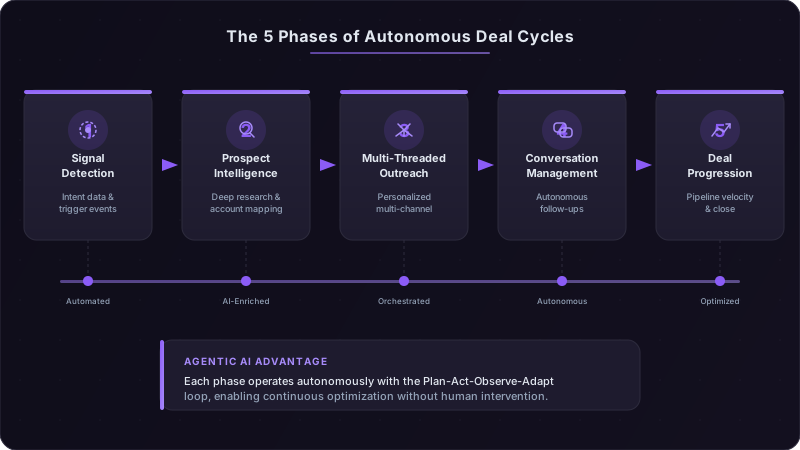
I've spent 18 years in B2B sales leadership. I've seen plenty of "this changes everything" moments come and go. CRM was going to fix everything. Social selling was going to fix everything. Predictive analytics was going to fix everything.
Agentic AI is different. Not because the hype says so, but because I'm watching it change how my own team operates, deal by deal, in ways I can measure.
Let me explain what's actually happening on the ground.
First: What "Agentic" Actually Means (Without the Buzzwords)
Most AI in sales today is reactive. You ask it to score a lead. You prompt it to write an email. You query it for an insight. It does what you tell it, when you tell it.
Agentic AI flips that. You give it a goal, "book a meeting with the VP of Engineering at Acme Corp", and it figures out the rest. It breaks that goal into steps, executes them, watches what happens, and adjusts.
The core loop looks like this:
- Plan: Decompose the goal into sub-tasks (research, channel selection, message crafting, timing)
- Act: Execute those tasks independently, no human in the loop
- Observe: Monitor what happens (opens, replies, bounces, engagement patterns)
- Adapt: Change approach based on results (switch channels, adjust tone, escalate to a human)
This loop runs around the clock across your entire pipeline.
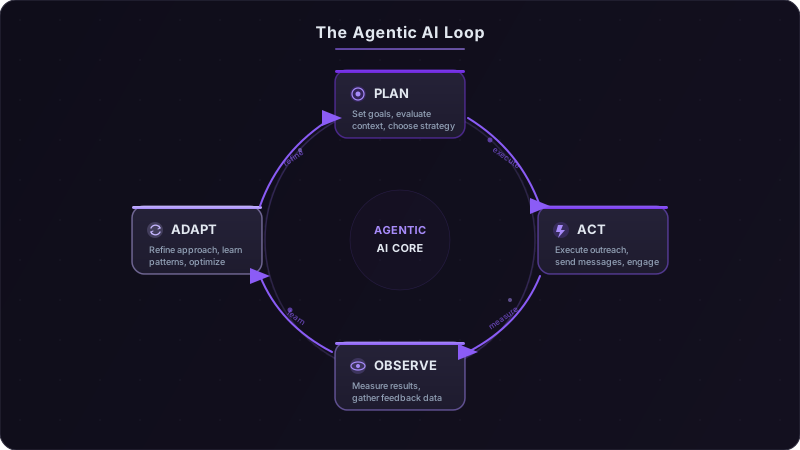
The difference between this and a drip sequence is enormous. A sequence is a fixed track. An agent is a problem-solver that rewrites its own playbook based on what's working.
What an Autonomous Deal Cycle Actually Looks Like
Let me walk through a real scenario. Last quarter, one of our agents picked up a signal on a mid-market SaaS company I'll call DataFlow.
DataFlow's VP of Sales posted on LinkedIn about "rebuilding our outbound motion from scratch." The agent flagged this, cross-referenced it with three other signals: DataFlow had recently raised a Series B, posted two SDR job listings, and their CTO had visited our pricing page twice that week. Within minutes, the agent had built a deal thesis: DataFlow is investing in outbound, has budget, is actively hiring, and someone senior is already evaluating tools.
The agent compiled a prospect profile: org chart with 4 key stakeholders identified, current tech stack (Salesforce, Outreach, ZoomInfo), recent company news, competitive landscape, and communication preferences pulled from each stakeholder's LinkedIn activity and email patterns.
Here's where it gets interesting. The agent didn't blast a template. It sent three different messages to three different people:
- The VP of Sales got a message referencing her LinkedIn post, with a specific point about outbound rebuild timelines
- The CTO got a technical comparison relevant to their current stack
- The SDR Manager (listed on a recent job posting) got a message about onboarding new reps faster
Each message was different in tone, length, and angle. All sent within the same 2-hour window.
The VP of Sales replied within 4 hours. The agent classified her response as high-intent (she asked about pricing and integration), drafted a reply addressing both questions with specific detail, and simultaneously flagged the conversation for a human AE to take over before the next exchange.
The agent prepped a briefing doc for the AE: prospect profile, all signals that triggered the outreach, engagement history across all three threads, competitive intel, and a suggested talk track. The AE walked into that first call better prepared than if she'd spent two hours researching manually.
Total time from signal to booked meeting: 4 days. Our old process? That same deal would have taken 3 weeks, if the rep even noticed the signal at all.
The Numbers I'm Actually Seeing
I'm not going to cite some industry report. Here's what our team has tracked over the past two quarters since deploying agentic workflows:
The pipeline number is the one that surprised me most. It's not that the agents are better at selling, they're not closing deals. They're just working signals that my team physically couldn't get to. We were ignoring roughly 80% of viable buying signals because reps didn't have bandwidth. The agents work all of them.
Where Humans Still Win (And Where They Don't)
I've had reps ask me, "Am I being replaced?" Honest answer: no. But your job description is changing.
Here's the division of labor that's emerged on my team:
| Activity | Agent Handles | Human Handles |
|---|---|---|
| Signal monitoring | Watches all signals 24/7 | Reviews top priorities weekly |
| Prospect research | Compiles full intelligence profiles | Validates for strategic accounts |
| Initial outreach | Runs personalized multi-channel plays | VIP and C-suite accounts only |
| Objection handling | Addresses common, well-documented objections | Nuanced negotiations, custom deal terms |
| Meeting prep | Generates briefing docs and talk tracks | Reviews, adds strategic context |
| Relationship building | Maintains consistent touchpoints | Deep relationship work, dinner meetings |
| Deal negotiation | Provides real-time competitive intel | Runs the negotiation |
The reps who thrive in this model are the ones who were always good at the human stuff: reading a room, building trust, creative problem-solving, navigating internal politics at a prospect's company. The reps who were mostly good at grinding through research and follow-ups? They need to evolve.
You're not competing with the AI. You're being freed from the work you were worst at (data assembly, follow-up timing, signal monitoring) so you can focus on the work you're best at (strategy, relationships, negotiation). The reps who embrace this are producing 3x their previous numbers.
How to Actually Implement This (Lessons from Getting It Wrong)
I didn't get this right on the first try. Here's what I learned.
Mistake 1: We tried to automate everything at once
We initially gave the agent control over the entire pipeline. Bad idea. It sent messages to a key enterprise prospect that were technically accurate but didn't match the nuance of a deal we'd been nurturing for months. The prospect was confused by the "new voice."
What works instead: Start with signal-rich, early-stage workflows. Signal detection and initial outreach for net-new accounts. That's where agents add the most value with the least risk.
Mistake 2: We didn't set clear handoff rules
For the first three weeks, agents and reps were sometimes reaching out to the same prospect on the same day with different messages. Embarrassing.
What works instead: Define explicit escalation boundaries. On our team, the rule is simple: once a prospect replies with anything beyond a one-line "not interested," a human takes over. The agent can still prep materials and suggest responses, but a person sends them.
Mistake 3: We measured activity instead of outcomes
At first, we were thrilled by the volume. The agent was sending 10x more outreach than our reps. But volume doesn't equal pipeline. We had to recalibrate metrics.
What works instead: Track these four metrics and nothing else at first:
- 1Signal-to-meeting conversion rate, Are we turning signals into real conversations?
- 2Qualified pipeline generated, Not emails sent, not opens, not clicks. Pipeline dollars.
- 3Rep time reallocation, How many hours per week did reps shift from research to selling?
- 4Win rate on agent-sourced opps, Are these deals closing at the same rate as rep-sourced ones?
Mistake 4: We forgot about brand voice
Early agent-written emails were technically good but read like a consultant wrote them, formal, stiff, full of "I'd love to explore mutual opportunities." We had to spend real time training the agent on our voice: direct, specific, no fluff, slightly informal.
What works instead: Feed the agent 50+ examples of your best-performing emails. Not your templates, your actual sent messages that got replies. Then review the first 100 messages it generates and give direct feedback. The calibration period takes about two weeks.
Mistake 5: We didn't build feedback loops
For the first month, the agent kept using the same approach even when results dropped off. We weren't feeding performance data back into its decision-making.
What works instead: Every agent action should generate data that improves the next action. Which subject lines get replies from CTOs vs. VPs of Sales? Which signals actually lead to closed deals vs. just meetings? Which industries respond better to which channels? This data compounds fast. By month three, our agent's outreach was measurably better than month one.
What's Coming in the Next 12-18 Months
Based on what I'm seeing from vendors and early-stage companies in this space, here's what's next:
- Multi-agent collaboration: Specialized agents that work together, one focused on research, one on outreach, one on deal management. Think of it like a pod model, but with AI.
- Cross-company agent interactions: This one's wild. Your selling agent communicating with your prospect's procurement agent to exchange information, schedule evaluations, and negotiate terms. It's already being prototyped.
- Predictive deal design: Agents that don't just find opportunities but recommend optimal deal structures based on the buyer's patterns, pricing models, contract terms, implementation timelines.
- Autonomous account expansion: Agents that monitor existing customer usage and proactively identify and pursue upsell and cross-sell opportunities before the customer even realizes they need them.
The Honest Bottom Line
Agentic AI is not magic. It's not going to fix a broken product, a bad ICP, or a weak value proposition. If your messaging doesn't resonate when a human sends it, it won't resonate when an agent sends it either.
What it does is remove the capacity ceiling. My team of 8 AEs now effectively operates like a team of 30 when it comes to coverage, speed, and follow-through. The deals we were missing because nobody had time to research that signal or follow up on that reply? We're catching those now.
If you're a sales leader considering this, my advice is simple: pick one workflow, set it up, measure it for 60 days, and let the data decide. That's how I got convinced. Not by a vendor pitch, by the pipeline numbers on my own dashboard.
Ready to transform your sales pipeline?
See how Prospectory's AI-powered platform can help your team research, reach, and relate to prospects at scale.
Related Articles
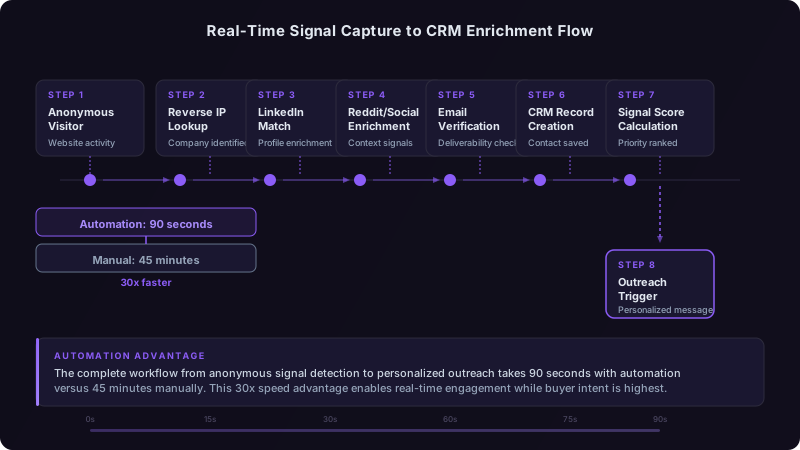
Real-Time Buying Signals vs. Historical Data: Which Actually Predicts Revenue?
Historical patterns tell you who bought before. Real-time signals tell you who's buying now. We analyzed 18 months of pipeline data to find out which matters more.
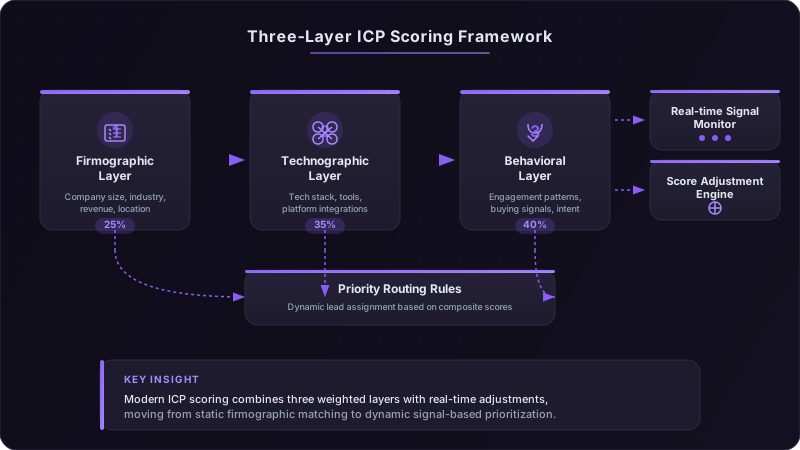
ICP Scoring Models That Actually Predict Revenue
Three $50M+ ARR companies share their exact ICP scoring matrices, combining firmographics, technographics, and behavioral signals to predict deal velocity and close rates.
The Rise of AI SDRs: How Autonomous Agents Are Transforming Sales Development
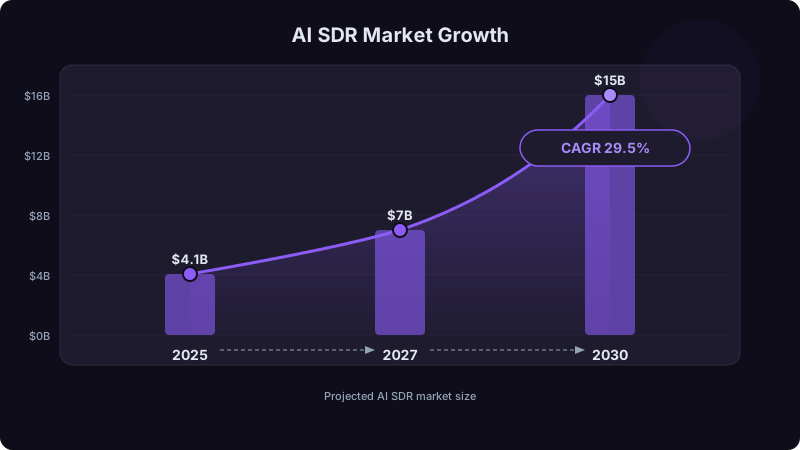
The AI SDR market is projected to reach $15 billion by 2030. Learn how autonomous sales agents are reshaping prospecting and what it means for your team.