SDR Productivity Benchmarks: How Top Teams Achieve 200% of Quota
What separates average SDRs from top performers? Data from 500+ sales teams reveals the habits, tools, and strategies that drive results.
I manage a team of 16 SDRs. Eight months ago, I sat down with our full performance dataset -- every activity, every conversion, every dollar of pipeline -- and built a picture of what was actually driving results. Some of what I found confirmed what I already believed. Some of it surprised me.
The biggest surprise: our top performer and our lowest performer logged almost the same number of activities per day. The difference wasn't effort. It was where that effort went.
This guide shares the benchmarks from our team and from published industry data. More importantly, it covers what the numbers actually mean and how to use them to coach your team.
The Performance Gap Is Wider Than You Think
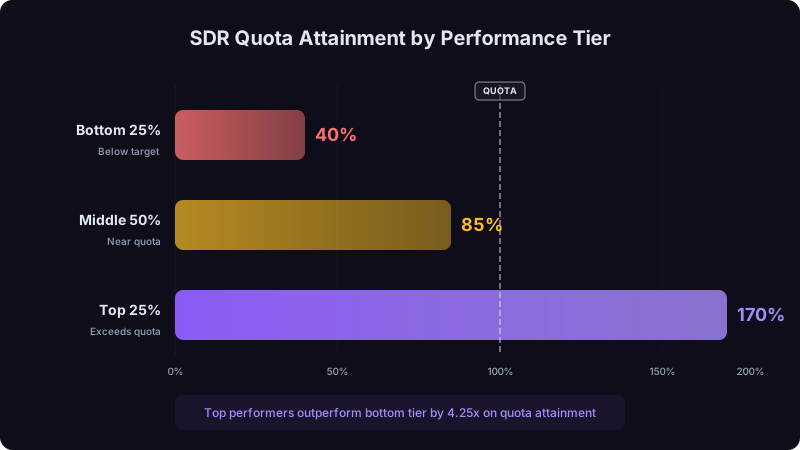
Across our team, the performance distribution looked like this:
| Percentile | Quota Attainment | Meetings/Month | Pipeline Generated/Month |
|---|---|---|---|
| Bottom 25% | 35-45% | 5-8 | $40K-$80K |
| Middle 50% | 75-100% | 12-16 | $120K-$200K |
| Top 25% | 150-200% | 22-30 | $300K-$500K |
That's not a normal distribution. It's bimodal -- a small group crushes it, a small group struggles, and the middle is roughly at plan. The question I became obsessed with: what do the top group do differently, and how much of it is coachable?
The Metrics That Actually Matter
Before I share what top performers do differently, let me address which metrics to track. Most SDR managers track too many metrics, and the wrong ones.
Metrics that matter
| Metric | Why It Matters | Our Benchmark |
|---|---|---|
| Qualified meetings set | The output metric. Everything else is an input. | 15-20/month for ramped SDRs |
| Meeting show rate | Are meetings actually happening? | 80%+ (below 70% = qualification problem) |
| SAL acceptance rate | Do AEs accept the meetings as qualified? | 85%+ |
| Pipeline created | The dollar value of opportunities generated | $200K+/month per ramped SDR |
| Positive reply rate | Are outbound messages getting engagement? | 8-15% |
| Conversations to meetings | When you reach someone, can you book? | 25-35% |
Metrics that mislead
Total activities per day. This is the metric most SDR orgs fixate on, and it's the one that causes the most damage. Setting a daily activity quota (e.g., "100 activities per day") incentivizes volume over quality. Our lowest performer hit 110 activities daily. Our top performer averaged 62.
Emails sent. Volume of emails sent tells you nothing about quality. A rep sending 80 templated emails performs worse than one sending 30 personalized ones.
Dials per day. Same problem. Calling 60 numbers with no research is less productive than calling 20 with preparation.
If your primary KPI is "activities per day," your SDRs will optimize for the metric instead of the outcome. They'll send more emails, but worse ones. They'll make more calls, but shorter and less prepared. Measure outputs (meetings, pipeline) and coach on the quality of inputs, not the volume.
What Top Performers Do Differently
I shadowed our top four performers for a full week each. I sat next to them, watched how they worked, and documented everything. Here's what separated them from the middle of the pack.
1. Account Selection: 80% of the Battle
Our top SDRs spent 15-20 minutes every morning curating their daily account list. They looked at:
- Intent signals: Which accounts are actively researching?
- Trigger events: Who just raised funding, hired a new VP, expanded to a new market?
- Firmographic fit: Does this company match our best-customer profile?
- Engagement history: Has anyone from this account visited our site, opened our emails, attended our events?
Bottom performers opened their sequencing tool and started at the top of the list. No prioritization. No curation. They worked accounts alphabetically or by whatever was next in the queue.
The result: our top reps were fishing in stocked ponds while bottom reps were casting into empty lakes.
2. Research Depth: Quality Over Speed
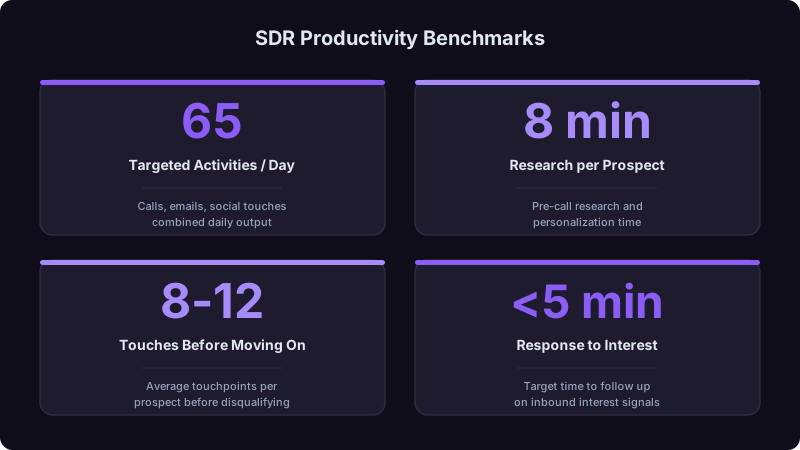
| Performance Tier | Research Time Per Account | Research Quality |
|---|---|---|
| Bottom quartile | 1-2 minutes | Company name, title, generic industry |
| Middle 50% | 3-5 minutes | Recent news, basic personalization |
| Top quartile | 5-8 minutes | Trigger events, specific challenges, connected context |
| Top quartile + AI tools | 2-3 minutes | Same depth as manual 8 min (AI handles the gathering) |
The top performers I shadowed had a consistent research routine. One of them described it as "the three-signal rule": don't reach out until you have three specific, relevant observations about the account or contact. Not "they're a SaaS company" -- that's a fact, not an insight. More like "they just opened an office in London" or "their VP Sales posted about struggling with SDR ramp time."
The fastest way to find relevant triggers: check the prospect's LinkedIn activity (posts, comments, job changes), their company's recent press releases, and their tech stack (tools like BuiltWith or Wappalyzer reveal what they're using). These three sources take 5 minutes and give you more personalization material than an hour of Googling.
3. Multi-Channel Execution
Every top performer on our team used at least three channels per prospect. Every bottom performer relied primarily on email.
| Channel Mix | Meeting Rate |
|---|---|
| Email only | 3-5% |
| Email + LinkedIn | 8-12% |
| Email + LinkedIn + Phone | 15-22% |
| Email + LinkedIn + Phone + Video | 20-28% |
This isn't just correlation. When we moved two underperforming reps from email-only to a mandatory multi-channel sequence, their meeting rates improved by 60% within six weeks. The prospects didn't change. The effort per prospect was similar. The distribution of that effort across channels made the difference.
4. Follow-Up Persistence
Our data on when meetings are booked across a sequence:
| Touch Number | % of Total Meetings Booked |
|---|---|
| Touch 1-2 | 12% |
| Touch 3-5 | 31% |
| Touch 6-8 | 35% |
| Touch 9-12 | 18% |
| Touch 13+ | 4% |
More than half of our meetings came after the fifth touch. Bottom performers averaged 3.2 touches before moving on. Top performers averaged 9.8. That persistence gap alone explains a large portion of the performance difference.
5. Response Speed
When a prospect replies to a cold email or engages with content, the clock starts. Our data:
| Response Time | Meeting Conversion Rate |
|---|---|
| Under 5 minutes | 42% |
| 5-30 minutes | 31% |
| 30 min - 2 hours | 18% |
| 2-4 hours | 11% |
| 4+ hours | 6% |
Our top performers had their notifications on and treated inbound responses like a fire drill. One rep told me: "If they responded to my cold email, they're interested right now. In an hour, they'll be in a meeting and forget about me."
The Benchmark Numbers
Here are the specific benchmarks we use, broken down by SDR tenure. These are for B2B SaaS selling to mid-market (100-2,000 employee companies), with an average deal size of $30K-$80K ACV.
Meetings booked per month
| Tenure | Ramp Expectation | Fully Ramped Target | Top Performer Level |
|---|---|---|---|
| Month 1-2 | 3-5 meetings | -- | -- |
| Month 3-4 | 8-12 meetings | -- | -- |
| Month 5-6 | 12-16 meetings | 15 meetings | -- |
| Month 7-12 | -- | 15-18 meetings | 25+ meetings |
| Year 2+ | -- | 18-22 meetings | 30+ meetings |
Conversion rates
| Metric | Industry Median | Our Team Average | Our Top Quartile |
|---|---|---|---|
| Email reply rate (cold) | 5-8% | 11% | 18% |
| Positive reply rate | 2-4% | 6% | 12% |
| LinkedIn acceptance rate | 20-30% | 35% | 48% |
| Phone connect rate | 3-5% | 7% | 12% |
| Connect-to-meeting rate | 15-20% | 28% | 38% |
| Meeting show rate | 70-80% | 84% | 92% |
| SAL acceptance rate | 60-75% | 87% | 95% |
These numbers vary significantly by market segment. Enterprise SDRs targeting Fortune 500 will have lower activity volume but higher deal values. SMB SDRs will have higher meeting volume but lower pipeline per meeting. Adjust benchmarks to your specific sales motion.
The Coaching Framework
Tracking metrics is useless without a coaching system to act on them. Here's the framework I use in my weekly one-on-ones.
Look at each SDR's funnel:
Accounts worked → Contacts reached → Conversations → Meetings → Qualified opportunities
Where is the drop-off?
- Low accounts worked: Time management problem. Are they spending too long on non-selling activities?
- Low contacts reached: Data quality or channel problem. Are they reaching the right people through the right channels?
- Low conversations: Messaging problem. Are their emails and calls getting responses?
- Low meetings from conversations: Qualification or pitch problem. Can they convert interest into commitment?
- Low qualification rate: Targeting problem. Are they working the wrong accounts?
Don't give generic coaching. If the problem is messaging, review their emails together. If the problem is account selection, walk through their prioritization process. If the problem is phone skills, do live call coaching.
One coaching focus per week. Not five. One.
"Book 20 meetings this month" is a goal that's too big to act on daily. Instead: "This week, test a new opening line on 30 prospects and track the reply rate." Small, specific, measurable.
In the next one-on-one, look at the data from that week's micro-goal. Did the new opening line perform better? By how much? What did we learn? What do we try next week?
Technology That Actually Helps vs. Shelfware
I've bought a lot of SDR tools. Some made a real difference. Others collected dust after month two. Here's my honest assessment.
| Tool Category | Impact on Productivity | Our Experience |
|---|---|---|
| Sequencing (Outreach, Salesloft) | High | Essential. Can't run multi-channel sequences without it. |
| Intent data | Medium-High | Good for prioritization, but only if reps actually use the signals daily |
| AI research tools | High | Biggest time saver we've adopted. Cut research time from 8 min to 2 min per account. |
| Dialer (parallel/power dialer) | Medium | Helps phone-heavy motions. Less relevant for email-first teams. |
| Data enrichment (ZoomInfo, Apollo) | High | Clean, accurate contact data is table stakes. Bad data wastes everyone's time. |
| Call recording/coaching (Gong, Chorus) | Medium-High | Invaluable for coaching. Low impact if managers don't actually review calls. |
| CRM (Salesforce, HubSpot) | Essential | Not a productivity tool per se, but poor CRM discipline tanks team visibility. |
Before buying a new tool, ask: "What manual process will this eliminate, and how many hours per SDR per week does that process currently take?" If you can't answer specifically, you're buying a solution for a problem you haven't quantified. In my experience, the highest-ROI SDR tech investments are: (1) a sequencing platform, (2) clean contact data, and (3) AI-assisted research. Everything else is incremental.
The Ramp Plan
New SDR ramp is where most productivity is lost. A rep who ramps in 3 months instead of 5 generates an extra two months of full productivity. That's worth $400K-$600K in pipeline at our benchmarks.
| Week | Focus | Expected Output |
|---|---|---|
| 1-2 | Product training, ICP training, tool setup | 0 meetings (training only) |
| 3-4 | Shadow top performers, practice sequences, first outbound | 2-4 meetings |
| 5-8 | Full outbound with daily manager check-ins | 6-10 meetings/month |
| 9-12 | Independent execution with weekly coaching | 12-15 meetings/month |
| 13+ | Fully ramped, optimization phase | 15-20+ meetings/month |
The two things that accelerate ramp most: (1) having new SDRs shadow a top performer for their first two weeks (not just in training, but sitting next to them and watching them work), and (2) daily 15-minute check-ins during weeks 3-8 where the manager reviews that day's outreach and gives specific feedback.
What I'd Do Differently If I Started Over
I'd measure positive reply rate from day one. It took me six months to realize that total reply rate is misleading (it includes "please remove me from your list"). Positive reply rate is the metric that correlates with meetings.
I'd invest in account selection tooling before sequencing tooling. We bought Outreach first and a prioritization tool second. Should have been the other way around. A great sequence targeting the wrong accounts produces nothing.
I'd create a "best of" library earlier. Our top performers had email templates, call scripts, and LinkedIn messages that worked. For the first year, those lived in their individual accounts. Once we created a shared library of proven messaging, middle performers got a 20% lift just from using better templates.
I'd set up peer coaching sooner. My weekly one-on-ones were helpful, but the most effective coaching came from pairing a struggling rep with a top performer for peer review sessions. Top performers often explain things differently than managers do, and the advice feels more credible coming from a peer.
SDR productivity isn't about working more hours or sending more emails. It's about working the right accounts, with the right message, through the right channels, with enough persistence to get a response. The benchmarks in this guide give you a baseline. But the real gains come from diagnosing where each individual rep is losing conversion -- and coaching specifically to that gap. Track outputs, coach on inputs, and never confuse activity with progress.
Ready to transform your sales pipeline?
See how Prospectory's AI-powered platform can help your team research, reach, and relate to prospects at scale.
Related Articles
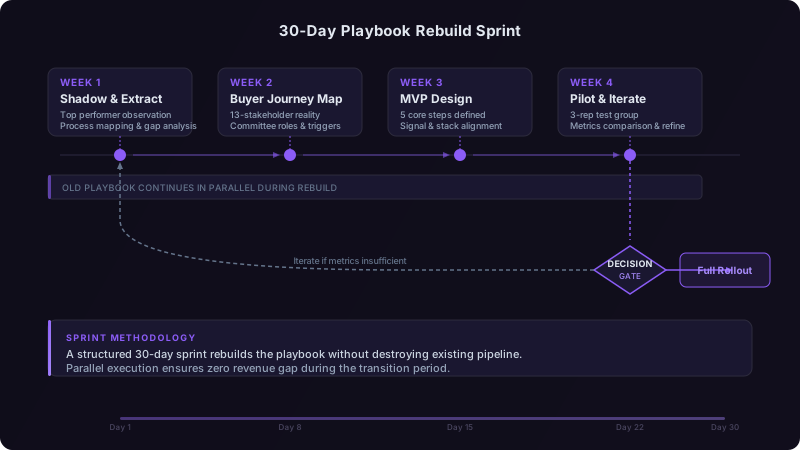
When to Fire Your Sales Playbook and Start Over
Five signals your playbook is broken beyond repair, plus a 30-day sprint framework for rebuilding from first principles without killing pipeline.
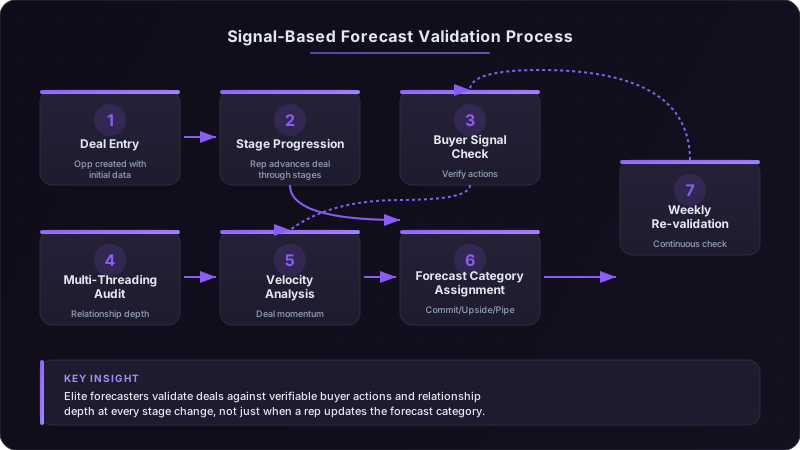
5 Sales Forecasting Mistakes Costing You 30% of Your Pipeline
Data from 200+ quarterly forecast reviews reveals the hidden errors that inflate commit numbers and destroy credibility. Here's what elite revenue teams do differently.
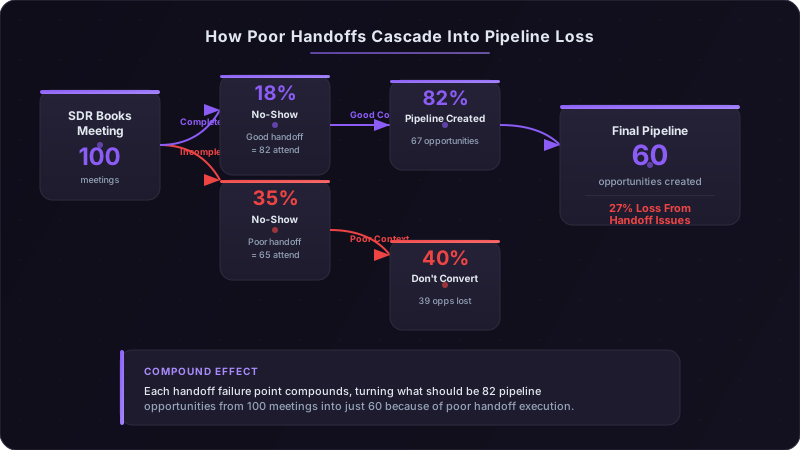
The SDR-AE Handoff Is Killing 27% of Your Qualified Pipeline
Poor handoff processes cost companies up to 30% of qualified opportunities. Here's the exact framework that fixes it, backed by data from 200+ sales teams.