AI Sales Forecasting: Why Your Pipeline Predictions Are Wrong (And How to Fix Them)
Most sales forecasts miss by 30%+. Learn how AI forecasting modules using conversation data and pipeline stages achieve 90%+ accuracy by analyzing signals humans miss.
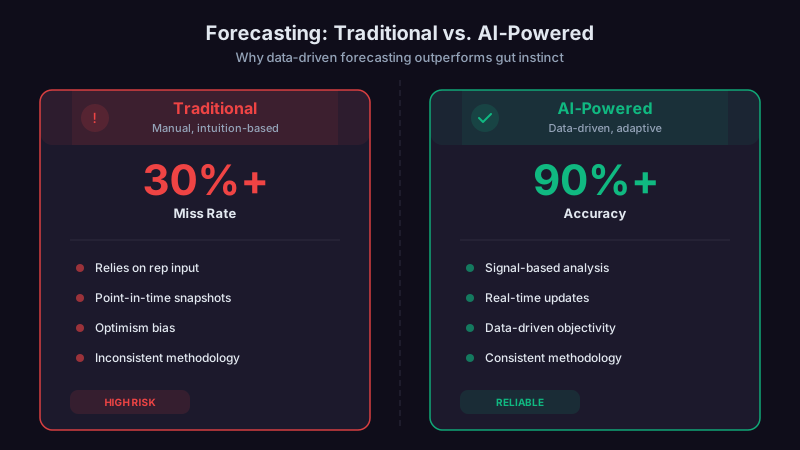
Every quarter, the same ritual plays out. Sales managers ask reps to "call their number." Reps say something optimistic. Managers apply a haircut. The VP of Sales rolls it up, adds a buffer, and presents to the board. The board plans around that number. And then reality arrives, usually 20-40% off target.
I've been in RevOps for eight years. I've owned the forecasting process at three companies. And I can tell you that traditional forecasting is fundamentally broken, not because people are bad at it, but because we're asking humans to do something humans aren't wired to do: accurately predict complex outcomes with incomplete information.
AI changes this equation. Not perfectly. Not magically. But measurably. Let me show you what I've learned.
Why Your Forecast Is Wrong
Before we talk about AI, we need to be honest about why the current approach fails. I've identified five distinct failure modes, and most organizations suffer from all of them simultaneously.
Failure Mode 1: The Optimism Tax
Reps are optimistic by nature. That's what makes them good salespeople. It also makes them terrible forecasters.
When a rep says "I'm 80% confident this deal closes this quarter," what they usually mean is "the champion said they're interested and I can't imagine why it wouldn't close." They're not factoring in the procurement review that takes six weeks, the competing project that's consuming the budget holder's attention, or the reorg that's about to shuffle priorities.
At my last company, I tracked rep-submitted close probabilities against actual outcomes for 18 months. Deals that reps rated at 80%+ closed at a 41% rate. Deals rated 50% closed at 22%. The optimism tax averaged 35-40 percentage points across the team.
Failure Mode 2: The Snapshot Problem
Your Monday morning forecast call captures a moment in time. By Wednesday, three deals have gone dark, one new opportunity has appeared, and a "commit" deal just pushed to next quarter. But the forecast number you reported to the board on Monday doesn't change until next week's call.
Traditional forecasting is like navigating with a map that updates once a week. You might be headed toward a cliff, but you won't know until your next map refresh.
Failure Mode 3: The Garbage In Problem
CRM data quality is the dirty secret of sales operations. At the last three companies I've worked at, I've found:
- 30-40% of opportunities have incorrect or outdated stage assignments
- Close dates are pushed forward so routinely they're meaningless
- Deal amounts are rough estimates that rarely get updated
- Required fields are filled with placeholder data just to move the record forward
When your forecast model runs on rep-entered data, the output can only be as good as the input. And the input is, charitably, approximate.
Failure Mode 4: The Complexity Ceiling
Here's a question: for a given deal, can you simultaneously account for email engagement trends, stakeholder sentiment changes, competitive activity, budget cycle timing, historical win rates for similar deal sizes, the rep's personal conversion patterns, and macroeconomic conditions? No. No human can hold all of that in their head and produce a probability estimate.
But a model can.
Failure Mode 5: The Incentive Problem
Reps sandbag deals to protect their upside. Managers inflate their forecasts to avoid being the team that misses. VPs add buffers. The CFO adds their own buffer on top. By the time the number reaches the board, it's been through so many layers of political adjustment that it barely relates to what's actually happening in the pipeline.
How AI-Powered Forecasting Works
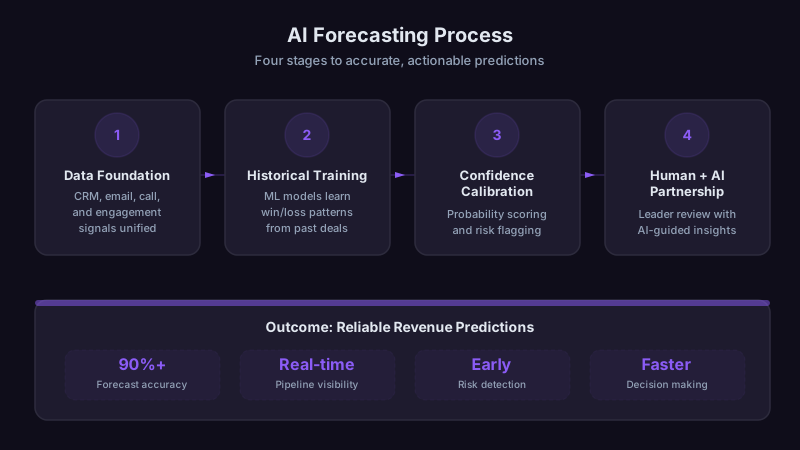
AI forecasting doesn't replace human judgment. It gives humans better data to judge with. Here's the mechanics of how it actually works.
Signal Collection
Instead of relying on what reps tell you about their deals, AI ingests signals directly from the systems where selling happens:
Email signals
- Response times (getting slower? The deal is cooling)
- Thread participants (new stakeholders joining? Deal is advancing. Champion going silent? Problem.)
- Sentiment patterns in email language
- Frequency of back-and-forth communication
Calendar signals
- Meetings scheduled with multiple stakeholders
- Meetings cancelled or postponed
- Prospect requesting meetings (strong signal) vs. rep requesting meetings (weaker signal)
CRM activity signals
- Stage progression velocity compared to historical norms
- How long the deal has been in current stage vs. similar deals
- Number of contacts engaged at the account
- Notes and call dispositions (NLP-analyzed for sentiment)
External signals
- Company news (funding, layoffs, leadership changes)
- Tech stack changes (are they adopting related tools?)
- Job postings (hiring for roles that suggest they need your product)
Pattern Matching
The model compares current deal signals against your historical database of won and lost deals. It asks: "When deals looked like this at this stage, what happened?"
For example, the model might identify that deals where:
- The champion responds to emails within 2 hours
- At least 3 stakeholders have attended a demo
- The deal has been in evaluation for less than 30 days
- The company recently raised funding
...close at an 78% rate in your specific business. While deals where:
- Response times have increased from 4 hours to 3 days over the past two weeks
- Only one contact is engaged
- A competitor was mentioned in the last email thread
...close at a 12% rate.
Continuous Scoring
The critical difference: AI doesn't forecast once a week. It recalculates every time new signal data arrives. That email your rep sent Tuesday afternoon that went unanswered by Thursday? The model noticed. The meeting that got rescheduled twice? The model noticed. The new VP who just connected with your champion on LinkedIn? The model noticed.
Your forecast updates in real time, not at your next Monday meeting.
Implementing AI Forecasting: A Practical Guide
I've implemented AI forecasting twice. The first time was a six-month slog that nearly failed. The second time took eight weeks. Here's what I learned.
You don't need perfect data. But you need sufficient data. Here's the minimum:
- 12+ months of closed-won and closed-lost opportunity data with accurate close dates and amounts
- Email integration so the system can ingest engagement signals (most AI forecasting tools connect directly to Gmail or Outlook)
- Calendar integration for meeting data
- Reasonably accurate stage definitions that your team actually follows
:::callout[Don't Wait for Perfect Data]{type=tip}
I've seen companies delay AI forecasting by a year because they wanted to "clean up the CRM first." That's a trap. Start with what you have. The AI model will identify data quality issues faster than a manual audit. Fix the biggest problems and iterate.
:::
Before you turn on AI, document your current forecast accuracy. Pull the last four quarters and calculate:
- How far off was each quarterly forecast from actual bookings?
- At what point in the quarter did the forecast converge to reality?
- Which deal stages had the most inaccurate probability assignments?
This baseline is crucial. Without it, you can't prove the AI is actually better.
Don't flip a switch and replace your forecast. Run the AI model alongside your existing process. Every week, compare:
- What does the AI predict for the quarter?
- What does the manager roll-up predict?
- Where do they disagree, and why?
The disagreements are the interesting part. When the AI says a deal is at risk and the rep says it's a commit, dig in. Usually, the AI has spotted a signal the rep missed, a stakeholder going quiet, a pace slowdown, a pattern that looks like deals that historically stalled.
This is where I differ from the "AI will replace the forecast call" crowd. The best forecasting process I've seen combines AI probability scores with structured human context.
Here's the workflow we use:
1. AI generates a deal-level probability score and a rolled-up quarterly forecast
2. Reps review their AI scores and flag any deals where they have material context the model can't see (e.g., "I had dinner with the CEO last night and she verbally committed")
3. Managers review the AI-human hybrid and adjust based on their judgment
4. The RevOps team compares the AI forecast, the human forecast, and the hybrid, tracking which one proves most accurate over time
The Results You Can Expect
I'll share real numbers from our implementation.
| Metric | Before AI | After AI (Quarter 2+) |
|---|---|---|
| Quarterly forecast accuracy (within 10% of actual) | 35% of quarters | 82% of quarters |
| At-risk deals identified more than 3 weeks before close date | ~20% | ~75% |
| Forecast variance | +/- 28% average | +/- 8% average |
| Time spent on forecast calls per week | 6+ hours across managers | 2 hours |
| Rep trust in forecast process | Low (felt like policing) | Higher (felt like a tool to help them) |
In Q3 of our first year with AI forecasting, the model flagged a $340K "commit" deal as high-risk three weeks before quarter end. The signal: the economic buyer had stopped responding to emails, and a competitor's sales engineer had connected with two of the prospect's technical leads on LinkedIn. Our rep hadn't noticed either signal. We intervened, re-engaged the account through a different contact, and ultimately saved the deal, closing it in Q4. Without the early warning, we would have missed it entirely.
Managing the Human Side
The hardest part of AI forecasting isn't the technology. It's the people.
Reps feel surveilled. When AI is analyzing their emails, meetings, and CRM activity, some reps get uncomfortable. Address this directly: the AI is evaluating deals, not people. Show reps how the tool helps them (early warnings on at-risk deals, better prioritization) rather than framing it as a management oversight tool.
Managers feel replaced. If the AI is forecasting, what's the manager's role? Answer: the manager's role shifts from gathering data (the drudge work of forecast calls) to coaching on deals the AI flags as at risk. That's a better use of their time.
The board needs calibration. Your board has been operating with inaccurate forecasts for years. They've built their own mental models to compensate. When you suddenly deliver accurate forecasts, they may not trust the numbers initially. Present the AI alongside your traditional forecast for 2-3 quarters before switching fully.
Common Objections (And My Responses)
"Our deals are too unique for pattern matching."
I hear this from every sales team. It's rarely true. After analyzing 4,000+ closed opportunities across two companies, I can tell you that 80% of deals follow recognizable patterns. Yes, every deal has unique context. But the signals that predict outcomes are remarkably consistent.
"What about data privacy?"
Legitimate concern. Make sure your AI forecasting tool processes data in compliance with your privacy policies. Most enterprise tools offer SOC 2 compliance and data processing agreements. Be transparent with your team about what data is being analyzed.
"We don't have enough historical data."
You need at minimum 100-200 closed opportunities to train a basic model. If you have less than that, start with a simpler approach: use AI to analyze engagement signals on current deals even if you don't have enough history for pattern matching. The signal data alone is valuable.
"Reps will game the signals."
This comes up constantly. If reps know that email engagement affects the AI score, won't they send more emails? Maybe. But the model is looking at two-way engagement, not one-way activity. You can't fake a prospect responding enthusiastically. And frankly, if gaming the model means reps are following up more consistently, is that really a problem?
Where to Start This Week
If you're a RevOps leader or CRO reading this, here's your Monday morning action plan:
- 1Pull your last four quarters of forecast vs. actual data. Calculate your average miss rate. This number is your burning platform.
- 2Audit your CRM data completeness. What percentage of closed opportunities have accurate close dates, amounts, and stage histories? If it's below 70%, fix that first.
- 3Evaluate one AI forecasting tool. Don't boil the ocean. Pick one, run a pilot on one team for one quarter, and measure the results.
- 4Have the conversation with your team. Explain why you're doing this, what data will be analyzed, and how it helps them. Transparency prevents backlash.
The goal isn't to remove humans from forecasting. The goal is to give humans better inputs so they can make better predictions. After two years of running this approach, I can't imagine going back to the old way. The Monday morning forecast call used to be the most painful meeting of my week. Now it's the most productive.
Ready to transform your sales pipeline?
See how Prospectory's AI-powered platform can help your team research, reach, and relate to prospects at scale.
Related Articles
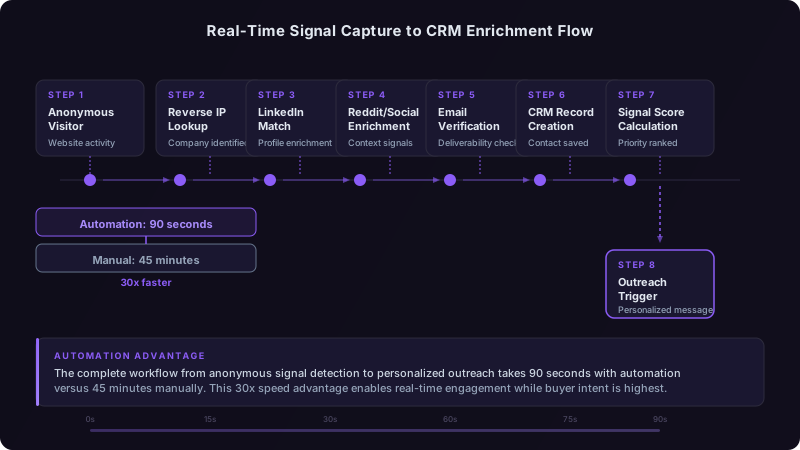
Real-Time Buying Signals vs. Historical Data: Which Actually Predicts Revenue?
Historical patterns tell you who bought before. Real-time signals tell you who's buying now. We analyzed 18 months of pipeline data to find out which matters more.
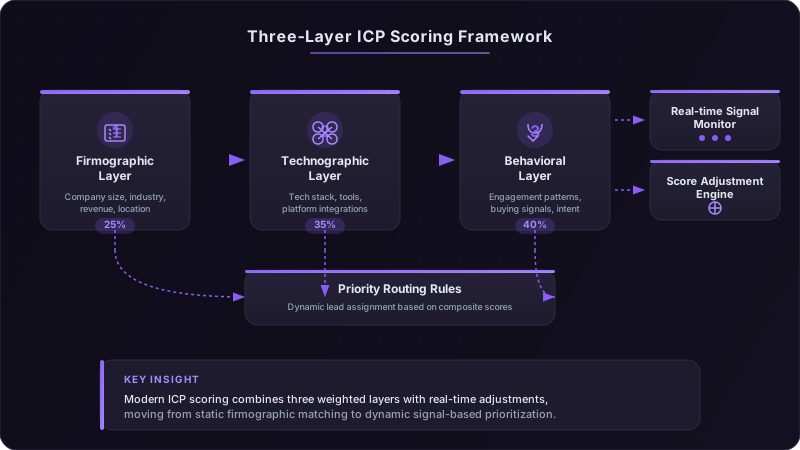
ICP Scoring Models That Actually Predict Revenue
Three $50M+ ARR companies share their exact ICP scoring matrices, combining firmographics, technographics, and behavioral signals to predict deal velocity and close rates.
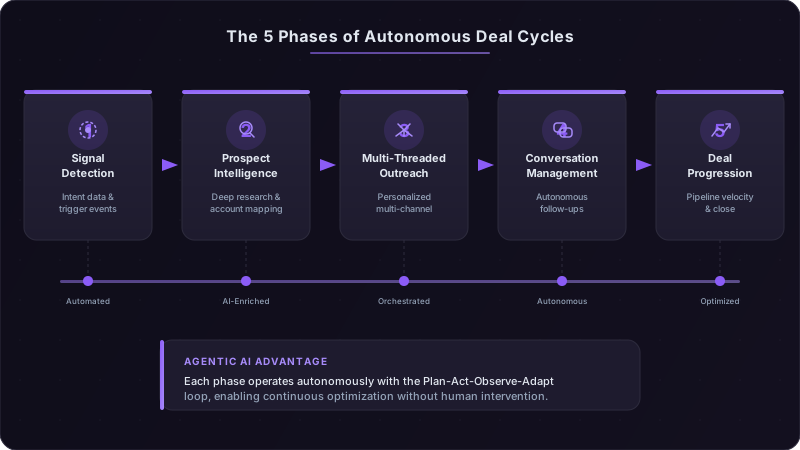
Agentic AI in Sales: How Autonomous Deal Cycles Are Replacing the Traditional Pipeline
Agentic AI is moving beyond task automation into fully autonomous deal orchestration. Learn how self-directed AI agents are compressing 90-day sales cycles into weeks.