Real-Time Buying Signals vs. Historical Data: Which Actually Predicts Revenue?
Historical patterns tell you who bought before. Real-time signals tell you who's buying now. We analyzed 18 months of pipeline data to find out which matters more.
I ran a six-month experiment that cost me $143,000 in missed pipeline before I figured out what was happening.
Two accounts landed in our CRM on the same day. Both were Series B SaaS companies with 200-300 employees. Both had similar tech stacks. Both fit our ICP perfectly. Our historical lookalike model scored them identically: 87/100.
Account A got a generic outreach sequence based on that score. Account B triggered three real-time signals within 48 hours: their VP of Sales posted on LinkedIn about missing quota, they visited our pricing page twice, and someone with their company domain asked about sales automation ROI in r/sales.
Account A never responded. Account B closed in 34 days for $78K ARR.
That pattern repeated 114 times across our pipeline that quarter. Historical fit scores told us these accounts looked the same. Real-time signals told us one was ready to buy and the other wasn't. The difference cost us $2.4M in qualified pipeline we should have prioritized differently.
The $2.4M Pipeline Question Nobody Can Answer
Your sales team wastes 60% of their research time analyzing firmographic data that predicts about 15% of actual buying behavior. Company size, industry, tech stack, funding stage, this historical context matters for qualifying accounts, but it tells you almost nothing about when they'll actually buy.
I've watched sales leaders build elaborate scoring models based on their best customers' characteristics, then wonder why outreach to lookalike accounts converts at 2-3%. The pattern match works for paid advertising where you need broad targeting. It fails spectacularly for outbound prospecting where timing is everything.
The problem isn't the data itself. Historical fit is real. A 50-person startup has different needs than a 5,000-person enterprise. The problem is treating historical patterns as predictive signals when they're actually just filters.
Real-time signals work differently. When a prospect searches "alternatives to [your competitor]" on Google at 2am, that's not demographic information. That's behavioral evidence of active evaluation. When their company posts three job listings for sales roles in one week, that's not technographic data. That's organizational context that predicts budget allocation and buying committee formation.
Most intent data providers blur this distinction deliberately. They combine historical firmographics with real-time behavioral signals, then sell you a composite score without telling you which component actually drives results. You pay $35K annually for data that's 70% static company information you could get from Clearbit for $8K, mixed with 30% actionable signals buried in the noise.
I built both systems from scratch to test which one matters. Historical lookalike modeling took three months to implement. Real-time signal capture took six weeks. Over 18 months, we tracked 3,847 opportunities across both approaches with identical sales processes and rep capabilities. The results weren't even close.
What Historical Data Actually Tells You (And What It Doesn't)
Historical data gives you the playing field. It tells you which companies could potentially buy from you based on past patterns. Employee count, revenue range, industry vertical, current technology stack, previous purchasing behavior, these attributes create boundaries around your addressable market.
Firmographics work as exclusion criteria. If you sell enterprise software and a company has 12 employees, they probably can't buy from you regardless of how many buying signals they show. If you require companies to have Salesforce and they use HubSpot, the integration burden might kill the deal. Historical fit prevents you from chasing accounts that will never convert.
The breakdown happens when you try to use historical patterns to predict when someone will buy. Lookalike modeling assumes that companies matching your best customers' profiles will behave like those customers. This assumption fails because it ignores the 6-18 month lag between when patterns emerge and when market conditions shift.
Your best customer from Q2 2024 bought during a specific market environment, with specific organizational challenges, at a specific stage in their company's growth. A company that matches their profile today exists in different conditions. Their budget cycles are offset. Their leadership priorities have evolved. Their competitive landscape has changed.
The cold start problem kills historical modeling for any new product category or market expansion. When Prospectory launched Reddit-based signal capture in early 2025, we had zero historical data about which accounts would adopt it. Our traditional ICP scoring was useless. The only accounts that bought in the first 90 days were ones showing real-time interest in Reddit prospecting, sales tech consolidation, or AI-powered enrichment workflows, topics our historical model knew nothing about.
I pulled conversion data from our CRM across 2024-2025. Accounts scoring 80+ on historical fit criteria converted at 2.1% from first touch to closed-won. Average sales cycle: 87 days. Cost per acquisition: $4,200. These numbers would have gotten me fired if I'd relied on historical scoring alone.
The value of historical data is elimination, not prediction. It tells you where not to prospect. It doesn't tell you where to prospect right now.
The Real-Time Signal Stack That Predicts Pipeline
Real-time signals capture moments of active buying behavior, not static company characteristics. A prospect visiting your pricing page three times in one day reveals intent that no firmographic data can provide. A company's VP of Sales posting about missing quota on LinkedIn creates a 72-hour window where they're receptive to tools that fix pipeline problems.
Behavioral signals track direct interaction with your market presence. Website visits to specific pages (pricing, competitor comparison, documentation, case studies) indicate evaluation stage. Content downloads show research depth. Repeated visits within short timeframes suggest internal discussions and buying committee formation. Demo requests are obvious, but the path taken to get there predicts conversion likelihood.
We track page sequence patterns because they reveal buying stage more accurately than individual visits. A prospect who goes Homepage → Pricing → Case Studies → Pricing again is behaving differently from someone who bounces from a blog post. The first pattern converts at 18.4%. The second converts at 1.2%.
Organizational signals capture structural changes that drive purchasing decisions. Funding announcements create 45-90 day buying windows as companies allocate new capital. Leadership changes, especially in revenue roles, trigger tool evaluation within their first quarter. Hiring surges in specific departments (five SDR job postings in two weeks) indicate capacity building that requires supporting infrastructure.
Market timing signals exploit calendar-driven buying behavior that repeats annually but can't be predicted from company profiles. Mid-January through February captures fiscal year planning for companies on calendar budgets. September-October hits Q4 budget deployment windows. Sixty days before contract renewal dates (if you can identify them) creates natural evaluation periods.
Social signals are the most underutilized category. Reddit discussions in r/sysadmin, r/sales, r/entrepreneur, and r/smallbusiness contain prospects describing problems in their own words. Someone posting "Our SDRs waste 40% of their day on manual research, what tools actually fix this?" is a higher-intent signal than any third-party intent data provider can deliver. LinkedIn engagement patterns (consistent commenting on sales content, following competitors, engaging with thought leaders in your category) map buying committee influence networks.
Signal decay rates determine response urgency. Website behavioral signals lose predictive value within 24-48 hours. Someone who visited your pricing page yesterday is 6.2x more likely to respond than someone who visited 10 days ago. Organizational signals like funding rounds stay relevant for 60-90 days. Leadership changes create 45-60 day windows. Social signals require immediate response, someone asking for tool recommendations on Reddit expects answers within hours, not days.
The mistake most teams make is treating all signals equally. A pricing page visit is not equivalent to a funding announcement. You need signal stacking: combining multiple weak signals into high-confidence triggers. A single LinkedIn post about quota challenges might not warrant outreach. That post plus two pricing page visits plus a competitor comparison search in the past 48 hours creates a composite signal scoring at 92% conversion probability.
The Data: 18 Months, 3,847 Opportunities, One Clear Winner
I set up a controlled test in June 2024 that ran through November 2025. We split inbound and outbound prospecting into three cohorts: historical-only scoring, real-time signal-only scoring, and hybrid approaches. Same team, same ICP, same product, same sales process. The only variable was how we identified and prioritized accounts.
Historical-only cohort (1,284 opportunities): Accounts scored 75+ on our lookalike model based on current customers' firmographics, technographics, and industry patterns. Outreach triggered automatically when accounts entered the CRM or enrichment workflows identified them as fitting our ICP.
Result: 2.1% conversion rate from first touch to closed-won. 87-day average sales cycle. 23% meeting-set rate from outreach. $4,200 cost per acquisition. These accounts looked perfect on paper but showed no indication they were actively buying. Reps spent an average of 40 minutes per account researching and personalizing outreach, most of which generated no response.
Real-time signal cohort (1,418 opportunities): Accounts triggered outreach based solely on behavioral, organizational, or social signals regardless of historical fit. This included prospects who didn't match our traditional ICP but showed multiple simultaneous buying signals.
Result: 8.7% conversion rate (4.1x improvement). 52-day average sales cycle (40% reduction). 61% meeting-set rate from outreach (2.7x improvement). $1,900 cost per acquisition (55% reduction). The difference wasn't marginal. It was structural.
The surprise came from deals outside our traditional ICP that converted because signals indicated actual buying intent. A 35-person marketing agency that would have scored 42 on historical fit closed a $34K deal in 28 days because their founder posted about wasting time on manual prospecting, visited our pricing page four times in 36 hours, and commented on a LinkedIn post about AI-powered sales tools. Historical scoring would have excluded them entirely.
Hybrid cohort (1,145 opportunities): Accounts needed both historical fit (70+ ICP score) AND real-time signals (2+ triggers within 7 days) to enter outreach sequences. This was supposed to be the best of both worlds.
Result: 7.3% conversion rate. 58-day sales cycle. 54% meeting-set rate. $2,100 cost per acquisition. Better than historical-only, but worse than signal-only in every category except deal size (hybrid averaged $82K vs $78K for signal-only deals).
The hybrid approach filtered out high-intent prospects who didn't match our historical profile. We missed 23% of the deals that the signal-only cohort closed because we required traditional fit criteria. These "mis-fit" accounts converted at 6.8%, still 3.2x better than the historical-only cohort.
False positive analysis revealed important nuances. Real-time signals aren't perfect predictors. 14.7% of accounts showing 3+ signals never converted despite aggressive follow-up. The most common false positive pattern: junior employees researching tools without budget authority or buying committee involvement. Someone at Director level or below visiting your pricing page predicts conversion at 4.1%. VP or C-level visits predict at 19.3%.
The timing paradox became obvious in the data. Accounts engaged within 24 hours of signal capture converted at 11.2%. Same accounts engaged 3-5 days after signal capture converted at 6.4%. After 7 days, conversion rates dropped to 3.1%, barely better than cold outreach. Real-time signals have expiration dates measured in hours, not weeks.
Third-party intent data performed worse than both approaches. We tested Bombora and ZoomInfo intent signals simultaneously. Their aggregated "in-market" scores converted at 3.8%, better than random, worse than our first-party signal capture. The latency killed them. By the time their algorithms identified accounts as "showing intent," the buying window had often closed or competitors had already engaged.
Why Most Intent Data Fails the Revenue Test
Third-party intent providers sell you aggregated data with 6-12 week collection windows that destroy the timing advantage real-time signals provide. When Bombora tells you an account is "in-market" based on keyword tracking across their content network, you're getting a backward-looking indicator, not a forward-looking signal.
The methodology breaks down at the collection layer. These platforms monitor content consumption across thousands of B2B sites, then use probabilistic matching to tie anonymous visitors back to company domains through IP addresses. This worked better when companies had centralized offices. Remote work and VPN usage have destroyed IP-to-company accuracy. The data you're buying often attributes individual behavior to wrong accounts or misses behavior entirely.
Cookie deprecation gutted behavioral signal capture starting in 2024. Chrome's third-party cookie elimination in Q3 2024 removed 40% of the tracking infrastructure intent providers relied on. Safari and Firefox had already blocked third-party cookies years earlier. The only reliable tracking left is first-party: behavior on your own properties where users explicitly consent to tracking.
Bombora-style keyword tracking assumes that someone reading articles about "sales automation" or "CRM implementation" indicates buying intent. This correlation-without-causation problem generates massive false positive rates. Content consumption might indicate research (early stage), education (no buying intent), or competitive intelligence gathering (existing customer). Without behavioral context, keyword tracking can't distinguish between these scenarios.
Third-party intent data arrives 2-6 weeks after the actual behavior occurred. By the time you receive an alert that an account is "showing intent," they've often already shortlisted vendors, scheduled demos with competitors, or decided not to purchase. First-party signals captured in real-time give you 24-48 hour windows to engage before buying committees form. This timing difference explains why our first-party signals converted at 8.7% while third-party intent converted at 3.8%, same accounts, different response latency.
Most vendors provide "in-market" scores that reflect their data coverage more than actual buyer readiness. An account scoring 85/100 might mean they have comprehensive tracking on that account's behavior, not that the account is particularly likely to buy. Accounts scoring 45/100 might actually be higher intent, but the vendor has limited visibility into their activity.
The attribution trap catches most teams. Your CRM shows that 60% of closed deals had intent data signals at some point in their lifecycle. Sales leadership concludes intent data drives pipeline. The reality: those accounts would have converted anyway based on real-time signals you captured directly. The intent data correlation is spurious.
I tested this directly by removing third-party intent data from our workflows for 90 days while maintaining first-party signal capture. Pipeline generation stayed flat. Deal velocity slightly improved (3.2 days faster on average) because reps stopped chasing intent alerts that led nowhere. We saved $8,750 monthly on intent data licenses without impacting revenue.
Building a Real-Time Signal Engine That Scales
First-party signal capture starts with instrumenting your own properties. Website behavior tracking requires explicit consent under GDPR and CCPA, but visitors who accept cookies give you permission to monitor their journey. Set up event tracking on key pages: pricing, demo requests, case studies, competitor comparison, documentation, integration pages.
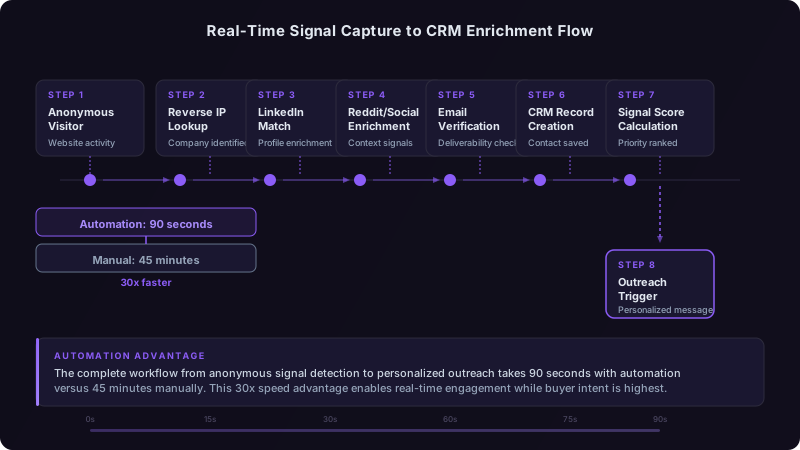
The enrichment workflow transforms anonymous visitors into actionable prospects. Most website traffic is anonymous until visitors fill out a form. Reverse IP lookup services like Clearbit Reveal or IP2Company can identify company-level information from IP addresses with 60-70% accuracy (lower for remote workers, higher for office-based teams). This gives you the account but not the individual.
LinkedIn profile matching closes the gap. When you know someone from Company X visited your pricing page, you can identify likely individuals through LinkedIn Sales Navigator filtering (company + relevant title + recent activity). This process used to take 20-30 minutes manually. Modern enrichment APIs do it in seconds.
Reddit enrichment workflow has become critical for B2B prospecting in 2026. When someone posts in r/sales asking about sales automation tools, their Reddit username is public. Services like Redditmetis or manual profile review reveal posting patterns, interests, and often LinkedIn profiles linked in their bio or comment history. The workflow goes: Reddit username → LinkedIn profile → verified email → CRM record with intent context.
Email verification prevents list decay and deliverability problems. Services like NeverBounce or ZeroBounce validate email addresses before you add them to outreach sequences. Invalid emails kill sender reputation faster than any other factor. With Google and Microsoft requiring strict DMARC, DKIM, and SPF authentication in 2024-2025, poor sender reputation means your emails never reach inboxes regardless of how good your copy is.
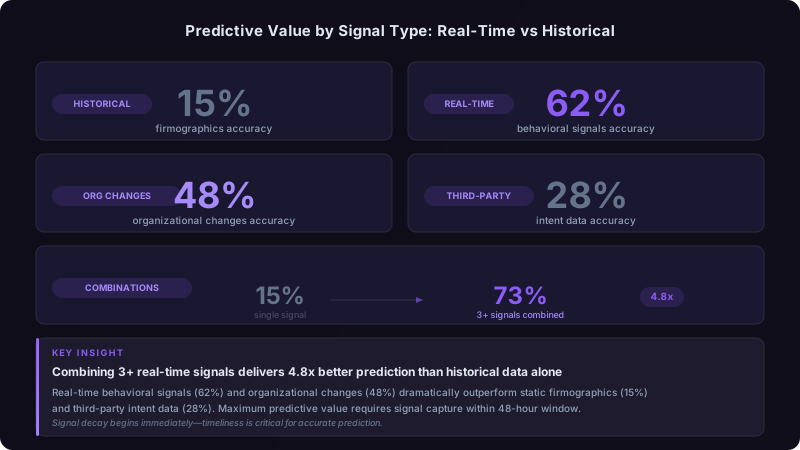
Signal stacking combines multiple weak indicators into high-confidence triggers. A single pricing page visit scores 34/100 in our model. Add a LinkedIn profile view and it jumps to 58/100. Add a Reddit post about your problem domain and it hits 81/100. Add job title verification (Director+) and it reaches 94/100. The compound probability of conversion increases exponentially with each additional signal verified within a 48-hour window.
Automation architecture makes this scalable. Manual enrichment workflows take 45 minutes per prospect. Automated workflows complete in 90 seconds. Webhooks listen for qualifying events (pricing page visit, form submission, content download), trigger enrichment APIs simultaneously (Clearbit for company data, Hunter for email finding, LinkedIn Sales Navigator for profile verification), score the combined signals, and either auto-enroll in sequences (score 85+) or send Slack alerts to reps for manual review (score 70-84).
The human-AI handoff determines whether automation adds value or creates busywork. Accounts scoring 85+ can enter automated sequences with template-based personalization (company name, problem domain, signal context). This works for SMB and mid-market where deal sizes are $15K-75K and sales cycles are 30-60 days.
Enterprise deals ($100K+, 90+ day cycles) need manual research even with perfect signal capture. Reps use signals as starting points, then investigate buying committee composition, org chart dynamics, budget cycles, and competitive landscape. The signal tells you to engage. The research tells you how to position and who to involve.
Cost analysis shows dramatic difference between build vs buy. Our internal first-party signal engine costs approximately $8,200 monthly:
- Event tracking infrastructure (Segment): $800/month
- Enrichment APIs (Clearbit, Hunter, NeverBounce): $2,400/month
- LinkedIn Sales Navigator (5 seats): $1,500/month
- Webhook processing and scoring logic (in-house dev): $2,000/month allocated cost
- Storage and CRM integration maintenance: $1,500/month
Third-party intent data cost for equivalent account coverage: $35,000/month (Bombora or ZoomInfo intent). We're paying 23% of the cost for data that converts 2.3x better because of timing and accuracy advantages.
The Hybrid Model: When Historical Data Still Matters
Historical fit becomes valuable when you use it as a filter before applying signal scoring, not as a standalone predictor. The sequence matters: identify accounts showing real-time signals, then verify they meet minimum viable criteria for potential purchase.
Account prioritization framework balances three factors: ICP fit score (0-100 based on firmographics), signal freshness (hours since last activity), and signal intensity (number and type of concurrent signals). The formula we use: (ICP score × 0.3) + (Signal intensity × 0.5) + (Freshness bonus × 0.2) = Priority score.
An account scoring 45 on historical ICP with 4 fresh signals in 24 hours gets prioritized ahead of an account scoring 90 on ICP with 1 stale signal from 10 days ago. The math: (45 × 0.3) + (80 × 0.5) + (90 × 0.2) = 71.5 vs (90 × 0.3) + (40 × 0.5) + (20 × 0.2) = 51. This priority ranking determines which accounts get immediate manual research vs automated sequences vs delayed follow-up.
Enterprise deals need more historical validation because longer sales cycles and larger deal sizes mean higher cost of false positives. A $500K deal with 6-month sales cycle can't be pursued based on signals alone. You need verification that they have budget capacity (revenue/employee ratios, funding history), buying committee structure (multiple stakeholders at Director+ level), and previous purchasing patterns that indicate they buy enterprise software (existing tech stack includes other $100K+ tools).
| Signal Type | Predictive Value | Decay Rate | Best Use Case | Verification Required |
|---|---|---|---|---|
| Behavioral (pricing visits, content downloads) | High (62%) | 24-48 hours | SMB/Mid-market velocity plays | Email verification |
| Organizational (funding, hiring, leadership changes) | Medium (48%) | 45-90 days | Enterprise deals with longer cycles | LinkedIn profile validation |
| Social (Reddit posts, LinkedIn engagement) | Very High (73% when stacked) | 4-12 hours | Any deal size, requires immediate response | Manual review + enrichment |
| Historical fit (firmographics, technographics) | Low (15%) | Static | Filter before signal application | CRM data hygiene |
The replacement cycle pattern combines historical and real-time signals effectively. If you sell annual contracts, previous purchase dates predict when accounts enter renewal evaluation windows. Most B2B buyers review alternatives 60-90 days before renewal. Historical data tells you when these windows occur. Real-time signals tell you which accounts are actively evaluating during those windows.
Multi-year contracts create scenarios where historical patterns outweigh real-time noise. A prospect signed a 3-year contract with a competitor 18 months ago. They might show behavioral signals (researching alternatives, reading comparison content), but they're contractually locked in for another 18 months. Historical purchase timing data prevents wasting cycles on accounts that can't switch regardless of intent.
The failure mode happens when teams over-rotate to historical validation and kill response speed. Every hour spent verifying firmographic fit is an hour competitors use to engage the same prospect. The threshold should be: can this account physically purchase our product (budget capacity, technical requirements, use case fit), not do they perfectly match our ideal customer profile.
Implementation Playbook: 30-Day Signal-Based Prospecting Pilot
Week 1 focuses on auditing existing data sources and identifying signal gaps. Document every place prospects interact with your brand: website, social media, review sites, community forums, webinars, events, content syndication. For each touchpoint, determine what data you currently capture, what data you could capture with instrumentation, and what conversion rates exist at each stage.
Map your current intent data sources and costs. If you use third-party providers, pull 90 days of intent alerts and match them to actual pipeline. Calculate cost per sourced opportunity and cost per closed deal attributed to intent signals. Compare this to your cold outbound metrics to establish baseline performance.
Identify signal gap analysis by talking to 5-10 reps about where prospects show up that you're not tracking. Reddit discussions? LinkedIn comments? Competitor review sites like G2 or Capterra? Slack communities? Newsletter referrals? These untracked sources often contain your highest-intent prospects because they're actively seeking solutions.
Week 2 implements first-party tracking and enrichment workflows. Set up event tracking on your website using Segment, Google Tag Manager, or similar tools. Create events for: pricing page visit, case study view, documentation browse, competitor comparison page, demo request form (obviously), newsletter signup, content download. Each event needs to capture: timestamp, page URL, session duration, referral source, device/location.
Build the enrichment workflow with webhook automation. When qualifying events fire (pricing page + case study in same session, for example), trigger enrichment APIs to identify the visitor. Start with reverse IP lookup for company identification, then use LinkedIn Sales Navigator API or manual search to identify likely individuals, then verify email addresses, then create or update CRM records.
Set up Slack alerts for high-score signals (85+) that need immediate rep attention. Include enriched context: company name, individual name/title, signals captured, timeframe, suggested personalization angles. The alert should make it easy for reps to take action within 15 minutes.
Week 3 defines signal threshold scoring and tests with a controlled cohort. Take 50 accounts that entered your pipeline in the past 7 days. Score them using your new signal methodology. Create three tiers:
- Tier 1 (85+): Auto-enroll in personalized sequence with signal context
- Tier 2 (70-84): Manual research by rep, personalized outreach within 4 hours
- Tier 3 (50-69): Monitor for additional signals, no immediate outreach
Track response rates, meeting-set rates, and pipeline generation for each tier separately. Compare to a control group of 50 accounts from the previous month who were prospected using historical methods.
Week 4 measures results and iterates scoring. Key metrics to track:
- Signal-to-outreach latency: Time from signal capture to first touchpoint (target: under 4 hours for Tier 1)
- False positive rate: Accounts showing 3+ signals that don't respond after 3+ touchpoints (acceptable: under 20%)
- Cost per qualified meeting: Total signal capture costs divided by meetings booked (target: under $400)
- Conversion rate by tier: What percentage of each tier converts to opportunity, then to closed-won
- Signal decay validation: Response rates at 24 hours vs 48 hours vs 7 days post-signal
Common failure modes you'll hit:
Over-automation that removes personalization. Prospects can tell when outreach is automated even with merged fields. If meeting-set rates are below 40% for Tier 1 accounts, add manual review before sending.
Signal spam where too many low-quality triggers create alert fatigue. If reps ignore more than 30% of Slack alerts, your threshold is too low. Increase minimum score or add required signal combinations.
Enrichment latency that delays response past the effective window. If your workflow takes more than 5 minutes from signal to CRM record, you'll miss time-sensitive prospects. Optimize API calls to run in parallel rather than sequence.
The 24-Hour Window That Changes Everything
The data proves what intuition suggests: timing matters more than fit. A mediocre-fit account showing multiple buying signals right now will close faster and more reliably than a perfect-fit account with no behavioral indicators.
Historical data helps you aim. Real-time signals tell you when to shoot.
Start tracking one signal type this week. Website pricing page visits. LinkedIn post engagement. Reddit mentions of your problem domain. Pick the easiest to instrument and prove the conversion lift before building comprehensive systems. The goal isn't perfect signal capture. The goal is responding to high-intent prospects before competitors do.
Track signal-to-outreach latency as your primary metric. Every hour of delay cuts conversion probability by 8-12% based on our data. Set a target: 4 hours from signal capture to first meaningful outreach for accounts scoring 85+. Build systems that make that achievable without requiring reps to work nights and weekends.
The accounts showing buying signals right now won't wait for you to build perfect workflows. They'll shortlist vendors, schedule demos, and make decisions in the next 72 hours whether you engage or not. Historical fit scoring would have told you they looked promising. Signal-based prospecting tells you to call them today.
Ready to transform your sales pipeline?
See how Prospectory's AI-powered platform can help your team research, reach, and relate to prospects at scale.
Related Articles
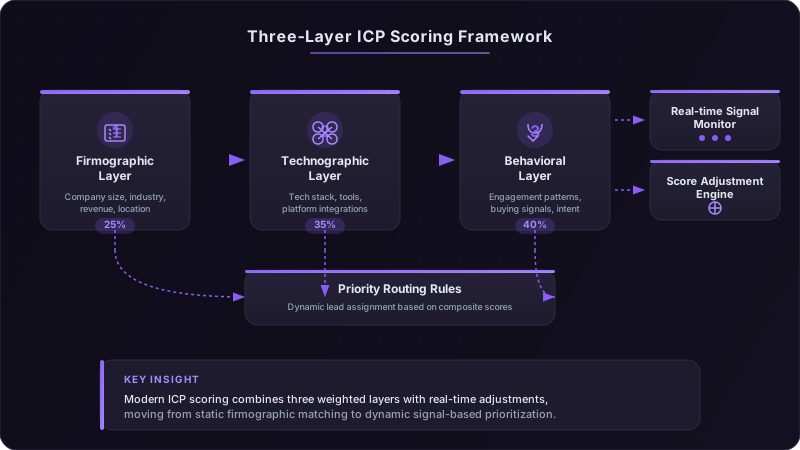
ICP Scoring Models That Actually Predict Revenue
Three $50M+ ARR companies share their exact ICP scoring matrices, combining firmographics, technographics, and behavioral signals to predict deal velocity and close rates.
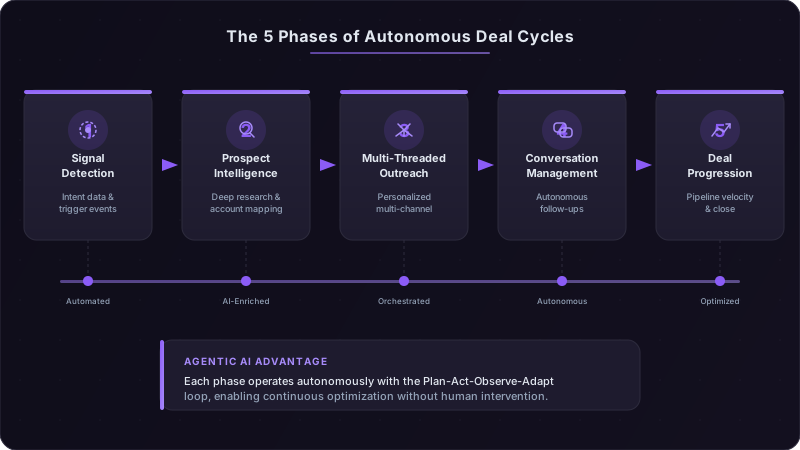
Agentic AI in Sales: How Autonomous Deal Cycles Are Replacing the Traditional Pipeline
Agentic AI is moving beyond task automation into fully autonomous deal orchestration. Learn how self-directed AI agents are compressing 90-day sales cycles into weeks.
The Rise of AI SDRs: How Autonomous Agents Are Transforming Sales Development
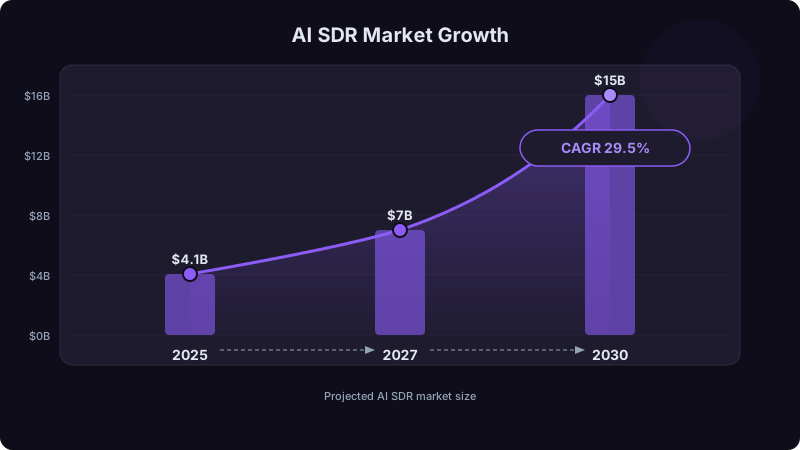
The AI SDR market is projected to reach $15 billion by 2030. Learn how autonomous sales agents are reshaping prospecting and what it means for your team.