Propensity to Buy Scoring: The Complete Guide to Predictive Lead Prioritization
Stop wasting time on leads that won't convert. Learn how P2B scoring uses AI to predict which accounts are ready to buy, and see 3x higher win rates.
I've built four propensity-to-buy models from scratch. Two of them worked. Two of them were expensive failures. The difference wasn't the algorithm or the data vendor, it was whether we actually understood what we were building and why traditional lead scoring had failed us in the first place.
If you're considering P2B scoring, this is what I wish someone had told me before I started.
The Problem with Traditional Lead Scoring
Let me paint a picture most sales leaders will recognize. You set up lead scoring in your CRM. Marketing assigns points: +10 for visiting the pricing page, +5 for downloading a whitepaper, +3 for opening an email. Seems logical.
Then six months later, your reps are complaining that "hot" leads are cold, and the deals they're actually closing came from accounts that scored medium or low.
Here's why this happens:
Static rules can't capture buying behavior. A pricing page visit from a competitor's employee doing research looks identical to a VP evaluating your product. A whitepaper download from a student writing a paper gets the same points as a CTO looking for a solution to a problem they need solved this quarter.
Point inflation is real. Over time, anyone who engages with enough content accumulates a high score, whether or not they have budget, authority, or intent to buy. I once audited a client's lead scoring and found their "hottest" lead was a marketing intern at a 3-person startup who had downloaded every piece of content on the site. Score: 97. Likelihood of buying enterprise software: roughly zero.
Rules don't learn. Your market shifts, your ICP evolves, buyer behavior changes. But your scoring rules from 18 months ago stay frozen in time until someone manually updates them. Nobody ever does.
Traditional lead scoring measures activity. P2B scoring predicts outcome. Those are fundamentally different things. A prospect can be highly active and never buy. Another can visit your site twice and close in 30 days. Activity is a vanity metric. Predicted conversion is what moves revenue.
What P2B Scoring Actually Is
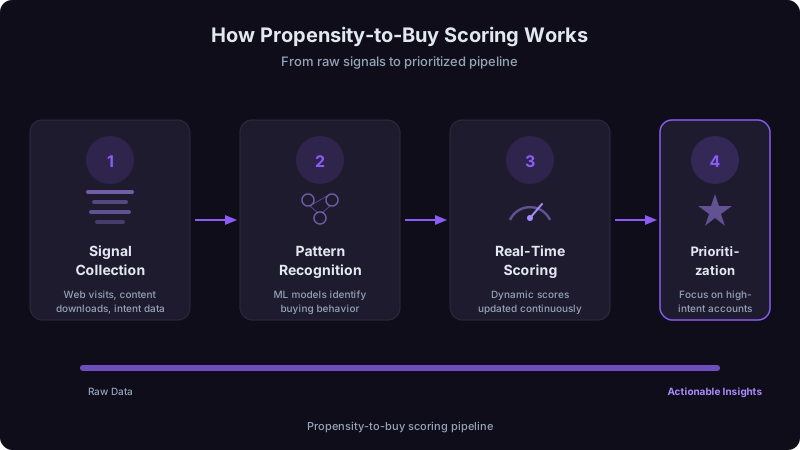
Propensity to Buy scoring is a predictive model that estimates the probability of an account converting within a specific time window. Instead of adding up arbitrary points, it analyzes patterns across your historical deal data and current prospect behavior to produce a probability score.
The inputs fall into four categories:
| Signal Category | Examples | Why It Matters |
|---|---|---|
| Behavioral | Page visits, content engagement, email responses, product trials | Shows active evaluation |
| Firmographic | Company size, industry, revenue, growth rate, tech stack | Matches your ICP profile |
| Intent | Third-party search data, G2 visits, competitor comparisons, review activity | Reveals research stage |
| Contextual | Hiring patterns, funding events, leadership changes, earnings calls | Indicates timing and budget |
The model looks at all of these together. Not as isolated signals, but as combinations. That's the part humans can't do at scale. Your brain can process maybe 5-6 factors simultaneously. A well-trained model considers hundreds of feature interactions and weights them based on what actually predicted closed deals in your data.
How It Works Under the Hood (Without the PhD)
I'm going to explain this accessibly because I've seen too many vendors hide behind jargon to avoid explaining what their model actually does.
The model starts by analyzing your last 12-24 months of closed-won and closed-lost deals. It's looking for what distinguishes the two groups. Maybe your wins tend to be mid-market SaaS companies (100-500 employees), who visited the pricing page 3+ times, had active hiring for sales roles, and engaged with a case study. Maybe companies that downloaded a whitepaper but never visited pricing almost never convert. The model finds these patterns statistically.
Raw data gets transformed into meaningful signals. For example, "visited the website" becomes "visited pricing page 4 times in 7 days after a 3-month gap in activity." That compound signal is far more predictive than a simple page view count. Good P2B systems create hundreds of these engineered features automatically.
The system uses your historical outcomes (won vs. lost) to train a classification model, typically gradient-boosted trees or logistic regression for interpretability. The model learns which feature combinations most reliably separate future wins from losses.
Once trained, the model scores every account in your pipeline continuously. New signals come in, someone visits your site, a funding round gets announced, a competitor mention appears, and the score updates. This is the key difference from static scoring: the model reacts to changes in real time.
Scores get calibrated against actual conversion rates. If the model says an account has a 70% P2B score, roughly 70% of accounts at that score level should actually convert. When they don't, the model retrains. This self-correcting loop is what keeps P2B accurate over time.
What Results Actually Look Like
I'll share real numbers from two implementations I led.
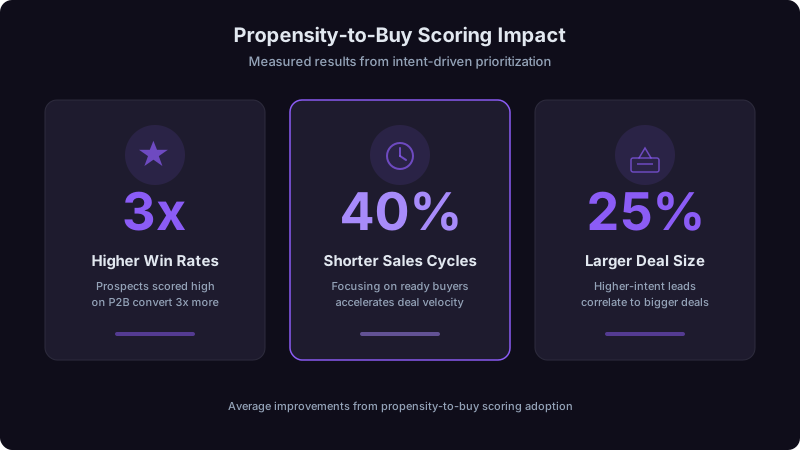
Implementation 1: 200-person SaaS company, mid-market focus.
We replaced their manual lead scoring with a P2B model trained on 14 months of CRM data (about 800 closed-won deals, 2,400 closed-lost). The model used firmographic data, first-party behavioral signals, and Bombora intent data.
Reps focused their time on the top 30% of scored accounts. Within one quarter, pipeline velocity increased measurably because reps weren't burning hours on accounts that were never going to close.
Implementation 2: Series A startup, limited data.
This is the one that failed first. We had only 47 closed-won deals. The model overfit badly, it essentially memorized those 47 deals and scored anything that looked similar as high. In practice, it was no better than random selection.
You need at least 200 closed-won deals for a reliable P2B model. Below 100, don't even try, you'll get a model that's confidently wrong. Between 100-200, proceed with caution and validate heavily. Above 500, you're in solid territory.
We fixed this by supplementing our first-party data with third-party intent signals and using a simpler model (logistic regression instead of gradient-boosted trees). The simpler model was less prone to overfitting with limited data. After six months of collecting more outcomes, we switched to a more sophisticated model.
Practical Implementation: A Step-by-Step Framework
Here's the implementation framework I use now, refined over four builds:
Phase 1: Data Audit (Week 1-2)
Before touching any model, audit your data. I use this checklist:
- [ ] CRM data completeness: Are deal stages, close dates, and deal amounts consistently filled in?
- [ ] Contact-to-account mapping: Can you reliably tie contacts to accounts?
- [ ] Win/loss coding: Are closed-lost deals actually marked as lost, or do they just sit in "open" forever?
- [ ] Historical depth: Do you have 12+ months of deal data?
- [ ] Deal count: 200+ closed-won deals minimum
- [ ] Source tracking: Can you trace where leads originated?
If more than 40% of your CRM records are missing key fields (industry, company size, deal stage dates), fix your data hygiene first. A P2B model trained on dirty data will produce garbage scores that your reps learn to ignore within a week.
Phase 2: Signal Integration (Week 2-4)
Connect your data sources. At minimum, you need:
- 1CRM data (Salesforce, HubSpot): Deal history, account info, activity logs
- 2Website analytics (GA4, your own tracking): Page visits, session depth, content engagement
- 3Email engagement: Opens, clicks, replies from your outreach tools
- 4Intent data (Bombora, G2, TrustRadius): Third-party buying signals
Nice-to-have sources that improve accuracy:
- Technographic data (what tools they use)
- Hiring data (job postings signal priorities)
- Funding and financial data
- Social engagement (LinkedIn activity)
Phase 3: Model Training (Week 4-6)
If you're building in-house, start simple. Logistic regression with your top 20-30 features will outperform a complex model with noisy data. If you're using a vendor (which I'd recommend for most teams), evaluate them on:
| Evaluation Criteria | What to Ask |
|---|---|
| Model transparency | Can they explain why an account scored high? |
| Data requirements | How many closed-won deals do they need? |
| Retraining frequency | How often does the model update? |
| Integration depth | Does it write scores back to your CRM? |
| Feedback loops | Can reps flag bad scores to improve the model? |
Phase 4: Rollout and Rep Adoption (Week 6-8)
This is where most implementations die. The model is ready, but reps don't trust it. Here's what I've learned:
Start with a parallel test. Run the P2B scores alongside your existing process for 4-6 weeks. Let reps see which approach produces better results without forcing them to change behavior yet.
Show them the receipts. After the parallel test, present the data: "Accounts with P2B scores above 70 converted at 3x the rate of your manually-prioritized accounts." Numbers build trust faster than directives.
Don't force blind adoption. Give reps score explanations, not just numbers. "This account scored 82 because they're in your ICP, visited pricing 4 times this week, and their VP of Sales just posted about needing a new outbound tool." That context makes the score actionable.
Phase 5: Iteration (Ongoing)
Retrain the model quarterly with new outcome data. Monitor score calibration monthly, are your 80+ scores actually converting at higher rates than your 50-60 scores? If the score distribution stops correlating with outcomes, something has shifted in your market and the model needs adjustment.
Common Mistakes I've Seen (and Made)
Scoring contacts instead of accounts. In B2B, buying decisions are made by committees, not individuals. Score at the account level, aggregating signals across all contacts.
Ignoring negative signals. A company that just signed a 3-year contract with your competitor has a low propensity to buy regardless of how much they visit your blog. Make sure your model captures disqualifying signals, not just positive ones.
Over-weighting recency. Yes, recent activity matters. But a company that visited your site once today shouldn't outscore an account with steady, sustained engagement over three months. Good models balance recency with consistency.
Not connecting the score to action. A score is useless if it just sits in a dashboard. Map score ranges to specific actions:
| Score Range | Recommended Action |
|---|---|
| 80-100 | Immediate AE outreach, priority booking |
| 60-79 | SDR multi-channel sequence, 48-hour SLA |
| 40-59 | Nurture track, monthly check-in |
| Below 40 | Marketing automation only |
The Bottom Line
P2B scoring isn't magic. It's pattern recognition applied to your sales data. When implemented with clean data, enough historical outcomes, and a team that trusts the process, it fundamentally changes how reps spend their time.
The best part isn't even the win rate improvement. It's that your reps stop wasting energy on accounts that were never going to close. That's less burnout, better morale, and a team that actually enjoys prospecting because they're talking to people who want to hear from them.
If you're evaluating P2B scoring, start with the data audit. Seriously. The biggest predictor of whether your P2B implementation succeeds isn't the vendor you pick or the model you use. It's the quality of the data you feed it. Spend the first two weeks getting your CRM in order. Everything else builds on that foundation.
Ready to transform your sales pipeline?
See how Prospectory's AI-powered platform can help your team research, reach, and relate to prospects at scale.
Related Articles
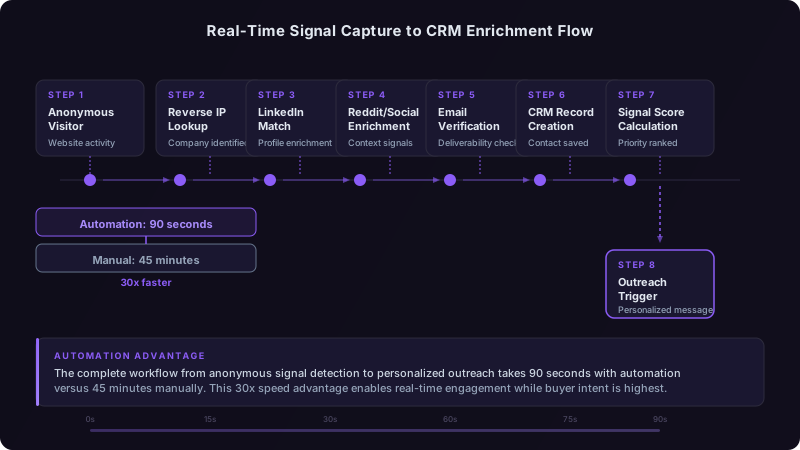
Real-Time Buying Signals vs. Historical Data: Which Actually Predicts Revenue?
Historical patterns tell you who bought before. Real-time signals tell you who's buying now. We analyzed 18 months of pipeline data to find out which matters more.
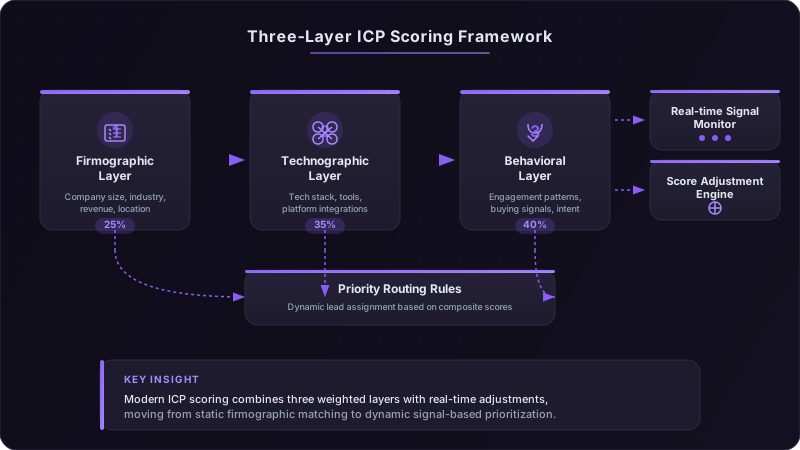
ICP Scoring Models That Actually Predict Revenue
Three $50M+ ARR companies share their exact ICP scoring matrices, combining firmographics, technographics, and behavioral signals to predict deal velocity and close rates.
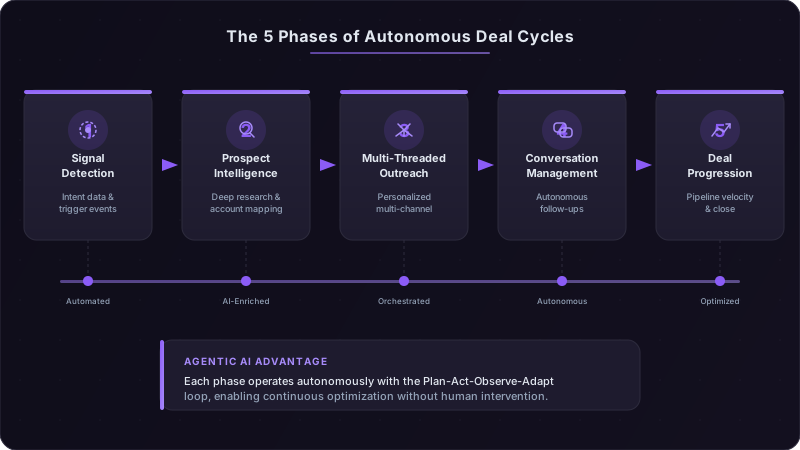
Agentic AI in Sales: How Autonomous Deal Cycles Are Replacing the Traditional Pipeline
Agentic AI is moving beyond task automation into fully autonomous deal orchestration. Learn how self-directed AI agents are compressing 90-day sales cycles into weeks.