Mastering Objection Handling: AI-Powered Responses That Convert Skeptics
Every objection is a buying signal in disguise. Learn how AI helps reps handle objections faster and more effectively.
Three years ago, I sat in on a call where one of our newest SDRs got hit with "We're already using [Competitor] and we're happy with them." She froze for a full four seconds, an eternity on a sales call, then stammered something about how our product was "better." The prospect politely ended the call.
That same week, I listened to our top AE handle the exact same objection from a similar prospect. His response: "That's great to hear, [Competitor] is solid for [specific use case]. Quick question: how are you handling [specific gap that our product addresses]?" The prospect paused, admitted they were struggling with exactly that, and the conversation opened up.
Same objection. Same product. Completely different outcome. The difference wasn't talent or charisma. It was preparation and framework.
I've spent the last decade training sales teams on objection handling. More recently, I've been figuring out how AI fits into that training, not as a replacement for human skill, but as a tool that helps reps prepare better, practice more, and respond faster. Here's everything I've learned.
Why Objections Are Actually Good News
Let me reframe something first. Most reps hear an objection and feel rejected. That's backwards.
A prospect who raises an objection is telling you three things:
- 1They're still engaged (a truly uninterested prospect just goes dark)
- 2They've thought about your pitch enough to identify concerns
- 3They're giving you a chance to address those concerns
The prospect who says "this sounds great, let me think about it" and then ghosts you? That's the one you should worry about. The prospect who says "I'm concerned about your pricing" is practically handing you a roadmap for what they need to hear.
An objection is not a "no." It's an incomplete "yes." The prospect is telling you what's standing between their current state and a buying decision. Your job is to address that gap, not to argue them out of their concern.
The Five Objection Categories (And What's Really Behind Them)
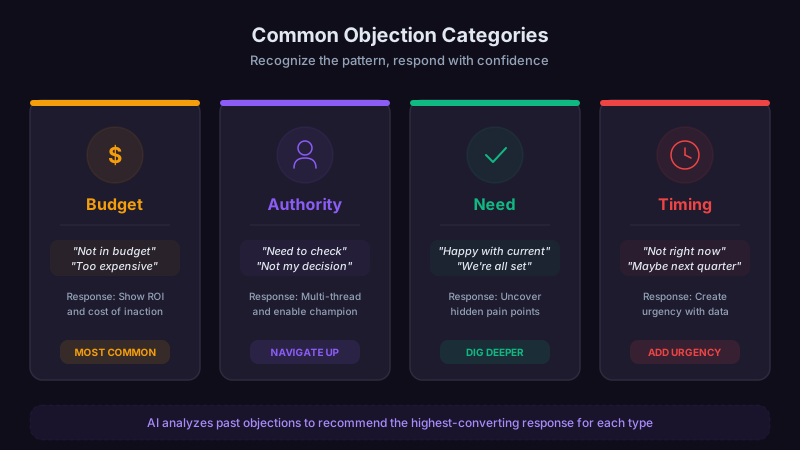
Every B2B objection I've ever heard falls into one of five categories. But the surface objection rarely matches the real concern. Here's how to decode them.
Category 1: Price and Budget
What they say: "It's too expensive." "We don't have the budget." "Can you do better on price?"
What they often mean:
- I don't understand the ROI well enough to justify this expenditure
- I'm comparing your price to a competitor or to doing nothing
- I need ammunition to sell this internally to my finance team
- This wasn't in my planned budget and I don't know how to get it approved
In my experience, fewer than 20% of price objections are truly about affordability. Most are about perceived value. If a prospect says "it's too expensive," the real question is: "Have I failed to communicate enough value?" Usually the answer is yes.
Category 2: Timing
What they say: "Not right now." "Maybe next quarter." "We've got too much going on."
What they often mean:
- This isn't a priority compared to other initiatives
- I'm not the decision maker and I don't want to admit it
- I'm interested but I need a reason to act now
- We're in the middle of another implementation and genuinely can't take this on
Category 3: Competition / Status Quo
What they say: "We're using [Competitor]." "Our current process works fine." "We built something internally."
What they often mean:
- I'm risk-averse and switching costs feel high
- I don't know enough about your product to see the difference
- The person who chose [Competitor] is still here and it would be politically awkward to switch
- I'm actually not happy, but I need you to help me articulate why switching is worth it
Category 4: Authority
What they say: "I need to check with my boss." "This isn't my decision." "Let me loop in our team."
What they often mean:
- I'm interested but I genuinely need buy-in from others
- I'm not sure how to sell this internally
- I want to say yes but I need cover from someone more senior
- I'm politely stalling because I don't want to say no directly
Category 5: Need / Relevance
What they say: "We don't really need this." "I'm not sure this is relevant for us." "Our current process works fine."
What they often mean:
- I don't understand what your product does well enough
- You haven't connected your solution to a problem I care about
- I have this problem but I've accepted it as normal
- I'm testing you to see if you can articulate a compelling reason
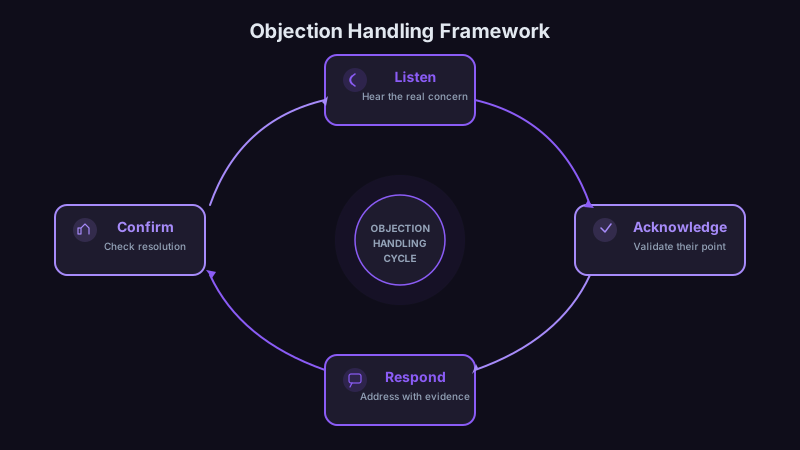
The PARE Framework for Handling Any Objection
I've tested a lot of frameworks over the years. SPIN, LAER, Feel-Felt-Found (please stop using this one, prospects see it coming a mile away). The one that sticks for my teams is PARE: Pause, Acknowledge, Reframe, Engage.
Pause
Stop talking for 2-3 seconds after the objection. This does three things: it shows you're not rattled, it gives you time to think, and it signals that you're taking their concern seriously rather than jumping to a rehearsed response.
Acknowledge
Validate their concern without agreeing with their conclusion. There's a critical difference between "I understand budget is tight right now" (good) and "Yeah, we are expensive" (bad).
Reframe
Shift the conversation from the surface objection to the underlying issue. This is where most reps fail, they respond to what was said instead of what was meant.
Engage
Ask a question that keeps the conversation going and deepens your understanding. Never end your objection response with a statement. Always end with a question.
Prospect: "Honestly, this is way more than we budgeted for."
Pause: (2 seconds of silence)
Acknowledge: "Totally fair, I appreciate you being direct about that."
Reframe: "Budget conversations usually come down to whether the ROI justifies the investment. Can I share what a company in a similar situation saw in their first six months?"
Engage: "And out of curiosity, when you say 'more than budgeted', is this a matter of the total cost, or is it more about how the budget is structured this year?"
Objection-Specific Playbooks
Let me give you specific response frameworks for the most common objections. These aren't scripts, they're structures. Adapt the language to your voice and your product.
"It's too expensive"
"Just so I understand, is it the total investment, the payment structure, or that you're not seeing enough value to justify the cost?"
"Let me share some numbers. [Company X], which is similar to you in [size/industry], saw [specific result] within [timeframe]. That worked out to a [X]x return on their investment."
"When you break it down per rep per month, you're looking at [$X]. If that helps each rep close just one additional deal per quarter, the tool pays for itself [X] times over."
"Is this something that could fit in this quarter's budget, or would it help to look at a phased rollout that starts smaller?"
"We're happy with [Competitor]"
Don't trash the competitor. Ever. It makes you look desperate and it insults the prospect's judgment.
Instead:
- 1Compliment their choice: "[Competitor] does [specific thing] well. Makes sense you'd be using them."
- 2Ask about gaps: "Where I've seen companies using [Competitor] run into challenges is [specific area]. Is that something you've experienced?"
- 3Plant a seed: "We're not asking you to rip and replace. A lot of our customers actually started by using us alongside [Competitor] for [specific use case] and expanded from there."
- 4Offer a concrete comparison: "Would it be worth 20 minutes to see how we approach [specific pain point] differently? No pressure, just so you have the information."
"Not the right time"
This one's tricky because sometimes it's genuine and sometimes it's a polite brush-off. Here's how to tell the difference:
Ask: "Totally understand. Out of curiosity, what would need to change for the timing to feel right?"
- If they give a specific answer ("We're migrating our CRM until March" / "Budget opens in Q2"), it's genuine. Set a concrete follow-up.
- If they give a vague answer ("We just need to get through this quarter"), it's usually a brush-off. You have a value problem, not a timing problem.
For genuine timing objections: agree on a specific follow-up date, send them valuable content in the interim, and stay visible without being pushy.
For polite brush-offs: go back to discovery. "Before we park this, I want to make sure I'm not missing something. When we talked about [pain point you discussed], you mentioned it was costing your team [X]. Is that still a priority, or has something changed?"
"I need to check with my boss"
This means you're not talking to the decision maker, or your champion doesn't feel equipped to sell internally. Both are fixable.
| Response Strategy | When to Use It |
|---|---|
| "Would it help if I joined that conversation? I can address any technical or ROI questions directly." | When the champion is genuinely interested but needs support |
| "Absolutely. What do you think their main concerns will be? I can put together a one-pager that addresses those specifically." | When a joint call isn't possible |
| "Makes sense. What criteria will they use to evaluate this?" | When you need to understand the real decision-making framework |
| "Happy to help. Who else should we include in the next conversation to make sure everyone's questions get answered?" | When you suspect there are multiple stakeholders you haven't met |
How AI Fits Into Objection Handling
Here's where it gets interesting. AI doesn't handle objections for you. But it makes you dramatically better at handling them yourself. Here are the four most practical applications.
1. Pre-Call Preparation
Before every call, AI can analyze the prospect's company, recent news, tech stack, likely pain points, and common objections from similar prospects. Instead of walking into a call blind, you walk in with a cheat sheet.
For example: "This prospect is a 200-person SaaS company using [Competitor]. Similar companies in this segment typically raise price and integration concerns. The most effective response has been the phased rollout approach with the [Industry] case study."
That's not replacing the rep's skill. It's giving them better inputs.
2. Real-Time Suggestions
During calls, AI can listen and surface relevant responses when an objection comes up. Think of it like a knowledgeable colleague whispering in your ear: "They just mentioned budget concerns, here's the ROI stat from the [Similar Company] case study."
Real-time AI suggestions only work if they're subtle and optional. If a rep is reading AI-generated responses verbatim, the prospect will notice. The delivery becomes robotic, the timing feels off, and trust drops. AI provides the what. The rep provides the how.
3. Post-Call Analysis
After every call, AI can identify which objections came up, how the rep handled them, and what the outcome was. Over time, this creates a massive dataset: for each objection type, which response approaches led to positive outcomes?
This is gold for coaching. Instead of generic advice like "handle price objections better," a manager can say: "When you get the price objection, try reframing around per-rep cost. That approach has a 3x higher success rate in our data than the ROI comparison you've been using."
4. Practice and Role-Play
This might be the most underrated application. AI can simulate realistic objection scenarios for reps to practice against. Not the stiff, predictable role-plays where your manager reads from a script. Dynamic conversations where the AI pushes back, changes direction, and responds based on what the rep says.
I've started using AI role-play as part of our weekly team training. Each rep runs two 10-minute scenarios per week, focused on the objection types they struggle with most (identified from their call data). The improvement has been noticeable within weeks.
Building Your Team's Objection Playbook
If you don't have a documented objection playbook, you're relying on every rep to figure it out independently. Some will. Most won't. Here's how to build one.
Pull the last 100 sales calls. Tag every objection raised. You'll find that 10-15 objections account for 80% of what your team hears.
Map each objection to one of the five categories (price, timing, competition, authority, need). Rank by frequency.
For each common objection, find 2-3 calls where a rep handled it well and the deal advanced. Transcribe the response. Note what made it work.
For each objection, write a framework that includes: the acknowledgment, the reframe, 2-3 supporting data points, and the follow-up question. Leave room for the rep's own words and style.
Review the playbook quarterly. Update responses based on what's working. Add new objections as your market changes. Make role-play a regular habit, not a one-time training event.
Measuring Objection Handling Effectiveness
How do you know if your team is getting better at handling objections? Track these metrics:
| Metric | What It Tells You |
|---|---|
| Objection-to-advance rate | When an objection is raised, how often does the deal still move forward? |
| Average calls before close (deals with objections vs. without) | Are objections adding cycles, or are they being handled efficiently? |
| Objection frequency by type | Are certain objections increasing? That might signal a market shift or a messaging problem |
| Win rate on objection-heavy deals | Can you close deals where prospects push back? |
In my experience, strong objection-handling teams convert 55-65% of deals that include objections, compared to 25-35% for teams without structured objection training. The gap is massive and it shows up directly in quota attainment.
Start Here
Pick the three objections your team hears most often. For each one, document a response framework using PARE. Practice it with your team this week. Review call recordings to see how it plays out.
Objection handling isn't about having the perfect comeback. It's about understanding what the prospect really needs to hear, and being prepared enough that you can deliver it naturally instead of freezing up or falling back on generic pitches.
The reps who handle objections well don't win because they're smoother talkers. They win because they've prepared for every scenario, they understand what's behind the objection, and they treat every pushback as a conversation to be continued, not a battle to be won.
Ready to transform your sales pipeline?
See how Prospectory's AI-powered platform can help your team research, reach, and relate to prospects at scale.
Related Articles
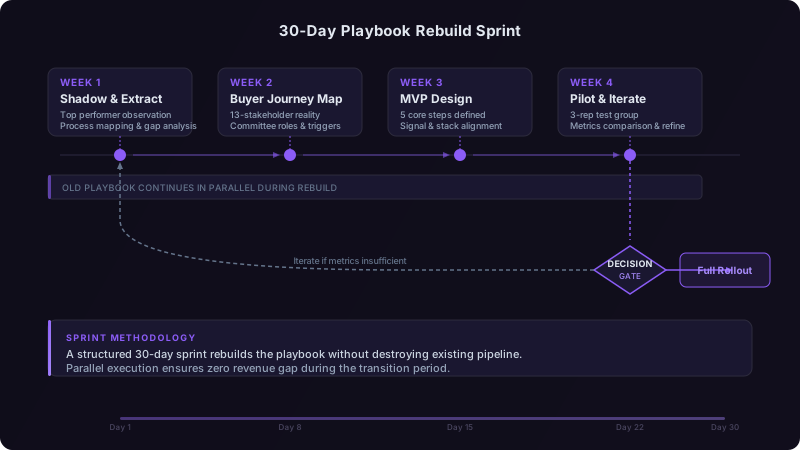
When to Fire Your Sales Playbook and Start Over
Five signals your playbook is broken beyond repair, plus a 30-day sprint framework for rebuilding from first principles without killing pipeline.
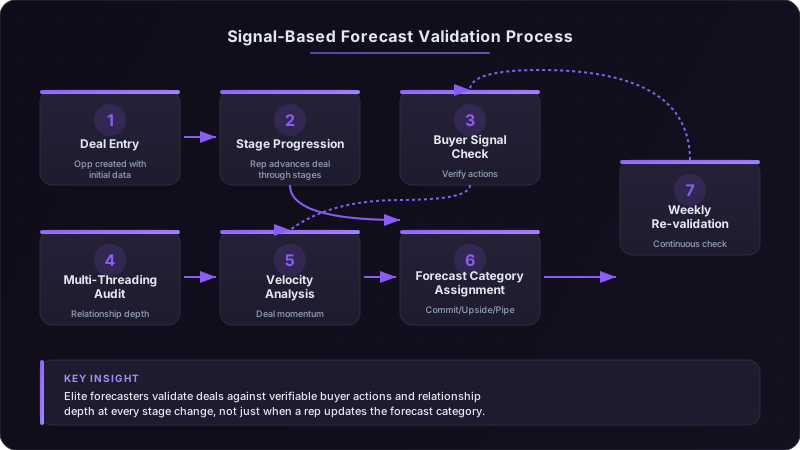
5 Sales Forecasting Mistakes Costing You 30% of Your Pipeline
Data from 200+ quarterly forecast reviews reveals the hidden errors that inflate commit numbers and destroy credibility. Here's what elite revenue teams do differently.
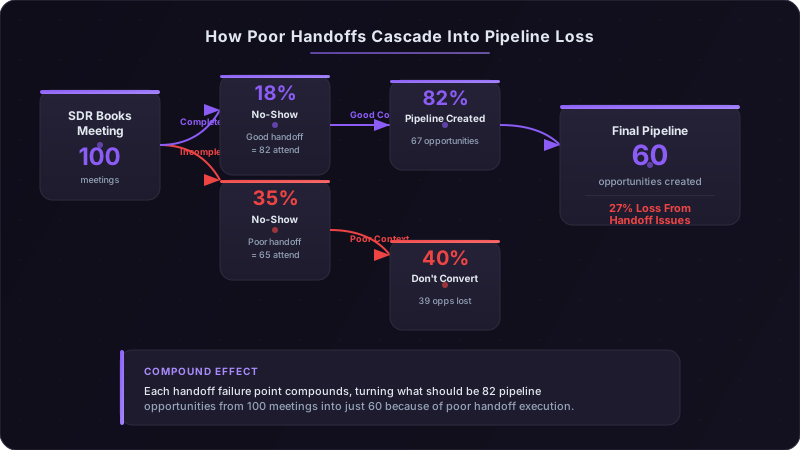
The SDR-AE Handoff Is Killing 27% of Your Qualified Pipeline
Poor handoff processes cost companies up to 30% of qualified opportunities. Here's the exact framework that fixes it, backed by data from 200+ sales teams.