Multi-Channel Outreach: Why Email-Only Strategies Are Dead
Buyers ignore single-channel outreach. Learn how to orchestrate email, LinkedIn, phone, and SMS into a cohesive strategy that gets 45% reply rates.
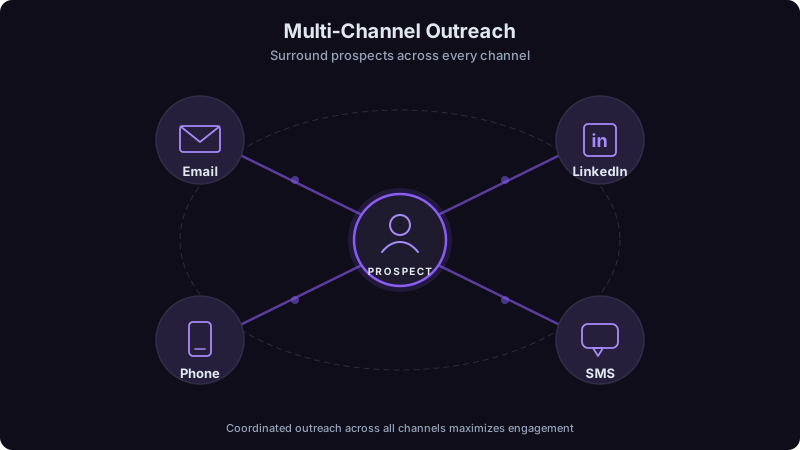
I ran an experiment last quarter. I split our SDR team into three groups. Group A used email only. Group B used email plus LinkedIn. Group C used email, LinkedIn, phone, and targeted ads. Same prospect list, same messaging framework, same time period.
Group A booked 12 meetings. Group B booked 28. Group C booked 41.
Same reps. Same prospects. The difference was channels.
I've been running outbound teams for seven years. The single biggest shift I've seen in that time isn't AI or automation, it's the move from single-channel to coordinated multi-channel outreach. And most teams are still doing it wrong.
Why Email-Only Outreach Is Dying
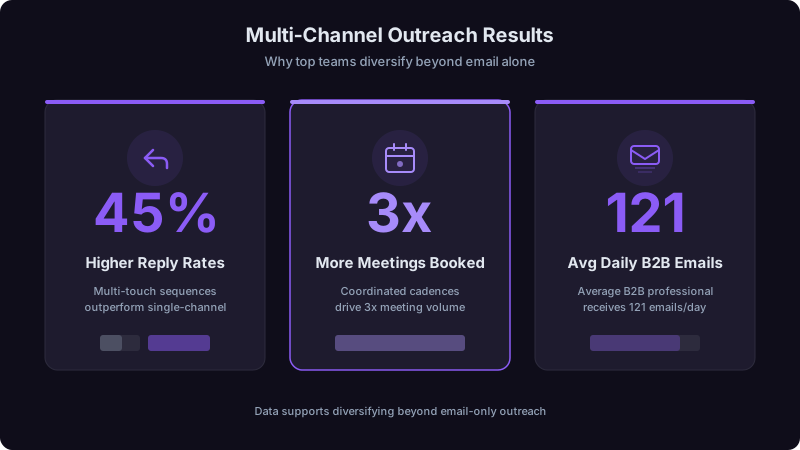
Let me be direct about the numbers. The average B2B decision-maker receives somewhere between 100 and 150 emails per day. Your carefully crafted cold email is competing with internal messages, vendor pitches, newsletters, automated notifications, and spam.
Even with perfect deliverability and great copy, your email-only outreach is fighting for attention in the most crowded channel in business communication. The best email-only campaigns I've seen cap out around 3-4% reply rates. Multi-channel sequences consistently hit 8-12%.
But the numbers only tell part of the story. Here's what actually happens psychologically when you show up on multiple channels:
Familiarity builds trust. When a prospect sees your name in their inbox, then notices you on LinkedIn, then gets a thoughtful voicemail, you're no longer a stranger. You're someone they recognize. And people respond to people they recognize.
Different channels reach different mental states. Someone who ignores emails all morning might scroll LinkedIn during lunch. Someone who'd never reply to a cold email might pick up a phone call because they're between meetings and curious.
Multi-touch signals seriousness. A single email says "I'm casting a wide net." A coordinated sequence across channels says "I specifically want to talk to you." Prospects notice the difference.
Channel-by-Channel Playbook
Let me break down what actually works on each channel, based on what I've seen with my team and the patterns across the 20+ outbound programs I've helped build.
Email: Your Foundation (But Not Your Crutch)
Email remains the backbone of outbound. It's scalable, trackable, and accepted as a normal business communication channel. But the bar for what works has risen dramatically.
What works now:
- Ultra-short emails (3-5 sentences max for cold outreach)
- Specific, relevant observations about the prospect's business
- Clear, low-commitment CTAs ("Worth a 15-minute conversation?" not "Let me show you a demo")
- Plain text formatting, no HTML templates, no images, no fancy signatures
- Sending between 8-10 AM in the prospect's local timezone on Tuesdays, Wednesdays, or Thursdays
What doesn't:
- Long-form introductions about your company
- Multiple CTAs in one email
- "Checking in" or "bumping this up" follow-ups with no new value
- Emails that start with "I hope this finds you well"
I tested sending times across 15,000 cold emails. Tuesday and Wednesday mornings between 8-9:30 AM local time consistently produced the highest reply rates. Monday mornings are too hectic. Thursday and Friday afternoons are mentally checked out. Match the prospect's timezone, not yours.
LinkedIn: The Warm-Up Channel
LinkedIn isn't just a place to send InMails. It's your best tool for creating familiarity before and after other touches.
The LinkedIn layering sequence I use:
- 1View their profile (Day 1). They get notified. You're now a name they've seen.
- 2Engage with their content (Day 2-3). Like a post. Leave a substantive comment, not "Great post!" but something that shows you actually read it and have a perspective.
- 3Send a connection request (Day 4). Include a short, personalized note. Reference something specific, their recent post, a shared connection, something about their company. No pitch in the connection request.
- 4Send a message after connecting (Day 5-7). Now you're connected, which makes your message feel like a warm outreach rather than a cold pitch. Keep it short and direct.
What makes LinkedIn outreach work:
- Your profile needs to look credible. Real photo, substantive headline (not "Helping companies achieve revenue goals"), actual content on your feed.
- Comments on prospects' posts are massively underrated. A thoughtful comment puts your name in front of their entire network. I've had prospects message me first after I commented on their posts three times over a month.
- InMails have low response rates (10-15% on average). Connection requests with personalized notes perform better when they accept.
Phone: The Differentiator Nobody Wants to Use
Here's the thing about cold calling in 2026: nobody wants to do it. That's exactly why it works.
When every other vendor is sending emails and LinkedIn messages, the SDR who picks up the phone stands out. The phone cuts through inbox noise instantly. It creates a real-time, human conversation that no text-based channel can replicate.
When to call:
- After your prospect has engaged with an email (opened, clicked) or LinkedIn message (viewed profile, accepted connection). A warm call converts at 3-5x the rate of a truly cold call.
- When timing matters. If a prospect just visited your pricing page or their company announced a funding round, a phone call within 24 hours capitalizes on that momentum.
- For high-value accounts where you need to get through to senior decision-makers. VPs and C-suite executives are more likely to take a 90-second phone call than respond to a cold email.
Phone call framework that works:
State your name, company, and exactly why you're calling. "Hi Sarah, this is David from [Company]. I'm calling because I saw you're hiring three new SDRs, and I have a specific idea about ramping them faster." No warm-up, no "How are you today?"
"Do you have 90 seconds? I'll be quick." Giving a specific time frame and respecting their day makes them more likely to stay on.
One specific, relevant point tied to something you know about their situation. Not a product pitch. A problem observation.
"Would it make sense to spend 15 minutes walking through how we helped [similar company] with this?" Simple, direct, low commitment.
SMS: The Post-Meeting Channel
I'm cautious about SMS for cold outreach. In most B2B contexts, an unsolicited text feels invasive. But SMS works well for:
- Meeting confirmations: "Hi Sarah, confirming our call tomorrow at 2 PM ET. Looking forward to it." This reduces no-shows by 30-40%.
- Re-engagement with warm contacts: If someone went dark after a good first meeting, a brief text can get a response when emails don't.
- Event-based follow-ups: Post-webinar or post-conference texts with a specific reference to the interaction.
Only text prospects who've already engaged with you through another channel. Include your name and company. Keep it under 160 characters. Never send more than one text without a response. Unsolicited B2B texting can trigger legal issues depending on jurisdiction, know your local regulations.
Sequencing: The Orchestration That Makes It Work
Individual channels are tools. The sequence is the strategy. Here's the 14-day multi-channel sequence template my team uses for mid-market accounts:
| Day | Channel | Action | Goal |
|---|---|---|---|
| 1 | View profile | Create familiarity | |
| 1 | First cold email (personalized) | Establish relevance | |
| 2 | Engage with their content | Build recognition | |
| 4 | Follow-up with new angle or value | Re-engage if no reply | |
| 5 | Send connection request | Deepen the relationship | |
| 6 | Phone | Call (reference email + LinkedIn) | Break through digitally |
| 8 | Third email, different value prop | Test different messaging | |
| 9 | Message (if connected) | Lower-friction touchpoint | |
| 11 | Phone | Second call attempt | Catch them at a different time |
| 13 | Break-up email | Create urgency through scarcity | |
| 14 | Final message or voice note | Close the loop warmly |
Each touchpoint must deliver unique value. If your LinkedIn message says the same thing as your email, you're not running a multi-channel strategy, you're just being annoying on multiple platforms. Every touch should offer a different angle, piece of information, or reason to respond.
Cross-Channel Coordination: What Most Teams Get Wrong
The biggest mistake I see is treating each channel as an independent silo. The rep sends emails through one tool, does LinkedIn manually, and makes calls from a separate system. Nobody knows what happened where.
What happens when channels aren't coordinated:
- A prospect replies on LinkedIn, but the email sequence keeps firing automatically, making you look like you don't pay attention.
- An SDR calls a prospect who already told a different rep "not interested" via email.
- A prospect engages with your LinkedIn content, but nobody notices because it's not connected to the outreach system.
How to fix this:
- 1Single source of truth. All outreach activity, across all channels, needs to live in one place. Whether that's your CRM, a sales engagement platform, or a shared tracker, every rep needs visibility into every touchpoint for every prospect.
- 1Channel-aware triggers. When a prospect responds on any channel, all other sequences should pause or adapt. If someone replies to your email, don't send them a LinkedIn InMail two days later repeating the same thing.
- 1Engagement-based routing. If a prospect engages on LinkedIn but ignores emails, shift more of your touches to LinkedIn. If they pick up the phone but never respond to written messages, call more. Let their behavior tell you where to focus.
- 1Rep-to-account ownership. One rep owns the entire relationship across all channels. When multiple people from your team reach out to the same prospect on different channels, it looks disorganized and erodes trust.
Measurement Framework
You need to measure both individual channel performance and the sequence as a whole. Here's the framework I use:
Channel-Level Metrics:
| Metric | Phone | ||
|---|---|---|---|
| Volume indicator | Emails sent | Connection requests / messages | Calls made |
| Engagement | Reply rate | Acceptance / response rate | Connect rate |
| Conversion | Meetings from email | Meetings from LinkedIn | Meetings from calls |
| Efficiency | Emails per meeting | Touches per meeting | Calls per meeting |
Sequence-Level Metrics:
- Overall reply rate: Responses from any channel / total prospects in sequence
- Meeting conversion rate: Meetings booked / total prospects in sequence
- Average touches to meeting: How many total touchpoints before a meeting books
- Channel attribution: Which channel generated the meeting-booking response
- Sequence completion rate: What percentage of prospects go through the full sequence vs. responding earlier
Don't over-index on which channel gets "credit" for the meeting. In my data, the meeting-booking response usually comes via email (easiest to reply to), but the LinkedIn and phone touches earlier in the sequence are what made the prospect willing to reply. Track the full sequence, not just the last touch.
Common Mistakes and How to Avoid Them
Mistake 1: Blasting all channels simultaneously. If a prospect gets an email, LinkedIn message, and phone call on the same day from you, it feels stalker-ish. Space your touches 1-2 days apart across channels.
Mistake 2: Copy-pasting messaging across channels. LinkedIn messages should feel like LinkedIn messages, conversational, brief, human. Emails can be slightly more structured. Phone calls are spontaneous and warm. Adapt your tone to the medium.
Mistake 3: Automating everything. Automated LinkedIn messages are obvious. Automated phone calls don't exist (yet). The channels that work best are the ones with genuine human effort. Automate email sequences and scheduling, but keep LinkedIn and phone manual or semi-manual.
Mistake 4: No exit criteria. If a prospect doesn't respond to 11 touches across 4 channels over 2 weeks, they're not interested right now. Move them to a long-term nurture list. Continuing to push is a waste of your reps' time and risks annoying a future buyer.
Mistake 5: Treating all prospects the same. Your Tier 1 accounts (enterprise, high revenue potential) deserve a 14-day, fully customized multi-channel sequence. Your Tier 3 accounts might get a 5-touch email-and-LinkedIn sequence. Match your effort to the opportunity size.
Getting Your Team to Actually Do This
I'll be honest: multi-channel outreach is harder than email-only. It requires more tools, more coordination, more skill variety, and more discipline. Here's how I got my team to adopt it:
- 1Start with your best reps. Pick 2-3 top performers and run a 4-week pilot. Let them prove the results before rolling it out.
- 2Build the sequences in advance. Don't ask reps to figure out the channel mix on their own. Give them templated sequences with clear instructions for each touchpoint.
- 3Provide daily activity targets by channel. Not just "book meetings." Specific targets like: 30 emails, 15 LinkedIn touches, 10 phone calls per day.
- 4Review multi-channel sequences weekly. Look at the full sequence data, not just email metrics. Celebrate the meetings that came from phone calls or LinkedIn, those are the behaviors you want to reinforce.
Multi-channel outreach isn't about being everywhere at once. It's about showing up in the right channel, at the right time, with the right message, and coordinating those touches so they feel like one coherent conversation rather than five separate sales pitches. Get the coordination right, and you'll book more meetings with less total outreach volume.
Ready to transform your sales pipeline?
See how Prospectory's AI-powered platform can help your team research, reach, and relate to prospects at scale.
Related Articles
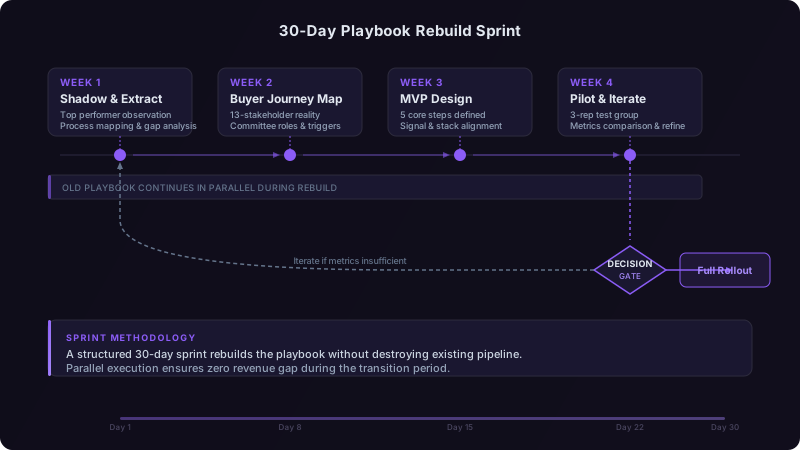
When to Fire Your Sales Playbook and Start Over
Five signals your playbook is broken beyond repair, plus a 30-day sprint framework for rebuilding from first principles without killing pipeline.
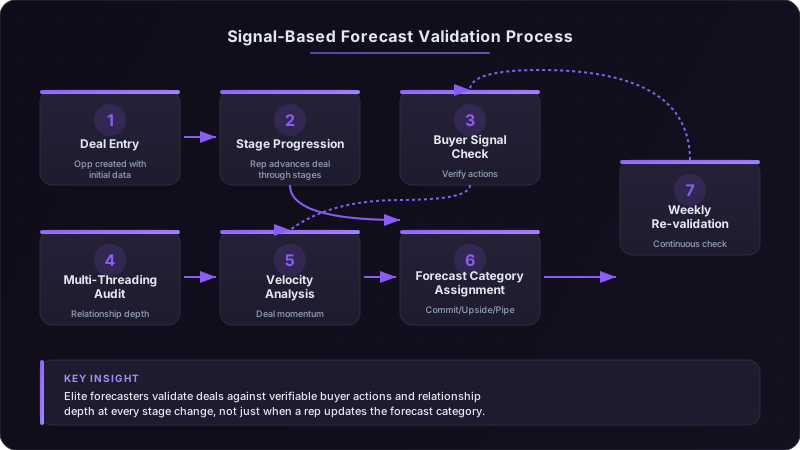
5 Sales Forecasting Mistakes Costing You 30% of Your Pipeline
Data from 200+ quarterly forecast reviews reveals the hidden errors that inflate commit numbers and destroy credibility. Here's what elite revenue teams do differently.
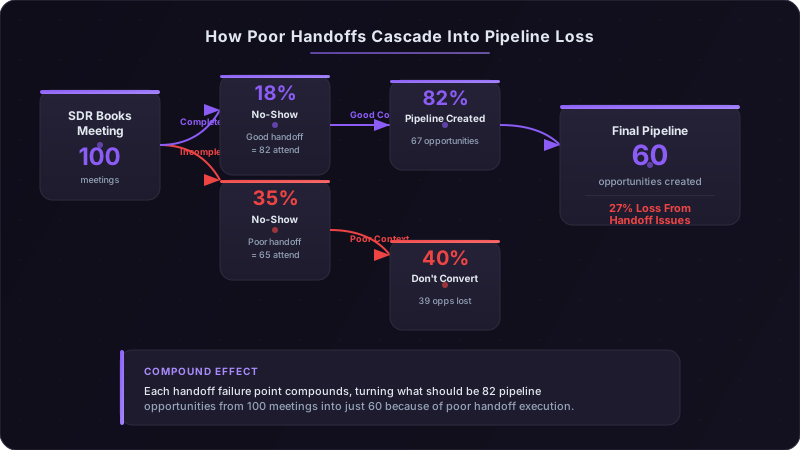
The SDR-AE Handoff Is Killing 27% of Your Qualified Pipeline
Poor handoff processes cost companies up to 30% of qualified opportunities. Here's the exact framework that fixes it, backed by data from 200+ sales teams.