Enterprise vs. SMB Sales: Why Your GTM Motion Needs Different Approaches
One-size-fits-all sales strategies fail. Learn how to build distinct motions for enterprise and SMB segments.
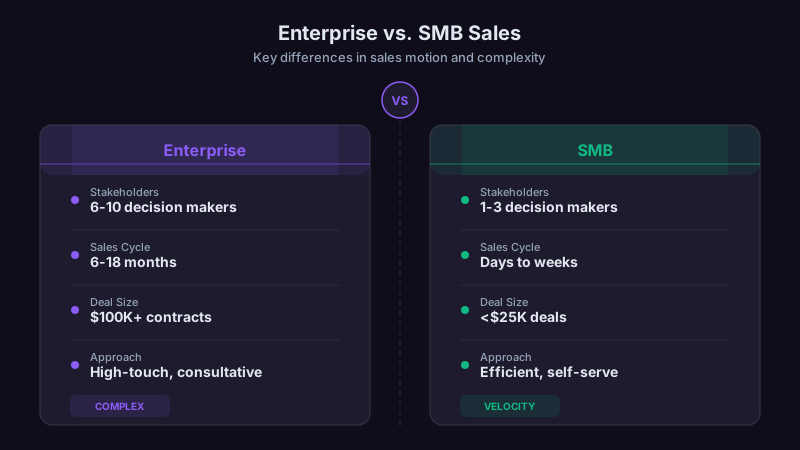
I spent my first four years in sales closing $8K-$15K deals to small businesses. Monthly targets, fast cycles, lots of volume. Then I moved to an enterprise team selling six-figure contracts to Fortune 1000 companies. My first quarter was a disaster. I booked zero revenue. I wasn't a bad salesperson, I was running the wrong playbook.
The skills that make you great at SMB sales can actively hurt you in enterprise. And the patience required for enterprise deals will drive an SMB closer crazy. I've now spent a decade working both segments, and I want to lay out what's actually different, why it matters, and what to do if your company is trying to move between them.
The Fundamental Differences (Beyond Deal Size)
Most people describe enterprise vs. SMB as "big deals vs. small deals." That's like describing the difference between a rowboat and a cargo ship as "small boat vs. big boat." Technically true, completely unhelpful.
Here's what's actually different:
| Dimension | SMB | Enterprise |
|---|---|---|
| Decision maker | Usually 1-2 people (often the owner or a department head) | 6-15 stakeholders across multiple departments |
| Sales cycle | 1-4 weeks | 3-18 months |
| Typical deal size | $1K-$25K ARR | $50K-$500K+ ARR |
| Buying process | Informal. "Does this solve my problem? Can I afford it? Let's go." | Formal. RFPs, security reviews, legal, procurement, committee approvals |
| What matters most | Speed to value, ease of use, price | Risk mitigation, scalability, integration, long-term ROI |
| Biggest competitor | Status quo / doing nothing | Incumbent vendor / building internally |
| Relationship depth | Transactional to light-touch | Deep, multi-threaded, trust-based |
| Churn dynamics | Higher churn, but faster replacement | Lower churn, but devastating when it happens |
Enterprise buying is about reducing risk. SMB buying is about solving a problem fast. Every other difference flows from this one distinction.
How Enterprise Sales Actually Works
When I closed my first enterprise deal, a $180K annual contract with a financial services company, it took 11 months from first meeting to signed contract. Here's what that process looked like, and why each step matters.
Building the Buying Committee Map
In enterprise sales, the person you first talk to is almost never the person who signs the check. At that financial services company, my initial contact was a Director of Sales Operations. Great champion. Zero purchasing authority.
I needed to understand the full cast of characters:
- Champion (Dir of Sales Ops): Believed in our product, would advocate internally
- Economic buyer (VP of Revenue): Controlled the budget, needed ROI justification
- Technical evaluator (IT Security): Had veto power over any new vendor
- End users (SDR team leads): Would revolt if the tool was hard to use
- Legal/Procurement: Would negotiate terms and could stall for months
My job was to get each of these people to "yes", or at least "not no", on their specific concerns. In SMB, you sell to one person. In enterprise, you build a coalition.
If your deal depends on a single contact at an enterprise account, you're one reorg away from losing everything. I've seen deals die because a champion changed roles and nobody else at the account knew who we were. Always have 3+ active threads.
The Consultative Sales Process
Enterprise buyers don't want a demo on the first call. They want to know that you understand their world. My discovery process for enterprise accounts typically spans 2-3 calls before I ever show the product:
- 1Situational discovery: What's their current process? What tools are they using? How is the team structured?
- 2Problem discovery: Where are the pain points? What's the business impact? What have they tried before?
- 3Impact quantification: If we solve this, what's it worth? (This becomes the ROI case for the economic buyer)
- 4Stakeholder mapping: Who else cares about this? Who needs to be involved?
Only after all of this do we demo, and the demo is customized to address the specific problems we've uncovered.
Enterprise Proof Points
Enterprise buyers need evidence. Not testimonials on your website. Proof that a company similar to theirs, in a similar situation, got specific measurable results.
What you need in your enterprise toolkit:
- Industry-specific case studies with real numbers
- A reference customer willing to take a call
- Security documentation (SOC 2, GDPR compliance, data handling policies)
- Integration architecture for their specific tech stack
- An implementation plan that shows you've done this before
How SMB Sales Actually Works
SMB sales is a completely different animal. When I was running an SMB team, our best reps closed 15-25 deals per month. Speed and efficiency were everything.
The Velocity Game
In SMB, the math is simple: more conversations = more deals. But it's not just about volume, it's about qualified volume. Here's the daily motion of a strong SMB closer:
- 40-60 outbound touches (calls, emails, LinkedIn)
- 4-6 discovery calls
- 2-3 demos
- 1-2 proposals sent
- Constant pipeline management to prevent deals from going dark
The best SMB reps I've managed share a trait: they're ruthless about qualification. They'd rather disqualify a bad-fit prospect in 5 minutes than spend two weeks chasing a deal that was never going to close.
The One-Call Close (When It Works)
Some SMB deals can close in a single call. This happens when:
- The prospect has an urgent, specific problem
- Your product clearly solves it
- The price is within their approval authority
- There's no committee to consult
When these conditions align, a great SMB rep combines discovery and demo into one conversation and asks for the business on the spot. Try that in enterprise and you'll never get a second meeting.
SMB Pricing and Packaging
SMB buyers are price-sensitive, but not in the way most people think. They're not looking for the cheapest option. They're looking for the option that solves their problem without requiring a CFO's approval.
The magic number varies by company, but most SMB buyers have a discretionary spending limit between $5K-$15K annually. Structure your SMB pricing to fall within this range and you'll avoid procurement involvement in 80%+ of deals.
Key SMB packaging principles:
- Monthly billing (reduces commitment anxiety)
- Self-serve onboarding (they want to use it today, not in 6 weeks)
- Transparent pricing on the website (SMB buyers hate "contact us for pricing")
- Free trial or freemium tier (let them experience value before buying)
The Five Mistakes Companies Make When Transitioning Segments
I've watched multiple companies try to move upmarket (SMB to enterprise) or downmarket (enterprise to SMB). These are the mistakes that kill them.
Mistake 1: Using the same sales team for both segments
Your best SMB rep is probably not your best enterprise rep. The skills are different. The mindset is different. The patience required is different. I've seen top SMB reps flame out in enterprise because they pushed for the close too early and alienated buying committees. I've seen enterprise reps flounder in SMB because they spent three weeks on discovery for a $10K deal.
There is one scenario where hybrid works: mid-market ($25K-$75K deals). Some reps can flex between consultative and transactional selling. But true SMB (<$15K) and true enterprise (>$100K) need dedicated motions.
Mistake 2: Applying SMB metrics to enterprise (or vice versa)
If you measure enterprise reps on meetings booked per week, they'll optimize for volume instead of quality. If you measure SMB reps on relationship depth, they'll over-invest in accounts that should close fast.
| Metric | SMB Focus | Enterprise Focus |
|---|---|---|
| Activity | Volume (calls, emails, demos per day) | Quality (stakeholders engaged, deal progression) |
| Pipeline | Number of opportunities | Weighted pipeline value |
| Conversion | Speed (days to close) | Win rate (% of qualified opps won) |
| Revenue | Deals closed per month | ARR per rep per quarter |
Mistake 3: One-size-fits-all content and messaging
SMB messaging should be punchy, benefits-focused, and urgency-driven. "Start your free trial. See results in 24 hours. No credit card required."
Enterprise messaging should be credibility-focused and insight-led. "Here's how Company X reduced their sales cycle by 35% while scaling from 50 to 200 reps."
Same product. Completely different story.
Mistake 4: Not adjusting the product experience
Enterprise buyers need SSO, role-based permissions, audit logs, custom integrations, and dedicated support. They expect a white-glove implementation process.
SMB buyers need a simple UI, quick setup, email support, and a knowledge base. They don't want to talk to an implementation consultant for a $200/month tool.
If your product can't serve both experiences, pick one segment and own it.
Mistake 5: Underestimating the go-to-market investment
Moving upmarket isn't just "hire enterprise reps." You need:
- Different content and collateral
- Security certifications
- Reference customers in target verticals
- Solution engineering capacity
- Longer cash flow runway (enterprise deals take months to close)
- Executive-level relationships (VP and C-suite engagement)
Moving downmarket isn't just "lower the price." You need:
- Self-serve product capabilities
- Automated onboarding
- Scaled support model
- Product-led growth motion
- Higher marketing volume at lower CAC
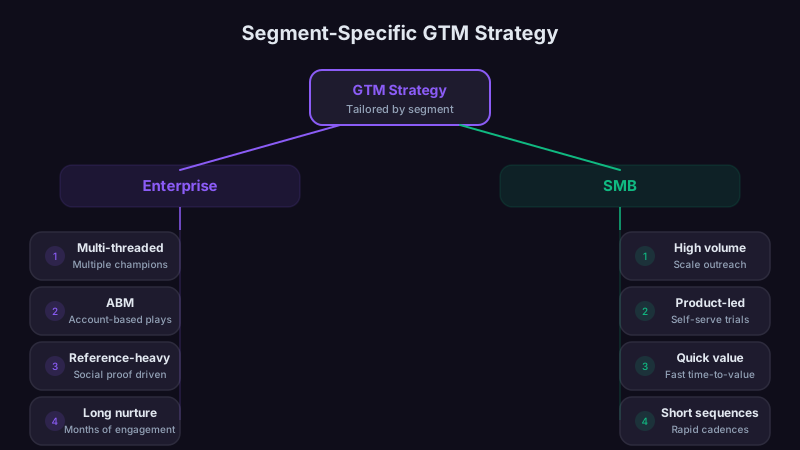
Building a Dual-Segment GTM: A Practical Framework
If your company sells to both segments (or plans to), here's how to structure it.
Dedicate reps to each segment. Minimum viable team per segment: 2 reps, 1 SDR (or shared SDR pool), and a manager who understands the motion.
Build different dashboards for each segment. Enterprise managers shouldn't see SMB-style activity metrics. SMB managers shouldn't see enterprise-style deal progression metrics.
Your CRM, data tools, and core infrastructure can serve both teams. Don't duplicate technology, duplicate playbooks.
For enterprise: invest in people, relationships, and content. Your competitive advantage is the quality of your sales team and the depth of your customer references.
For SMB: invest in product, automation, and process. Your competitive advantage is how quickly and efficiently prospects can buy and get value.
If you have deals falling between $25K-$75K, create a hybrid motion. These deals need more touch than SMB but less than full enterprise. A skilled mid-market AE can handle 6-10 deals simultaneously with moderate sales cycles.
Where I'd Start
If you're a sales leader evaluating your segment strategy, ask yourself three questions:
- 1Where does 80% of your revenue come from today? That's your core segment. Get great at it before expanding.
- 2Is your product ready for the other segment? Enterprise buyers need security and integrations. SMB buyers need self-serve and simplicity. You can't fake either.
- 3Do you have the right people? Transitioning segments means hiring reps who've done it before, not asking your current team to learn a completely new selling motion.
The companies that win in both segments treat them as genuinely different businesses that share a product. Same brand, same values, different everything else. That's not easy, but it's the only approach I've seen work consistently.
Ready to transform your sales pipeline?
See how Prospectory's AI-powered platform can help your team research, reach, and relate to prospects at scale.
Related Articles
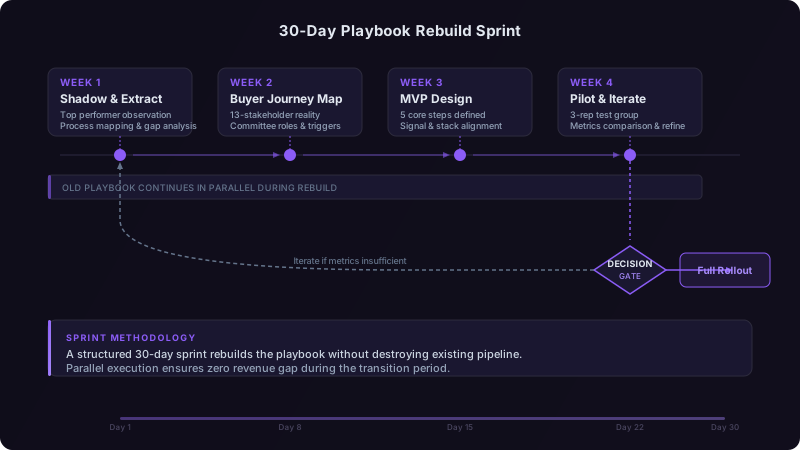
When to Fire Your Sales Playbook and Start Over
Five signals your playbook is broken beyond repair, plus a 30-day sprint framework for rebuilding from first principles without killing pipeline.
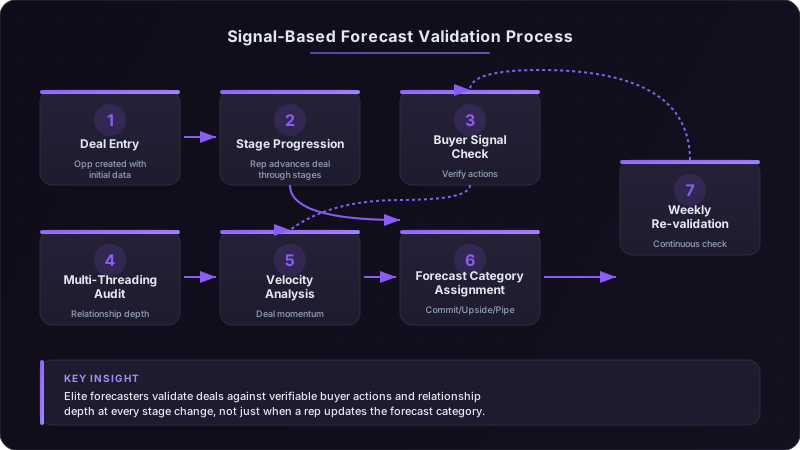
5 Sales Forecasting Mistakes Costing You 30% of Your Pipeline
Data from 200+ quarterly forecast reviews reveals the hidden errors that inflate commit numbers and destroy credibility. Here's what elite revenue teams do differently.
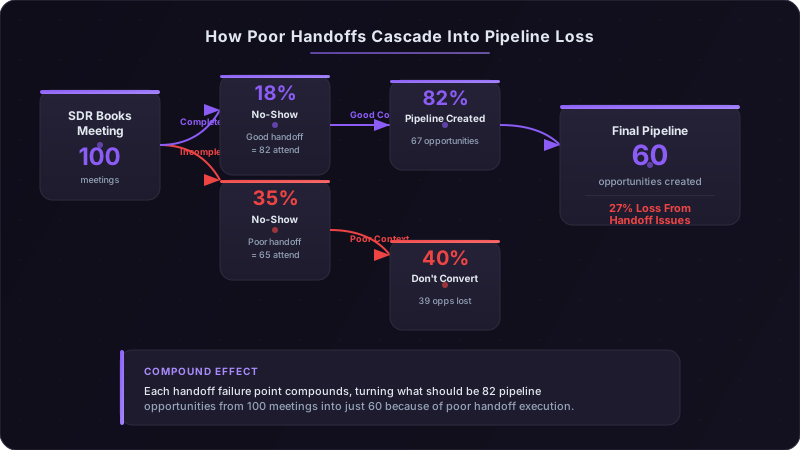
The SDR-AE Handoff Is Killing 27% of Your Qualified Pipeline
Poor handoff processes cost companies up to 30% of qualified opportunities. Here's the exact framework that fixes it, backed by data from 200+ sales teams.