The Only 7 Sales Metrics That Actually Matter in 2026
Stop drowning in dashboards. Here are the seven metrics that actually predict revenue, and how to improve each one.
I've managed sales teams for 12 years. At my worst, I had a 47-tab dashboard that took 20 minutes to load and told me absolutely nothing useful. My reps hated it. I hated it. Our CFO hated it because we were paying for three analytics tools nobody understood.
Here's what I've learned: most sales metrics are noise. They make you feel productive without actually changing outcomes. The teams that consistently hit quota aren't tracking more data, they're tracking the right data and acting on it fast.
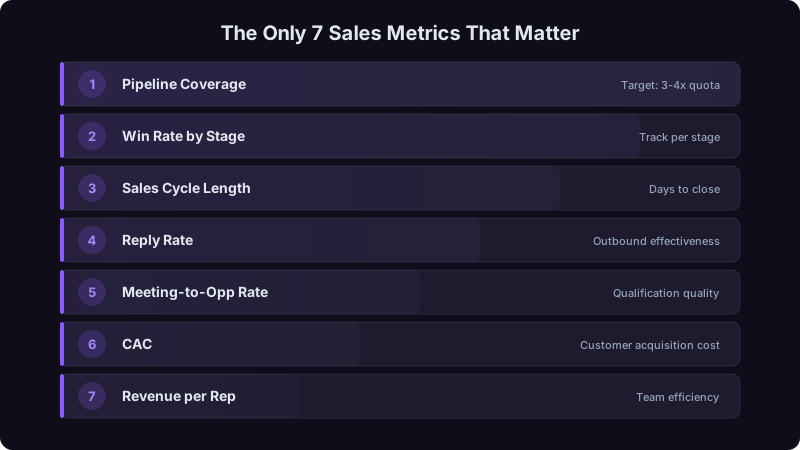
This is the metrics framework I've built and refined across four different sales orgs. Seven metrics. That's it. If you're tracking more than this, you're probably drowning in dashboards instead of coaching your team.
Why Most Sales Dashboards Fail
Before we get to what works, let's talk about what doesn't. I've seen the same pattern at every company I've joined:
- 1Someone buys an analytics tool
- 2They set up every metric the tool offers (because why not, it's already paid for)
- 3Weekly meetings become two-hour data reviews where everyone nods but nobody changes behavior
- 4Reps start gaming the metrics that get attention
- 5Revenue stays flat, but the dashboards look beautiful
The core problem? Most teams confuse activity metrics with outcome metrics, and lagging indicators with leading indicators. You end up measuring what's easy to count instead of what actually predicts revenue.
If your Monday morning meeting starts with "how many calls did everyone make last week," you're already in trouble. Activity volume without conversion context is meaningless. A rep who made 30 calls and booked 8 meetings is outperforming the rep who made 150 calls and booked 3.
The 7 Metrics That Actually Predict Revenue
I've organized these into two groups: leading indicators (things you can influence now) and outcome indicators (results that confirm your leading indicators are working).
Leading Indicators
#### 1. Pipeline Coverage Ratio
This is the single most predictive metric in B2B sales. It answers one question: do you have enough pipeline to hit your number?
Formula: Total qualified pipeline value / Quota target
I check this metric every Monday morning. If a rep's coverage drops below 3x with six weeks left in the quarter, we build a recovery plan that same day, not at the end-of-month review when it's too late.
Common mistake: Including unqualified or stale pipeline in the calculation. If a deal hasn't had activity in 30 days, it's not real pipeline. Strip it out. Your coverage number should make you slightly uncomfortable, that's how you know it's honest.
#### 2. Reply Rate (Outbound Effectiveness)
Reply rate measures how many of your outreach attempts generate a human response. Not opens. Not clicks. Actual replies.
Formula: Total replies / Total outreach attempts
Benchmarks I've seen work:
- Cold email only: 8-15%
- Multi-channel (email + LinkedIn + phone): 25-45%
- Warm or triggered outreach: 35-60%
This metric is a leading indicator because it sits at the top of your funnel. If reply rates drop, pipeline dries up 4-6 weeks later. By the time you see it in revenue, it's too late to fix.
The three biggest reply rate killers I've diagnosed across teams: (1) targeting the wrong persona, sending product messages to C-suite who only care about outcomes, (2) leading with features instead of the prospect's specific problem, and (3) sending the same sequence to everyone regardless of industry or role. Fix these before you touch subject lines.
#### 3. Meeting-to-Opportunity Conversion Rate
This tells you whether the meetings you're booking are actually worth having. A high meeting count with a low conversion rate means your targeting is off or your discovery calls need work.
Formula: Qualified opportunities created / Total first meetings held
Healthy range: 35-55%
When this metric drops below 30%, I look at two things. First, are we booking meetings with actual decision-makers or just anyone who says yes? Second, are reps running proper discovery or jumping straight into demos? In my experience, the demo-first approach kills this metric because prospects who aren't qualified sit through a 30-minute show, say "looks interesting," and vanish.
#### 4. Sales Cycle Length (by Deal Size)
Average days from first meaningful conversation to closed-won. The key word is average, you need to track this by deal size tier, because a $15K deal and a $150K deal shouldn't have the same cycle expectation.
Cycle length creep is a silent killer. It happens gradually, a few extra days here, another stakeholder review there. Before you know it, your Q3 deals are slipping to Q4 and your forecast is fiction.
How I use this: If a deal exceeds 1.5x the average cycle for its size tier, I flag it for a deal review. Not to pressure the rep, but to diagnose what's stalling it. Usually it's a missing stakeholder, unclear next steps, or a champion who's gone quiet.
Outcome Indicators
#### 5. Win Rate by Stage
Overall win rate is helpful. Win rate by stage is where the real coaching insights live.
Formula: Deals won / Total deals that entered each stage
Here's a real example from a team I ran. Our overall win rate was 22%, fine for our market. But when I broke it down by stage:
- Discovery to Demo: 65% (good)
- Demo to Proposal: 40% (concerning)
- Proposal to Negotiation: 80% (strong)
- Negotiation to Close: 70% (solid)
That Demo-to-Proposal drop told me everything. Reps were doing great discovery and giving solid demos, but something broke when it came time to propose. Turned out our proposal process took 5 days on average, and prospects were going cold. We cut it to same-day proposals and that stage conversion jumped to 58% in one quarter.
Map your win rate at each stage transition. The biggest single drop is your highest-ROI coaching opportunity. Fix that one stage and you'll see disproportionate revenue impact.
#### 6. Customer Acquisition Cost (CAC)
Formula: (Total sales costs + Total marketing costs) / Number of new customers acquired
This is the metric your finance team cares about most, and the one sales leaders ignore most often. That's a mistake. Understanding your CAC helps you fight for budget, justify headcount, and prioritize which segments to target.
What to include in the calculation:
- All sales compensation (base + variable)
- Sales tools and software
- Marketing spend attributed to pipeline
- SDR/BDR team costs
- Sales enablement and training
What healthy looks like: Your CAC should be recoverable within 12-18 months of customer revenue. If it takes longer than 18 months to pay back CAC, your unit economics are broken regardless of how fast you're growing.
#### 7. Revenue per Rep (Fully Ramped)
Formula: Total new business revenue / Number of fully ramped reps
This is the ultimate productivity metric, but it's only useful if you define "fully ramped" consistently. I use reps who have been carrying quota for at least two full quarters.
Why this matters more than total revenue: Total revenue can grow just by adding headcount. Revenue per rep tells you whether your system is getting better. If you doubled your team and revenue per rep stayed flat, you didn't improve, you just spent more.
I track this quarterly and share it with the entire team. Not to create competition (though it does), but because it sets a clear performance standard. When the team sees that top performers are at $180K/quarter and the median is $120K, it opens natural coaching conversations about what the top third is doing differently.
The Vanity Metrics Graveyard
These are metrics I've actively removed from dashboards because they distracted more than they helped:
Calls made / Emails sent: Without conversion context, this just rewards busy work. I've seen reps game activity metrics by making 2-minute throwaway calls to hit their daily number.
Email open rates: Too unreliable with modern email privacy (Apple Mail Privacy Protection, corporate proxies). An "open" doesn't mean a human read your message.
LinkedIn connection count: Having 5,000 connections means nothing if none of them are in your ICP.
Number of demos given: This incentivizes reps to demo unqualified prospects. Track demo-to-opportunity conversion instead.
Pipeline created (without quality filter): I've watched reps create $2M in pipeline on Monday and have $1.5M of it disappear by Friday. Track qualified pipeline only.
Building Your Review Cadence
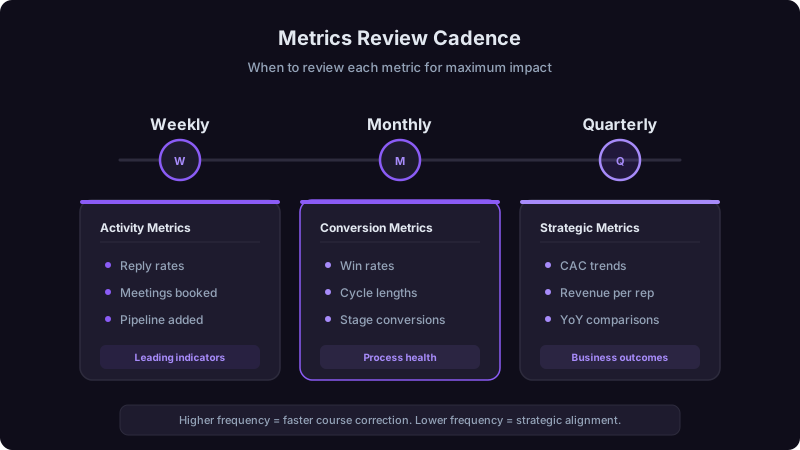
The metrics are only valuable if you review them at the right frequency. Too often and you're reacting to noise. Too infrequently and you're finding problems after they've already impacted revenue.
Focus on leading indicators only:
- Pipeline coverage ratio per rep
- Reply rates for active sequences
- Meetings booked vs. target
- Any deals at risk of stalling
Keep this short. No deep analysis. Just: are we on track, and what's the one thing each rep needs to do this week?
This is where you analyze trends:
- Win rate by stage (identify coaching opportunities)
- Sales cycle trends (are deals speeding up or slowing down?)
- Meeting-to-opportunity conversion (is our targeting holding?)
- Pipeline quality audit (remove stale deals, recalculate coverage)
Come with hypotheses, not just data. "Win rate dropped 5% at the proposal stage, I think it's because we started selling to mid-market without adjusting our proposal format."
Big picture:
- CAC trends and unit economics
- Revenue per rep vs. previous quarters
- Year-over-year comparisons
- Tech stack and process ROI
- Hiring plan adjustments based on productivity data
A Practical Framework for Acting on Metrics
Tracking is step one. Acting is where results come from. For every metric, I use this simple framework:
| Question | Example (Win Rate by Stage) |
|---|---|
| What's the current number? | 40% Demo-to-Proposal |
| What's the target? | 55% Demo-to-Proposal |
| What are 2-3 things that influence this? | Proposal speed, stakeholder mapping, pricing clarity |
| What's one experiment we'll run this month? | Same-day proposals for all deals under $50K |
| How will we measure the experiment? | Track Demo-to-Proposal rate for same-day vs. delayed proposals |
Don't try to improve all seven metrics at once. Pick the one that's furthest from target AND has the highest revenue impact. Fix that one. Then move to the next. In my experience, improving one bottleneck metric by 15-20% has more revenue impact than marginally improving five metrics by 3% each.
What This Looks Like in Practice
Last year I joined a team that was tracking 34 different metrics across three dashboards. Reps were spending 45 minutes every Monday morning in a "metrics review" that felt more like a public audit than a coaching session. Morale was low and quota attainment was at 62%.
We stripped it down to these seven metrics. Weekly meetings went from 45 minutes to 15. Monthly analysis sessions became the main coaching forum. Within two quarters, quota attainment hit 78%, not because we found magic metrics, but because we stopped measuring everything and started acting on the few things that mattered.
The math is straightforward. Better metrics lead to better coaching conversations. Better coaching leads to better rep behavior. Better behavior leads to more revenue. But it starts with having the discipline to ignore the noise and focus on the signal.
Your move: audit your current dashboard this week. Count how many metrics you're tracking. Then ask yourself, for each one, "if this number changed by 20%, would I do something different?" If the answer is no, remove it. You'll probably end up somewhere close to seven.
Ready to transform your sales pipeline?
See how Prospectory's AI-powered platform can help your team research, reach, and relate to prospects at scale.
Related Articles
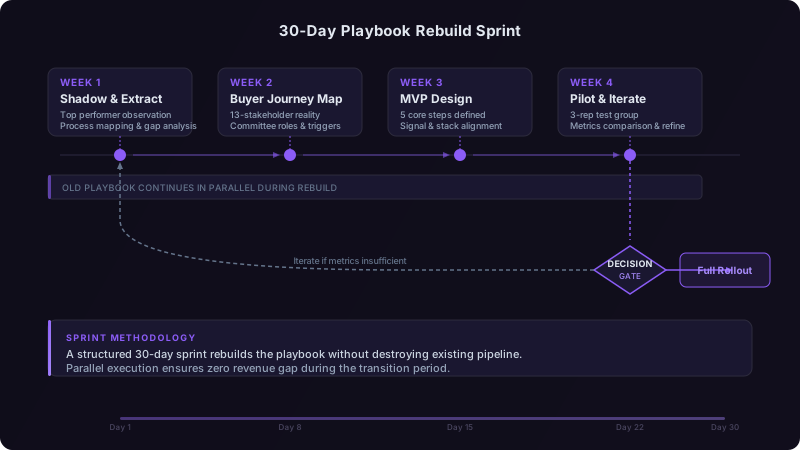
When to Fire Your Sales Playbook and Start Over
Five signals your playbook is broken beyond repair, plus a 30-day sprint framework for rebuilding from first principles without killing pipeline.
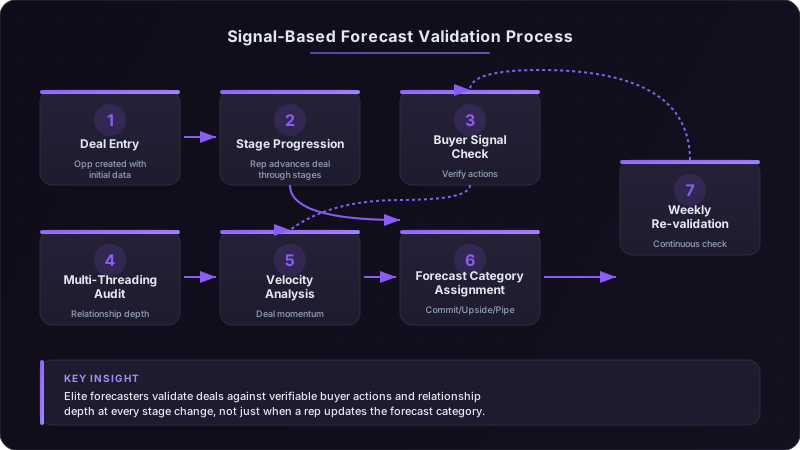
5 Sales Forecasting Mistakes Costing You 30% of Your Pipeline
Data from 200+ quarterly forecast reviews reveals the hidden errors that inflate commit numbers and destroy credibility. Here's what elite revenue teams do differently.
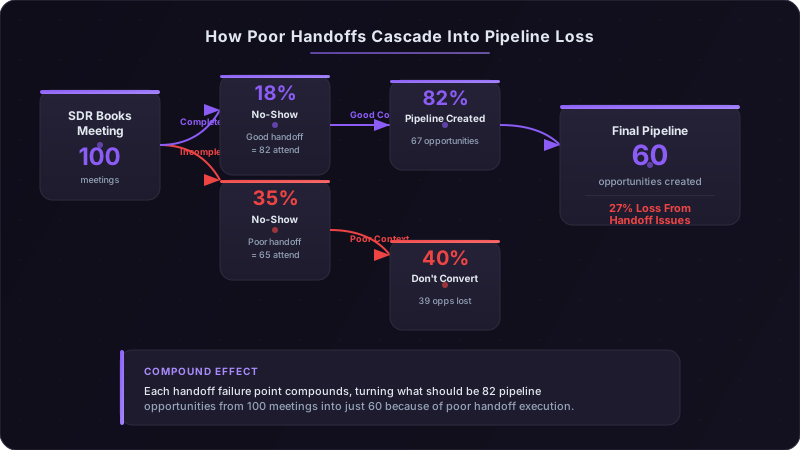
The SDR-AE Handoff Is Killing 27% of Your Qualified Pipeline
Poor handoff processes cost companies up to 30% of qualified opportunities. Here's the exact framework that fixes it, backed by data from 200+ sales teams.