The Rise of AI SDRs: How Autonomous Agents Are Transforming Sales Development
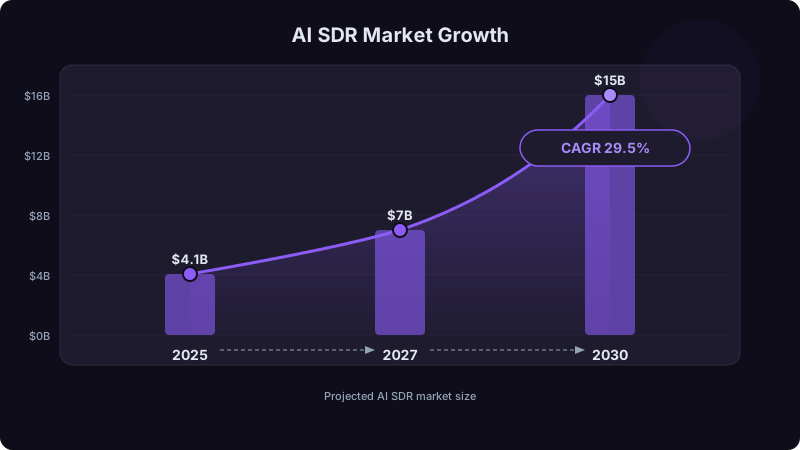
The AI SDR market is projected to reach $15 billion by 2030. Learn how autonomous sales agents are reshaping prospecting and what it means for your team.
I deployed our first AI SDR in September 2024. By December, it had booked 147 meetings. It also sent an email to a prospect's CEO calling their product "a declining platform", which was a direct quote from a competitor's blog post that the AI had scraped for personalization context.
That email got screenshot and posted on LinkedIn. It got 2,300 likes.
So let me give you the real story on AI SDRs. Not the vendor pitch, not the doom-and-gloom "robots are replacing us" narrative. The actual, messy, sometimes-brilliant-sometimes-embarrassing truth about what happens when you deploy autonomous AI agents to do sales development work.
I've now run AI SDRs alongside a human team for 16 months across two companies. I've tested four different platforms. I have data on over 85,000 AI-generated outreach attempts and their outcomes. Here's what I know.
What AI SDRs Actually Do (And Don't Do)
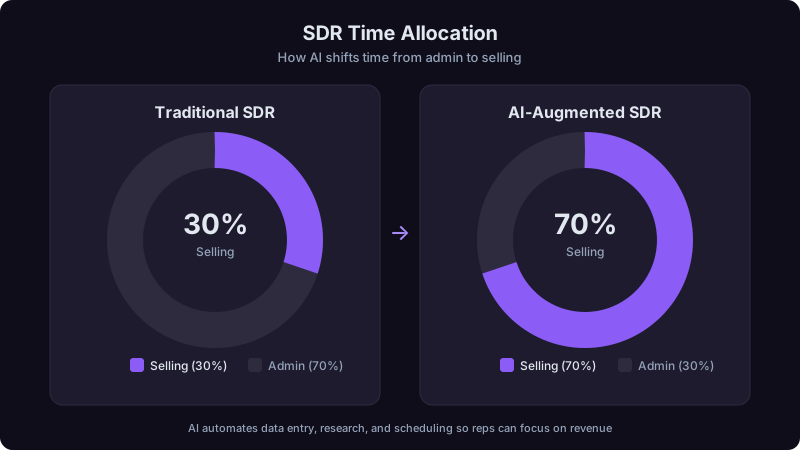
First, let's kill the confusion. An "AI SDR" is not a chatbot that sends emails. It's also not a human SDR with a better CRM. It's an autonomous agent that handles the full top-of-funnel workflow: identifying target accounts, researching prospects, writing personalized outreach, managing multi-channel sequences, handling responses, qualifying interest, and booking meetings.
The best AI SDRs today can do the following without human intervention:
- Research a prospect in seconds: Pull firmographic data, recent news, tech stack, LinkedIn activity, job postings, and funding history, then synthesize it into a relevant outreach angle
- Write genuinely personalized emails: Not "Hi {first_name}, I noticed {company_name} is in the {industry} space" personalization. Actual references to specific things the prospect has done, published, or experienced
- Run multi-step sequences: Email, LinkedIn connection request, follow-up email, LinkedIn message, adapting the cadence based on engagement signals
- Classify and route responses: Distinguish between "interested, book a meeting," "interested but not now," "wrong person, try someone else," and "not interested, stop emailing me", and take the appropriate action for each
- Book meetings directly: Access your AE's calendar, propose times, handle scheduling back-and-forth, and send confirmations
That's a lot. And for a specific type of outreach, high-volume, mid-market, relatively straightforward value proposition, AI SDRs are genuinely good at it.
But here's the part the vendors don't emphasize: AI SDRs are also reliably bad at several things that matter a lot.
Where AI SDRs Excel: The Honest Assessment
1. Volume and Consistency
This is the obvious win. A single AI SDR can execute 500-800 personalized outreach attempts per day across email and LinkedIn. A human SDR doing quality work maxes out at 60-80. The math is simple.
But volume alone is worthless if quality drops. So here's the real question: does AI outreach quality hold up at scale?
In my experience: yes, for Tier 2 and Tier 3 accounts. No, for Tier 1.
We segment our accounts into three tiers:
- Tier 1: Strategic accounts worth $200K+ ARR. Require deep research, executive-level messaging, and creative angles.
- Tier 2: Core accounts worth $50-200K ARR. Need solid personalization but follow more predictable patterns.
- Tier 3: Volume accounts worth $10-50K ARR. Standard value prop, light personalization sufficient.
AI SDRs produce outreach quality that's roughly equivalent to a mid-performing human SDR on Tier 2 and Tier 3 accounts. For Tier 1, they consistently fall short, more on that below.
2. Speed to Lead
When an inbound lead fills out a form at 2:47 AM, the AI SDR responds in under 3 minutes with a personalized message. When a target account shows a buying signal on a Saturday, the AI SDR acts on it before Monday morning. This alone is worth the investment.
We measured the impact of response speed on our inbound conversion:
| Response Time | Meeting Book Rate |
|---|---|
| Under 5 min | 38% |
| 5-30 min | 21% |
| 30 min - 2 hrs | 14% |
| 2-24 hrs | 7% |
| 24+ hrs | 3% |
AI SDRs guarantee you're always in the "under 5 minutes" bucket. Human SDRs, no matter how disciplined, have lunch breaks, meetings, and sleep cycles. We saw a 26% increase in inbound-to-meeting conversion just from faster response times.
3. Data Discipline
AI SDRs log everything. Every email, every response, every engagement signal, automatically recorded in the CRM with proper disposition codes. After 16 months with AI SDRs, our CRM data quality is the best it's ever been. No more "forgot to log the call" or "marked it as interested but there's no note explaining why."
This sounds mundane, but clean data compounds. Better data means better signal stacking models, better forecasting, and better handoff to AEs.
4. Consistent Messaging
AI SDRs don't have off days. They don't send sloppy emails on Friday afternoon. They don't go rogue with a pitch that contradicts your positioning. They follow your playbook every single time.
For companies with compliance requirements or regulated industries, this consistency is enormously valuable.
Where AI SDRs Fall Short: The Honest Assessment
1. Tier 1 Account Outreach
This is the biggest limitation, and it's not close. When you're going after a strategic account, say, a Fortune 500 company where the deal could be worth $500K, you need outreach that demonstrates genuine understanding of their business, their specific challenges, and why this specific moment matters.
AI SDRs can pull data about these companies. They can reference recent earnings calls and leadership changes. But they can't synthesize that information into a truly compelling narrative the way a sharp human SDR can.
Here's a real example. We were targeting a large healthcare company. The AI SDR generated an email referencing their recent acquisition and a job posting for a revenue operations lead. Solid signals. The email said: "With your recent acquisition of MedCore and your investment in revenue operations, it seems like you're scaling your go-to-market team."
Our best human SDR wrote this instead: "I noticed you acquired MedCore in Q3. Based on what I've seen when companies integrate a sales team of that size, the first 90 days are usually spent figuring out which tech stack survives and which gets deprecated. If your RevOps hire is walking into that situation, we might be able to help them get to a unified view faster."
The difference is obvious. The AI referenced facts. The human demonstrated understanding. The human email got a reply from the CRO. The AI email wouldn't have.
Never let an AI SDR be your first touch on a strategic account. The cost of a bad first impression on a $500K opportunity is too high. Use AI to research and draft, but have a human review and personalize outreach to your top 50-100 accounts.
2. Handling Objections and Nuance
AI SDRs handle positive responses well. "Yes, I'm interested, let's book a call" is easy to route. But real sales conversations are messy.
"We just signed a 3-year contract with [competitor], but I'm curious what's changed in the market", is that a dead end or a long-term nurture opportunity? "My colleague might be a better fit for this conversation", should you ask for a warm intro or just email the colleague directly? "We've tried tools like yours before and the implementation was a nightmare", that's an objection that needs a specific, empathetic response.
AI SDRs either misclassify these or give generic responses. We've found that about 15% of AI-handled responses require human intervention to recover the conversation. Not a dealbreaker, but you need a human in the loop reviewing AI responses daily.
3. Relationship Building
There's a reason your best SDR can get meetings that nobody else can. They've built relationships over months or years. They comment on prospects' LinkedIn posts. They send relevant articles without any ask. They remember that the prospect's daughter just started college.
AI SDRs don't build relationships. They execute transactions. For many accounts, that's fine. For your highest-value accounts, relationships are the difference between getting the meeting and getting ignored.
4. The Uncanny Valley Problem
AI-generated outreach has gotten remarkably good, but sophisticated buyers can still detect it. And when they do, it backfires. I've had prospects reply with "Please remove me from your AI-generated outreach", and those prospects are usually the senior executives you most want to reach.
The tells are subtle: slightly-too-perfect structure, references that are accurate but feel researched rather than known, a tone that's professional but lacks a discernible personality. As AI writing improves this gap will narrow, but in 2026, it's still real.
The Deployment Model That Works: Hybrid Tiered Approach
After testing multiple configurations, here's the model that consistently produces the best results.
| Tier 1 (Strategic) | Tier 2 (Core) | Tier 3 (Volume) | |
|---|---|---|---|
| Research | AI drafts, human refines | AI handles | AI handles |
| First touch | Human writes | AI writes, human reviews top 20% | AI handles autonomously |
| Follow-up sequence | Human manages | AI manages, human handles replies | AI manages fully |
| Response handling | Human handles all | AI handles positive, human handles complex | AI handles all, human escalation on edge cases |
| Meeting booking | Human coordinates | AI books, human confirms strategic | AI books autonomously |
This model gives us the volume advantages of AI across our full account base while preserving human quality where it matters most.
Implementation Lessons From Two Deployments
Lesson 1: Spend 80% of Your Setup Time on the Guardrails
The actual AI SDR platforms are pretty good out of the box. What makes or breaks your deployment is the rules you set around them. Which accounts can the AI touch autonomously? What response types require human review? What topics or competitors should never be mentioned? What's the maximum outreach volume per domain per day?
We learned this the hard way (see: the LinkedIn screenshot incident). Now we have a 47-point guardrail checklist that every AI outreach template goes through before activation.
Lesson 2: Your Human SDRs Are Not Obsolete, Their Job Description Is Changing
We didn't lay anyone off when we deployed AI SDRs. We redeployed. Our human SDRs now focus on:
- Tier 1 strategic account research and outreach
- Reviewing and improving AI-generated content weekly
- Handling complex response conversations
- Building relationships at target accounts through social selling
- QA-ing the AI's work and flagging errors
Their job went from "send 80 emails and make 40 calls a day" to "manage the AI, own the top accounts, and handle the conversations that require a human brain." Most of them prefer the new job.
AI SDRs don't eliminate SDR roles, they eliminate SDR tasks. The SDRs who thrive in this new model are the ones who can think strategically about accounts, write compelling narratives, and manage AI systems. It's a higher-skill role than traditional SDR work. Plan your hiring and training accordingly.
Lesson 3: Monitor Output Quality Weekly, Not Monthly
AI SDR output quality drifts. The models update, your data changes, new edge cases emerge. If you set it and forget it, you'll get slowly-degrading quality that you won't notice until a prospect posts your email on social media.
We do a weekly audit: randomly sample 50 outreach messages, grade them on personalization quality, accuracy, tone, and compliance with our guardrails. If quality drops below our threshold, we pause the agent and investigate.
Lesson 4: The Data Feedback Loop Is Everything
Your AI SDR gets better or worse based on the data you feed it. Every meeting that books, what signals triggered it? Which email version got the reply? What personalization angle resonated? Feed this data back into the system religiously.
After 16 months, our AI SDR's meeting book rate has improved 3x from where it started, almost entirely from iterative data feedback. The platform didn't change. Our data and rules got better.
Lesson 5: Set Expectations With Your AEs
Your AEs need to know when a meeting was booked by AI vs. a human. Not because AI-booked meetings are worse, they convert at roughly the same rate in our data, but because the context package is different. An AI-booked meeting comes with a structured research brief. A human-booked meeting might come with additional context from a real conversation. AEs should adjust their prep accordingly.
The Numbers: AI SDR vs. Human SDR Economics
Here's our actual cost comparison from the past four quarters:
| Metric | Human SDR | AI SDR | Hybrid (Our Model) |
|---|---|---|---|
| Monthly cost per seat | $7,200 (fully loaded) | $2,100 (platform + management time) | $4,800 (blended) |
| Meetings booked/month | 14 | 49 | 38 (per human SDR + AI coverage) |
| Cost per meeting | $514 | $43 | $126 |
| Meeting-to-opportunity rate | 34% | 28% | 36% |
| Avg deal size from sourced meetings | $68K | $52K | $71K |
The AI SDR books more meetings at lower cost, but the meetings are slightly lower quality (lower conversion rate, smaller deal size). The hybrid model, AI handling volume, humans handling strategic, delivers the best overall economics.
Don't just compare cost per meeting. Calculate cost per closed-won deal from AI-sourced vs. human-sourced meetings. In our data, the AI SDR's lower meeting quality is more than offset by its dramatically lower cost and higher volume. But the math depends on your deal sizes, close rates, and how well you segment the AI's territory.
What's Coming Next
Based on what I've seen in the past 16 months, here's where I think AI SDRs are headed:
Within 12 months: Response handling will improve dramatically. The current crop of AI SDRs is good at outbound but clumsy with nuanced replies. The next generation will handle 90%+ of response types without human intervention.
Within 24 months: AI SDRs will manage multi-threaded account strategies autonomously, reaching different stakeholders with coordinated messaging that adapts based on the aggregate account response, not just individual replies.
Within 36 months: The line between AI SDR and AI AE will blur. AI agents will handle discovery calls, demo scheduling, and initial qualification calls via voice. Human sellers will focus on strategic accounts, complex negotiations, and relationship management.
This isn't speculation. I've seen early versions of all three of these working in beta. They're rough, but the trajectory is clear.
Where to Start If You're Evaluating AI SDRs
Before you buy any platform, define your Tier 1 / Tier 2 / Tier 3 segmentation. This determines where the AI operates autonomously vs. where it assists humans. Skip this step and you'll either waste the AI on accounts that need a human touch, or waste human time on accounts the AI could handle.
Deploy the AI SDR on your lowest-tier accounts first. These are accounts where the downside of a bad email is minimal and the upside of increased volume is real. Run it for 60 days. Measure meeting book rate, response quality, and any negative incidents.
Based on what you learn in Step 2, build your rules: which accounts, which topics, which response types require human review. Document everything. This rulebook is your most valuable asset.
Move the AI into Tier 2 accounts with a human review layer. Have your SDRs spot-check 20% of outreach before it sends. Gradually reduce the review percentage as quality stabilizes.
Track everything: cost per meeting, meeting quality, AE feedback, prospect complaints, response accuracy. Adjust weights, templates, and guardrails weekly for the first quarter, then monthly once things stabilize.
AI SDRs are not the future of sales development. They're the present. The question isn't whether to deploy them, it's how to deploy them in a way that amplifies your team instead of embarrassing your brand. Get the segmentation right, build strong guardrails, keep humans on your strategic accounts, and iterate based on real data. That's the playbook that works.
Ready to transform your sales pipeline?
See how Prospectory's AI-powered platform can help your team research, reach, and relate to prospects at scale.
Related Articles
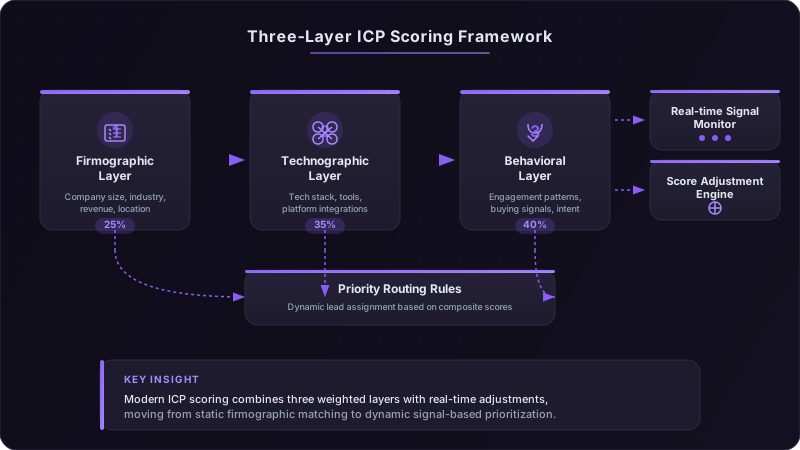
ICP Scoring Models That Actually Predict Revenue
Three $50M+ ARR companies share their exact ICP scoring matrices, combining firmographics, technographics, and behavioral signals to predict deal velocity and close rates.
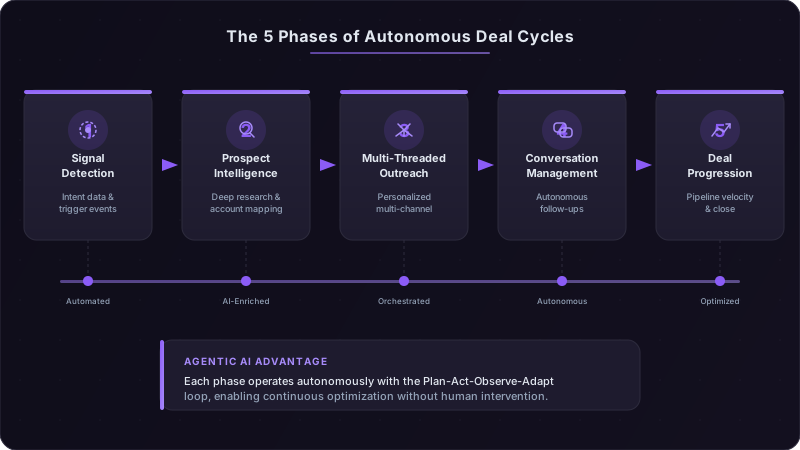
Agentic AI in Sales: How Autonomous Deal Cycles Are Replacing the Traditional Pipeline
Agentic AI is moving beyond task automation into fully autonomous deal orchestration. Learn how self-directed AI agents are compressing 90-day sales cycles into weeks.
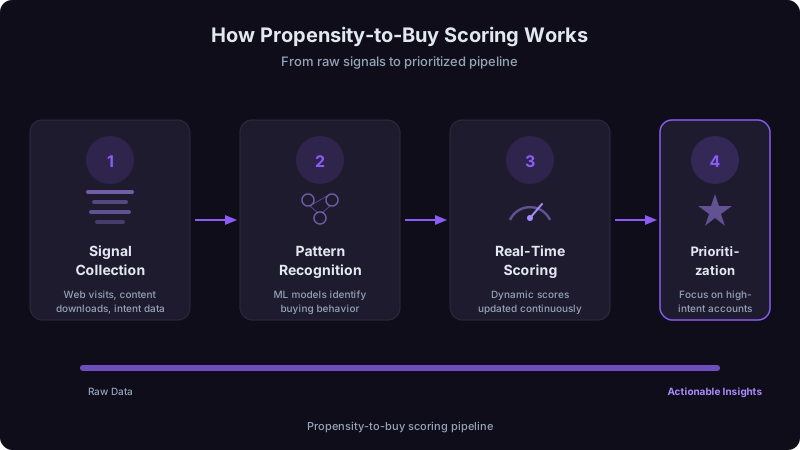
Propensity to Buy Scoring: The Complete Guide to Predictive Lead Prioritization
Stop wasting time on leads that won't convert. Learn how P2B scoring uses AI to predict which accounts are ready to buy, and see 3x higher win rates.