AI Lead Qualification: Separating Hot Prospects from Time Wasters
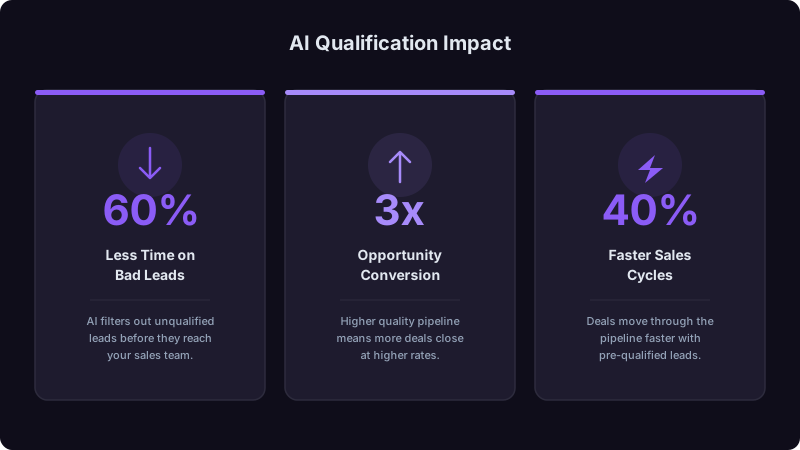
Your team spends 60% of time on leads that will never buy. Learn how AI qualification identifies real opportunities instantly.
I've built lead qualification frameworks at three different companies. At the first, we used strict BANT. At the second, we built a custom scoring model in Salesforce. At the third, we implemented AI-powered qualification. The results weren't even close.
With BANT, our SDRs passed leads that hit the checklist but missed context. With the custom scoring model, we improved by about 20%, but the model was static -- it couldn't adapt to shifts in our market. With AI qualification, our lead-to-opportunity conversion rate went from 9% to 27% in six months.
This guide covers what I learned across all three approaches: why traditional frameworks fall short, how AI qualification actually works under the hood, how to build a scoring model that holds up, and how to design the SDR-to-AE handoff so nothing falls through.
The Real Problem with Lead Qualification
The qualification problem isn't that teams lack a framework. It's that the frameworks we've relied on for decades were designed for a different buying environment.
BANT (Budget, Authority, Need, Timeline) was created by IBM in the 1960s. Think about what B2B buying looked like then: single decision-maker, clear budgets, linear processes. Today's B2B purchases involve an average of 6-10 decision-makers, budgets that get created after the need is validated, and buying processes that loop and stall unpredictably.
When I enforced strict BANT at my first company, we disqualified leads that didn't have confirmed budget. Problem was, 40% of our closed-won deals started without a defined budget. The budget got created during the sales process. We were filtering out our best opportunities.
BANT vs. Modern Qualification Frameworks
Before we talk about AI, let's look at how qualification thinking has evolved.
| Framework | Core Idea | Strength | Weakness |
|---|---|---|---|
| BANT | Budget, Authority, Need, Timeline | Simple, easy to train | Assumes linear buying; misses early-stage opportunities |
| MEDDIC | Metrics, Economic Buyer, Decision Criteria, Decision Process, Identify Pain, Champion | Rigorous for enterprise | Heavy; better for qualifying opportunities than leads |
| CHAMP | Challenges, Authority, Money, Prioritization | Starts with pain, not budget | Still relies on single-call discovery |
| GPCTBA/C&I | Goals, Plans, Challenges, Timeline, Budget, Authority, Consequences, Implications | Very thorough | Complex; requires extensive training |
| AI-Powered | Multi-signal pattern matching + behavioral data | Adapts continuously; scales | Requires data infrastructure; needs human oversight |
No framework is universally wrong. MEDDIC is still excellent for qualifying late-stage enterprise opportunities. CHAMP works well for initial discovery calls. But for the first-pass question of "should a rep spend time on this lead at all?" -- that's where AI qualification outperforms everything else.
How AI Qualification Actually Works
I want to demystify this because "AI qualification" has become a buzzword that vendors throw around without explaining the mechanics. Here's what's actually happening.
Layer 1: Signal Aggregation
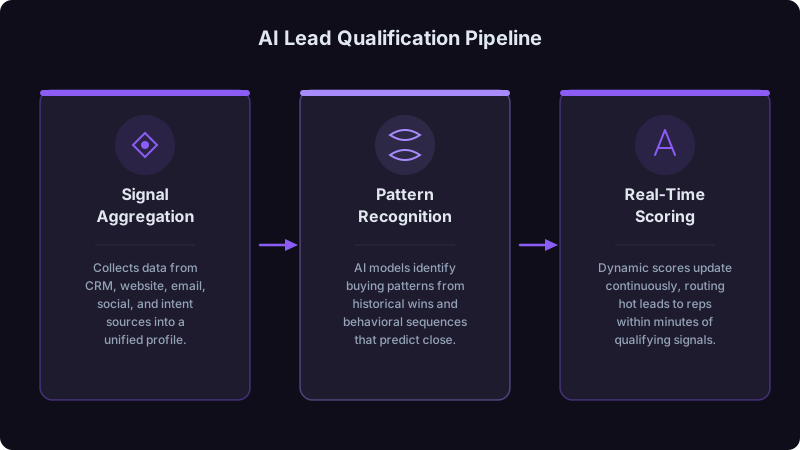
The AI system pulls data from multiple sources and creates a composite profile for each lead. The signals fall into three categories.
Firmographic signals (who they are):
- Company size, industry, revenue, growth rate
- Technology stack (what tools they already use)
- Funding status and recent financial events
- Geographic location and market presence
Behavioral signals (what they're doing):
- Website pages visited, time on site, return visits
- Content downloaded (whitepapers, case studies, pricing pages)
- Email engagement (opens, clicks, replies)
- Event attendance (webinars, conferences)
- Product usage data (for freemium or trial models)
Intent signals (what they're researching):
- Third-party intent data (Bombora, G2, TrustRadius activity)
- Search behavior on topics related to your solution
- Competitor research activity
- Job postings that signal a need (e.g., hiring for a role your product supports)
Layer 2: Pattern Recognition
This is the part that makes AI qualification fundamentally different from rules-based scoring. Instead of a human deciding "VP title = +10 points, visited pricing page = +15 points," the model analyzes your historical conversion data and identifies which combinations of signals actually predict outcomes.
At my last company, we discovered something our scoring model would never have caught: leads from companies that had recently posted a job for a "Revenue Operations Manager" converted at 4x the rate of our average lead. No human built that rule. The model found the pattern in our data.
The model also identifies negative signals. We learned that leads who downloaded more than three whitepapers without ever visiting our pricing page almost never converted. They were researchers, not buyers.
Layer 3: Dynamic Scoring
Every lead gets a score that updates continuously. This is critical. A static score assigned at the moment of form fill becomes stale within days. A dynamic score reflects what's happening right now.
A lead might score a 45 on Monday (low fit, no engagement). By Thursday, they've visited your pricing page twice, downloaded a competitor comparison guide, and their company just posted a new VP Sales role. Their score jumps to 82. That lead should be at the top of someone's list before Friday.
Building Your AI Scoring Model
Before you build anything, get sales and marketing leadership in a room and agree on definitions. I use three tiers:
- MQL (Marketing Qualified Lead): Shows interest and fits basic firmographic criteria. Marketing continues nurturing.
- SQL (Sales Qualified Lead): Fits ICP and shows active buying signals. Routed to SDR for outreach.
- SAL (Sales Accepted Lead): SDR has confirmed fit and interest through conversation. Passed to AE.
The AI model needs a clear target variable. Ours was: "Did this lead become a Sales Accepted Lead within 60 days?" That's the outcome the model optimizes for.
The model is only as good as your data. Before implementation, audit:
- Do you have at least 12 months of lead data with outcomes tracked?
- Are lead sources attributed correctly?
- Is your CRM data clean enough that conversion stages are reliable?
- Do you have behavioral data connected (website, email, content engagement)?
If you have fewer than 1,000 leads with tracked outcomes, a rules-based scoring model might be more practical until you accumulate enough data.
Option A: Platform-native AI scoring. Tools like HubSpot, Salesforce Einstein, and Marketo have built-in predictive scoring. Easiest to implement, least customizable.
Option B: Specialized qualification tools. Platforms like MadKudu, Infer, or 6sense offer dedicated AI scoring with more sophisticated models and data enrichment.
Option C: Custom model. Built by your data team on your own data. Most powerful, most expensive, requires ongoing maintenance.
For most teams with 50-200 leads per month, Option A or B is the right call. Custom models make sense at 500+ leads per month where the ROI justifies the investment.
Split your historical data: 80% for training the model, 20% for testing. The model should be able to predict your test set outcomes meaningfully better than random chance. If it can't, you either need more data or better data.
Run the AI scoring alongside your current process for 30-60 days before making it the primary system. Compare: Are the AI's top-scored leads actually converting better than the leads your team would have prioritized manually?
The Scoring Model in Practice
Here's a simplified version of the scoring rubric we used, showing how different signals contributed to the overall score.
| Signal Category | Example Signals | Weight Range | Notes |
|---|---|---|---|
| Firmographic fit | Company size, industry, tech stack | 0-30 points | Baseline fit; doesn't change often |
| Behavioral engagement | Page visits, content downloads, email clicks | 0-25 points | Changes daily; decays over time |
| Intent signals | Third-party intent, competitor research | 0-25 points | Most volatile; highest predictive value |
| Timing indicators | Job postings, funding, leadership changes | 0-20 points | Event-driven; spikes matter |
Score thresholds we used:
- 0-40: Low priority. Marketing nurture only.
- 41-65: Medium priority. SDR outreach within 48 hours.
- 66-85: High priority. SDR outreach within 4 hours.
- 86-100: Critical. Route to SDR immediately with context alert.
Behavioral scores should decay over time. A prospect who visited your pricing page 90 days ago is very different from one who visited yesterday. We applied a 15% weekly decay to behavioral signals so scores reflected current interest, not historical interest.
The SDR-to-AE Handoff
Qualification doesn't end when the AI assigns a score. The handoff from SDR to AE is where deals die if the process isn't tight.
What a good handoff includes:
- 1The AI score and top contributing factors ("Scored 78. Key factors: matches ICP firmographics, visited pricing page 3x this week, active G2 research in our category")
- 2SDR discovery notes (what they learned in their conversation: confirmed pain, identified stakeholders, timeline discussion)
- 3Prospect's own words (direct quotes from the call about their challenges and goals)
- 4Recommended next step ("Prospect wants a 30-minute technical demo focused on the reporting module. Their VP Ops is the economic buyer.")
What a bad handoff looks like: "Talked to them, seems interested, passed to AE." That's not a handoff. That's a punt.
We built a handoff template in Salesforce that required SDRs to fill in six fields before they could change the lead status. Some of them complained it took too long. But our AE acceptance rate went from 60% to 91%, and the time AEs spent re-qualifying leads dropped by half.
Measuring Your Qualification System
Track these metrics weekly to ensure your AI qualification is actually working.
| Metric | Why It Matters | Our Before/After |
|---|---|---|
| Lead-to-opportunity rate | Are we passing better leads? | 9% → 27% |
| AE acceptance rate | Do AEs agree the leads are qualified? | 60% → 91% |
| Time to first touch | Are high-score leads getting fast outreach? | 18 hours → 2 hours |
| False positive rate | How many high-score leads never convert? | Track monthly; should decrease |
| False negative rate | Are good deals being missed by the model? | Review closed-won deals that scored low |
| Cycle time by score tier | Do higher-scored leads close faster? | High-score leads closed 35% faster |
The false negative rate is the one teams forget to check. Every month, look at your closed-won deals and check their original qualification scores. If you're consistently closing deals that the model scored low, the model is missing a pattern. Feed that information back into training.
Common Pitfalls
Over-trusting the model. AI qualification should inform decisions, not make them. We had a lead score 34 out of 100 -- tiny company, no budget signals, wrong industry. An SDR decided to call them anyway because she recognized the company name from a conference. That "low-score" lead became our second-largest deal that quarter. The model is a tool, not a boss.
Under-investing in data quality. Garbage in, garbage out. If your CRM data is inconsistent (different reps logging stages differently, lead sources mis-attributed, duplicate records), the model trains on noise. Spend the time cleaning your data before turning on AI scoring.
Ignoring the human element. The best qualification systems combine AI scoring with SDR judgment. The AI handles the first pass at scale. The SDR adds context that data can't capture: tone of voice on a call, the specific way a prospect described their pain, whether the champion seems like someone who can actually drive an internal decision.
Setting and forgetting. Markets shift. Your ICP evolves. New competitors enter. A model trained on last year's data might not reflect this year's reality. Retrain quarterly at minimum.
If you're currently using manual qualification: start by defining your ICP in measurable terms, connecting your behavioral data sources to your CRM, and implementing your platform's built-in predictive scoring. That gets you 70% of the value. You can invest in more sophisticated approaches once you see the initial lift and have the data volume to support it.
AI qualification isn't about replacing human judgment. It's about making sure your reps spend their limited time on the leads most likely to become customers. When you combine a well-tuned scoring model with structured handoffs and continuous feedback, the impact on pipeline quality is dramatic. Our reps stopped complaining about lead quality. That alone was worth the investment.
Ready to transform your sales pipeline?
See how Prospectory's AI-powered platform can help your team research, reach, and relate to prospects at scale.
Related Articles
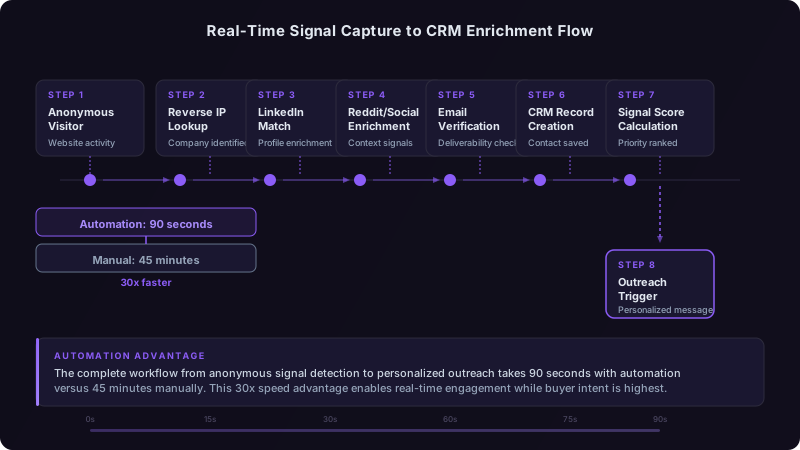
Real-Time Buying Signals vs. Historical Data: Which Actually Predicts Revenue?
Historical patterns tell you who bought before. Real-time signals tell you who's buying now. We analyzed 18 months of pipeline data to find out which matters more.
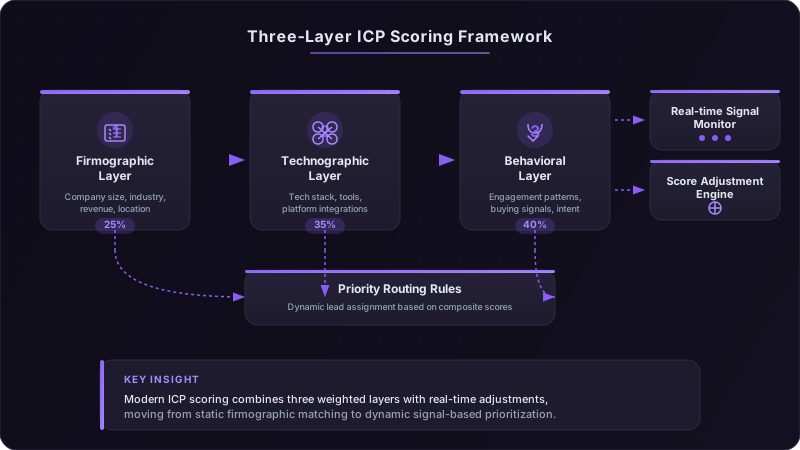
ICP Scoring Models That Actually Predict Revenue
Three $50M+ ARR companies share their exact ICP scoring matrices, combining firmographics, technographics, and behavioral signals to predict deal velocity and close rates.
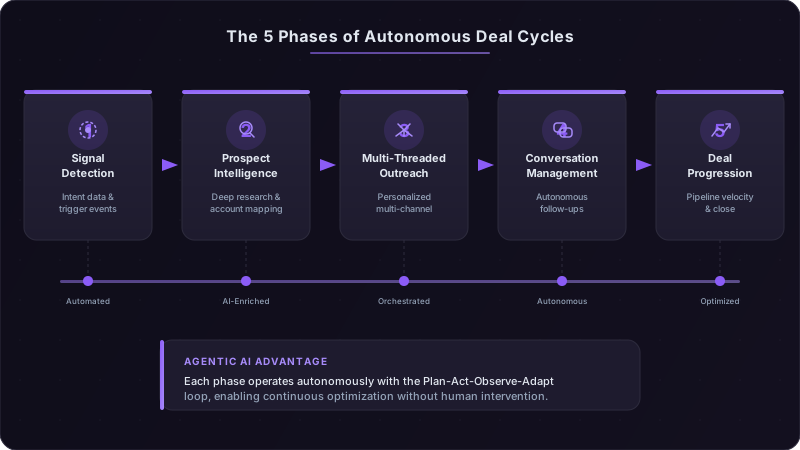
Agentic AI in Sales: How Autonomous Deal Cycles Are Replacing the Traditional Pipeline
Agentic AI is moving beyond task automation into fully autonomous deal orchestration. Learn how self-directed AI agents are compressing 90-day sales cycles into weeks.