Account Prioritization: The Framework for Deciding Who to Pursue
With limited time and infinite accounts, prioritization is everything. Learn the systematic approach to focusing on the right opportunities.
Two years ago, I ran a team of 12 AEs. We had a TAM list of about 14,000 accounts. Every quarter, reps would cherry-pick the ones they "had a good feeling about," and the result was predictable: uneven coverage, duplicated effort on the same big logos, and a pipeline that looked full but converted at 11%.
The fix wasn't more accounts or more reps. It was a prioritization framework that forced us to score every account on two dimensions -- Fit and Intent -- and then route resources accordingly. Within three quarters, our pipeline-to-close rate jumped to 24%, and AEs stopped wasting cycles on accounts that were never going to buy.
This article shares the exact framework we built, the scoring models behind it, and the mistakes I made along the way so you don't have to.
Why Most Prioritization Fails
The default state for most B2B sales teams is one of two extremes. Either every account is treated equally (spray and pray), or a small number of "named accounts" get all the attention and everything else is ignored. Both are wrong.
Spray and pray fails because your team is spread thin across thousands of accounts, giving each one minimal attention. No account gets enough touches to break through. Your AEs send three emails, get no reply, and move on. Pipeline looks active on paper; conversion tells a different story.
Named-account-only strategies fail for a subtler reason: they're static. You pick 50 accounts in January, and by March half of them have gone cold, had a reorg, or chosen a competitor. Meanwhile, accounts that weren't on the list six months ago are now actively researching your category -- and nobody's talking to them.
The solution is a prioritization system that's both structured (not gut-based) and dynamic (not static lists).
The Prioritization Matrix
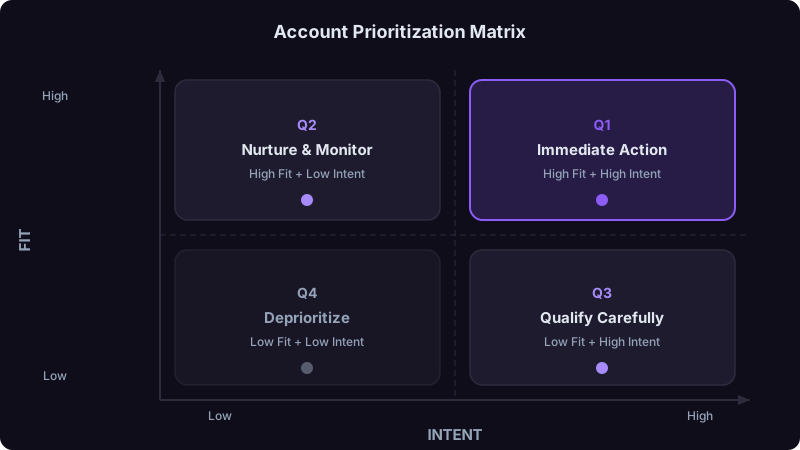
We recommend a 2x2 matrix combining Fit and Intent. I've seen more complex models -- 3x3 grids, weighted composite scores with 15 variables, ML models that nobody trusts. The 2x2 works because it's simple enough that reps actually use it and nuanced enough to drive meaningful differentiation.
Here's how each quadrant maps to action:
| Quadrant | Fit | Intent | Priority | Action | Resource Allocation |
|---|---|---|---|---|---|
| Q1 | High | High | Immediate | Full multi-channel sequence, fast follow-up, custom pitch | Senior AE, exec sponsor |
| Q2 | High | Low | Nurture | Light-touch sequence, content marketing, event invites | Automated nurture + SDR check-in quarterly |
| Q3 | Low | High | Qualify | Discovery call to validate fit, assess deal viability | SDR qualification, pass to AE only if fit confirmed |
| Q4 | Low | Low | Deprioritize | Add to marketing database, no direct sales outreach | None direct -- marketing only |
Let me walk through each quadrant with more specifics, because the devil is in how you define "high" and "low."
High Fit + High Intent (Quadrant 1)
These are your money accounts. They match your ICP and they're showing active buying behavior right now. Every sales org knows these are gold -- the problem is most teams don't have a systematic way to identify them.
At my last company, Q1 accounts made up roughly 8% of our total addressable list but generated 41% of closed-won revenue. That concentration alone tells you where your time should go.
What "immediate action" means in practice: A Q1 account should have a personalized multi-channel sequence launched within 24 hours of being flagged. Not a template with a first-name merge tag -- actual research, a specific observation about why now is the right time, and outreach across email, LinkedIn, and phone. If you have a champion or an existing relationship, call them directly. If the account is large enough, bring in an exec sponsor for a warm intro.
High Fit + Low Intent (Quadrant 2)
These accounts match your ICP perfectly but aren't showing buying signals yet. They're your future pipeline. The mistake I see most teams make is either ignoring these entirely (because there's no urgency) or hammering them with the same intensity as Q1 accounts (which burns the relationship before they're ready).
The right play is a nurture cadence: one meaningful touch per month. Share relevant content, invite them to events, comment on their LinkedIn posts. The goal is to stay on their radar so that when intent spikes -- and it will for some percentage of them -- you're already a familiar name.
We tracked our Q2 accounts over 12 months. Roughly 15% of them migrated to Q1 during that period. The ones we'd been nurturing converted to meetings at 3x the rate of the ones we hadn't touched.
Low Fit + High Intent (Quadrant 3)
This is the trap quadrant. These accounts are actively looking for a solution, and your reps will want to chase them because "they raised their hand." But if the fit isn't there -- wrong company size, wrong industry, wrong use case -- the deal will either stall in diligence or close and churn within a year.
Our rule: Q3 accounts get a discovery call to validate fit, but no further investment until the SDR confirms they meet at least 4 of our 6 ICP criteria. If they don't, politely disqualify and redirect them to a partner or a self-serve option if you have one.
I learned this lesson the hard way. In 2022, we closed a Q3 account -- a 15-person startup that had strong intent but was way below our ideal company size. The deal took 3 months to close, required heavy customization, and churned after 7 months. Total cost to us: about $45K in sales and CS time for a $12K contract. Never again.
Low Fit + Low Intent (Quadrant 4)
Don't spend sales time here. Add them to your marketing database and move on. If a Q4 account suddenly shows intent, they'll migrate to Q3 and get the qualification treatment. If their fit changes (they grow, they get acquired, they expand into your target segment), they'll move to Q2. Until then, they're marketing's responsibility, not sales'.
Scoring Fit
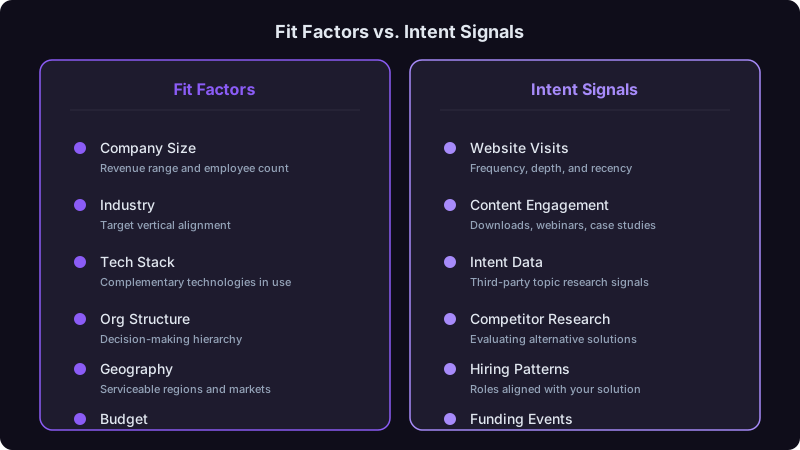
Fit scoring answers the question: "If this company wanted to buy from us, would the deal be successful?" It's about structural alignment, not current interest.
Here are the fit factors we weight, in order of predictive importance based on our closed-won analysis:
Tier 1 fit factors (must-haves):
- Company size: We sell best to 200-2,000 employee companies. Below 100, the deal size doesn't justify our sales motion. Above 5,000, the procurement process drags out.
- Industry vertical: We have case studies and product features for SaaS, fintech, and healthcare tech. Outside those verticals, our win rate drops from 28% to 9%.
- Budget authority: Is the prospect's team able to make a $30K+ purchasing decision? Org structure and seniority of our champions matter here.
Tier 2 fit factors (strong indicators):
- Technology stack: If they're already using complementary tools (a specific CRM, a certain MAP), implementation is faster and adoption is higher.
- Growth trajectory: Companies that recently raised funding, are hiring aggressively, or expanded to new markets are more likely to invest in new tooling.
- Geographic alignment: Our support team is US and EU-based. APAC-only companies face time zone challenges that increase churn.
Tier 3 fit factors (tiebreakers):
- Competitive displacement: Are they using a competitor we frequently displace? Those deals close faster because the pain is already understood.
- Existing relationships: Do we have a former champion, a mutual connection, or brand recognition at the account?
We score each factor on a 0-3 scale (0 = doesn't meet, 1 = partially meets, 2 = meets, 3 = exceeds) and weight Tier 1 factors at 3x, Tier 2 at 2x, and Tier 3 at 1x. Maximum possible fit score is 66. Accounts scoring 45+ are "High Fit." Below 30 is "Low Fit." Between 30 and 44 is a gray zone that gets reviewed manually each quarter.
| Fit Score Range | Classification | % of Our TAM | Historical Win Rate |
|---|---|---|---|
| 45-66 | High Fit | 22% | 31% |
| 30-44 | Medium Fit | 35% | 18% |
| 0-29 | Low Fit | 43% | 7% |
That win rate spread is the whole argument for fit scoring. Your high-fit accounts close at 4x the rate of low-fit accounts. Every hour spent on a low-fit deal is four hours of opportunity cost on a high-fit one.
Scoring Intent
Intent scoring answers a different question: "Is this company actively evaluating a solution right now?" Fit tells you who could buy. Intent tells you who might buy soon.
Intent signals break into three categories:
First-party signals (your own data):
- Pricing page visits: 2+ visits in 7 days is the strongest first-party signal we've found. These accounts convert to meetings at 38% when contacted within 24 hours.
- Multiple stakeholders from the same account engaging with your content (3+ people = buying committee forming).
- Demo or trial requests (obvious, but sometimes these sit in a queue too long).
- Return visits after going dark for 30+ days.
Third-party intent signals (external data):
- Category research surges on Bombora, 6sense, or G2.
- Competitor website visits (available through some intent providers).
- Search behavior spikes on keywords related to your solution.
Event-based signals (changes at the company):
- New executive hires in your buyer persona (a new VP Sales re-evaluates tools in their first 90 days roughly 70% of the time).
- Funding announcements (Series B and C are the sweet spot for tool purchases).
- Hiring spikes in the department you sell to.
- M&A activity, which triggers consolidation decisions.
We assign points to each signal and apply a 14-day decay (signals lose 50% of their value every two weeks). An account with a pricing page visit yesterday is worth more than one with a G2 surge three weeks ago.
Intent scoring thresholds:
- Score 40+: High Intent (top 15% of accounts at any given time)
- Score 15-39: Medium Intent (next 25%)
- Score 0-14: Low Intent (bottom 60%)
The combination of fit score and intent score places every account into one of the four quadrants. We recalculate daily and push updates to Salesforce so reps see their prioritized list every morning.
Dynamic Prioritization: Why Static Lists Kill Pipeline
Static lists become stale. I've watched teams build a beautiful prioritized account list in January and never update it. By March, half the Q1 accounts have gone silent, and new accounts showing strong intent signals are sitting untouched because nobody added them to the list.
Your prioritization should:
- Update in real-time as signals change. An account that hits your pricing page three times today should be flagged for Q1 action today, not at the next weekly pipeline review.
- Surface newly hot accounts immediately. If a company in your ICP just raised a Series C and their VP Sales visited your site twice, that account should appear in a rep's morning workflow automatically.
- Demote accounts that have gone cold. An account that was Q1 three months ago but hasn't engaged since should decay back to Q2 or even Q4. Holding onto stale Q1 accounts inflates your "active pipeline" and gives leadership a false sense of health.
We built a simple automation in Salesforce that recalculates quadrant placement nightly and sends a Slack digest to each AE every morning: "3 accounts moved to Q1 overnight. 2 accounts dropped from Q1 to Q2." That morning briefing became the single most-used feature in our sales ops stack.
Common Mistakes
I've made most of these, so consider this a list of expensive lessons.
1. Over-indexing on fit. High-fit accounts with no intent are appealing because they look like dream customers on paper. But if they're not in-market, your outreach is just noise. I watched one of my best AEs spend an entire quarter building a relationship with a perfect-fit Fortune 500 account that had zero buying intent. Four months of effort, no pipeline. That same time spent on Q1 accounts would have generated $300K-$400K.
2. Ignoring smaller accounts. We initially set our fit scoring to penalize companies under 500 employees. Six months later, we analyzed our customer base and found that 30% of our fastest-growing accounts started as 150-300 person companies. We adjusted the scoring, and our Q1 pool grew by 18%.
3. Set-and-forget scoring models. Your first scoring model will be wrong. Ours was. We overweighted industry fit and underweighted technology stack overlap. It took two quarterly calibrations -- comparing our scores against actual pipeline data -- before the model became genuinely predictive. Budget time to review and adjust your weights every quarter.
4. One-size-fits-all for different segments. If you sell multiple products or serve different market segments, you need separate scoring models. Our mid-market scoring weights are completely different from our enterprise weights. A company that's high-fit for our core product might be low-fit for our enterprise add-on. We learned this when our enterprise AEs kept getting "Q1" accounts that were really mid-market Q1 accounts misrouted.
5. Not involving reps in the model. Your AEs have pattern-matching instincts that are hard to quantify. When we built our first scoring model in a spreadsheet without rep input, adoption was 30%. When we rebuilt it with rep feedback -- they told us which signals actually correlated with their closed deals -- adoption jumped to 85%. Reps use frameworks they helped build.
6. Treating the matrix as a religion instead of a guide. Sometimes a rep has a strong relationship with a Q3 account and can close it quickly despite imperfect fit. The framework should inform decisions, not replace judgment. We allow reps to override the quadrant classification, but they have to document why. That override data is gold for refining the model later.
Effective account prioritization requires both fit and intent signals. High-fit accounts without intent waste time, while high-intent accounts without fit waste pipeline. The intersection of both is where the best opportunities live.
Implementing This on Your Team
If you're starting from scratch, here's the sequence I'd follow:
Week 1-2: Define your ICP with data, not opinions. Pull your last 12-18 months of closed-won deals. What firmographic attributes do they share? Company size, industry, tech stack, deal size. This becomes your fit scoring model. Don't trust gut feel -- I was wrong about two of our top three fit factors until I looked at the data.
Week 3-4: Inventory your intent signals. What first-party data are you already capturing that you're not routing to sales? Most teams have website analytics, email engagement data, and CRM activity logs that never make it to reps. Start there before buying third-party intent data.
Month 2: Build the matrix and score your TAM. Combine fit and intent scores, place every account in a quadrant, and assign resource allocation rules. Keep it simple: a spreadsheet works for the first iteration. Don't build a complex system until you've validated the model works.
Month 3: Pilot with a small group. Pick 3-4 reps, give them prioritized lists, and compare their results against a control group still working off gut feel. At our company, the pilot group booked 47% more qualified meetings than the control group in the first month. That data made the full rollout an easy sell.
Quarter 2: Automate and iterate. Move the scoring into your CRM, set up real-time alerts for quadrant changes, and build the daily digest. Then start the quarterly calibration cycle -- compare your scoring predictions against actual pipeline outcomes and adjust weights.
The hardest part isn't building the framework. It's changing the behavior. Reps are used to picking their own accounts. Telling them "the model says these are your top 20 for this week" requires trust, and trust requires the model being right often enough that reps stop fighting it. That takes two to three months of calibration and honest feedback.
But once it clicks -- once your team stops debating which accounts to pursue and starts competing on how well they execute against the right ones -- the pipeline impact is substantial. Our Q1 account win rate is 31%. Our overall blended rate before the framework was 11%. That delta is the entire argument for doing this work.
Ready to transform your sales pipeline?
See how Prospectory's AI-powered platform can help your team research, reach, and relate to prospects at scale.
Related Articles
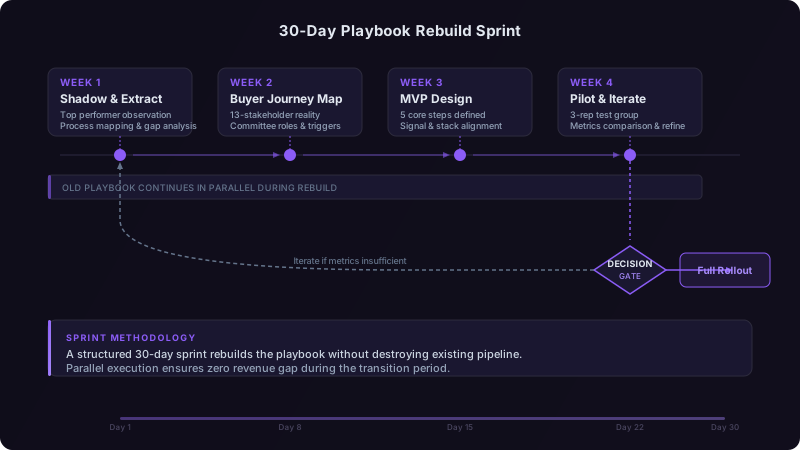
When to Fire Your Sales Playbook and Start Over
Five signals your playbook is broken beyond repair, plus a 30-day sprint framework for rebuilding from first principles without killing pipeline.
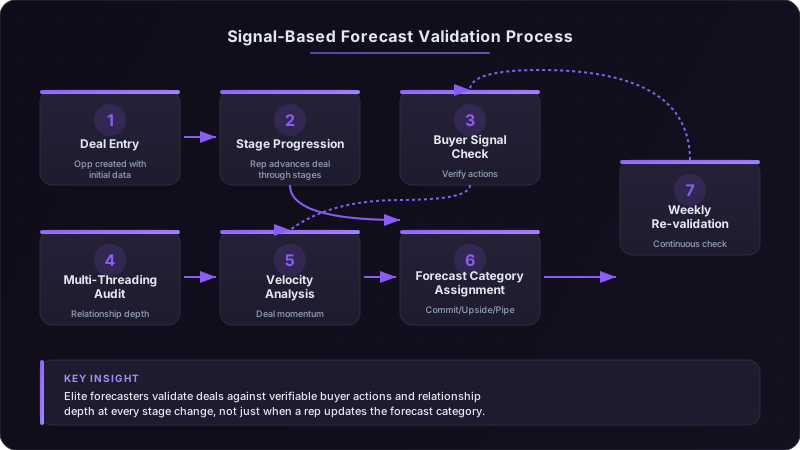
5 Sales Forecasting Mistakes Costing You 30% of Your Pipeline
Data from 200+ quarterly forecast reviews reveals the hidden errors that inflate commit numbers and destroy credibility. Here's what elite revenue teams do differently.
The SDR-AE Handoff Is Killing 27% of Your Qualified Pipeline
Poor handoff processes cost companies up to 30% of qualified opportunities. Here's the exact framework that fixes it, backed by data from 200+ sales teams.