ABM + Sales: How to Finally Align Marketing and Sales on Target Accounts
Account-based marketing fails when sales and marketing aren't aligned. Here's the playbook for true ABM success.
I've run ABM programs at three different companies. The first one was a spectacular failure. We spent six months building a "target account list" of 500 companies, created beautiful personalized landing pages, ran LinkedIn ads against those accounts, and generated... almost nothing. Pipeline was flat. Sales ignored our "marketing qualified accounts." And the CMO started asking hard questions about ROI.
The problem wasn't our tactics. It was that marketing and sales were running two completely different programs and calling both "ABM."
Here's what I've learned since then about making ABM actually work.
Why Most ABM Programs Fail
Let me be blunt: ABM fails because of people, not technology. I've seen companies buy six-figure ABM platforms, configure every feature, and still get nothing because their marketing and sales teams operate like separate companies.
If your sales team can't name the top 25 accounts marketing is targeting, you don't have ABM. You have marketing running campaigns with a shorter list.
The symptoms show up fast:
- Marketing picks accounts based on firmographic fit. Sales picks accounts based on existing relationships. Overlap? Maybe 20%.
- Marketing sends nurture emails. Sales sends cold outreach. Same account, different messages, neither team aware of the other.
- Marketing measures engagement scores. Sales measures pipeline. Nobody connects the two.
- Quarterly business reviews become blame sessions. Marketing says "we generated MQAs." Sales says "those accounts weren't real opportunities."
I lived this exact scenario. And fixing it required dismantling how both teams thought about their jobs.
The ABM Alignment Framework That Actually Works
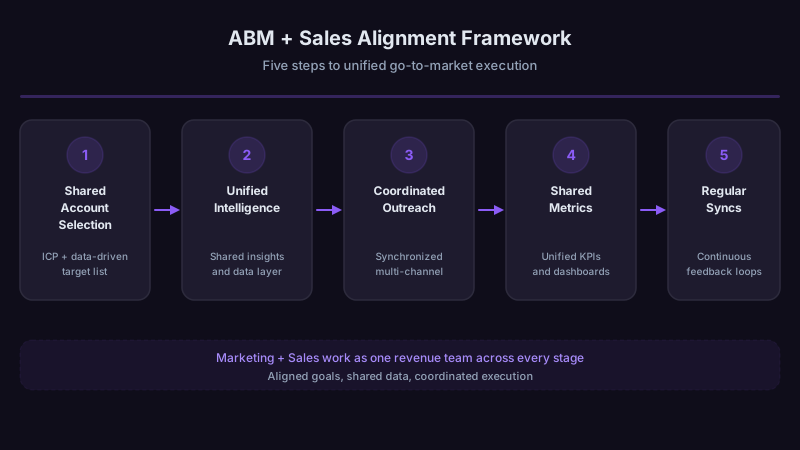
After failing forward through multiple ABM iterations, here's the framework I've settled on. It's not complicated, but the hard part is execution, not strategy.
This sounds obvious. It's not. Most companies have marketing build a list, present it to sales, and ask for buy-in. That's backwards.
Here's what works: get sales leaders and marketing leaders in the same room. Pull up your CRM. Pull up your intent data. And build the list together using these four criteria:
| Criterion | Who Owns It | How to Score |
|---|---|---|
| ICP fit (firmographics, technographics) | Marketing | Score 1-5 based on your best customer profile |
| Revenue potential | Sales | Estimate based on similar accounts won |
| Existing relationships | Sales | Do we know anyone? How senior? |
| Buying signals (intent, engagement) | Marketing | Intent data + website visits + content downloads |
The sweet spot is accounts that score high on at least three of these four. That's your Tier 1 list. Keep it to 25-50 accounts max. Yes, that's small. That's the point. ABM isn't demand gen with a filter, it's focused investment in accounts that matter.
:::callout[Tier Structure]{type=tip}
I use three tiers: Tier 1 (25-50 accounts, full 1:1 treatment), Tier 2 (100-200 accounts, 1:few campaigns), Tier 3 (industry/segment targeting, 1:many). Only Tier 1 is true ABM. Be honest about that.
:::
Once you have your list, every piece of information about those accounts needs to live in one place where both teams can see it.
At my last company, we had marketing tracking engagement in Marketo, sales tracking conversations in Salesforce, SDRs tracking outreach in Outreach, and customer success tracking usage in Gainsight. Four systems, zero shared visibility.
We fixed this by creating an account-level dashboard that pulled signals from everywhere:
- Firmographic updates: funding rounds, leadership changes, office expansions, earnings reports
- Intent signals: what topics are they researching? Where are they in the buying journey?
- Engagement history: every marketing touch and sales touch, chronologically
- Contact map: who we know, who we need to know, and the relationships between stakeholders
- Competitive intelligence: are they using a competitor? Is the contract up for renewal?
The rule was simple: if you learn something about a Tier 1 account, it goes in the system. Sales call notes, marketing event attendance, SDR call disposition, everything.
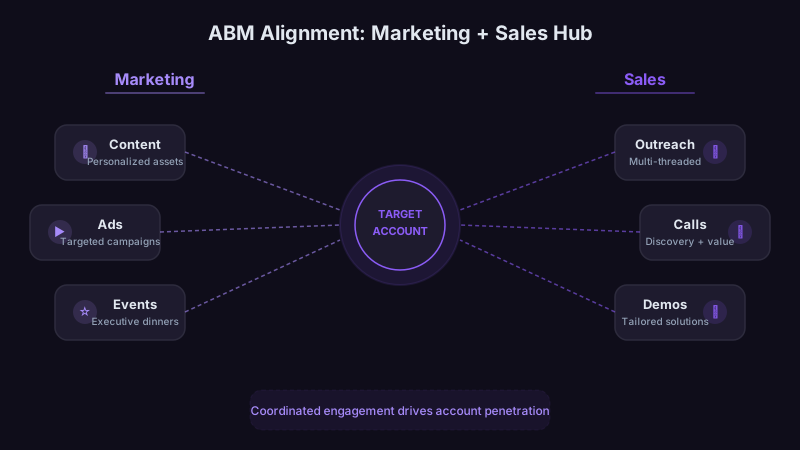
This is where most ABM programs get it right conceptually and wrong practically. Everyone agrees that marketing and sales should coordinate. But coordinating day-to-day outreach across two teams with different tools, priorities, and workflows is genuinely hard.
Here's how I structure it. For each Tier 1 account, we define a "play" based on where they are:
Cold accounts (no engagement yet)
- Marketing runs targeted ads and content syndication
- Sales does NOT cold-call yet
- Goal: generate enough awareness that outbound feels warm
Warming accounts (showing intent signals)
- Marketing increases ad frequency, sends direct mail, invites to events
- Sales begins personalized outreach to 2-3 contacts
- Both teams reference the same messaging framework
- Goal: get a meeting
Active accounts (in conversations)
- Marketing provides air cover: case studies, analyst reports, ROI tools
- Sales runs the deal
- Marketing creates custom content if the deal warrants it
- Goal: advance the opportunity
Post-close accounts (customers)
- Marketing shifts to customer marketing
- Sales/CS focuses on expansion
- Goal: grow the account
If marketing is measured on MQLs and sales is measured on closed revenue, ABM will fail. Full stop. You need shared metrics.
Here's what I track:
:::stats
85% | Target account coverage (% of Tier 1 accounts with active engagement)
3.2x | Pipeline-to-spend ratio on ABM accounts vs. non-ABM
42% | Win rate on ABM accounts (vs. 18% overall)
$187K | Average deal size on ABM accounts (vs. $72K overall)
:::
The metrics that matter most:
- Account engagement score: are more people at the account engaging with us over time?
- Pipeline generated from Tier 1 accounts: not MQLs, not MQAs, pipeline dollars
- Win rate on ABM accounts vs. non-ABM: this is your proof that the program works
- Average deal size: ABM should produce larger deals because you're targeting bigger accounts with more personalized outreach
Kill vanity metrics. Nobody cares how many impressions your LinkedIn ads got against target accounts.
Every Monday morning, our ABM team meets for 30 minutes. Marketing, sales, SDRs, and sometimes product marketing. We review:
1. Movement: which Tier 1 accounts moved stages this week? Why?
2. Signals: any new intent signals, engagement spikes, or news?
3. Plays: what's the coordinated plan for each active account this week?
4. Blockers: what's stalled, and what can we do about it?
This meeting is non-negotiable. It's where alignment actually happens. Strategy decks and SLAs don't create alignment. Weekly face-to-face coordination does.
Common ABM Mistakes (I've Made All of Them)
ABM is not "run a campaign against a list." It's an ongoing, always-on program. When I shifted from thinking about ABM in campaign sprints to thinking about it as a persistent motion, results improved dramatically.
Mistake 2: Personalizing the wrong things. Companies spend hours creating personalized landing pages with the prospect's logo and name. That's cosmetic personalization. Real personalization means understanding that Company X just lost their VP of Sales and will need to rebuild their pipeline strategy, then creating outreach around that insight.
Mistake 3: Trying to scale too fast. Your first ABM program should be 10-25 accounts. I know it feels small. Do it anyway. Learn what works with those accounts before expanding. The company that runs great ABM for 25 accounts will outperform the company running mediocre ABM for 500.
Mistake 4: No executive buy-in. ABM requires sales and marketing leadership to agree on shared goals, shared accounts, and shared metrics. If your CRO and CMO aren't in a room together deciding this, you're building on sand.
Mistake 5: Giving up too soon. ABM takes time. The average enterprise deal cycle is 6-9 months. You won't see pipeline impact for at least two quarters. Set expectations early and track leading indicators (engagement, meetings booked) while you wait for lagging indicators (pipeline, revenue).
A 90-Day ABM Launch Plan
If you're starting from scratch or resetting a failed program, here's what the first 90 days look like:
| Timeframe | Focus | Deliverables |
|---|---|---|
| Days 1-14 | Foundation | Shared ICP definition, account selection criteria, joint kickoff with sales |
| Days 15-30 | Account selection | Tier 1 list (25-50), tier structure, account research completed |
| Days 31-45 | Play design | Stage-based plays documented, content mapped to each stage, outreach templates |
| Days 46-60 | Launch | Ads running, SDR outreach started, weekly review cadence established |
| Days 61-90 | Optimize | First results analyzed, plays adjusted, early wins documented and shared |
Before you do anything else, schedule a meeting with your sales counterpart. Just the two of you. Ask one question: "If we could only focus on 25 accounts for the next six months, which ones would they be?" The conversation that follows will tell you everything about your alignment, or lack of it.
The Bottom Line
ABM works. I've seen it produce 3x higher win rates, 2x larger deal sizes, and significantly better unit economics than spray-and-pray demand gen. But only when marketing and sales are genuinely aligned, same accounts, same intelligence, same goals, same weekly rhythm.
The companies that get this right don't treat ABM as a marketing program. They treat it as a revenue program that both teams own equally. That's the difference between ABM that shows up in slide decks and ABM that shows up in bookings.
Ready to transform your sales pipeline?
See how Prospectory's AI-powered platform can help your team research, reach, and relate to prospects at scale.
Related Articles
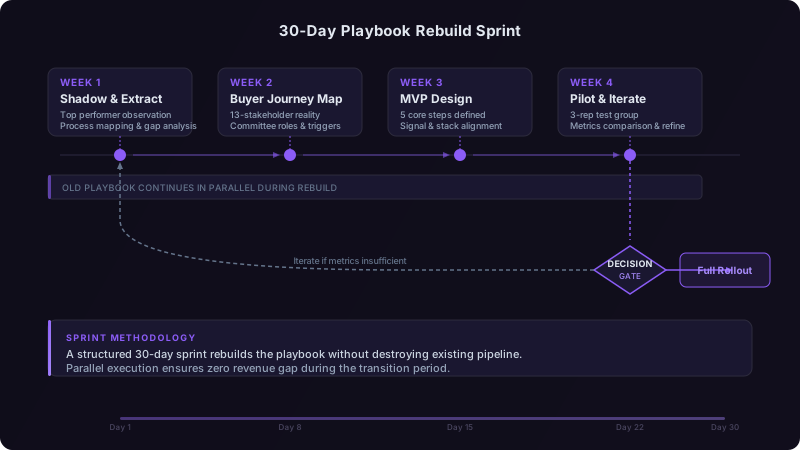
When to Fire Your Sales Playbook and Start Over
Five signals your playbook is broken beyond repair, plus a 30-day sprint framework for rebuilding from first principles without killing pipeline.
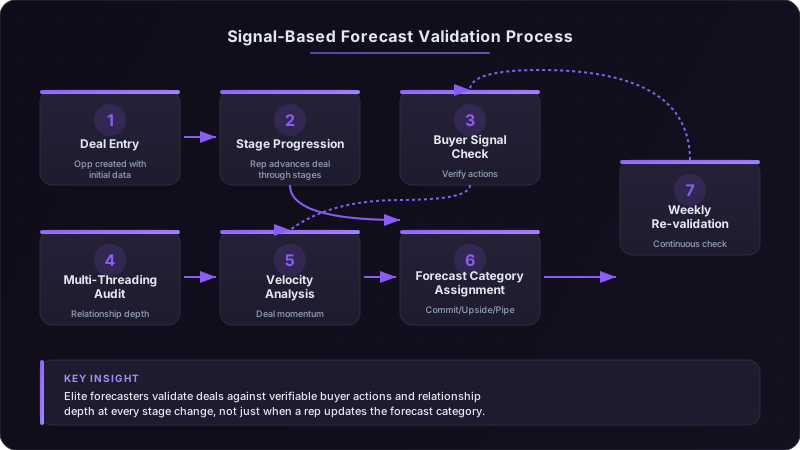
5 Sales Forecasting Mistakes Costing You 30% of Your Pipeline
Data from 200+ quarterly forecast reviews reveals the hidden errors that inflate commit numbers and destroy credibility. Here's what elite revenue teams do differently.
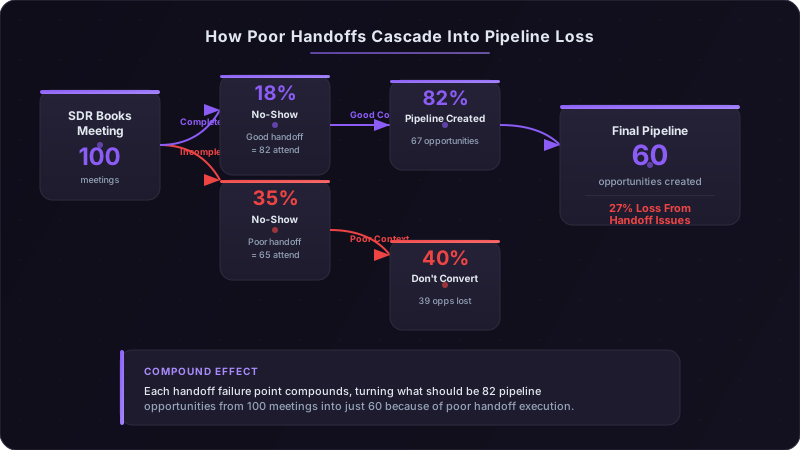
The SDR-AE Handoff Is Killing 27% of Your Qualified Pipeline
Poor handoff processes cost companies up to 30% of qualified opportunities. Here's the exact framework that fixes it, backed by data from 200+ sales teams.