The Science of Sales Sequences: Optimal Timing, Channels, and Cadence
Random follow-ups don't work. Learn the data-driven approach to building sequences that convert at 3x the industry average.
Six months ago I ran an experiment across our outbound team. I took our three highest-performing reps and our three lowest-performing reps and compared everything: messaging, timing, channel mix, follow-up cadence, and prospect targeting.
The targeting was roughly the same. The messaging quality was close. What separated a 7% reply rate from a 34% reply rate was sequence structure: how many touches, what channels, what order, what timing, and what happened between steps.
Sequence design is the most under-optimized part of outbound sales. Most teams copy a template from a blog post (ironic, I know), set it up in their sequencing tool, and never revisit it. The teams that treat sequences like a testable, improvable system consistently outperform everyone else.
I've spent the last three years running our outbound operations -- building, testing, and iterating on sequences. Here's everything I've learned about what actually works.
The Data Behind Sequence Performance
Let me start with the numbers that should frame your thinking.
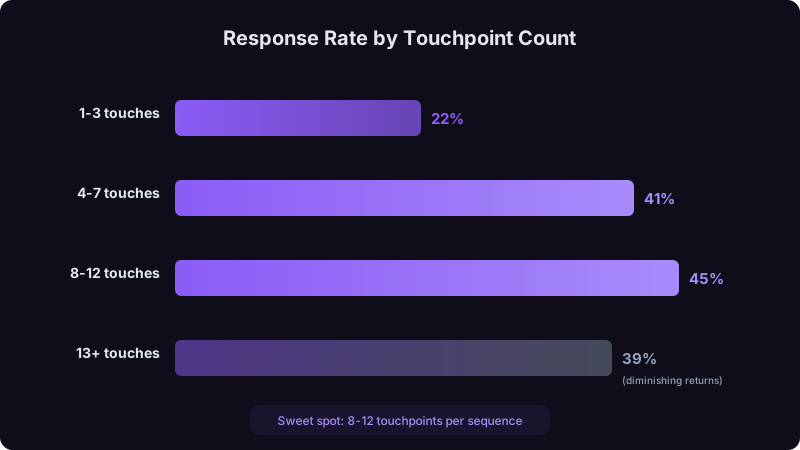
We analyzed 14,000 outbound sequences across our team over 18 months. Combined with published research from Outreach, Salesloft, and Gong, the patterns are consistent:
| Touchpoints | Average Response Rate | Notes |
|---|---|---|
| 1-3 | 9-15% | Most teams stop here |
| 4-7 | 22-30% | Significant jump from adding touches |
| 8-12 | 35-45% | Sweet spot for most B2B sales |
| 13+ | 38-42% | Diminishing returns; risk of annoyance |
The thing that surprised me most: the jump from 3 to 7 touchpoints was worth more than doubling our response rate. We'd been leaving meetings on the table by quitting too early.
The Five Principles of Sequence Design
Before I get into the tactical framework, here are the principles I use to evaluate any sequence.
Principle 1: Every touch earns the next one
The worst sequences treat each step as "checking in" or "bumping this to the top of your inbox." Those phrases should be banned from your org. Each touchpoint should deliver something new: a relevant insight, a useful resource, a provocative question, a customer proof point.
If you can't articulate what new value a touch adds, cut it.
Principle 2: Channels should vary, not repeat
Sending seven emails in a row trains your prospect to ignore you in email. Mixing channels -- email, LinkedIn, phone, even video -- breaks pattern and increases the chance that one channel catches them at the right moment.
Principle 3: Timing should mirror attention, not your calendar
Don't space touches evenly because it's neat. Front-load when interest is fresh. Space out as time passes. The research is clear: engagement drops sharply after the first week, so your early touches matter most.
Principle 4: Engagement signals should change the path
A sequence that runs identically regardless of prospect behavior is a missed opportunity. If someone opens your email three times but doesn't reply, that's a different signal than no opens at all. Build branching logic.
Principle 5: The sequence serves the prospect's timeline, not yours
Your prospect doesn't care about your end-of-quarter push. Sequences built around internal pressure (aggressive follow-ups to hit quota) perform worse than sequences built around the prospect's buying rhythm.
The Multi-Channel Sequence Framework
Here's the framework we use for cold outbound to mid-market prospects (companies with 100-2,000 employees). I'll share the full day-by-day, then break down the reasoning.
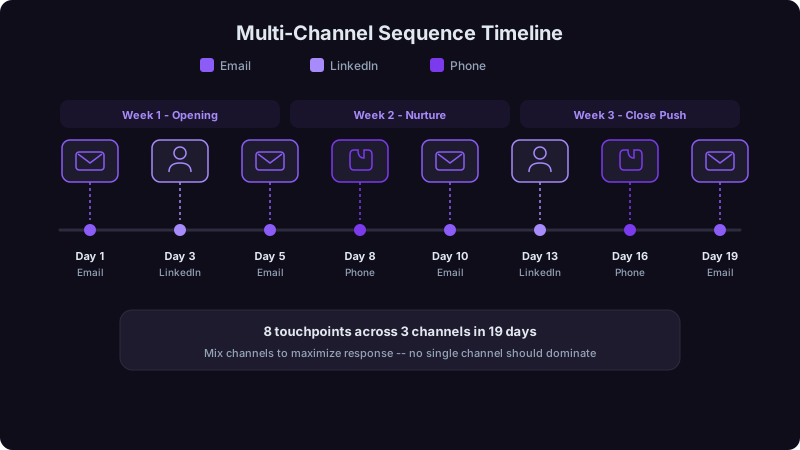
Focus on one specific, relevant observation about their business. No product pitching. No feature lists. One sentence about them, one sentence about why that's relevant, one clear question.
Subject line: short, lowercase, conversational. Our best performers: questions, specific references, or pattern interrupts.
With a note. Keep it to 2 sentences. Reference the email: "Sent you a note about [topic] -- figured I'd connect here too." This creates a multi-channel presence early.
Just view their profile. No message. Many people check who viewed their profile. This creates a subtle third touchpoint without being pushy.
Don't reference your first email. Bring something new: a relevant stat, a customer story from their industry, a link to a useful piece of content (not your marketing collateral -- something genuinely useful like industry research).
Call with a prepared 15-second opener. If you get voicemail, leave a message that references one of your emails. Keep it under 30 seconds. "Hi [name], this is [you] from [company]. I sent you a note about [topic]. Curious to hear your take -- I'll follow up with one more thought by email."
Different channel, new angle. Share a specific insight relevant to their role or industry. Something like: "Noticed [their company] is expanding into [market]. Worked with [similar company] on a similar move -- happy to share what we learned if useful."
Lead with a customer result from a similar company. "[Similar Company] was dealing with [problem]. They [outcome] in [timeframe]. I think there's a parallel to what you're doing at [prospect company]."
Second call attempt, different time of day than the first. If voicemail: reference something specific from their LinkedIn activity or company news.
Not a guilt-trip breakup. A genuine, respectful close. "I've shared a few ideas about [topic] -- if the timing isn't right, no worries. I'll keep an eye on [something relevant to their business] and circle back if I see something worth sharing."
If they engaged at all (opened emails, viewed your LinkedIn profile) but never replied: one final touch. New angle, new value. If zero engagement: move to a nurture sequence with monthly touchpoints.
Testing Methodology: How to Actually Optimize
Building a sequence is the beginning. Optimizing it is where the real results come from. Here's our testing process.
What to test (in priority order)
| Variable | Impact Level | Test Method | Sample Size Needed |
|---|---|---|---|
| Subject lines | High | A/B test, 2 variants | 200+ sends per variant |
| Email body (first line) | High | A/B test | 200+ sends per variant |
| Number of touchpoints | High | Compare cohorts | 500+ prospects per cohort |
| Channel sequence order | Medium | A/B test | 300+ per variant |
| Timing between touches | Medium | A/B test | 300+ per variant |
| Send time (hour/day) | Low-Medium | A/B test | 200+ per variant |
| CTA phrasing | Medium | A/B test | 200+ per variant |
The testing rules we follow
Test one variable at a time. Changing the subject line AND the email body simultaneously tells you nothing about what caused the difference.
Run tests to statistical significance. This is the one most teams skip. A 50-person test that shows "Variant A got 12% replies vs Variant B at 8%" is not a result. That's noise. You need enough volume for the difference to be meaningful.
Test against a control, not against nothing. Always keep your current best-performing sequence running as the control. New variants compete against the champion, not against each other.
Document everything. We maintain a simple spreadsheet: test name, hypothesis, variants, sample size, start date, end date, results, decision. After 18 months, this document is our most valuable outbound asset.
Don't test send times until you've optimized everything else. The difference between sending at 8am vs 10am is almost always smaller than the difference between a good subject line and a bad one. Optimize the high-impact variables first.
Channel Mix: What the Data Shows
Our data across 14,000 sequences breaks down channel effectiveness like this:
| Channel | Reply Rate (Solo) | Reply Rate (In Multi-Channel Sequence) | Best For |
|---|---|---|---|
| 5-8% | 12-18% | First touch, value delivery, documentation | |
| LinkedIn Message | 8-12% | 15-22% | Relationship building, content sharing |
| Phone | 2-4% connect rate | 8-12% connect rate | Urgency, complex conversations, warm follow-up |
| Video (Loom/Vidyard) | 10-15% | 18-25% | Standing out, demonstrating effort |
| SMS | 15-25% (warm only) | N/A | Post-meeting follow-up, event-triggered only |
Video messages (60-90 second Loom recordings) are the single highest-performing touch type in our sequences when used as touch 3 or 4. They signal effort and personalization in a way text can't. But they don't scale, so use them selectively for high-value prospects.
The key finding: every channel performs significantly better inside a multi-channel sequence than it does alone. Email that gets 5-8% solo gets 12-18% when the prospect has also seen you on LinkedIn. The channels reinforce each other.
Timing Optimization
Day of week
Our data (B2B mid-market, US-based):
- Tuesday-Thursday: Highest reply rates
- Monday: Decent, but avoid first thing in the morning (inbox overload)
- Friday: Lower volume but higher reply rate per send (less competition)
- Weekend: We don't send. Some teams report good results with Sunday evening sends that land at the top of Monday's inbox, but it feels wrong to me.
Time of day
- 7:00-8:00 AM (prospect's time zone): Highest open rate for email
- 11:00 AM - 12:00 PM: Best for phone connects (pre-lunch window)
- 4:00-5:00 PM: Second-best phone window
- After 6 PM: Don't. Respect boundaries.
Spacing between touches
Our framework uses decreasing frequency:
| Phase | Days | Spacing | Rationale |
|---|---|---|---|
| Opening burst | 1-5 | Every 1-2 days | Capture attention while interest is fresh |
| Mid-sequence | 5-12 | Every 3-4 days | Maintain presence without fatigue |
| Late sequence | 12-19 | Every 4-7 days | Persistence without pressure |
| Re-engagement | 19-30 | One touch | Final attempt with new angle |
Sequence Metrics: What to Track
| Metric | What It Tells You | Healthy Benchmark | Action If Below |
|---|---|---|---|
| Open rate | Subject line + deliverability | 45-65% | Test subject lines; check spam score |
| Reply rate (total) | Overall sequence effectiveness | 15-25% | Review messaging and targeting |
| Reply rate (positive) | Quality of replies | 8-15% | Better targeting; more relevant messaging |
| Meetings booked rate | End-to-end conversion | 5-10% of prospects | Review full sequence + qualification criteria |
| Bounce rate | Data quality | Under 3% | Clean your data; verify emails before sending |
| Unsubscribe rate | Relevance and frequency | Under 1% | You're targeting wrong or too aggressive |
| Opt-out at step N | Which touch is pushing too far | Should not spike at any step | Revise or remove the problem touch |
The Mistakes That Kill Sequences
Starting with "I" instead of "you." Audit your sequences right now. If any email starts with "I wanted to reach out" or "I'm the [title] at [company]," rewrite it. Start with the prospect. "Your team's expansion into [market] caught my attention" is a different opening than "I help companies expand into new markets."
Identical follow-ups. "Just following up on my last email" is the most-sent and lowest-performing sentence in outbound. If your follow-up doesn't contain new information, it's not a follow-up. It's spam.
No branching logic. A prospect who opened your email four times is showing interest. They should get a different next touch than someone who never opened. At minimum, build two branches: engaged (opens/clicks) and unengaged (no activity).
Sequences that are too long OR too short. Under 5 touches leaves money on the table. Over 14 touches rarely improves results and increases opt-out risk. The sweet spot for most B2B outbound is 8-12 touches over 3-4 weeks.
Not personalizing the first AND last touch. Most teams personalize email one and template everything else. The breakup email matters too. A personalized close ("I'll be watching how your [specific initiative] develops") leaves a better impression than "If the timing isn't right, I'll stop reaching out."
Treat your sequences like a product. Build deliberately, measure everything, test continuously, and iterate based on data. The teams running the same sequence they built a year ago are being outperformed by teams that test weekly. Sequence optimization is the highest-ROI activity in outbound operations, and most teams barely do it at all.
Ready to transform your sales pipeline?
See how Prospectory's AI-powered platform can help your team research, reach, and relate to prospects at scale.
Related Articles
The Follow-Up Problem: Why 80% of Sales Emails Never Get a Second Touch
Most sales sequences die after one email. Here's the data-backed 5-touch framework that increased our response rates from 3.4% to 18.2%.
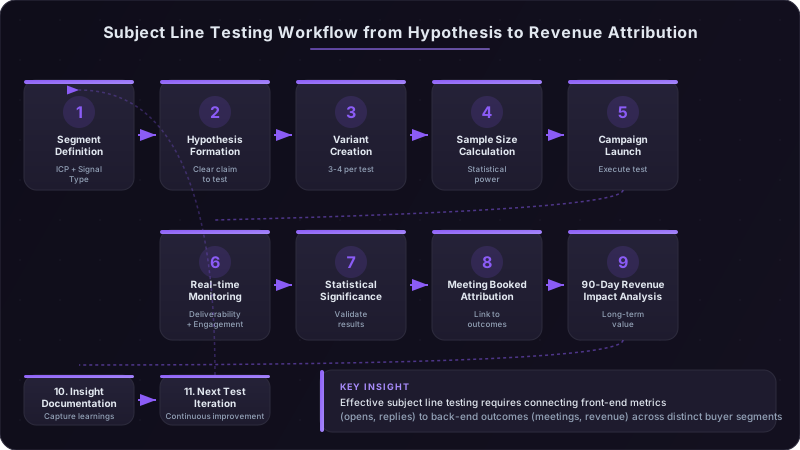
Subject Line Testing That Actually Drives Pipeline, Not Just Opens
Most teams optimize for open rates and lose deals. Here's how to test subject lines for reply rates and meeting conversion across different buyer segments.
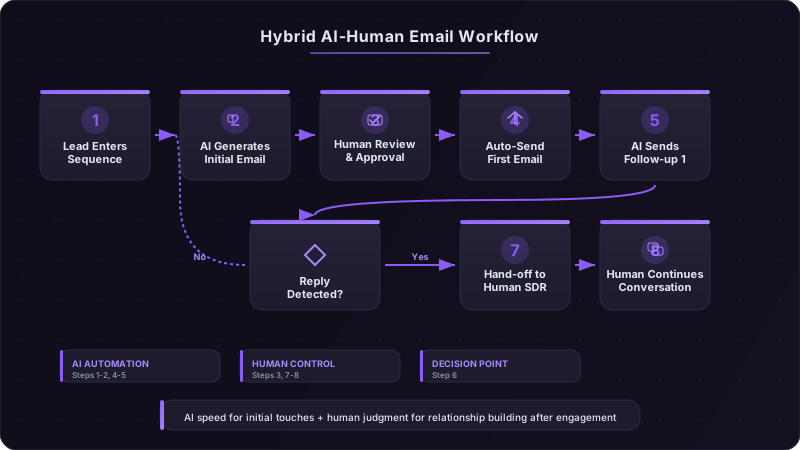
AI vs. Human Email Writing: What 10,000 Emails Taught Us About Reply Rates
We tested AI-generated emails against human-written outreach across 10,000 sends. The results surprised us, and they'll change how you think about email automation.