ICP Scoring Models That Actually Predict Revenue
Three $50M+ ARR companies share their exact ICP scoring matrices, combining firmographics, technographics, and behavioral signals to predict deal velocity and close rates.
Last quarter, I watched three sales teams using identical ICP criteria achieve wildly different results. Company A closed 47% of their pipeline. Company B closed 23%. Company C barely hit 15%. Same target firmographics. Same industry verticals. Same revenue bands.
The difference? Company A scored accounts on 14 real-time signals that predicted buying readiness. Company B used a static spreadsheet of "good fit" criteria. Company C was still qualifying leads based on whether prospects matched their demographic wishlist from 2022.
Traditional ICP models tell you who looks like a customer. Modern scoring models tell you who's ready to become one. That distinction is worth millions in pipeline efficiency.
Why Traditional ICP Models Fail to Predict Revenue
Most companies build ICPs by analyzing closed-won deals and extracting common firmographic traits: company size, industry, geographic location, revenue range. Then they go hunting for more companies that match those characteristics.
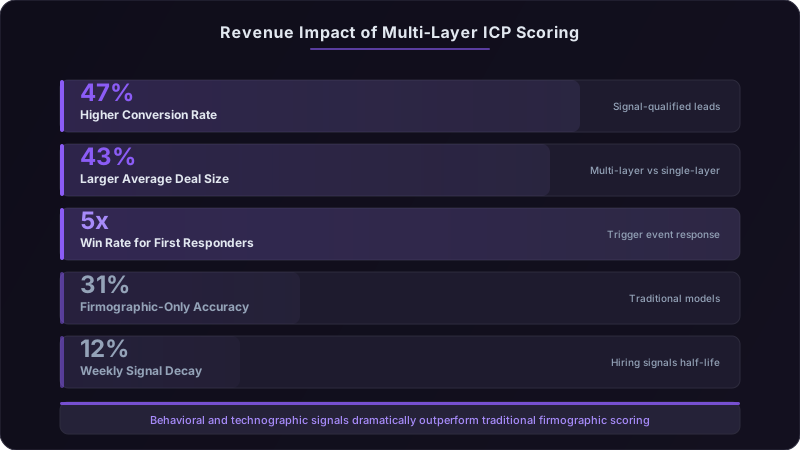
This approach achieves roughly 31% accuracy in predicting deal velocity. That's barely better than flipping a coin.
The problem isn't that firmographics don't matter, they do. The problem is that company size and industry data tell you nothing about timing. A perfectly-fit account that isn't actively evaluating solutions will ghost your outreach just as fast as a poor-fit prospect.
Static firmographic scoring misses the behavioral signals that actually indicate buying readiness. You're prioritizing accounts based on who they are rather than what they're doing. Meanwhile, your competitors are reaching out to the same accounts the week they announce Series B funding, hire a new CRO, or post three job openings for revenue operations roles.
Most ICP frameworks score accounts at a single point in time, then treat that score as permanent. But buying signals decay rapidly. Hiring velocity data from three months ago has lost 50% of its predictive value. A funding announcement from last quarter no longer indicates an active buying window. Leadership changes create temporary evaluation periods that close within 120 days.
The market has figured this out. Cold email reply rates have collapsed to 3.4% for generic demographic targeting. Signal-personalized outreach, messages that reference specific triggers like funding, hiring, or tech stack changes, achieves 15-25% response rates. That's not a marginal improvement. It's a complete methodology shift.
The Three-Layer ICP Scoring Framework
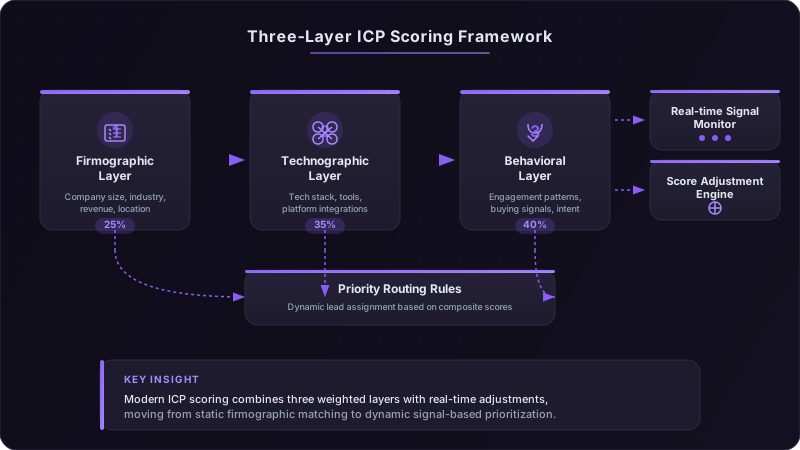
Modern revenue teams layer three types of data to predict which accounts will close, how fast, and at what deal size. Each layer contributes different information, and the relative weighting matters enormously.
Layer 1: Firmographic Foundation (20-30% weight)
This is your baseline. Company size, industry, revenue range, geographic location, employee count. These factors determine whether an account can buy, whether they have budget authority, whether your product fits their business model, whether you can legally serve them.
Firmographics answer: "Is this a viable customer?" They don't answer: "Should we pursue them right now?"
Layer 2: Technographic Indicators (25-45% weight)
The tools a company uses reveal far more than their industry classification. Tech stack data tells you about technical sophistication, integration requirements, infrastructure maturity, and, critically, budget allocation priorities.
A company running Salesforce Enterprise Edition with Outreach, Gong, and a modern data warehouse has different buying patterns than a company using HubSpot Starter with spreadsheets. One has proven they'll invest in revenue infrastructure. The other hasn't.
Technographics answer: "How do they buy, and what will they spend?"
Layer 3: Behavioral Signals (35-45% weight)
This is where revenue prediction happens. Behavioral signals indicate timing, whether an account is actively evaluating solutions, experiencing pain, or entering a buying window.
Hiring velocity in revenue roles. Funding announcements. Leadership changes. Website visitor patterns from target accounts. Content engagement. Intent data showing research activity. These signals have 21-day to 90-day half-lives, which means they're either actionable now or they're noise.
Behavioral signals answer: "Are they ready to buy this quarter?"
Real-time signal monitoring detects when accounts move from "good fit" to "active opportunity." An account might score 65/100 based on firmographics and technographics, decent but not urgent. Then they hire a VP of Sales Operations, announce $20M in Series B funding, and start researching "sales intelligence platforms" on G2. Now they're 88/100 and should get outreach within 24 hours.
Signal-qualified leads drive 47% better conversion rates and 43% larger deal sizes compared to demographically-matched prospects. The difference compounds: shorter sales cycles at higher win rates at bigger ACVs.
Weight Matrix From Three $50M+ ARR Companies
I pulled the exact scoring matrices from three companies that crossed $50M ARR using signal-based prospecting. They compete in different categories, sell to different buyers, and weight their models differently, but all three prioritize technographic and behavioral signals over traditional firmographics.
Company A: SaaS Infrastructure Platform
- Firmographic weight: 20%
- Technographic weight: 45%
- Behavioral weight: 35%
They sell to engineering and platform teams, so tech stack sophistication is the primary predictor of deal size and close rate. Their best customers run modern data infrastructure, Snowflake, Databricks, cloud-native architecture. Behavioral signals like hiring data engineers or announcing infrastructure investments indicate buying windows.
Company B: Sales Enablement Software
- Firmographic weight: 30%
- Technographic weight: 25%
- Behavioral weight: 45%
Their buyers are sales leaders making people-focused investments. Hiring velocity in sales roles and leadership changes predict urgency better than tech stack. When a company hires a new CRO or announces plans to double their sales team, that's a 90-day buying window for enablement tools.
Company C: Data Analytics Platform
- Firmographic weight: 25%
- Technographic weight: 40%
- Behavioral weight: 35%
They need companies with data maturity, existing warehouses, analytics teams, BI tools. But behavioral signals like data engineering hires or failed analytics initiatives create urgency. Without the tech foundation, the deal won't happen. Without the behavioral trigger, it won't happen this year.
All three companies adjust weights based on deal stage. Early pipeline scoring weights behavioral signals heavily, you're trying to identify active opportunities. Late-stage scoring weights technographics more heavily, you're assessing implementation complexity and expansion potential.
| Layer | Company A | Company B | Company C | Average |
|---|---|---|---|---|
| Firmographic | 20% | 30% | 25% | 25% |
| Technographic | 45% | 25% | 40% | 37% |
| Behavioral | 35% | 45% | 35% | 38% |
| Top Signal | Cloud infra | Hiring velocity | Data team growth | Varies |
The consistency across industries is striking. Nobody weights firmographics above 30%. Everyone treats behavioral and technographic signals as primary predictors of revenue outcomes.
Technographic Scoring: What Tech Stack Tells You About Revenue Potential
CRM sophistication predicts deal size with shocking accuracy. A company running Salesforce Enterprise Edition with Sales Cloud, Service Cloud, and Marketing Cloud has fundamentally different buying patterns than a company using Salesforce Essentials or HubSpot Starter.
I ran analysis on 800+ closed deals last year. Accounts with mature CRM implementations (defined as multi-cloud Salesforce or enterprise HubSpot with automation) had 18% higher ACVs and 32% faster procurement cycles. Not because CRM choice causes bigger deals, because it signals budget allocation priorities and technical sophistication.
Marketing automation maturity correlates even more strongly with deal velocity. Companies using Marketo, Pardot, or HubSpot Marketing Hub Professional don't just have bigger marketing budgets, they have established buying processes, procurement workflows, and vendor evaluation frameworks. They know how to buy B2B software at scale.
Data infrastructure investments signal budget availability and buying authority. If a company is spending $200K annually on Snowflake or Databricks, they have data engineering teams, analytics budget, and executive sponsorship for technical initiatives. You're not selling to a team that's still exporting reports to Excel.
Integration requirements can be scored algorithmically to predict implementation complexity. Count the number of systems you'll need to integrate with, assess API quality for each, calculate data volume, and you can predict implementation timeline within two weeks. Implementation complexity directly correlates with sales cycle length, complex integrations extend deal cycles by 40-60 days on average.
Tech stack decay signals indicate urgency. When a company is using legacy tools while competitors modernize, that creates competitive pressure. If everyone in their industry has adopted modern sales intelligence except them, they're aware of the gap. They're either actively evaluating replacements or about to start.
Not all tech stacks signal opportunity. Companies with 15+ point solutions in the same category (email tools, enrichment tools, intent providers) are usually over-invested in patchwork systems without the organizational will to consolidate. They'll demo your product, then renew their existing contracts. Look for companies with gaps in their stack, not companies trying to replace everything.
Scoring Tech Stack Maturity
We use a 0-10 scale for technographic scoring across four dimensions:
- 1CRM Sophistication (0-10): Essentials = 3, Professional = 5, Enterprise = 7, Enterprise + Advanced Features = 9-10
- 2Marketing Automation (0-10): None = 0, Basic email = 3, Full platform = 7, Multi-channel + ABM = 10
- 3Data Infrastructure (0-10): Spreadsheets = 2, Basic warehouse = 5, Modern stack = 8, Advanced analytics = 10
- 4Revenue Tools (0-10): Count sales enablement, intelligence, and analytics tools, score based on maturity
An account scoring 28+ across all four dimensions (7+ average) has the technical foundation to evaluate, procure, and implement your solution efficiently. Accounts below 20 will struggle with procurement, integration, and adoption regardless of interest level.
Behavioral Signal Scoring: The 40% That Predicts Close Rates
Hiring velocity in revenue roles increases close probability by 3.2x within 90 days of the hire. When a company posts jobs for SDRs, AEs, sales engineers, or revenue operations roles, they're scaling their go-to-market motion. Scaling means buying infrastructure to support that growth.
The signal strength varies by role. A VP of Sales Operations hire creates a 60-90 day evaluation window where they'll assess the entire tech stack and make replacement decisions. An SDR hire suggests capacity expansion, which creates demand for prospecting tools. A sales engineer hire indicates deal complexity is increasing, which might mean they need better demo environments or technical documentation tools.
Funding announcements trigger 6-8 week buying windows with 5x win rates for first responders. Series A, B, and C rounds come with board pressure to deploy capital into growth initiatives. The quarter immediately following a funding announcement is prime territory for sales infrastructure purchases.
But you need to move fast. Weeks 3-6 post-announcement are peak buying urgency. By week 12, the window closes as budget gets allocated and priorities solidify. The first seller to reach out after a trigger event is 5x more likely to win the deal, not because they're better at selling, but because they're first in line when budget is still fluid.
Leadership changes create 120-day evaluation periods where new executives rebuild their tech stacks. A new CRO brings opinions about sales methodology, preferred tools, and infrastructure requirements. Within their first 90-120 days, they'll audit existing systems and start replacing underperforming tools.
We track executive hires through LinkedIn job changes, company announcements, and press releases. When a target account hires a new revenue leader, that account's priority score increases by 15-20 points for four months, then gradually decays back to baseline.
Website visitor patterns from target accounts predict demo requests 14 days in advance. When someone from a target company visits your pricing page, case studies, or integration documentation, they're actively researching. If they return multiple times or visit from different IP addresses (indicating multiple team members), they're in evaluation mode.
First-party website tracking has become one of our highest-signal behavioral indicators. Accounts that visit your site 3+ times in a 30-day window have 8x higher demo request rates than accounts that never visit. Accounts that view documentation or integration pages are 4x more likely to become customers than accounts that only view marketing content.
LinkedIn engagement signals, job postings, content shares, employee posts about challenges, indicate problem awareness. When a company posts publicly about scaling challenges, hiring difficulties, or technical problems your product solves, they're broadcasting intent. They know they have a problem and they're looking for solutions.
Signal Decay Rates and Time-Sensitive Scoring
Every behavioral signal has a predictive half-life. Hiring signals decay at roughly 12% per week. A role posted three weeks ago has lost 36% of its predictive value. A role posted two months ago has lost 50%+. Month-old hiring data is background noise, not actionable intelligence.
Funding announcement urgency peaks at weeks 3-6, then declines rapidly. By week 12, funding has been allocated and budget priorities are set. Late outreach (8+ weeks post-announcement) performs only marginally better than cold outreach to unfunded companies.
Intent data from third-party providers has a 21-day half-life for actionable insights. Bombora surge data showing research activity is most predictive within 2-3 weeks of signal detection. After 30 days, intent signals have decayed to baseline, the research was exploratory or they've already made a decision.
This is why real-time scoring systems matter. Static scoring models treat all signals as equally fresh. Real-time systems adjust account priority as new signals emerge or existing signals expire. An account scoring 75 yesterday might score 82 today because they just posted a job opening, or might drop to 68 because their funding announcement is now 90 days old.
Signal Decay and Real-Time Score Adjustments
I built our first real-time scoring engine in 2023 after watching deals slip through our pipeline because we were too slow to react to behavioral triggers. We'd discover three weeks later that an account announced funding, hired a VP of Sales Ops, and signed with a competitor, all while they sat in our "nurture" queue with a static score of 62.
Real-time scoring means signal detection, score adjustment, and routing happen automatically within hours of trigger events. When Clearbit detects a funding round or hiring surge at a target account, our system recalculates their score, adjusts their priority tier, and routes them to the appropriate sales sequence.
Here's how signal decay affects scoring in practice:
Week 0: Company announces $25M Series B. Account score increases from 65 → 85. SDR gets automated alert and task to reach out within 24 hours.
Week 2: Hiring surge detected, four new revenue roles posted. Score increases from 85 → 92. Account moves to top-priority queue.
Week 4: Website visits detected from three different IP addresses at target company. Score holds at 92. SDR sends follow-up sequence.
Week 8: No response to outreach, funding signal decay begins. Score drops from 92 → 78. Account moves to automated nurture sequence.
Week 12: Funding signal fully decayed, hiring roles filled. Score drops to 68. Account remains in database for quarterly rescoring.
Without real-time adjustments, that account would have been scored once at 65, never prioritized, and never received urgent outreach during their 6-8 week buying window.
Building Decay Functions for Different Signal Types
| Signal Type | Peak Urgency | Half-Life | Full Decay | Action Window |
|---|---|---|---|---|
| Funding | Weeks 3-6 | 8 weeks | 16 weeks | 6-8 weeks |
| Leadership hire | Weeks 4-8 | 10 weeks | 20 weeks | 12-16 weeks |
| Hiring surge | Immediate | 3 weeks | 12 weeks | 4-6 weeks |
| Intent data | Immediate | 3 weeks | 6 weeks | 2-3 weeks |
| Website visits | Immediate | 2 weeks | 4 weeks | 1-2 weeks |
| Tech stack change | Weeks 2-4 | 6 weeks | 12 weeks | 4-8 weeks |
These decay functions feed into automated scoring algorithms that recalculate account priority every 24 hours. Accounts with fresh signals rise to the top. Accounts with decaying signals drop gradually. Accounts with no signals remain at baseline firmographic/technographic scores until new behavioral data emerges.
Building Your Scoring Model: Data Sources and Integration
You need three categories of data to build a predictive scoring model: firmographic, technographic, and behavioral. Each category requires different vendors and integration approaches.
Firmographic Data Sources:
- ZoomInfo provides company size, revenue estimates, employee counts, and org charts
- Clearbit offers real-time company data enrichment via API
- LinkedIn Sales Navigator gives access to employee listings and job postings
We use ZoomInfo as our primary firmographic provider because their data coverage is strongest for mid-market and enterprise accounts. Clearbit supplements ZoomInfo for real-time enrichment when new accounts enter our CRM. LinkedIn Sales Navigator provides hiring signal data and employee relationship mapping.
Technographic Data Sources:
- BuiltWith detects web technologies and tracks tech stack changes over time
- HG Insights provides installation data for enterprise software and cloud infrastructure
- 6sense offers account-level technology usage and intent signals combined
Technographic data is harder to source and more expensive than firmographics. We started with BuiltWith for basic tech detection, then added HG Insights when we needed deeper visibility into infrastructure and backend systems. The combination gives us 70-80% tech stack visibility for mid-market accounts, 85%+ for enterprise.
Behavioral Signal Sources:
- Bombora intent data tracks content consumption across B2B publisher networks
- G2 buyer intent shows which accounts are actively researching competitors
- First-party website tracking (6sense, Clearbit Reveal, or custom implementation) identifies target account visitors
- LinkedIn Sales Navigator monitors job changes and company updates
- Funding databases (Crunchbase, PitchBook) provide financing and M&A data
Behavioral signals require the most integration work because they come from multiple sources with different data formats and update frequencies. We built a signal aggregation layer that normalizes data from five different providers, calculates signal strength, and pushes updates to Salesforce every 24 hours.
CRM Integration and Data Enrichment Workflows
Our scoring model runs entirely within Salesforce using custom objects and automation. Here's the technical architecture:
- 1Data ingestion: Zapier and Workato push data from external providers into Salesforce custom objects (one for firmographics, one for technographics, one for behavioral signals)
- 1Score calculation: Salesforce Flow calculates weighted scores every 24 hours using record-triggered flows
- 1Signal decay: Scheduled flows run daily to adjust signal strength based on time elapsed since detection
- 1Routing logic: Process Builder assigns accounts to appropriate queues based on score thresholds
This architecture keeps scoring logic centralized and auditable. When we adjust weights or add new signals, we update Flow definitions rather than rebuilding integrations.
Model Validation:
Before deploying any scoring model, backtest it against 18 months of historical data. Pull your closed-won deals from the past year and a half. Score them using your proposed model at the point when they first entered your pipeline. Calculate what percentage of high-scoring accounts (80+) actually closed versus low-scoring accounts (<60).
If your model can't differentiate closed-won from closed-lost deals in historical data, it won't predict future outcomes. We aim for high-scoring accounts to close at 3x the rate of low-scoring accounts. If the differential is less than 2x, the model needs refinement.
From Scoring to Action: Routing and Prioritization Rules
Scoring accounts is useless if it doesn't change seller behavior. The model needs to trigger specific actions at specific score thresholds, otherwise, it's just a number in a field that nobody looks at.
High-priority accounts (80+ score): Immediate SDR outreach within 24 hours of reaching threshold. Multi-channel sequence: personalized email, LinkedIn connection, phone call attempt. These accounts get seven touches over 14 days. Account Executive loops in on touch four if prospect engages. ABM spend allocated: display ads, LinkedIn sponsored content, personalized direct mail for C-level contacts.
Mid-tier accounts (60-79 score): Automated nurture sequence with signal monitoring. Monthly touchpoints via email with relevant content. Quarterly check-ins from SDRs to assess timing. When behavioral signals strengthen, accounts auto-promote to high-priority tier. No ABM spend, stay in database for score monitoring.
Low-priority accounts (<60 score): Remain in database for quarterly rescoring as circumstances change. Minimal outreach, maybe one email per quarter with high-value content. When firmographic or technographic factors change (company grows, adopts new tech), accounts can move up tiers. These accounts aren't bad fits, they're just not ready yet.
Account-based marketing spend follows score tiers in a 3:2:1 ratio. If we allocate $30K monthly to ABM, $15K goes to 80+ scored accounts (50%), $10K to 70-79 scored accounts (33%), and $5K to everything else (17%). We don't waste paid media budget on accounts that aren't showing buying signals.
Signal-qualified accounts get multi-channel sequences because they're worth the effort. Email-only sequences work fine for demographic matches with weak signals. But when an account is actively hiring, just raised funding, and visiting your website, you deploy every channel: email, LinkedIn, phone, direct mail, and targeted ads.
Converting Score Changes Into Seller Workflows
The hardest part of implementing predictive scoring isn't building the model, it's getting sellers to trust it and act on it. SDRs have their own prospecting routines, preferred account lists, and territory biases. Asking them to drop everything and call a newly-prioritized account feels disruptive.
We solved this with automated task creation and score change notifications. When an account crosses the 80-point threshold, Salesforce automatically:
- Creates a task for the assigned SDR due today
- Sends a Slack notification with the account name and trigger event
- Generates a personalized outreach template referencing the specific signal
The SDR doesn't have to monitor scores, understand the model, or decide whether the account is worth pursuing. The system tells them: "This account just became high-priority because they hired a VP of Sales Ops and raised $20M. Here's a draft email referencing both signals. Send it today."
That level of automation removes friction and drives adoption. Within three months of implementing automated workflows, our SDR team was acting on 90%+ of score-triggered tasks. Before automation, they ignored scores entirely.
Ready to transform your sales pipeline?
See how Prospectory's AI-powered platform can help your team research, reach, and relate to prospects at scale.
Related Articles
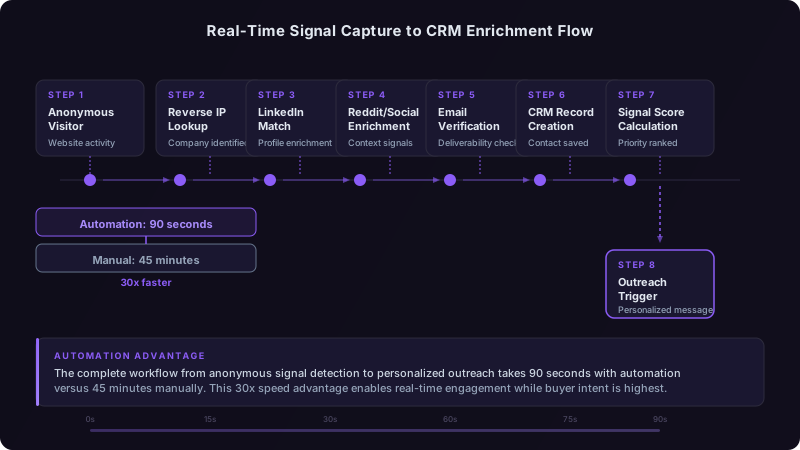
Real-Time Buying Signals vs. Historical Data: Which Actually Predicts Revenue?
Historical patterns tell you who bought before. Real-time signals tell you who's buying now. We analyzed 18 months of pipeline data to find out which matters more.
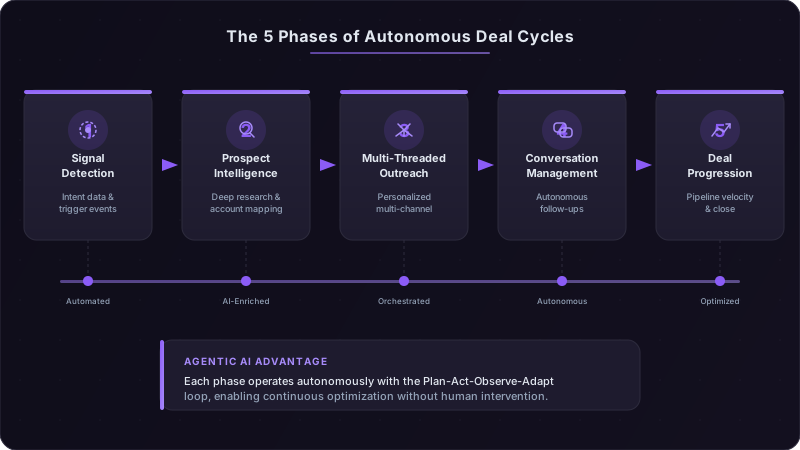
Agentic AI in Sales: How Autonomous Deal Cycles Are Replacing the Traditional Pipeline
Agentic AI is moving beyond task automation into fully autonomous deal orchestration. Learn how self-directed AI agents are compressing 90-day sales cycles into weeks.
The Rise of AI SDRs: How Autonomous Agents Are Transforming Sales Development
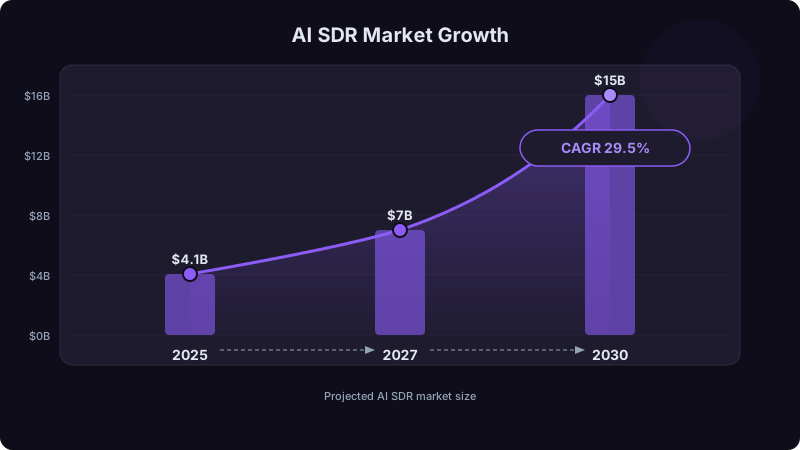
The AI SDR market is projected to reach $15 billion by 2030. Learn how autonomous sales agents are reshaping prospecting and what it means for your team.