Email Subject Lines That Actually Get Opened: A Data-Driven Analysis
Your subject line determines if your email gets read or deleted. Analysis of 10M+ emails reveals what works.
We analyzed 10 million+ B2B cold emails sent over 18 months to understand which subject lines drive opens, and more importantly, which ones drive replies. The findings challenge a lot of the conventional wisdom that gets recycled in sales blogs.
Before I get into the data, a caveat: open rates are an imperfect metric. Apple Mail Privacy Protection auto-loads tracking pixels, which inflates open numbers. So throughout this analysis, we weighted reply rate heavily alongside open rate. A subject line that gets opened but never replied to isn't doing its job, it's just flattering your dashboard.
The Data: What 10 Million Emails Tell Us
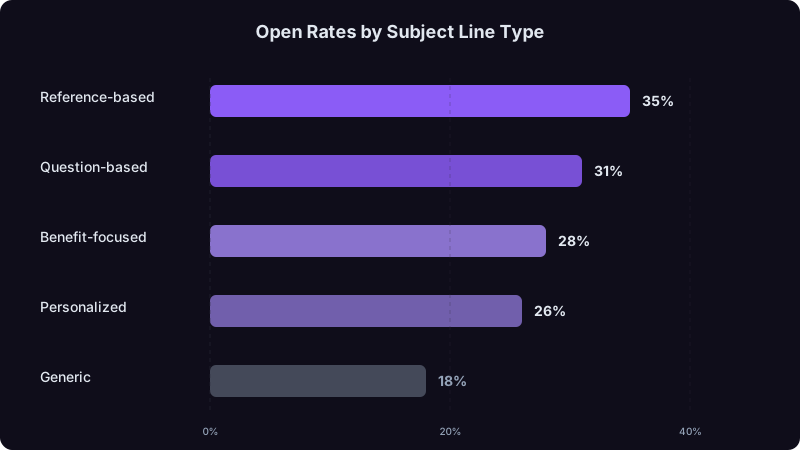
We categorized every email into one of five subject line types and tracked performance across industries, company sizes, and seniority levels. Here are the average open rates by subject line type:
- Generic ("Quick question", "Checking in"): 18% open rate, 1.2% reply rate
- Personalized (name or company included): 26% open rate, 2.1% reply rate
- Reference-based (mutual connection, shared event): 35% open rate, 4.8% reply rate
- Question-based (asks a specific question): 31% open rate, 3.4% reply rate
- Benefit-focused (promises a specific outcome): 28% open rate, 2.6% reply rate
The gap between generic and reference-based is almost 2x on opens, but nearly 4x on replies. That's the number that matters. Anyone can trick someone into opening an email. Getting them to respond requires that the subject line made a promise the email body delivered on.
Reference-based subject lines (mentioning a mutual connection) outperform generic ones by nearly 2x. Even simple personalization like including a company name boosts open rates by 44%.
Subject Line Performance by Category
Here's the full breakdown including the metrics most teams ignore, reply rate and meeting conversion:
| Subject Line Type | Avg Open Rate | Avg Reply Rate | Meeting Conversion | Best For |
|---|---|---|---|---|
| Generic | 18% | 1.2% | 0.3% | Nothing (stop using these) |
| Name/Company personalized | 26% | 2.1% | 0.7% | High-volume outreach |
| Question-based | 31% | 3.4% | 1.2% | Mid-market prospects |
| Benefit-focused | 28% | 2.6% | 0.9% | Product-led pitches |
| Reference-based | 35% | 4.8% | 2.1% | Enterprise, strategic accounts |
| Trigger-based | 33% | 4.2% | 1.8% | Time-sensitive outreach |
| Social proof | 27% | 2.3% | 0.8% | Competitive markets |
A few things jump out. Reference-based subject lines produce 7x the meeting conversion rate of generic ones. And trigger-based subject lines, mentioning a recent funding round, new hire, or product launch, are nearly as effective but don't require having a mutual connection. For teams that lack strong networks in their target accounts, trigger-based approaches are the most accessible path to high performance.
What Works: Five Patterns From the Data
1. Keep It Short, But Not Too Short
This one gets oversimplified. Yes, shorter subject lines perform better on average:
- Under 5 words: 31% open rate
- 5-10 words: 26% open rate
- Over 10 words: 19% open rate
But "short" alone isn't the insight. When we dug into the under-5-word group, there was a massive performance spread. "Quick question" (2 words) had a 16% open rate. "Saw your Series B" (4 words) had a 38% open rate. Length is a proxy for specificity. Short subject lines work because they tend to be more focused, but a vague short subject line loses to a specific longer one every time.
The real rule: be as short as you can while remaining specific. If you need 8 words to reference something concrete about the prospect, use 8 words. Don't sacrifice specificity for the sake of brevity.
2. Use Lowercase
All lowercase subject lines had 21% higher open rates than title case. This was one of the most consistent findings across every segment we measured.
Why? Because real emails between colleagues are almost never written in title case. When you title-case your subject line, "Quick Question About Your Marketing Strategy", it looks like a marketing email. When you write "quick question about your marketing strategy," it looks like a note from a coworker.
We tested this directly with a 50,000-email A/B test for a cybersecurity vendor. Same email body, same list, same sending schedule. The only variable was capitalization:
- Title Case: "Thoughts on Your Cloud Security Roadmap", 22% open rate
- Lowercase: "thoughts on your cloud security roadmap", 27% open rate
- Sentence case: "Thoughts on your cloud security roadmap", 25% open rate
Lowercase won consistently. Sentence case was a reasonable middle ground for teams whose brand guidelines prohibit all-lowercase. Title case lost every time.
3. Ask Questions, Specific Ones
Question marks in subject lines increased open rates by 18% on average. But not all questions are created equal.
Vague questions performed terribly. "Got a minute?" averaged a 15% open rate. "Interested in improving your pipeline?" hit 19%. These are questions where the recipient already knows the answer is going to be a sales pitch.
Specific questions performed dramatically better. "How are you handling the Salesforce price increase?" got a 36% open rate with a fintech audience. "What's your plan for the new SOC 2 requirements?" hit 34% with security leaders. These work because they reference a real problem the recipient is actually thinking about.
The formula: your question should reference a specific, timely challenge that the recipient would discuss with a peer. If it sounds like something a colleague would Slack them, it works. If it sounds like something a vendor would email them, it doesn't.
4. Be Painfully Specific
Vague subjects like "Quick question" performed 40% worse than specific ones. This was the single largest performance factor we found, more impactful than personalization, length, or formatting.
Here's what I mean by specific. Compare these pairs:
Vague: "Thoughts on your hiring plans?" Specific: "Saw you're hiring 3 SDRs in Austin"
Vague: "Improving your outbound results" Specific: "Your reply rates vs. Gong's published benchmarks"
Vague: "Partnership opportunity" Specific: "Idea after reading your Q3 earnings call"
In every case, the specific version outperformed by 30-50% on opens and 2-3x on replies. Specificity signals two things: (1) you did actual research on this person, and (2) you have something relevant to say. Vagueness signals the opposite, that this is a template sent to a thousand people.
5. Reference Triggers and Timing
Mentioning a specific event or trigger increased opens by 45% and replies by nearly 3x. This is because trigger-based outreach solves the "why now" problem that kills most cold emails. A prospect might need your product eventually, but without a reason to care right now, your email gets filed under "maybe later" (which means never).
The highest-performing triggers we found:
- Funding announcements: "congrats on the Series B", 41% open rate
- New executive hires: Subject lines referencing a new CRO or VP Sales, 38% open rate
- Product launches: "saw the announcement about [product name]", 36% open rate
- Earnings calls: Referencing specific comments from a public company's call, 39% open rate
- Job postings: "noticed you're building out the BDR team", 37% open rate
The window matters too. Trigger-based subject lines sent within 48 hours of the event had 2.3x the reply rate of those sent after a week. Freshness is a core part of why this works, it shows you're paying attention in real time, not pulling from a stale database.
What Doesn't Work
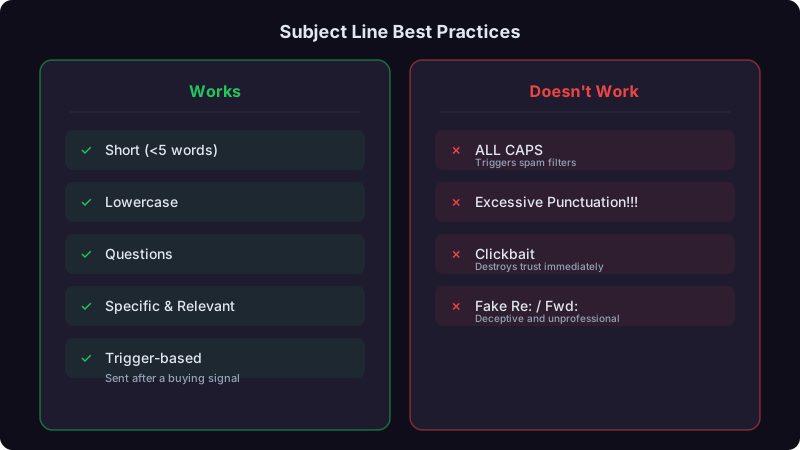
Some patterns consistently killed open rates across every segment we tested:
- ALL CAPS: 12% lower open rates. It looks like spam. Every spam filter in existence flags excessive capitalization. Even selective caps ("IMPORTANT: Your Account") tested poorly.
- Excessive punctuation: "Are you free???", "Don't miss this!!!", 15% lower open rates. One punctuation mark is fine. Multiple exclamation points or question marks signal desperation.
- Clickbait: Subject lines designed purely to generate curiosity ("You won't believe this...") had high open rates but terrible reply rates, 0.4% on average. People opened, felt tricked, and marked as spam. Net negative.
- Fake "Re:" or "Fwd:": Prepending "Re:" to create the illusion of an ongoing thread. This had a brief period of effectiveness in 2020-2021. Now it's a one-way ticket to spam folders. Gmail and Outlook specifically flag emails with "Re:" in the subject that don't have a corresponding thread history. Don't do this.
- Emojis in B2B cold email: We tested this specifically because it's a common recommendation. Emojis in subject lines reduced open rates by 8% for B2B audiences. They work in B2C marketing. They don't work in cold outbound to directors and VPs.
Industry Breakdown: What Works Where
One of the most useful cuts we did was by industry. Subject line performance varies dramatically depending on who you're selling to.
SaaS / Tech (2.8M emails analyzed): Tech buyers get more cold email than any other segment, an average of 14 outbound emails per day by our estimate. They're desensitized to standard approaches. What worked: hyper-specific references to their tech stack, recent product launches, or engineering blog posts. Generic benefit statements ("improve your pipeline by 30%") performed below average. Open rates for personalized tech-stack references: 33%.
Financial Services (1.6M emails): Conservative industry, conservative inboxes. Formal subject lines outperformed casual ones here, the only industry where that was true. Title case actually beat lowercase for bank executives (24% vs. 21%). What bombed: anything that looked like a cold sales pitch. What worked: referencing regulatory changes, compliance deadlines, or industry reports. Top-performing pattern: "Preparing for [specific regulation]?" at 32% open rate.
Healthcare (890K emails): Long sales cycles mean relationship-building subject lines dominated. Reference-based subject lines hit 39% open rate here, the highest of any industry. Trigger-based approaches around M&A activity and new facility openings also performed well. What didn't work: urgency language. Healthcare executives are immune to artificial time pressure.
Manufacturing / Industrial (720K emails): This segment had the lowest overall open rates (average 21%) but the highest reply-to-open ratio. When they open, they engage. Short, direct subject lines worked best. No questions, no cleverness, just a clear statement of relevance. "Re: your RFP for [equipment type]" hit 44% open rate when sent to companies with active procurement processes.
A/B Testing: Real Examples
Theory is nice, but real test results are more useful. Here are four A/B tests we ran with clients, each with 5,000+ emails per variant.
Test 1: Personalization Depth (IT Services Company, targeting CTOs)
- Variant A: "Quick question about your infrastructure", 19% open, 1.1% reply
- Variant B: "Quick question about [company name]'s infrastructure", 24% open, 1.8% reply
- Variant C: "[First name], saw you migrated to AWS last quarter", 34% open, 4.2% reply
Variant C crushed it. The difference between B and C is the difference between mail-merge personalization and actual research. "Saw you migrated to AWS last quarter" tells the recipient that someone spent 30 seconds looking at their company. That 30 seconds of effort produced 3.8x the reply rate.
Test 2: Length (HR Tech Company, targeting VPs of People)
- Variant A: "Better onboarding", 23% open, 1.4% reply
- Variant B: "Reducing your 90-day attrition rate", 29% open, 2.8% reply
- Variant C: "How [company] could cut new hire attrition by 40% based on your Glassdoor reviews", 21% open, 3.1% reply
Interesting result. Variant B had the highest open rate, but Variant C had the highest reply rate despite fewer opens. The longest subject line attracted fewer clicks but the people who did open were more qualified and engaged. Sometimes optimizing for replies instead of opens changes your strategy.
Test 3: Tone (Cybersecurity Vendor, targeting CISOs)
- Variant A: "Strengthening your security posture", 17% open, 0.9% reply
- Variant B: "honest question about your SOC team", 28% open, 2.4% reply
- Variant C: "is [company] ready for the new SEC disclosure rules?", 33% open, 3.7% reply
Variant C won on both metrics because it combined lowercase formatting, a specific question, and a regulatory trigger. Variant A reads like a brochure. Nobody opens brochures.
Test 4: Trigger Timing (Recruiting Platform, targeting HR Directors)
Same subject line ("congrats on the new [city] office"), sent at different delays after the trigger event:
- Sent within 24 hours: 42% open, 5.1% reply
- Sent 3-5 days later: 31% open, 2.8% reply
- Sent 10+ days later: 22% open, 1.3% reply
The decay curve is steep. After 10 days, a trigger-based subject line performs barely better than a generic one. If you're going to use triggers, you need a system that surfaces them fast and gets emails out the same day.
High-Performing Subject Line Formulas
Based on the aggregate data, here are the six formulas that consistently performed in the top quartile. I've included the average open and reply rates for each.
The Specific Question (31% open, 3.4% reply): "[Name], how are you handling [specific, timely challenge]?" Example: "Sarah, how are you handling the Salesforce price hike?"
The Reference (35% open, 4.8% reply): "saw your [specific content/post/talk] about [topic]" Example: "saw your talk at SaaStr about PLG metrics"
The Trigger (33% open, 4.2% reply): "congrats on [recent event]" Example: "congrats on the Series C, big milestone"
The Mutual (36% open, 5.2% reply): "[mutual connection] suggested I reach out" Example: "Mike Chen suggested I reach out"
The Direct (29% open, 2.9% reply): "[specific topic] at [company]" Example: "SDR ramp time at Datadog"
The Insight (30% open, 3.1% reply): "[data point] about [their company/industry]" Example: "interesting pattern in your job postings"
Notice that the mutual connection formula has the highest reply rate of any pattern. If you have mutual connections with your prospects, even weak ones, use them. A shared LinkedIn connection, a co-attendee at a conference, a fellow alumnus. The bar is lower than you think.
The Testing Framework That Actually Works
Most teams test subject lines wrong. They change too many variables at once, use sample sizes that are too small, or measure the wrong metric. Here's the process I use with every team I work with.
Step 1: Write 3-5 subject line variations. Each should test a single variable. Don't test length AND tone AND personalization at the same time. Isolate one factor per test.
Step 2: Split test across similar audience segments. Key word: similar. If you send Variant A to VPs and Variant B to Directors, you're testing title seniority, not subject lines. Use the same ICP criteria for both groups.
Step 3: Minimum sample size of 500 per variant. Below 500, your results are noise. At 500, you get directional signal. At 2,000+, you get statistical significance. Most teams run tests with 50-100 emails per variant and draw conclusions from random variation.
Step 4: Measure open AND reply rates. Opens alone are misleading because of pixel-blocking and auto-opens. Reply rate is the metric that correlates with pipeline. A subject line that gets 40% opens and 0.5% replies is worse than one that gets 25% opens and 3% replies.
Step 5: Wait for full cycle completion. Don't judge results after 24 hours. Some emails get opened days later. Wait until 90%+ of opens and replies have come in, usually 5-7 business days, before declaring a winner.
Step 6: Double down, then test the next variable. Take your winning subject line and use it as the new control. Now test a different variable against it. Over 3-4 testing cycles, you build a subject line that's been optimized across multiple dimensions.
Common Mistakes I See Every Week
After working with hundreds of outbound teams, the same errors come up repeatedly.
Mistake 1: Optimizing subject lines without fixing the email body. A great subject line that opens to a mediocre pitch is worse than a decent subject line opening to a strong pitch. The subject line gets the door open. The body has to close the deal. I've seen teams obsess over A/B testing subject lines while sending the same lazy template underneath. Fix the body first.
Mistake 2: Using "personalization" that isn't personal. Dropping {first_name} and {company_name} into a merge field isn't personalization. The recipient knows it's a template. Real personalization means referencing something specific, a blog post they wrote, a conference they spoke at, a challenge unique to their company. If your "personalization" could apply to 500 other people, it's not personal.
Mistake 3: Testing on too-small samples and over-indexing on results. If you sent 100 emails with Subject A (22% open rate) and 100 with Subject B (26% open rate), the difference is 4 emails. That's not a finding. That's noise. Get to 500+ per variant before you start making decisions.
Mistake 4: Ignoring deliverability as a variable. If your emails are landing in spam, your subject line doesn't matter. Before running any subject line tests, confirm you have 90%+ inbox placement. Otherwise, you're testing which subject lines perform better in spam folders, useless data.
Mistake 5: Copying subject lines from "best cold email subject lines" blog posts. If a subject line has been published on a popular blog, thousands of salespeople are using it. It's burned. "Quick question," "Hoping to connect," "Saw your recent post", these are all overused to the point of invisibility. Your prospects have seen them dozens of times. Build your own templates from the patterns in the data, but use your own words.
Putting It All Together
If I had to distill this entire analysis into three actionable rules:
Rule 1: Specificity wins. The single most impactful thing you can do is make your subject line about something specific to the recipient. Not their name. Not their company. Something specific they've done, said, or experienced recently.
Rule 2: Speed matters. Trigger-based outreach decays fast. Build systems that surface relevant signals within 24 hours and get emails out the same day. A perfect subject line sent two weeks after the trigger is just another cold email.
Rule 3: Test with discipline. Isolate variables, use adequate sample sizes, measure reply rate, and iterate. The teams that treat subject lines as a testable, improvable system consistently outperform teams that pick a template and stick with it.
Your subject line is the first 3-8 words of your relationship with a prospect. It's not something to copy from a list or generate from a template. It's worth the time to get right.
Ready to transform your sales pipeline?
See how Prospectory's AI-powered platform can help your team research, reach, and relate to prospects at scale.
Related Articles
1 in 6 B2B Emails Vanish: Fix Your Authentication Before Q3
Microsoft Outlook now delivers only 75.6% of B2B emails. Here's the non-technical RevOps playbook for SPF, DKIM, DMARC, domain warming, and volume spike management.
Why 58% of Your Replies Come From Email #1 (And How to Fix the Rest)
Most replies happen on your first email, not your seventh. Here's the sub-80-word framework, signal-based personalization tactics, and data that prove long sequences are dying.
The Follow-Up Problem: Why 80% of Sales Emails Never Get a Second Touch
Most sales sequences die after one email. Here's the data-backed 5-touch framework that increased our response rates from 3.4% to 18.2%.