B2B Buyer Journey Mapping: Understanding How Modern Buyers Make Decisions
The B2B buyer journey has changed dramatically. Learn how to map and influence the modern buying process.
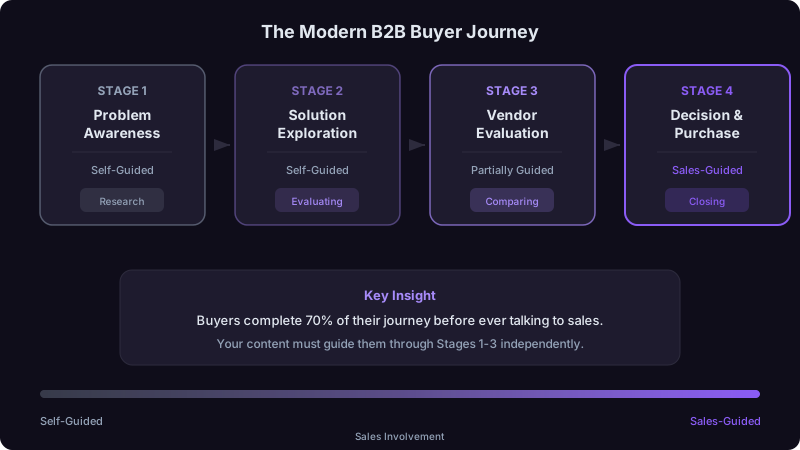
The old sales funnel is dead. I don't mean that in a clickbait way, I mean the linear model where a buyer moves from awareness to interest to decision to purchase in a predictable sequence is simply not how B2B buying works anymore. I've watched this shift happen over the past eight years running content marketing for two SaaS companies, and the gap between the funnel we draw on whiteboards and the actual path buyers take keeps getting wider.
Today's B2B buyers complete 70% of their journey before talking to sales. They're researching solutions, reading reviews, asking peers in Slack communities, watching comparison videos on YouTube, all before they ever fill out your demo form. And when they do reach out, they've usually already made up their mind. Your sales team isn't guiding the decision. They're confirming it.
Understanding this new reality isn't optional. It's the difference between showing up at the right time with the right message and sending a cold email to someone who already picked your competitor three weeks ago.
Why Most Journey Maps Are Useless
Before I get into what works, let me be blunt about what doesn't. Most B2B buyer journey maps I've seen, and I've seen dozens across companies I've worked with, are aspirational fiction. They describe how marketing wants the buyer to behave, not how the buyer actually behaves.
The typical journey map looks something like: buyer sees an ad, clicks to the blog, downloads a whitepaper, gets nurtured via email, books a demo, talks to sales, closes. Nice and tidy. Except real journeys look more like: buyer hears about you from a colleague at a conference, Googles you on their phone during the keynote, reads half a blog post, forgets about you for six weeks, sees a LinkedIn post from your CEO, clicks through to your pricing page, shares the link in a Slack DM with their CTO, gets pulled into a quarterly planning meeting, comes back two months later because budget got approved, reads three G2 reviews, requests a demo, and then tells your BDR they "found you on Google."
That's not a funnel. That's a pinball machine. And if your journey map doesn't account for the bouncing, the stalling, the backtracking, and the invisible peer conversations, it's not a map, it's a fantasy.
The New Buyer Journey
I've found it most useful to think about the buyer journey in four stages, but with a critical mindset shift: the stages aren't linear. Buyers move backward as often as they move forward. New stakeholders enter the process and restart earlier stages. Budget changes force a return to problem awareness. The stages describe types of activity, not a sequence.
Stage 1: Problem Awareness (Self-Guided)
This is where the buyer recognizes they have a challenge worth solving. Maybe their sales team missed quota for the third straight quarter. Maybe a competitor just launched a feature they can't match. Maybe a new VP came in and asked "why are we still doing this manually?"
What happens here:
- Buyer searches for information online, typically broad queries like "why is our outbound response rate dropping" rather than "best sales engagement platform"
- Consumes educational content: blog posts, industry reports, podcast episodes
- Asks peers for input in private channels (Slack communities, group texts, LinkedIn DMs)
- Your role: Be discoverable. Provide educational content that names the problem before pitching a solution. This is where SEO and thought leadership matter most.
Here's a number that stuck with me: when we surveyed 200 B2B buyers in mid-2024, 83% said they had already defined the problem and identified potential solution categories before they typed a single branded search query. By the time they're searching for your company name, the problem awareness stage is long over.
Stage 2: Solution Exploration (Self-Guided)
Now the buyer knows they need something, but they're figuring out what kind of something. Should they build internally or buy? Do they need a point solution or a platform? Is this a sales problem or a marketing problem?
What happens here:
- Buyer researches solution categories and approaches
- Reads comparison content (your product vs. alternatives, but also your category vs. adjacent categories)
- Evaluates whether the problem is big enough to justify a purchase
- Reviews analyst reports, peer review sites, and community recommendations
- Your role: Thought leadership and social proof. Help the buyer understand the landscape. If you only talk about your product at this stage, you'll lose credibility.
I made this mistake at my previous company. We created "solution exploration" content that was essentially product marketing disguised as education. Every blog post ended with "and that's why you need [our product]." Engagement was terrible. When we shifted to genuinely comparative content, here are five ways to solve this problem, here are the tradeoffs of each, our organic traffic increased 140% in six months. Buyers rewarded us for being honest, even when that honesty meant acknowledging that our product wasn't the best fit for certain use cases.
Stage 3: Vendor Evaluation (Partially Guided)
This is where sales gets involved, but the buyer is still driving. They've narrowed down to 3-5 potential vendors and they're doing due diligence.
What happens here:
- Buyer shortlists vendors based on earlier research
- Requests demos and pricing information
- Involves more stakeholders, this is where the buying committee expands
- Runs technical evaluations, security reviews, and reference checks
- Your role: Differentiate on specifics. Generic value propositions don't work here. Buyers want to know exactly how you handle their specific use case, what implementation looks like, and what comparable customers have achieved.
One data point that changed how I think about this stage: Gartner found that the average B2B buying group spends only 17% of the total purchase journey meeting with potential suppliers. If you have three vendors in the running, each one gets roughly 5-6% of the total journey time. That's it. Everything else is the buyer doing their own research, having internal discussions, and building consensus.
This means that the materials you leave behind, case studies, ROI calculators, implementation guides, comparison sheets, matter more than the demo itself. Your champion needs ammunition to sell internally when you're not in the room.
Stage 4: Decision and Purchase (Sales-Guided)
The buyer has picked their preferred vendor (often before this stage officially "starts"). Now the process is about confirming the decision, getting organizational buy-in, and navigating procurement.
What happens here:
- Final evaluation and internal consensus-building
- Negotiation on pricing, terms, and implementation timeline
- Security review, legal review, and procurement process
- Contract finalization and signature
- Your role: Handle objections, manage stakeholders you haven't met yet, and reduce friction in the procurement process.
The biggest killer at this stage isn't competition, it's indecision. Gartner's research shows that 40-60% of B2B purchase processes end in "no decision" rather than a competitive loss. The buyer couldn't build consensus, budget got reallocated, the internal champion left, or the committee decided the status quo was good enough. I'll talk more about this later, because it has major implications for how you map and manage the journey.
A Practical Framework for Journey Mapping
Mapping the buyer journey isn't a one-time whiteboard exercise. It's an ongoing process of collecting data, validating assumptions, and updating your understanding. Here's the framework I use.
Step 1: Interview Recent Buyers (Not Just Won Deals)
Most companies only interview customers they won. That gives you a biased view of the journey, you're only seeing the path that led to you. Interview three groups:
- Closed-won customers: How did they find you? What content did they consume? Who was involved in the decision? What almost stopped them?
- Closed-lost prospects: Where did the journey break down? What did the winner do differently? What information did they wish they had?
- No-decision prospects: Why did they stop? What would have kept them moving? This group gives you the most valuable insights, because "no decision" is your biggest competitor.
When I ran these interviews at my current company, I talked to 35 buyers across all three groups. The patterns were immediately obvious. Closed-won deals almost always had an internal champion who was active in the evaluation. Closed-lost deals usually had a champion, but that champion didn't have enough organizational influence. No-decision deals rarely had a true champion at all, just a "researcher" who was gathering information without authority to push a purchase forward.
Step 2: Map the Buying Committee by Stage
The buying committee isn't static. Different people engage at different stages, and understanding who enters when is critical for timing your outreach.
| Stage | Primary Personas | Their Key Question | Content They Need | Typical Entry Point |
|---|---|---|---|---|
| Problem Awareness | End user, team lead | "Is this problem big enough to solve?" | Educational content, benchmark data | Organic search, peer conversation |
| Solution Exploration | Manager, director | "What kind of solution should we look at?" | Comparison guides, analyst reports | Forwarded content, G2/Capterra |
| Vendor Evaluation | VP/director, technical lead | "Which vendor is the best fit?" | Case studies, ROI calculators, demos | Demo request, sales outreach |
| Decision and Purchase | C-suite, procurement, legal | "Is this worth the investment and risk?" | Security docs, implementation plans, references | Internal introduction by champion |
This table is based on patterns from our buyer interviews, but yours will look different. The important thing is to actually map it out for your specific product and market. Don't guess, ask.
Step 3: Identify the "Dark Moments"
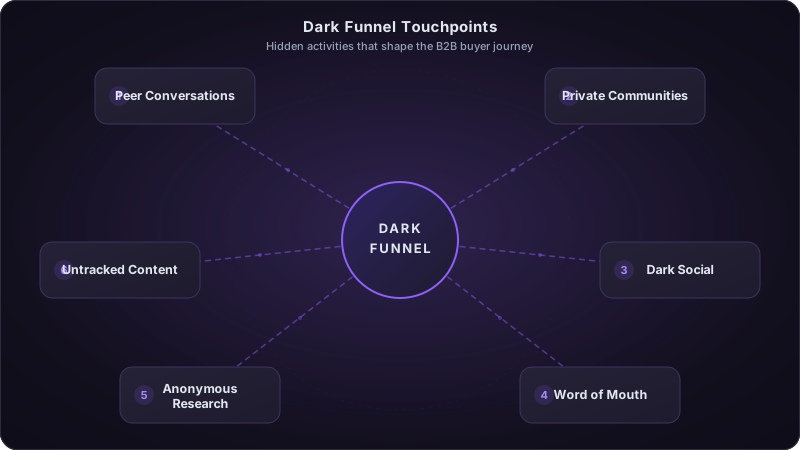
Every buyer journey has moments that are invisible to your analytics. I call them dark moments, the points where critical decisions happen outside your view:
- A Slack DM where a peer recommends (or warns against) your product
- An internal meeting where the budget holder asks "do we really need this?"
- A conversation between the champion and their boss in the hallway
- A competitor's sales rep who name-drops your weaknesses
You can't track these moments, but you can influence them. The way you influence dark moments is by arming your champion with the right information at the right time. If your champion can answer the CFO's objection about ROI without scheduling another call with your sales team, the deal keeps moving. If they can't, it stalls.
Step 4: Map the Stall Points
Based on our data and what I've seen across the industry, here are the most common places where B2B deals stall or die:
Between Solution Exploration and Vendor Evaluation, the buyer decides the status quo is good enough. This accounts for roughly 35% of journey abandonments in our data. The antidote is content that quantifies the cost of inaction. Not fear-mongering, but honest math about what the problem costs over time.
Between Vendor Evaluation and Decision, the buying committee can't reach consensus. This is about 25% of abandonments. The antidote is multi-threading. If your AE is only talking to one person, the deal is fragile.
During Decision and Purchase, procurement or legal creates enough friction to kill momentum. About 20% of abandonments. The antidote is making procurement easy: pre-built security questionnaire responses, standard contract terms, clear implementation timelines.
The remaining 20% are external factors you can't control: budget freezes, reorgs, mergers, leadership changes.
Mapping Your Buyers: The Documentation Process
For each stage, document specific, concrete answers to these questions:
- Who is involved? Not just titles, actual names at your target accounts if you can get them.
- What questions are they asking? Use exact language from buyer interviews. "How much does this cost?" is different from "What's the total cost of ownership including implementation?"
- What content do they consume? Track this through your CMS, but also through self-reported attribution ("how did you hear about us?")
- What actions do they take? Website visits, content downloads, but also the dark funnel actions you learn about in interviews.
- What triggers movement to the next stage? This is the most important question and the hardest to answer. In our data, the single most common trigger was a peer recommendation, not content, not a sales touch, but a trusted colleague saying "we use this and it works."
Key Journey Insights
The Buying Committee Problem
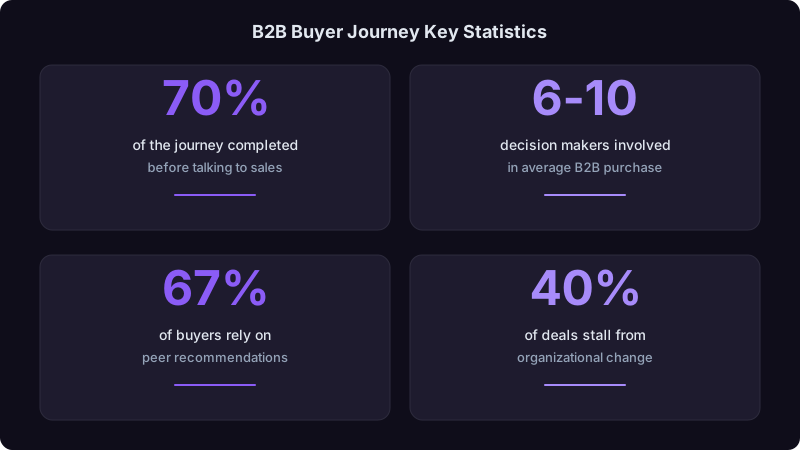
The average B2B purchase involves 6-10 decision makers. That number goes up for enterprise deals, I've seen buying committees of 15-20 people for six-figure annual contracts. Each person has different priorities, different evaluation criteria, and different levels of enthusiasm for making a change.
Here's how those roles typically break down:
- Economic buyer (budget authority): Cares about ROI, payback period, total cost of ownership. Usually a VP or C-level executive.
- Technical buyer (implementation owner): Cares about integration complexity, data migration, security requirements. Usually an engineering or IT leader.
- User buyer (daily operator): Cares about ease of use, workflow fit, and whether this will actually make their job easier. Usually a manager or individual contributor.
- Coach (internal advocate): This is your champion. They're the one who found you, believes in you, and is pushing the deal forward internally. Their credibility within the organization directly correlates with your win rate.
The most common mistake I see sales teams make is treating the champion as the buyer. They're not. They're your internal sales rep. And just like your actual sales reps, they need enablement: battle cards, objection-handling guides, ROI calculators, and competitive comparisons they can use in internal meetings.
At one company I worked with, we started creating "champion kits", internal presentation decks, one-page summaries, and ROI spreadsheets designed specifically for our champion to present to their leadership team. Win rates on deals where the champion used the kit were 2.4x higher than deals where they didn't. That's not a rounding error. That's the difference between arming your champion and leaving them to figure it out.
Information Sources and Trust Hierarchy
Where B2B buyers get their information, ranked by trust level based on survey data from Demand Gen Report and our own research:
- 67% peer recommendations: Still the most trusted source by a wide margin. When a buyer's former colleague says "we switched to X and it increased our pipeline 40%," that carries more weight than any analyst report.
- 47% review sites (G2, Capterra, TrustRadius): Buyers treat these like Amazon reviews, they're looking for patterns, not perfection. A product with 200 reviews averaging 4.3 stars is more credible than one with 15 reviews averaging 4.9 stars.
- 46% analyst reports (Gartner, Forrester): Still influential for enterprise deals, less so for mid-market. The main value isn't the ranking, it's giving the champion organizational cover. "Gartner says this is a leader" is a powerful internal argument.
- 42% vendor websites: Buyers visit your website, but they're skeptical of everything on it. The most useful pages, according to our interviews, are pricing (if available), case studies with specific numbers, and integration/technical documentation. "Award-winning platform" means nothing. "Reduced SDR ramp time from 8 weeks to 3 weeks at Company X" means everything.
Deal Killers: Why Deals Actually Stall or Die
Understanding why deals fail is more actionable than understanding why they succeed. Here's the breakdown from our analysis of 450 lost or stalled deals over 18 months:
- 40% organizational change: Reorgs, budget freezes, leadership turnover. When your champion's boss gets replaced, the new boss wants to run their own evaluation. You're back to square one, or worse, because the new leader might have a relationship with a competitor.
- 25% budget reallocation: The money was there, then it wasn't. A common pattern: the company had a bad quarter, the CFO froze discretionary spending, and your deal, which was "approved in principle", died in procurement.
- 20% lost champion: Your champion left the company, changed roles, or lost organizational influence. This is why multi-threading matters so much. If you only have one relationship in the account, your deal is one resignation away from zero.
- 15% competitive loss: The least common reason, and the one sales teams overweight. Reps often blame "competitive loss" when the real reason is one of the above. It's easier to say "we lost to Competitor X" than "our champion didn't have enough influence."
Multi-threading across the buying committee is critical. Deals with a single point of contact are 2-3x more likely to stall than those with multiple engaged stakeholders.
Turning Journey Insights Into Action
All of this mapping and analysis is useless if it doesn't change how you sell and market. Here are the four operational changes that had the biggest impact when we applied journey mapping insights at my current company.
1. Engage Earlier with Educational Content
We used to wait for inbound leads and then nurture them with product content. Now we invest heavily in top-of-funnel educational content designed for the Problem Awareness stage. Blog posts about the problem itself, not our solution. Podcast appearances where our subject matter experts discuss industry challenges. Original research reports with benchmarks that buyers can use regardless of whether they buy from us.
The result: our "time to first engagement" dropped from an average of 6.2 months (from first website visit to demo request) to 3.8 months. Buyers who consumed our educational content before reaching the Vendor Evaluation stage closed at a 28% higher rate than those who didn't.
2. Multi-Thread Every Deal Over $30K
We implemented a hard rule: no deal over $30K ACV can advance to the proposal stage with fewer than three engaged contacts. "Engaged" means they've attended a meeting, responded to an email, or viewed a shared resource. If we only have one contact, the AE's job is to get introduced to others before moving the deal forward.
This felt aggressive when we started, AEs worried it would slow deals down. It did, by about a week on average. But our Stage 3 to Closed-Won conversion rate went from 22% to 31%. Slower deals, but dramatically more of them actually closed.
3. Provide Value Throughout the Journey, Not Just at the End
We stopped treating content as a "lead gen" tool and started treating it as a "deal acceleration" tool. For every stage of the journey, we built content specifically designed to help the buyer move forward:
- Problem Awareness: Benchmark reports, industry surveys, "is this a problem worth solving?" frameworks
- Solution Exploration: Comparison guides (including competitors), build-vs-buy calculators, category explainers
- Vendor Evaluation: Detailed case studies with specific metrics, implementation guides, security and compliance documentation
- Decision and Purchase: ROI calculators, executive summary decks (for the champion to present internally), procurement-ready documentation
4. Track Engagement Signals by Account, Not by Lead
Individual lead scoring is misleading in a world of buying committees. We switched to account-level engagement scoring that aggregates signals across all known contacts at an account. When three people from the same company visit your pricing page in the same week, that's a stronger signal than one person downloading a whitepaper.
Our account scoring model weights recent activity, breadth of engagement (how many people), depth of engagement (what pages and content), and stage-appropriate behavior. An account with five people reading case studies is further along than an account with one person reading blog posts, even if the blog reader has a higher individual lead score.
The Bottom Line
B2B buyer journey mapping isn't about creating a pretty slide for your next QBR. It's about genuinely understanding how your buyers make decisions so you can show up with the right message, at the right time, through the right channel, for the right person.
The buyers I talk to don't want to be "nurtured." They don't want to be "qualified." They want to solve a problem. They want to do it with minimal risk. And they want to work with vendors who understand their situation well enough to be actually helpful, not just vendors who are good at sending automated email sequences.
Map the journey as it actually is, not as you wish it were. Talk to real buyers, including the ones you lost. Document the dark moments and stall points. Arm your champions. Multi-thread your deals. And accept that the journey will never be as clean as your CRM stages suggest.
The companies that do this well don't just win more deals. They win faster, at higher ACVs, with lower churn. Because when you truly understand the buyer's journey, you stop selling and start helping. And it turns out that's the most effective sales strategy of all.
Ready to transform your sales pipeline?
See how Prospectory's AI-powered platform can help your team research, reach, and relate to prospects at scale.
Related Articles
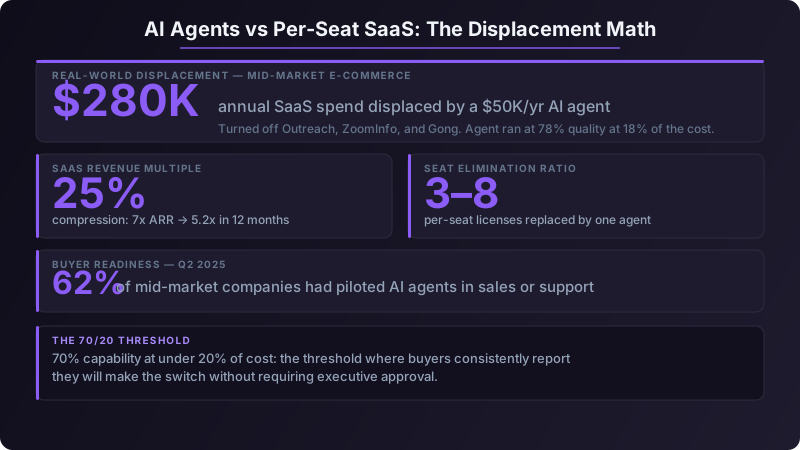
AI Agents Are Killing Per-Seat SaaS: What B2B Sellers Must Do Now
SaaS revenue multiples dropped 25% in twelve months. One AI agent subscription now replaces 3–8 seats at under 20% of current spend. Here's the repositioning playbook for vendors who want to survive the transition.
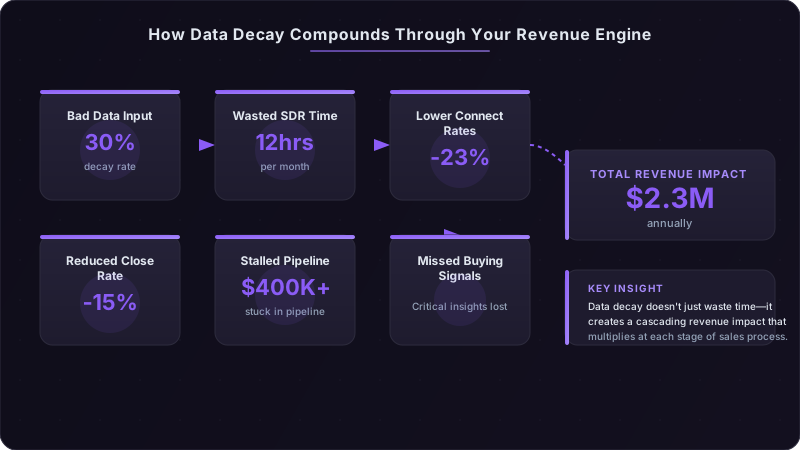
The Real Cost of Bad Sales Data: A $2.3M Problem Most Teams Ignore
Outdated contacts and wrong job titles cost B2B teams an average of $2.3M annually in lost pipeline. Here's how to calculate your own data decay rate.
Cracking the Dark Funnel: How to Attribute Revenue When 70% of the Buyer Journey Is Invisible
Most of your pipeline is influenced by channels you can't track. Podcasts, Slack communities, word-of-mouth, and private social sharing drive deals you'll never see in your CRM. Here's how to measure the unmeasurable.