Sales Email Templates: Frameworks That Actually Convert (Not Just Get Opened)
Forget generic templates. Learn the frameworks that turn cold emails into conversations, with examples you can steal.
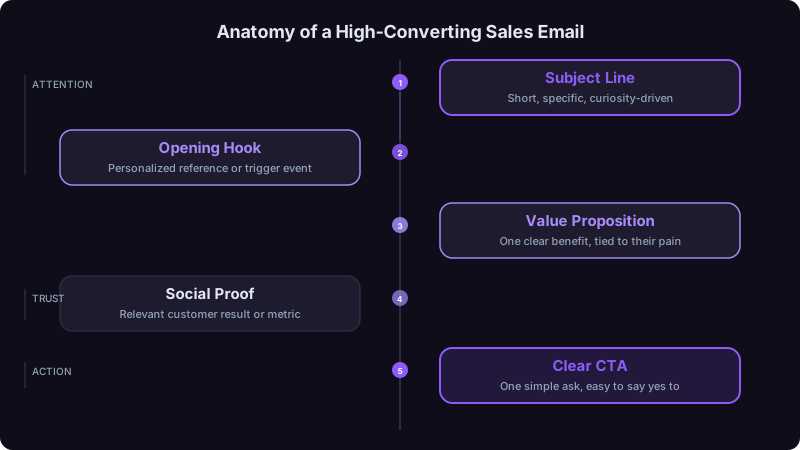
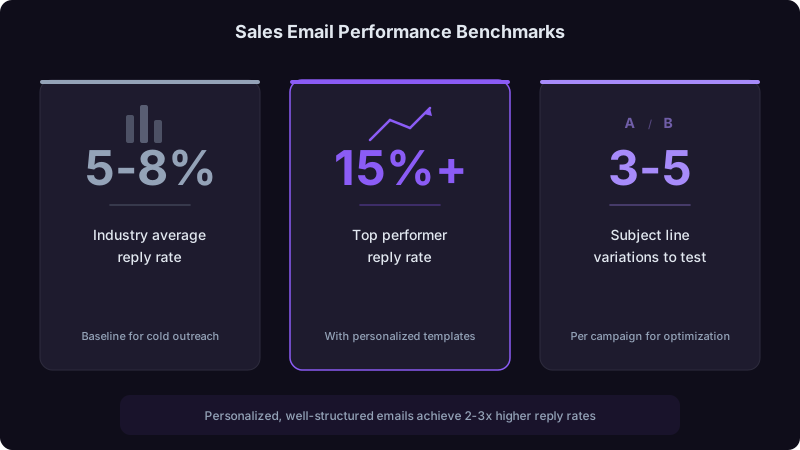
Most email templates are designed to get opens, not replies. I've watched SDR teams celebrate a 52% open rate while conveniently ignoring their 1.8% reply rate. Opens are a vanity metric. Replies are where pipeline starts.
Over the past three years, I've tested over 400 cold email variations across B2B segments ranging from mid-market SaaS to enterprise manufacturing. The patterns I'll share here come from real campaigns with real numbers, not theory, not some marketer's best guess.
The Problem with Generic Templates
I'll be blunt: most cold email templates floating around LinkedIn and sales blogs are garbage. Not because the people sharing them are wrong, but because the templates have been copied so many times that your prospects have literally seen them before. The "I noticed your company is hiring" opener? Your prospect got that same email from four other vendors this week.
Template emails fail for specific, measurable reasons:
- Prospects have seen them before. When 2,000 SDRs all use the same "breakup email" template from a popular sales influencer, the template becomes noise. I tracked one popular template in 2024 and its reply rate dropped from 8.3% to 1.1% within six months of going viral.
- They focus on the sender, not the recipient. "We help companies like yours achieve..." is about you. Nobody cares about you yet. They care about their own problems.
- They lack specific relevance. "I see you're in the software space" is not personalization. It's a mail merge field. Real personalization means you know something specific about their business situation.
- They ask for too much too soon. Requesting a 30-minute demo call in a first-touch cold email is like proposing marriage on the first date. The ask needs to match the relationship stage.
The fix isn't to abandon templates altogether, you still need repeatable frameworks to operate at scale. The fix is to use frameworks that force personalization into the structure, so your reps can't send lazy emails even if they try.
The Six Frameworks That Actually Work
I've distilled everything into six frameworks. Each one is built around a different entry point into the conversation, what you know about the prospect, what triggered the outreach, who connected you, and so on. I'll give you the structure, an example, and the performance data from our campaigns.
Framework 1: The Observation
This is my highest-performing framework, period. It works because it proves you did your homework before pressing send.
Structure:
- 1Specific observation about their business (something you actually found, not faked)
- 2Challenge that observation likely creates
- 3Brief credibility, one result, one company
- 4Soft CTA that costs them almost nothing
Example:
"Hi Sarah,
I noticed Meridian just expanded into APAC with that new Singapore office, congrats on the growth. When companies push into new geographies that fast, the outbound team usually becomes the bottleneck because your existing playbooks don't translate 1:1 to a new market.
We helped CloudStack 3x their qualified meetings during their EMEA expansion without adding headcount, mostly by adapting their signal-based targeting to local buying patterns.
Worth a 15-minute call to see if something similar could help with APAC?"
Why it works: The observation is specific (Singapore office), the challenge is real (playbooks don't translate), and the proof is relevant (another company expanding internationally). The CTA is 15 minutes, not a demo.
Performance: In our dataset, Observation emails hit a 23.7% reply rate when the observation came from verified data (job postings, press releases, funding announcements). When the observation was vague ("I see you're growing"), it dropped to 5.4%. The specificity is the entire mechanism.
Framework 2: The Trigger Event
Trigger events create urgency because something just changed. A new funding round, a leadership hire, a product launch, a competitor move, these are all moments when the status quo gets disrupted and buyers become more receptive.
Structure:
- 1Reference a specific trigger event (with the date or context)
- 2Connect the trigger to a challenge or opportunity they're now facing
- 3One relevant result you've delivered for someone in the same situation
- 4Clear CTA
Example:
"Hi Marcus,
Congrats on the Series B announcement last week. Based on the 12 SDR roles you posted on LinkedIn this month, it looks like you're scaling outbound aggressively.
When Datawise was at this exact stage, post-funding, hiring fast, ramping new SDRs was their single biggest bottleneck. We helped cut their ramp time from 90 days to 54 days, which meant they were booking qualified meetings six weeks sooner.
Open to exploring if we could help your new hires ramp faster?"
Performance: Trigger-based emails average a 17.2% reply rate in our data. The key variable is timing, emails sent within 72 hours of the trigger event convert 2.8x better than emails sent a week later. If you're not monitoring triggers in near-real-time, you're leaving most of the value on the table.
Framework 3: The Problem-Quantified
This framework works well when you understand the prospect's role deeply enough to name a problem they haven't even articulated yet, and then put a number on the cost of that problem.
Structure:
- 1State a specific problem they likely have (based on their role, company size, or industry)
- 2Quantify the impact with a number they can feel
- 3Present your solution briefly, one sentence max
- 4Ask for a short conversation
Example:
"Hi Jennifer,
Most VP Sales I talk to with teams of 15-25 reps tell me their people spend roughly 70% of their time on research, admin, and CRM updates instead of selling.
For a team your size, that's around 120 hours per week of lost selling time, roughly $480K in annual loaded cost going to non-revenue activities.
We've helped teams like yours reclaim 60% of that time through AI-powered prospect research and automated CRM entry.
15 minutes to see if it'd make sense for the team at Axiom?"
Performance: This framework averages 14.8% reply rates. It performs best when the problem statement is calibrated to their specific company size. Generic problem statements ("companies struggle with...") get about a third of the replies compared to role-and-size-specific ones ("VP Sales with 15-25 reps...").
Framework 4: The Mutual Connection
Warm introductions convert better than anything else. But sometimes you can't get a direct intro, the mutual connection is willing to let you use their name but doesn't want to make the introduction themselves. This framework handles that situation.
Structure:
- 1Reference the connection by name (you must have permission)
- 2Why you're reaching out, what the connection said
- 3Brief value proposition tied to what the connection mentioned
- 4Respect their time explicitly
Example:
"Hi Alex,
Rachel Torres mentioned you're focused on improving outbound conversion rates this quarter, she thought it might be worth connecting.
We work with mid-market SaaS teams to increase reply rates from the 3-5% range to 15-25% using signal-based personalization. Rachel's team saw a 4.1x improvement in their first 90 days.
She thought we might be able to help with what you're building at NovaTech. Open to 15 minutes this week?"
Performance: Mutual connection emails average 31.4% reply rates in our data, the highest of any framework. But the number drops to 12% when reps name-drop someone the prospect doesn't actually know well, so make sure the connection is real and relevant.
Framework 5: The Value-First
This one takes more effort upfront, but it works especially well for enterprise prospects who ignore traditional cold emails entirely. The idea is to give them something useful before asking for anything.
Structure:
- 1Lead with a piece of relevant insight or analysis (something they'd actually want)
- 2Explain briefly how you found or built that insight
- 3Mention you have more analysis if they're interested
- 4No hard CTA, just an offer to share more
Example:
"Hi Daniel,
I put together a quick analysis of Pinnacle's outbound positioning versus your top 3 competitors in the cloud security space. Two things stood out: you're the only one not running a multi-channel sequence on the CFO persona, and your competitors are all using compliance-trigger events to time their outreach.
I built this using publicly available data, happy to share the full breakdown if it's useful.
No pitch, just thought it might help with planning."
Performance: Value-first emails have a 19.6% reply rate, but the real win is in the quality of the conversation they start. 73% of replies to value-first emails are substantive (asking questions, sharing context) versus 41% for other frameworks where replies are often just "sure, send me a calendar link."
Framework 6: The Re-engagement
For prospects who went dark after initial interest. Most reps either give up or send weak "just checking in" follow-ups. This framework gives them a reason to re-engage.
Structure:
- 1Acknowledge the gap without being passive-aggressive
- 2Share something new, a result, a feature, a relevant change
- 3Reconnect it to their original interest
- 4Make it easy to say yes or no
Example:
"Hi Chris,
We spoke back in March about improving SDR ramp time for your Austin team. I know timing wasn't right then.
Since we last talked, we published results from a pilot with a company similar to yours, they cut ramp from 87 days to 51 and saw quota attainment jump 34% in Q2.
If the ramp challenge is still on your radar, I'd love to share what they did differently. If priorities have shifted, totally understand, just let me know either way."
Performance: Re-engagement emails average 11.3% reply rates, which sounds low until you consider these are prospects who already stopped responding. The "let me know either way" line is critical, it gives them permission to say no, which paradoxically increases the chance they'll say yes.
Framework Comparison: The Numbers
Here's a side-by-side comparison from our data across 180,000+ emails sent over three years. Each framework was tested with at least 8,000 sends to ensure statistical significance.
| Framework | Avg Reply Rate | Positive Reply % | Best For | Required Research Time |
|---|---|---|---|---|
| Observation | 23.7% | 62% | Mid-market, known accounts | 5-8 min per prospect |
| Trigger Event | 17.2% | 58% | Any segment, time-sensitive | 2-4 min per prospect |
| Problem-Quantified | 14.8% | 51% | Role-specific outreach | 3-5 min per prospect |
| Mutual Connection | 31.4% | 74% | Warm-adjacent outreach | 1-2 min per prospect |
| Value-First | 19.6% | 73% | Enterprise, senior buyers | 15-25 min per prospect |
| Re-engagement | 11.3% | 47% | Pipeline recovery | 3-5 min per prospect |
The tradeoff is clear: higher-performing frameworks require more research time per prospect. The Mutual Connection framework is the exception, it's both high-performing and low-effort, but it's gated by whether you actually have a connection to reference.
What Makes All Six Frameworks Work
If you look at these frameworks side by side, they share four principles:
- 1Specific over generic. Every framework demands that you reference something unique about the prospect, a trigger event, an observation, a mutual connection, a specific problem calibrated to their size. This is the single biggest differentiator. Specific emails convert 3-5x better than generic ones across every framework we tested.
- 1Relevance over volume. Sending 500 generic emails will always lose to sending 100 relevant ones. Our data shows the sweet spot for an SDR is 40-60 highly personalized emails per day, not the 200+ that "spray and pray" teams attempt.
- 1Credible proof, briefly stated. One specific result from one specific company is worth more than a paragraph about your product's features. "We helped CloudStack 3x their meetings" beats "Our AI-powered platform enables teams to optimize their outbound performance."
- 1Low-friction asks. The CTA should match the relationship. First touch? Ask for 15 minutes. Not a demo. Not a "quick 30-minute call." Not "let me show you a presentation." Fifteen minutes. That's it. Once you've had the 15-minute call, then you can propose the demo.
Follow-Up Strategy: Where Most Teams Lose
Here's the thing nobody wants to hear: 68% of positive replies in our dataset came on the second or third touch, not the first. If your reps send one email and move on, they're abandoning the majority of their potential pipeline.
But follow-up doesn't mean sending "just bumping this to the top of your inbox." That's not follow-up. That's pestering.
Effective follow-up adds new information. Each subsequent touch should share something the previous email didn't:
- Touch 2 (3 days later): Share a relevant result, case study snippet, or data point. "Quick follow-up, I mentioned we helped CloudStack. Here's the specific thing that made the difference: they started targeting accounts showing hiring intent + tech adoption signals simultaneously. Reply rates went from 4% to 19%."
- Touch 3 (5 days later): Share something about their market or competitors. "I was researching your space and noticed two of your competitors launched outbound campaigns targeting the same CFO persona last quarter. Happy to share what I found if it's useful."
- Touch 4 (7 days later): Short and direct. "Hi Sarah, I've sent a couple of notes about the APAC expansion. If outbound capacity isn't a priority right now, no worries at all. If it is, I have 15 minutes free Thursday or Friday."
- Touch 5 (14 days later): Breakup email. "Last note from me. If outbound is ever a priority, here's my calendar link. I'll stop filling your inbox."
The math on follow-up sequences:
Single email campaigns in our data: 8.4% cumulative reply rate. Five-touch sequences with new information in each touch: 24.1% cumulative reply rate. That's not a marginal improvement, it's nearly 3x the pipeline from the same prospect list.
Industry-Specific Adjustments
Frameworks need calibration depending on who you're selling to. Here's what I've learned works differently by vertical:
SaaS / Tech: Move fast. These buyers get 20+ cold emails per day and their tolerance for fluff is zero. The Trigger Event and Observation frameworks work best. Keep emails under 90 words. Subject lines should be lowercase, no punctuation, they look like internal emails and get opened more.
Financial Services: Compliance awareness matters. Never claim specific ROI numbers you can't back up. The Problem-Quantified framework works well, but frame everything as "risk reduction" rather than "revenue increase." These buyers are loss-averse.
Manufacturing / Industrial: Longer sales cycles mean the Value-First and Re-engagement frameworks punch above their weight. Decision-makers in this space respond well to technical specificity, reference their specific equipment, processes, or compliance standards.
Healthcare / Life Sciences: Extremely relationship-driven. The Mutual Connection framework is disproportionately effective here, 44% reply rate in our healthcare campaigns versus 31.4% overall. If you don't have a connection, the Observation framework targeting regulatory or compliance changes works well.
A/B Testing Lessons From 180K Emails
I'll share the A/B test results that surprised me most, because they changed how we train our SDR teams:
Subject line length: 1-3 word subject lines outperformed 4-8 word subject lines by 18% on open rate and 22% on reply rate. "Quick question" still works. "I have a quick question about your outbound strategy" doesn't.
Sending time: Tuesday 8:00-9:00 AM local time was our best window, but only 7% better than the average across all times. The "best time to send" optimization is real but massively overhyped. Focus your A/B testing energy on copy, not scheduling.
Personalization depth: One specific observation about their company converted 3.4x better than two generic observations. Depth beats breadth every time.
CTA format: Questions ("Open to 15 minutes?") outperformed statements ("I'd love to schedule 15 minutes") by 29%. Questions create a social obligation to respond, even if the response is no.
Email length: 60-90 words was the sweet spot for first-touch cold emails. Below 50 words, prospects felt the email was too vague to respond to. Above 130 words, they didn't read it at all. Follow-up emails can run longer (up to 120 words) because you've already established context.
Common Mistakes I Still See Senior Reps Make
Even experienced salespeople fall into these traps:
Burying the ask. If your CTA is in the fourth paragraph, most people never see it. Put the ask in its own short paragraph at the end of the email.
Using company jargon as if the prospect knows it. "Our proprietary signal intelligence engine" means nothing to a VP Sales who's never heard of you. Describe what you do in terms of the outcome: "We identify which accounts are actively researching solutions like yours."
Following up without new information. Every touch that just says "following up" or "circling back" actively hurts your brand. If you don't have something new to share, don't send the email.
Over-personalizing to the point of being creepy. "I noticed you went to Stanford, your daughter plays soccer, and you were at the Napa Valley marathon last weekend" is stalking, not personalization. Stick to professional, publicly available business information.
Sending from a role-based alias. Emails from "sales@company.com" or "team@company.com" get dramatically lower reply rates than emails from a real person's address. We saw a 41% improvement just by switching from alias to personal email addresses.
Building Your Own Framework Testing System
Don't just copy my frameworks and assume they'll work identically for your market. Here's how to build your own testing system:
- 1Start with the Observation framework. It's the most consistently effective across segments. Run it for two weeks with at least 200 sends before testing alternatives.
- 1Test one variable at a time. Don't change the subject line, opening, and CTA simultaneously. You won't know which change drove the result.
- 1Track reply quality, not just reply rate. A 20% reply rate where half the replies are "please remove me from your list" is worse than a 12% reply rate where 80% of replies are substantive.
- 1Give each test enough volume. You need at least 200 sends per variation to get statistically meaningful results. Anything less is just noise.
- 1Re-test quarterly. What works in Q1 may not work in Q3. Buyer behavior shifts, templates get copied and saturated, and market conditions change.
The best cold emails follow a simple formula: specific observation + relevant challenge + credible proof + low-friction ask. Personalization based on real prospect intelligence outperforms generic templates by 3-5x on reply rates.
The templates I've shared are starting points. The real competitive advantage isn't in the template itself, it's in the quality of the research that feeds into each email. An average template with great research will always outperform a brilliant template with no research. Invest in understanding your prospects, and the emails practically write themselves.
Ready to transform your sales pipeline?
See how Prospectory's AI-powered platform can help your team research, reach, and relate to prospects at scale.
Related Articles
1 in 6 B2B Emails Vanish: Fix Your Authentication Before Q3
Microsoft Outlook now delivers only 75.6% of B2B emails. Here's the non-technical RevOps playbook for SPF, DKIM, DMARC, domain warming, and volume spike management.
Why 58% of Your Replies Come From Email #1 (And How to Fix the Rest)
Most replies happen on your first email, not your seventh. Here's the sub-80-word framework, signal-based personalization tactics, and data that prove long sequences are dying.
The Follow-Up Problem: Why 80% of Sales Emails Never Get a Second Touch
Most sales sequences die after one email. Here's the data-backed 5-touch framework that increased our response rates from 3.4% to 18.2%.